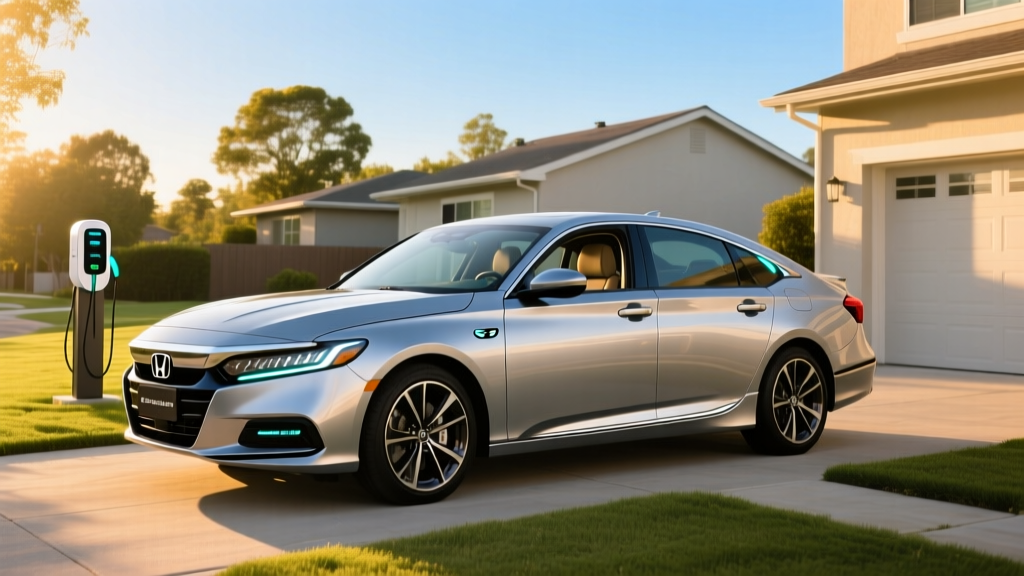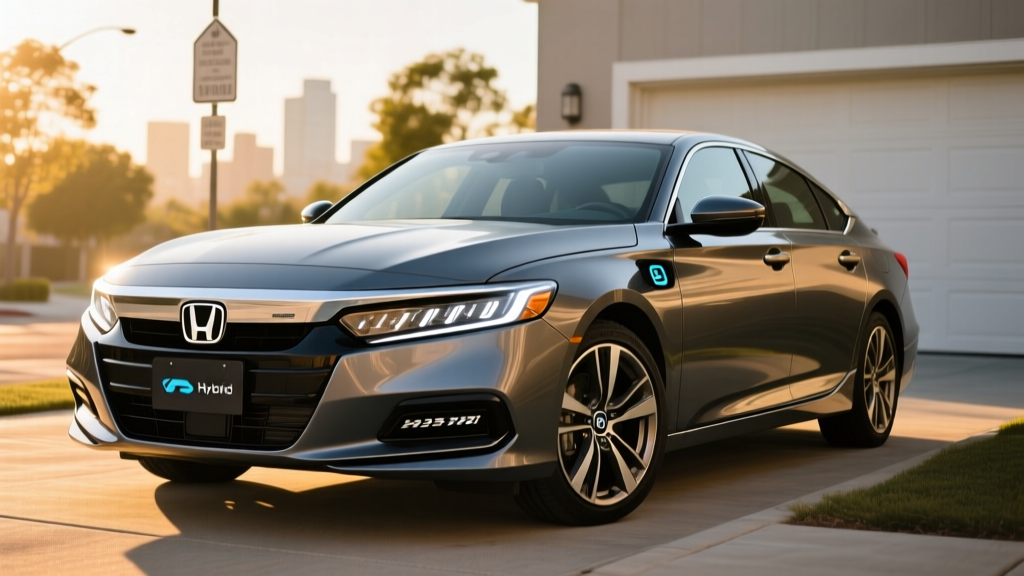
Quick Verdict: The 2025 Honda Accord Touring Hybrid
The 2025 Honda Accord Touring Hybrid is the flagship trim of Honda's midsize sedan lineup, pairing a turbocharged 2.0-liter four-cylinder with a two-motor hybrid system for 204 combined horsepower and an EPA-estimated 46 MPG combined. At roughly $39,445 (including destination), the Touring trim bundles Honda's most complete feature set — wireless Apple CarPlay/Android Auto, a 12-speaker Bose audio system, Google built-in, heated and ventilated front seats, heated rear seats, and the full Honda Sensing suite of driver-assistance features.
For buyers who want near-EV efficiency in city driving without ever plugging in, the Accord Hybrid remains one of the most compelling midsize sedans available. It is not a plug-in hybrid (PHEV) — it is a conventional hybrid electric vehicle (HEV) that regenerates energy through braking and engine operation, requiring zero behavioral change from a standard gas car.
Fuel Economy: EPA Ratings and Real-World MPG
| Metric | Sport/L Sport/Touring (2.0L) | LX/EX (1.5T Non-Hybrid) |
|---|---|---|
| City MPG | 51 | 29 |
| Highway MPG | 44 | 37 |
| Combined MPG | 48 | 32 |
| Fuel Tank | 12.8 gal | 14.8 gal |
| Total Range (Combined) | ~614 miles | ~474 miles |
Source: fueleconomy.gov — EPA estimates. Your mileage will vary.
Powertrain and Performance Specs
| Specification | Value |
|---|---|
| Engine | 2.0L DOHC Atkinson-cycle 4-cylinder |
| Engine Output | 146 hp / 134 lb-ft torque |
| Electric Motors | Two-motor hybrid system (propulsion + generator) |
| Electric Motor Output | 181 hp / 247 lb-ft torque |
| Combined System Output | 204 hp / 247 lb-ft torque |
| Hybrid Battery | ~1.3 kWh lithium-ion |
| Transmission | e-CVT (electrically variable) |
| Drivetrain | Front-wheel drive |
| 0-60 mph (est.) | ~7.0 seconds |
| Plug-In Required? | No — self-charging HEV |
Honda's two-motor hybrid system operates primarily as a series hybrid at low-to-moderate speeds: the gasoline engine spins a generator that powers the propulsion motor, which drives the wheels. At highway cruising speeds, a lock-up clutch mechanically connects the engine directly to the wheels for greater efficiency. This means the Accord Hybrid drives like an EV around town — smooth, linear torque delivery — while maintaining highway efficiency through direct engine drive.
The 247 lb-ft of electric motor torque is available from near zero RPM, giving the Accord Hybrid responsive off-the-line acceleration that the non-hybrid 1.5T models (192 hp, 192 lb-ft) cannot match. Sport mode sharpens throttle response and adds simulated shift points through the e-CVT for a more engaging feel.
Pricing, Trims, and Tax Credit Eligibility
The 2025 Honda Accord Hybrid is available in four trims. The Touring Hybrid sits at the top:
| Trim | MSRP (incl. destination) | EPA Combined MPG |
|---|---|---|
| Sport Hybrid | ~$34,395 | 48 |
| Sport-L Hybrid | ~$35,045 | 48 |
| EX-L Hybrid | ~$36,695 | 48 |
| Touring Hybrid | ~$39,445 | 48 |
Source: Honda official specifications. Prices subject to change; confirm with dealer.
Battery Warranty, Reliability, and Replacement Costs
- Duration: 8 years / 100,000 miles (10 years / 150,000 miles in California and states that follow CARB emissions standards)
- Coverage: Defects and capacity loss below functional thresholds
- Hybrid System Components: Also covered under the 8yr/100k-mi powertrain warranty — includes the electric motors, inverter, and e-CVT
Honda's hybrid system has proven highly reliable across multiple generations. The current two-motor system debuted in the 2017 Accord Hybrid and has carried forward with iterative improvements. Unlike early hybrid systems from the 2000s, modern Honda hybrid batteries use lithium-ion chemistry with advanced thermal management, and failure rates are low.
The hybrid battery in the Accord is relatively small (~1.3 kWh) compared to a PHEV or BEV, which means lower replacement cost if a failure occurs outside warranty. Based on current parts and labor estimates, a hybrid battery replacement for the Accord Hybrid typically ranges from $2,000 to $4,000. However, most owners will never need this — Honda's hybrid batteries are designed to last the life of the vehicle, and real-world data from owners reaching 150,000+ miles shows minimal degradation.
The e-CVT transmission is not a traditional belt-and-pulley CVT; it uses planetary gearsets and the two electric motors to create a continuously variable ratio. This design eliminates the mechanical wear points associated with conventional CVTs and has an excellent reliability record.
Touring Trim: What You Get for the Premium
The Touring Hybrid commands roughly $5,000 more than the Sport Hybrid and adds meaningful comfort and technology upgrades:
- Infotainment: 12.3-inch touchscreen with Google built-in (Google Assistant, Google Maps, Play Store), wireless Apple CarPlay and Android Auto
- Audio: 12-speaker Bose premium sound system
- Seating: Leather-trimmed seats, heated and ventilated front seats, heated rear outboard seats
- Convenience: Wireless phone charger, 10.2-inch digital instrument cluster, low-speed braking control, front and rear parking sensors
- Driver Assist: Full Honda Sensing suite — adaptive cruise control with low-speed follow, lane-keeping assist, road departure mitigation, traffic sign recognition, blind-spot monitoring with cross-traffic alert
- Wheels: 19-inch alloy wheels (shared with Sport-L)
One note on the Honda Sensing suite: this is an SAE Level 2 driver-assistance system. It provides simultaneous steering and speed assistance, but you must keep your hands on the wheel and eyes on the road at all times. It is not a self-driving system and does not offer hands-free operation like GM's Super Cruise or Ford's BlueCruise on mapped highways.
Hybrid vs PHEV vs BEV: Which Is Right for You?
| Factor | HEV (Accord Hybrid) | PHEV (e.g., Toyota Prius Prime) | BEV (e.g., Tesla Model 3) |
|---|---|---|---|
| Plug in required? | No | Yes (for full benefit) | Yes (always) |
| Electric-only range | ~1 mi (low-speed only) | 25-45 miles | 250-360 miles |
| Fuel cost (per mile) | ~$0.07-0.08 | ~$0.04-0.08 (varies) | ~$0.03-0.05 |
| Federal tax credit | None | Up to $7,500* | Up to $7,500* |
| Home charging needed? | No | Strongly recommended | Essential |
| Road-trip ease | Excellent (gas stations) | Excellent (gas engine) | Requires planning |
| Maintenance cost | Moderate (oil, filters) | Moderate (oil, filters) | Low (no engine) |
*Federal §30D credit eligibility depends on MSRP caps, buyer income limits, battery sourcing requirements, and point-of-sale transfer rules. Consult the IRS and a tax professional.
- Choose the Accord Hybrid (HEV) if: You want maximum fuel efficiency with zero lifestyle change — no plugging in, no range planning, no charging install. You drive a mix of city and highway. You want a proven, reliable sedan with a full feature set under $40K.
- Choose a PHEV if: You have home charging access, a short commute (under 40 miles), and want to drive mostly on electricity daily while keeping a gas engine for road trips. You can benefit from the $7,500 federal credit.
- Choose a BEV if: You have reliable home or workplace charging, want the lowest per-mile fuel cost and minimal maintenance, and are comfortable planning longer road trips around DC fast charging.
Pros and Cons of the 2025 Accord Touring Hybrid
- 51 MPG city EPA — real hybrid efficiency, not a mild-hybrid gimmick
- EV-like smooth acceleration from 247 lb-ft electric motor torque
- No plug-in required — zero behavior change from a gas car
- 614+ miles of total range; rare fuel stops
- Touring trim includes premium features (Bose, ventilated seats, Google built-in) at a reasonable price
- Strong reliability history; 8yr/100k-mi hybrid battery warranty
- Spacious cabin with 16.7 cu ft trunk (no hybrid battery intrusion)
- No federal tax credit (HEV, not PHEV/BEV)
- No AWD option — FWD only (a drawback in snow-belt states)
- Highway MPG drops to ~40-43 real-world at 75+ mph
- 12.8-gallon fuel tank is smaller than non-hybrid (14.8 gal)
- Touring trim at ~$39.5K approaches entry-luxury pricing
- Honda Sensing is Level 2 only — no hands-free highway driving
- Infotainment learning curve with Google built-in vs. standard CarPlay
Frequently Asked Questions
How many MPG does the 2025 Honda Accord Touring Hybrid get?
The EPA rates the 2025 Accord Hybrid (all trims including Touring) at 51 city / 44 highway / 48 combined MPG. In real-world driving, expect to match or exceed 51 MPG in city traffic, but highway-only driving at 75+ mph typically yields 40-43 MPG. Cold weather reduces efficiency by roughly 5-10%.
Does the 2025 Accord Hybrid need to be plugged in?
No. The Accord Hybrid is a conventional hybrid (HEV). Its small lithium-ion battery charges through regenerative braking and the gasoline engine. You fuel it like any other car at a gas station and never need a charger, outlet, or installation.
How far can the Accord Hybrid drive on electric only?
Effectively zero miles as a standalone EV. The hybrid system uses the electric motor extensively at low speeds, but the ~1.3 kWh battery is too small for sustained electric-only driving. The engine engages frequently. If you want meaningful electric-only range (25-45 miles), you need a PHEV like the Toyota Prius Prime.
Is the Honda Accord Hybrid reliable? What does battery replacement cost?
Honda's hybrid system has an excellent reliability track record since its 2017 debut in the Accord. The hybrid battery is warranted for 8 years/100,000 miles (10/150,000 in CARB states). Out-of-warranty replacement costs approximately $2,000-$4,000, but failures are uncommon. Most hybrid batteries last well beyond 150,000 miles with minimal degradation.
Does the 2025 Honda Accord Hybrid qualify for any tax credit?
No. The federal §30D Clean Vehicle Credit applies only to plug-in electric vehicles (BEVs and PHEVs) meeting battery capacity, sourcing, MSRP, and buyer income requirements. As a conventional hybrid, the Accord Hybrid does not qualify for any federal tax credit. Some states may offer minor hybrid incentives — check your state energy office.
How does the Accord Hybrid compare to the Toyota Camry Hybrid?
The 2025 Toyota Camry Hybrid (redesigned for 2025) offers an EPA-estimated 51 combined MPG in FWD form and is available with AWD. Both sedans deliver similar efficiency, but the Accord Hybrid has a more responsive electric-motor-dominant driving feel and a slightly larger trunk. The Camry Hybrid offers AWD, which the Accord does not. Pricing is comparable in equivalent trims. Both carry 8yr/100k-mi hybrid battery warranties.
Is the Accord Touring Hybrid worth the premium over the Sport Hybrid?
The ~$5,000 premium for Touring adds leather, ventilated front seats, heated rear seats, Bose 12-speaker audio, Google built-in navigation, wireless charging, and parking sensors. If you plan to keep the car 5+ years and value daily comfort features, the Touring is well-equipped for the price. If you prioritize value, the Sport Hybrid at ~$34,400 delivers identical fuel economy and powertrain performance.