The midsize sedan segment hasn't disappeared — it's just gotten smarter. The 2025 Honda Accord Hybrid Sport-L sits in the sweet spot of Honda's lineup: a sport-tuned hybrid that delivers genuine fuel savings without the plug-in complexity or range anxiety of a full EV. If you're cross-shopping this against the Toyota Camry Hybrid, Hyundai Sonata Hybrid, or even a base Tesla Model 3, this guide gives you the exact numbers you need to decide.
We'll break down the Accord Hybrid Sport-L's EPA fuel economy versus real-world results, the two-motor powertrain specs, battery warranty and replacement realities, and whether this conventional hybrid (HEV) or a plug-in alternative makes more sense for your commute.
What Is the 2025 Honda Accord Hybrid Sport-L?
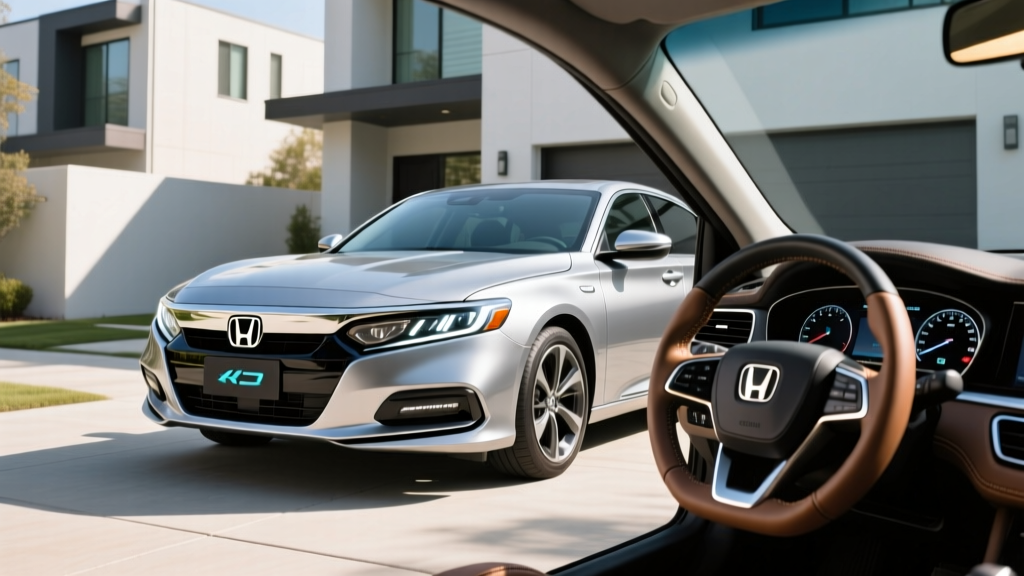
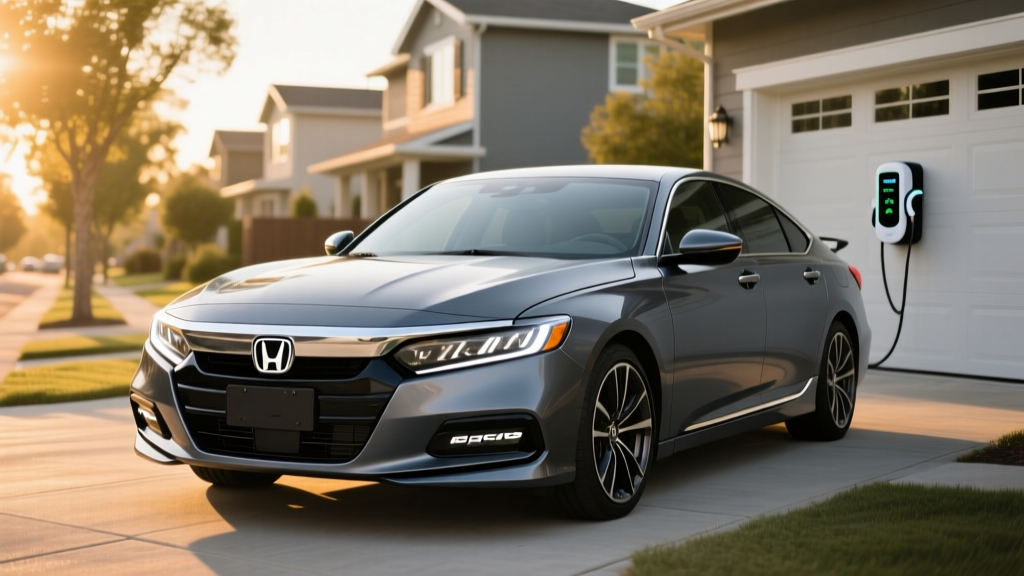
The Accord Hybrid Sport-L is one of four hybrid trims Honda offers for the 2025 model year (Sport, Sport-L, EX-L, and Touring). The "L" in Sport-L adds leather-trimmed seats and a leather-wrapped steering wheel to the Sport's already aggressive equipment list, which includes 19-inch alloy wheels, a 12.3-inch touchscreen with wireless Apple CarPlay and Android Auto, heated front seats, and Honda Sensing ADAS suite.
Critically, this is a conventional hybrid (HEV), not a plug-in hybrid (PHEV). You never plug it in. The 1.3 kWh lithium-ion battery pack recharges exclusively through regenerative braking and the gasoline engine. This distinction matters because it determines your fueling routine, tax credit eligibility, and daily driving experience.
HEV vs. PHEV: Where the Accord Hybrid Fits
Conventional Hybrid (HEV) — like the Accord Hybrid Sport-L: Small battery (~1-2 kWh), no plug, no electric-only range to speak of. The electric motor assists the gas engine and enables engine-off coasting at low speeds. You fuel it like any gas car and get 40-50+ MPG.
Plug-in Hybrid (PHEV) — like the Toyota RAV4 Prime or Chrysler Pacifica Hybrid: Larger battery (15-20+ kWh), plugs into a wall outlet, delivers 25-45 miles of electric-only driving before the gas engine kicks in. Qualifies for partial or full federal tax credits depending on battery capacity and sourcing.
Full EV (BEV) — like the Tesla Model 3 or Hyundai Ioniq 6: No gas engine. 250-360+ miles of all-electric range. Requires home or public charging infrastructure.
Fuel Economy: EPA Ratings and Real-World MPG
The 2025 Accord Hybrid Sport-L carries the same EPA ratings as all Accord Hybrid trims equipped with 19-inch wheels:
| Metric | MPG |
|---|---|
| City | 51 |
| Highway | 44 |
| Combined | 48 |
| Fuel Tank Capacity | 12.8 gal |
| Total Range (est.) | ~614 miles |
Source: fueleconomy.gov
Real-World MPG: What to Actually Expect
Honda's two-motor hybrid system excels in city driving, where regenerative braking recaptures energy at every stoplight and the electric motor handles low-speed propulsion. In urban and suburban commuting, owners regularly report 50-55 MPG — matching or exceeding the EPA city rating. This is a hallmark of series-dominant hybrid systems: the gas engine acts primarily as a generator, running at its most efficient RPM regardless of vehicle speed.
Highway driving tells a different story. At sustained 70-80 mph speeds, the Accord Hybrid's 2.0-liter Atkinson-cycle engine directly drives the wheels (via a lock-up clutch), but aerodynamic drag and the hybrid system's added weight reduce efficiency. Expect 40-44 MPG on the highway in temperate conditions. In cold weather (below 35°F), the engine runs more frequently to provide cabin heat and maintain battery temperature, dropping observed economy to roughly 38-42 MPG combined until the powertrain warms up.
Powertrain and Performance Specs
The Accord Hybrid uses Honda's fourth-generation two-motor hybrid system, which pairs a 2.0-liter DOHC Atkinson-cycle inline-4 with two electric motors and an electronically controlled continuously variable transmission (e-CVT). Here are the hard numbers:
| Specification | Value |
|---|---|
| Combined System Horsepower | 204 hp |
| Gas Engine | 2.0L Atkinson I-4, 146 hp / 134 lb-ft |
| Drive Motor | 181 hp / 247 lb-ft torque |
| Generator Motor | Starter/generator (not traction) |
| Transmission | e-CVT (direct drive w/ lock-up clutch) |
| Drivetrain | Front-wheel drive |
| 0-60 mph (est.) | ~7.5 seconds |
| Hybrid Battery Capacity | 1.3 kWh (lithium-ion) |
| Towing Capacity | Not rated for towing |
The 247 lb-ft of electric torque is available from zero RPM, which gives the Accord Hybrid Sport-L a responsive, almost EV-like feel from stoplights. The e-CVT avoids the rubber-band sensation of traditional CVTs because Honda's system uses a direct-drive lock-up clutch at highway speeds rather than continuously varying ratios. The result is linear, predictable acceleration that feels more like a geared automatic than a typical hybrid drone.
Pricing, Trims, and Tax Credit Eligibility
The 2025 Honda Accord Hybrid Sport-L carries an MSRP of $34,250 (including destination charge). This positions it roughly $1,200 above the Sport hybrid and $3,500 below the top-tier Touring hybrid.
| Trim | MSRP |
|---|---|
| Sport | $33,050 |
| Sport-L | $34,250 |
| EX-L | $34,900 |
| Touring | $38,250 |
Does the Accord Hybrid Qualify for a Federal Tax Credit?
No. The 2025 Accord Hybrid Sport-L does not qualify for the federal §30D Clean Vehicle Credit. Under current IRS rules, only plug-in electric vehicles (PHEVs and BEVs) with a battery capacity of at least 7 kWh and meeting critical mineral and battery component sourcing requirements are eligible. The Accord Hybrid's 1.3 kWh battery is far below that threshold, and as a conventional hybrid, it has no plug-in capability.
Some states offer their own incentives for hybrid vehicles — for example, certain utility rebates or HOV lane access — but these vary widely by jurisdiction. Check your state's energy office or your local utility's EV/hybrid programs for specifics. A tax professional can advise on any state-level deductions.
Battery Warranty, Reliability, and Replacement Cost
Hybrid Battery Warranty
Honda covers the Accord Hybrid's lithium-ion battery pack for 8 years / 100,000 miles (whichever comes first) under the federal emissions-related hybrid component warranty. In California Air Resources Board (CARB) states — which include CA, CO, CT, ME, MD, MA, NJ, NY, OR, RI, VT, and WA — that coverage extends to 10 years / 150,000 miles.
The warranty covers battery capacity loss below a functional threshold (typically defined as the inability to hold sufficient charge for hybrid operation) and any manufacturing defects in the battery management system, power control unit, and drive motors.
How Long Do Honda Hybrid Batteries Actually Last?
Honda's hybrid system uses a relatively small 1.3 kWh battery that operates in a narrow state-of-charge window — typically between 40% and 70% SoC. This shallow cycling is enormously beneficial for longevity. Unlike a full EV battery that regularly cycles from 10% to 90%, the Accord's battery experiences minimal stress per cycle.
Based on historical data from Honda's hybrid lineup (Insight, Accord Hybrid, CR-V Hybrid), most hybrid battery packs last 150,000 to 200,000+ miles before significant degradation. Many first-generation Insight and Civic Hybrid owners reported original batteries exceeding 200,000 miles. The fourth-generation system in the 2025 Accord benefits from improved thermal management and more stable lithium-ion chemistry.
Battery Replacement Cost
If your hybrid battery does fail outside of warranty, expect a replacement cost in the range of $2,000 to $4,000 for a new OEM battery pack, including labor. Refurbished or reconditioned packs are available from third-party suppliers for $1,000 to $2,000. This is dramatically less expensive than EV battery replacement (which can run $8,000-$20,000+) because the hybrid pack is small and accessible.
The rest of the Accord Hybrid powertrain is proven and low-stress: the e-CVT has no belts, chains, or conventional clutch packs to wear out, and regenerative braking significantly extends brake pad life (many owners report 80,000+ miles on original pads).
Accord Hybrid Sport-L vs. the Competition
The midsize hybrid sedan market is competitive. Here's how the Accord Hybrid Sport-L stacks up against its closest rivals on the metrics that matter:
| Attribute | Accord Hybrid Sport-L | Camry Hybrid SE | Sonata Hybrid SEL |
|---|---|---|---|
| Combined MPG (EPA) | 48 | 47 | 47 |
| Combined HP | 204 | 225 | 192 |
| Drivetrain | FWD | FWD / AWD | FWD |
| Cargo (cu ft) | 16.7 | 15.1 | 16.0 |
| MSRP | $34,250 | $33,495 | $31,250 |
| Battery Warranty | 8yr/100k mi | 10yr/150k mi | 10yr/100k mi |
The Accord Hybrid's 16.7 cu-ft trunk is the largest in this group, and its 48 MPG combined rating edges out both rivals. The Camry Hybrid offers AWD (useful in snow-belt states) and slightly more peak horsepower. The Sonata Hybrid undercuts on price but trails in rear-seat space and refinement.
Who Should Buy the Accord Hybrid Sport-L (and Who Shouldn't)
✓ Pros
- 48 MPG combined; routinely 50+ in city driving
- 247 lb-ft electric torque for responsive launches
- 16.7 cu-ft trunk — no hybrid battery cargo intrusion
- No plug-in required; fuel anywhere in 5 minutes
- Honda Sensing ADAS standard (adaptive cruise, lane-keep, AEB)
- Proven 4th-gen hybrid system with low replacement cost
- Strong resale value and Honda reliability reputation
✗ Cons
- FWD only — no AWD option (Camry Hybrid offers it)
- No federal tax credit eligibility
- Highway MPG drops to ~42 at 75+ mph
- Engine drone under hard acceleration (typical e-CVT)
- $34,250 MSRP is above some competitors' hybrid trims
- No spare tire — tire repair kit only
- Cabin noise on coarse pavement at highway speeds
Choose the Accord Hybrid Sport-L If:
- Your commute is mostly city/suburban (where the 51 MPG city rating shines)
- You want maximum fuel savings without changing your fueling routine
- You need a large trunk for family or work cargo
- You don't have access to home or workplace charging (ruling out PHEVs and BEVs)
- You plan to keep the car 8-12 years and value Honda's long-term reliability
Consider a PHEV or Full EV Instead If:
- You have home Level 2 charging and a short commute (a PHEV like the Prius Prime gives 44 electric miles, qualifying for a partial tax credit)
- You need AWD for snow or mountain driving (Camry Hybrid AWD or a BEV like the Ioniq 5)
- You want zero tailpipe emissions and have reliable charging access (a BEV eliminates gas entirely)
- You drive 200+ highway miles daily and want the lowest cost-per-mile (BEVs win on fuel cost at scale)
5-Year Ownership Cost Snapshot
Let's put the Accord Hybrid Sport-L's fuel savings in context. Assuming 15,000 miles per year, $3.50/gallon regular fuel, and the EPA 48 MPG combined rating:
| Vehicle | MPG Comb. | Annual Fuel | 5-Year Fuel |
|---|---|---|---|
| Accord Hybrid Sport-L | 48 | $1,094 | $5,469 |
| Accord 1.5T (gas) | 31 | $1,694 | $8,468 |
| Toyota Camry (gas 4-cyl) | 30 | $1,750 | $8,750 |
| Tesla Model 3 RWD (electric) | ~130 MPGe | ~$650* | ~$3,250* |
*EV cost assumes $0.14/kWh national average electricity rate. Actual EV charging costs vary significantly by region and home vs. public charging mix.
Over five years, the Accord Hybrid saves roughly $3,000 in fuel compared to the gas-only Accord 1.5T. That nearly closes the price gap between the hybrid and gas trims, and it does so without requiring any behavioral change — no plugging in, no route planning, no charging apps.
Frequently Asked Questions
How many MPG does the 2025 Honda Accord Hybrid Sport-L get?
The EPA rates it at 51 city / 44 highway / 48 combined. In real-world city and suburban driving, many owners see 50-55 MPG. Highway-only driving at 70+ mph typically yields 40-44 MPG, and cold weather can drop combined figures to the low 40s.
Does the Accord Hybrid need to be plugged in?
No. The Accord Hybrid is a conventional hybrid (HEV). Its 1.3 kWh battery recharges through regenerative braking and the gasoline engine. You fuel it exclusively at gas stations, just like a conventional car.
How far can the Accord Hybrid drive on electric power alone?
Effectively zero miles in sustained electric-only mode. The hybrid system can propel the car on electric power alone for very short distances (roughly 0.5-1 mile) at low speeds under 30 mph, but the engine starts automatically when more power is needed or the small battery depletes. This is fundamentally different from a PHEV, which offers 25-45 miles of genuine electric-only range.
Is the Accord Hybrid reliable, and what does battery replacement cost?
Honda's hybrid system is one of the most proven on the market, now in its fourth generation. The hybrid battery is covered for 8 years/100,000 miles (10 years/150,000 miles in CARB states), and historical data suggests most packs last 150,000-200,000+ miles. Out-of-warranty replacement runs $2,000-$4,000 for an OEM pack — far less than EV battery replacement. The e-CVT transmission has no wearable belts or clutch packs, and regenerative braking extends brake pad life significantly.
Does the 2025 Accord Hybrid qualify for any federal tax credit?
No. The federal §30D Clean Vehicle Credit applies only to plug-in vehicles (PHEVs and BEVs) with battery packs of 7 kWh or more that meet critical mineral and component sourcing requirements. The Accord Hybrid's 1.3 kWh conventional hybrid battery does not qualify. Check your state and local utility for any hybrid-specific rebates or incentives.
How does the Accord Hybrid compare to a full EV like the Tesla Model 3?
The Model 3 offers zero tailpipe emissions, lower per-mile fuel costs (especially with home solar), instant 283 lb-ft of torque, and eligibility for the $7,500 federal tax credit (subject to current IRS income and sourcing rules). However, it requires reliable charging access, costs more upfront ($38,990 base for the 2025 RWD), and adds range planning for road trips. The Accord Hybrid is the pragmatic choice if you lack home charging, frequently drive long distances in rural areas, or simply don't want to change your fueling habits.
Is the Sport-L trim worth the upgrade over the base Sport hybrid?
The $1,200 premium adds leather-trimmed seats, a leather-wrapped steering wheel, and a 4-way power passenger seat. If you prioritize cabin material quality and plan to keep the car for many years, the leather holds up better than the Sport's cloth in high-use scenarios. If budget is the priority, the Sport hybrid delivers identical MPG, powertrain, and technology at a lower price.
Sources: EPA fuel economy data from fueleconomy.gov; Honda specifications from automobiles.honda.com; federal tax credit rules from irs.gov. Pricing and incentives are based on 2025 model-year information and are subject to change. Verify eligibility with a tax professional.