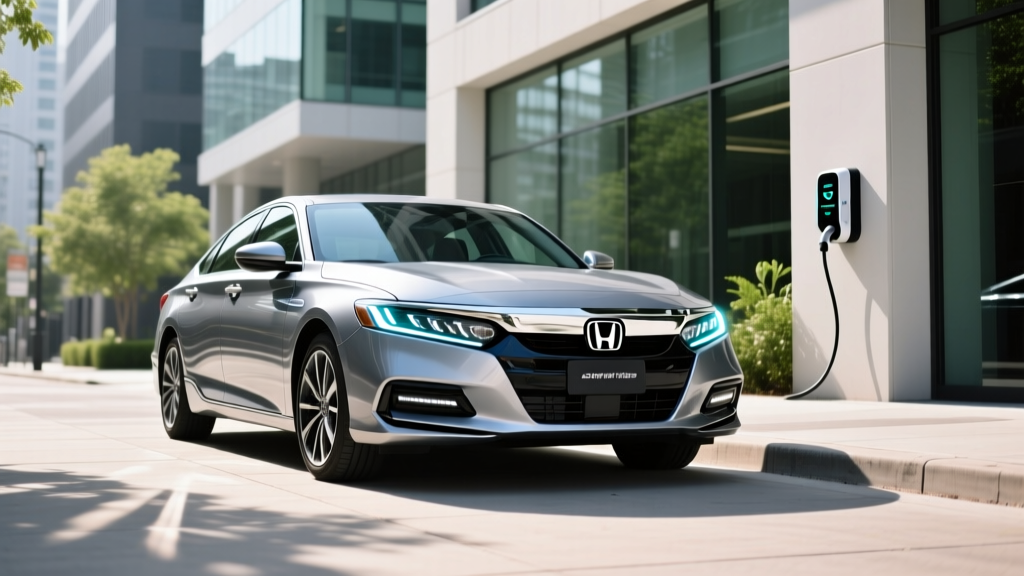
The Honda Accord Hybrid has long occupied the sweet spot for buyers who want electric-motor efficiency without ever plugging in. For the 2025 model year, Honda continues its two-motor hybrid system across four trims, delivering sedan practicality with fuel economy that routinely beats its EPA estimates in city driving. If you're researching the 2025 Honda Accord Hybrid MSRP and trying to figure out whether this HEV makes more sense than a PHEV or full EV, this guide gives you every number you need.
2025 Honda Accord Hybrid MSRP by Trim
Honda positions the Accord Hybrid as the premium powertrain option in the Accord lineup. For 2025, all four available trims use the same hybrid powertrain — there is no non-hybrid Accord sold in the U.S. market. Here's the pricing breakdown:
| Trim | MSRP | Destination | Total Starting Price |
|---|---|---|---|
| Sport Hybrid | $33,655 | $1,195 | $34,850 |
| Sport-L Hybrid | $36,355 | $1,195 | $37,550 |
| EX-L Hybrid | $37,255 | $1,195 | $38,450 |
| Touring Hybrid | $40,155 | $1,195 | $41,350 |
All trims share the identical 2.0-liter four-cylinder hybrid powertrain producing 204 combined horsepower. The price differences come down to interior materials, technology features, and wheel size — not performance or fuel economy. The Sport and Sport-L ride on 19-inch wheels, while the EX-L and Touring use 17-inch wheels, which contributes to a slight EPA efficiency advantage for the latter two trims.
EPA MPG and Real-World Fuel Economy
The Accord Hybrid's fuel economy varies slightly by trim due to wheel and tire differences. Here are the official EPA estimates from fueleconomy.gov:
| Trim Group | City MPG | Highway MPG | Combined MPG |
|---|---|---|---|
| Sport / Sport-L (19" wheels) | 46 | 41 | 44 |
| EX-L / Touring (17" wheels) | 51 | 44 | 48 |
Real-world expectations: Honda's hybrid system, like most series-parallel hybrids, excels in stop-and-go city driving where regenerative braking recaptures energy frequently. In real-world mixed driving, owners commonly report matching or slightly exceeding the EPA combined figure — particularly on the EX-L and Touring trims. Highway-only trips at 75+ mph will pull fuel economy closer to the 38-41 MPG range, as the gasoline engine carries more of the load at sustained high speeds. Cold-weather driving (below 30°F) typically reduces efficiency by 5-10% due to cabin heating demands and reduced battery efficiency.
With a 12.4-gallon fuel tank, the EX-L and Touring trims deliver a theoretical maximum range of approximately 595 miles on a single fill-up — enough for most drivers to go 2-3 weeks between gas station visits.
Hybrid vs. Plug-In Hybrid: What the Accord Is (and Isn't)
This is a critical distinction that trips up many shoppers. The 2025 Honda Accord is a conventional hybrid electric vehicle (HEV), not a plug-in hybrid (PHEV). Here's what that means in practice:
Conventional Hybrid (HEV) — Honda Accord Hybrid
- No plug — the battery charges through regenerative braking and the gasoline engine
- Small battery (~1.1 kWh usable) — not designed for electric-only driving beyond low-speed, short-distance maneuvers
- No electric-only range rating — the gasoline engine and electric motors work together seamlessly
- Eligible for no federal EV tax credits under IRS §30D
- Lower upfront cost, no charging infrastructure needed
Plug-In Hybrid (PHEV) — e.g., Toyota Prius Prime, Hyundai Tucson PHEV
- Requires plugging in to access full benefits
- Larger battery (typically 11-18 kWh) enabling 25-45 miles of electric-only driving
- EPA-rated electric-only range + total combined range
- May qualify for the federal §30D clean vehicle credit (up to $7,500, subject to MSRP caps, income limits, and battery sourcing rules)
- Higher upfront cost, benefits from home Level 2 charging
If you want to commute on electricity alone and plug in at night, you need a PHEV or a full BEV. The Accord Hybrid is designed for drivers who want maximum fuel efficiency with zero lifestyle changes — you just fill it with gas and drive.
Powertrain Specs and Driving Impressions
| Specification | Value |
|---|---|
| Engine | 2.0L DOHC 4-cylinder Atkinson cycle |
| Engine Power | 146 hp @ 6,100 rpm |
| Electric Motors | Dual-motor system (propulsion + generator) |
| Electric Motor Power | 181 hp |
| Combined System Output | 204 hp / 247 lb-ft torque |
| Transmission | e-CVT (electronic continuously variable) |
| Drivetrain | Front-wheel drive |
| 0-60 mph | ~7.2 seconds (est.) |
| Battery Type | Lithium-ion, ~1.1 kWh |
| Drive Modes | ECON, Normal, Sport, Individual |
Honda's fourth-generation two-motor hybrid system operates primarily in electric-drive mode at low and moderate speeds, with the gasoline engine acting as a generator to feed the propulsion motor. At highway speeds, a lock-up clutch allows the engine to drive the wheels directly for optimal efficiency. The result is a driving experience that feels more like an EV around town — smooth, responsive torque delivery — with the seamless range extension of a gasoline engine for longer trips.
The 204 combined horsepower is adequate for daily driving and highway merging, though it won't win any stoplight races. Sport mode sharpens throttle response and increases regenerative braking intensity, but the fundamental character remains efficiency-oriented. The e-CVT is well-calibrated with none of the rubber-band drone associated with older CVT designs.
Battery Warranty, Reliability, and Replacement Costs
2025 Accord Hybrid Battery Warranty
Hybrid battery: 8 years / 100,000 miles (10 years / 150,000 miles in CARB states including CA, NY, MA, and others)
Powertrain warranty: 5 years / 60,000 miles
Basic warranty: 3 years / 36,000 miles
Honda's hybrid system has proven highly reliable across multiple generations. The Accord Hybrid's lithium-ion traction battery is substantially smaller and less stressed than a full EV battery — it rarely sees deep discharge cycles, which is the primary driver of lithium-ion degradation. Based on historical data from Honda and Toyota hybrid platforms, these batteries routinely last 150,000-200,000+ miles before requiring replacement.
Battery replacement cost: If a hybrid battery does fail outside of warranty coverage, expect a replacement cost in the range of $2,000-$4,000 for the battery pack itself, plus labor. This is dramatically lower than EV battery replacement costs ($8,000-$20,000+) because the Accord's hybrid battery is roughly 1/60th the capacity of a typical EV battery. Third-party refurbishment and cell-level repair services are also increasingly available, often reducing costs to $1,000-$2,000.
According to IIHS, the 2025 Accord carries top safety ratings, and Honda Sensing — the brand's ADAS suite including adaptive cruise control, lane-keeping assist, and automatic emergency braking — comes standard on every trim.
Tax Credits and Incentives: What You Actually Qualify For
Because the 2025 Honda Accord Hybrid is a conventional HEV (not a PHEV or BEV), it does not qualify for the federal §30D New Clean Vehicle Credit. That credit, which offers up to $7,500, is reserved for plug-in vehicles with battery capacities of at least 7 kWh — far above the Accord's ~1.1 kWh pack.
- Federal tax credit: Not eligible (HEV, not PHEV/BEV)
- State incentives: A small number of states offer modest rebates for conventional hybrids, but most state incentive programs have shifted focus to PHEVs and BEVs. Check your state's energy or environmental agency for current programs.
- Employer/utility rebates: Some utility companies and employers offer hybrid purchase incentives — check locally.
The lack of federal tax incentives means the Accord Hybrid's value proposition rests entirely on its fuel savings, reliability, and lower total cost of ownership versus a comparable gasoline-only midsize sedan.
5-Year Ownership Cost Estimate
| Category | Accord Hybrid EX-L | Gas Sedan (28 MPG avg) |
|---|---|---|
| MSRP (incl. destination) | $38,450 | ~$35,000 |
| Fuel cost (75,000 mi @ $3.40/gal) | ~$5,313 | ~$9,107 |
| Fuel savings over 5 years | ~$3,794 saved | |
| Maintenance (est.) | ~$2,800 | ~$3,200 |
| Insurance (est.) | ~$7,500 | ~$7,000 |
The Accord Hybrid commands roughly $3,000-$4,000 more upfront than a comparably equipped non-hybrid midsize sedan, but the fuel savings largely close that gap within 4-5 years of average driving. Hybrids also tend to experience less brake wear (regenerative braking reduces friction brake use) and have no additional maintenance items beyond a standard gasoline car.
Who Should Buy the Accord Hybrid — and Who Shouldn't
Choose the Accord Hybrid if:
- You want 44-48 MPG without changing your fueling habits
- You don't have access to home or workplace charging (apartment, street parking)
- You regularly take long road trips and don't want to plan around charging stations
- You want a spacious midsize sedan with strong resale value and proven reliability
- Your daily commute involves heavy stop-and-go traffic (where hybrids shine brightest)
Consider a PHEV or full EV instead if:
- You have reliable home Level 2 charging and a commute under 40 miles round-trip (a PHEV like the Prius Prime lets you drive on electricity daily)
- You want to eliminate gasoline entirely (look at BEVs like the Tesla Model 3 or Hyundai Ioniq 6)
- You want to take advantage of the $7,500 federal tax credit (requires a qualifying PHEV or BEV — check IRS §30D rules for current eligibility)
- You prioritize acceleration and performance (EVs deliver instant torque that hybrids can't match)
Frequently Asked Questions
How many MPG does the 2025 Honda Accord Hybrid get?
The EPA rates the Accord Hybrid at 51 city / 44 highway / 48 combined MPG on EX-L and Touring trims (17-inch wheels). Sport and Sport-L trims with 19-inch wheels are rated at 46 city / 41 highway / 44 combined. Real-world city driving often meets or slightly exceeds these figures thanks to regenerative braking.
Does the Honda Accord Hybrid need to be plugged in?
No. The Accord Hybrid is a conventional HEV. Its small lithium-ion battery recharges automatically through regenerative braking and the gasoline engine. There is no plug, no charging cable, and no electric-only range rating.
Is the 2025 Accord Hybrid reliable, and what does battery replacement cost?
Honda's hybrid system has an excellent reliability track record spanning multiple generations. The hybrid battery is warrantied for 8 years/100,000 miles (10 years/150,000 miles in CARB states). Out-of-warranty replacement typically costs $2,000-$4,000 — far less than an EV battery. Most hybrid batteries last 150,000+ miles based on historical data.
Does the 2025 Honda Accord Hybrid qualify for any tax credit?
No. The federal §30D New Clean Vehicle Credit applies only to plug-in vehicles (PHEVs and BEVs) with battery capacities of 7 kWh or more. The Accord Hybrid's ~1.1 kWh battery does not qualify. A small number of state-level programs may offer hybrid incentives, but these are increasingly rare.
Hybrid vs. PHEV vs. EV — which is right for me?
If you lack home charging access or take frequent long road trips, a conventional hybrid like the Accord Hybrid is the lowest-friction choice. If you have home charging and a short commute, a PHEV gives you daily electric driving with a gas backup. If you want zero emissions at the tailpipe, lower fueling costs, and have reliable charging access, a full BEV offers the lowest long-term operating cost — but requires the biggest lifestyle adjustment.
How does the Accord Hybrid compare to the Toyota Camry Hybrid?
The 2025 Toyota Camry Hybrid (now exclusively hybrid, like the Accord) is the closest competitor, with EPA ratings up to 51 combined MPG and a starting MSRP around $33,000. The Accord Hybrid offers slightly more rear-seat legroom and cargo space, while the Camry Hybrid holds a marginal fuel economy edge on certain trims. Both are strong choices — the decision often comes down to styling preference and dealer availability.