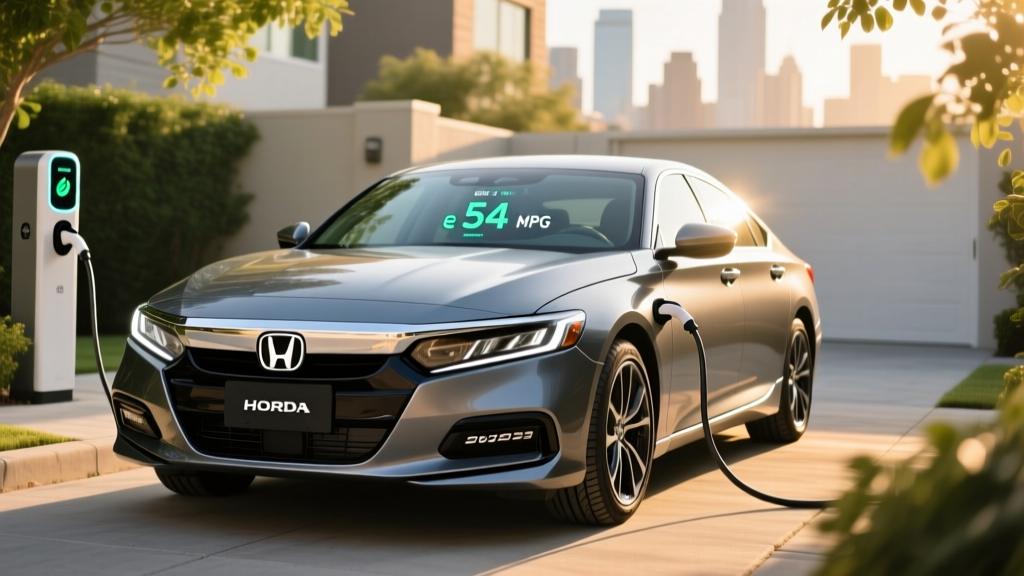
The 2025 Honda Accord Hybrid carries over the sixth-generation two-motor powertrain that made the 2023 redesign a midsize-sedan benchmark. For buyers searching for the 2025 Honda Accord Hybrid MPG official numbers, the EPA rates the Sport, EX-L, Sport-L, and Touring trims at 46 city / 41 highway / 44 combined MPG, while the Sport Hybrid trim is rated slightly higher at 48 city / 47 highway / 48 combined MPG. Those figures place it near the top of the midsize hybrid sedan segment — and as we'll show, real-world city driving frequently beats the EPA sticker.
This guide breaks down the official fuel-economy data, explains how the Accord Hybrid's series-parallel powertrain actually works, covers battery warranty and longevity, and helps you decide whether this conventional hybrid (HEV), a plug-in hybrid (PHEV), or a full battery-electric vehicle (BEV) is the right move for your commute.
Official 2025 Honda Accord Hybrid MPG Ratings by Trim
Honda offers the 2025 Accord Hybrid across four trims. The EPA fuel-economy ratings split into two tiers based on wheel size and curb weight:
| Trim | City MPG | Highway MPG | Combined MPG | Annual Fuel Cost* |
|---|---|---|---|---|
| Sport Hybrid | 48 | 47 | 48 | $1,150 |
| EX-L Hybrid | 46 | 41 | 44 | $1,250 |
| Sport-L Hybrid | 46 | 41 | 44 | $1,250 |
| Touring Hybrid | 46 | 41 | 44 | $1,250 |
*Based on 15,000 miles/year, 55% city driving, and regular gasoline at $3.50/gallon. Your costs will vary with local fuel prices and driving habits.
The Sport Hybrid's 19-inch wheels are lighter and carry lower rolling-resistance tires than the 19-inch alloys on the Sport-L and Touring, which is why it earns 4 additional combined MPG. If maximum fuel economy is your priority, the Sport Hybrid trim is the efficiency pick.
Real-World MPG: How the Accord Hybrid Performs Beyond the Sticker
EPA testing uses standardized dynamometer cycles, but Honda's two-motor hybrid system has a distinct advantage in stop-and-go traffic that lab numbers don't fully capture. Here's what to expect in practice:
- City / suburban driving: 46–52 MPG (frequent stops let the electric motors handle most propulsion)
- Highway cruising (70–75 mph): 38–42 MPG (engine runs more directly; less regen opportunity)
- Cold weather (below 30°F): 36–40 MPG combined (engine runs longer to heat the cabin and warm the battery)
- Mixed commute (50/50 city-highway): 43–47 MPG
The key insight: hybrids typically beat their EPA city rating in real-world urban driving because regenerative braking recovers energy that a gas car wastes as heat at every stoplight. The Accord Hybrid's two-motor system can propel the car on electric power alone at low speeds (roughly up to 25–35 mph under light throttle), which is why owners who do mostly city commuting often report 48–52 MPG. Highway driving is a different story — at sustained speed, the 2.0-liter Atkinson-cycle engine does most of the work, and the hybrid advantage shrinks.
For comparison, the non-hybrid 2025 Accord with the 1.5L turbo is rated at 29 city / 37 highway / 32 combined. The hybrid delivers roughly 38% better combined fuel economy, with the gap widening in city traffic.
Powertrain Specs: How the Two-Motor Hybrid System Works
The 2025 Accord Hybrid uses Honda's fourth-generation two-motor hybrid system. It's a series-parallel architecture — meaning it can operate as a pure series hybrid (engine generates electricity, motors drive the wheels), a parallel hybrid (engine directly drives the wheels through a lock-up clutch), or in full-electric mode at low speeds.
| Component | Specification |
|---|---|
| Engine | 2.0L DOHC Atkinson-cycle 4-cylinder |
| Engine Output | 146 hp @ 6,100 rpm / 134 lb-ft @ 4,500 rpm |
| Drive Motors | Two electric motors (one propulsion, one generator) |
| Propulsion Motor Output | 181 hp / 247 lb-ft torque |
| Combined System Output | 204 hp / 247 lb-ft |
| Transmission | Direct-drive (no conventional transmission; single fixed gear ratio for engine lock-up) |
| Drive Type | Front-wheel drive |
| 0–60 mph | ~6.5 seconds (estimated) |
| Fuel Tank | 12.4 gallons (regular unleaded) |
| Total Range | ~545 miles (44 combined × 12.4 gal) |
Under normal acceleration, the propulsion motor does most of the work, drawing electricity from either the lithium-ion battery pack or the generator motor (which is spun by the gasoline engine). At highway speeds, a lock-up clutch connects the engine directly to the drive wheels — this avoids the efficiency loss of converting mechanical energy to electrical and back again. The result is seamless, electric-feeling acceleration around town with efficient direct-drive cruising on the open road.
HEV vs PHEV vs EV: Which Powertrain Fits Your Life?
The Accord Hybrid is a conventional hybrid (HEV) — it does not plug in, has no electric-only range to speak of, and recovers all its energy from the gasoline engine and regenerative braking. Honda does not currently offer a plug-in hybrid (PHEV) version of the Accord in the US market. Here's how the three electrified powertrain types compare:
HEV (Accord Hybrid)
- No plug required — fuel at any gas station
- 44–48 MPG combined
- ~545-mile total range
- Lower purchase price
- No home charging needed
- No federal tax credit
PHEV (e.g., Toyota Prius Prime)
- Plugs in for 25–44 mi electric-only range
- Gas engine for longer trips
- ~480–640 mi total range
- Higher purchase price
- Home charging recommended
- May qualify for up to $3,750–$7,500 credit (varies by model)
BEV (e.g., Tesla Model 3, Hyundai Ioniq 6)
- 100% electric — no gasoline
- 250–360 mi EPA range
- Lowest per-mile fuel cost
- Highest purchase price (typically)
- Home Level 2 charging strongly recommended
- Up to $7,500 federal credit (model-dependent)
- Choose the Accord Hybrid (HEV) if: You don't have reliable access to home or workplace charging, you want the lowest purchase price, you take frequent road trips, and you want a no-compromise midsize sedan with excellent fuel economy and no plug-in hassle.
- Choose a PHEV if: You can charge at home, your daily commute is under 30–40 miles (so you'd drive mostly on electricity), but you still want the flexibility of a gas engine for weekend road trips without route-planning.
- Choose a BEV if: You have Level 2 home charging, your daily driving is under 200 miles, you want the lowest operating cost and zero tailpipe emissions, and you're comfortable with public DC fast charging for road trips.
Pricing, Trims & Tax Credit Eligibility
| Trim | MSRP | Federal Tax Credit |
|---|---|---|
| Sport Hybrid | $34,450 | None |
| EX-L Hybrid | $36,700 | None |
| Sport-L Hybrid | $37,050 | None |
| Touring Hybrid | $40,150 | None |
The 2025 Accord Hybrid does not qualify for the federal §30D Clean Vehicle Credit. That credit applies only to plug-in electric vehicles (BEVs and PHEVs) that meet battery capacity, critical-mineral sourcing, MSRP caps, and buyer income requirements as defined by the IRS. Conventional hybrids like the Accord Hybrid are excluded from §30D regardless of price.
However, the Accord Hybrid's lower MSRP and no-plug-in convenience mean the total cost of ownership is highly competitive. Let's run the numbers:
| Cost Factor | Accord Hybrid (EX-L) | Accord Gas 1.5T (EX-L) | Tesla Model 3 LR (BEV) |
|---|---|---|---|
| MSRP (approx.) | $36,700 | $34,100 | $42,630 |
| Federal Tax Credit | $0 | $0 | Up to $7,500 (if eligible) |
| Fuel / Energy (5 yr, 75k mi) | ~$6,250 | ~$9,100 | ~$2,700 |
| Maintenance (5 yr) | ~$2,500 | ~$3,200 | ~$1,500 |
| Estimated Depreciation | ~$14,000 | ~$13,500 | ~$18,000 |
| 5-Year Total (approx.) | ~$59,450 | ~$59,900 | ~$57,330 |
Assumptions: $3.50/gal gas, $0.14/kWh electricity, 15,000 mi/yr. Tax credit eligibility depends on income, sourcing, and MSRP caps — verify at IRS.gov. Depreciation estimates based on historical segment averages.
The Accord Hybrid essentially breaks even with the gas Accord over five years despite a ~$2,600 higher MSRP, thanks to fuel savings and slightly lower maintenance. The BEV scenario is cheapest if you qualify for the full $7,500 credit and have home charging — but the Accord Hybrid requires zero infrastructure changes.
Battery Warranty, Reliability & Replacement Cost
- Hybrid Battery (IPU): 8 years / 100,000 miles (10 years / 150,000 miles in CARB states including CA, NY, MA, and others)
- Hybrid System Components: 8 years / 100,000 miles
- Powertrain Warranty: 5 years / 60,000 miles
- Bumper-to-Bumper: 3 years / 36,000 miles
Honda's hybrid battery pack (the Intelligent Power Unit, or IPU) uses a lithium-ion chemistry mounted under the rear seats. Based on data from Honda's previous-generation hybrid systems — including the Accord Hybrid, CR-V Hybrid, and Insight — these packs have demonstrated strong longevity. Most owner reports and third-party data suggest 10–15 years of useful life with gradual capacity loss of roughly 10–15% over that period. Because the Accord Hybrid's battery is relatively small (~1.1 kWh usable) and is constantly cycled in a shallow charge window (roughly 20–80% state of charge), the cells experience far less stress than a full BEV battery.
Battery replacement cost: If the IPU fails outside of warranty, Honda dealer replacement currently runs approximately $2,500–$4,000 including parts and labor. Independent hybrid specialists can often replace or recondition the pack for $1,500–$2,500. Given the 8–10 year warranty coverage and the pack's track record, out-of-pocket replacement during typical ownership is uncommon.
Reliability-wise, the Accord Hybrid's powertrain has fewer wear items than a conventional gas car — no traditional automatic transmission, no starter motor, no alternator, and regenerative braking extends brake pad life significantly (many hybrid owners report 60,000–80,000+ miles on original brake pads). Honda's Accord lineup consistently earns strong marks from Consumer Reports and J.D. Power for long-term dependability.
Safety & Driver Assistance
Every 2025 Accord Hybrid comes standard with Honda Sensing, Honda's suite of Level 2 driver-assistance features. This includes:
- Adaptive Cruise Control with Low-Speed Follow
- Lane Keeping Assist and Road Departure Mitigation
- Collision Mitigation Braking System
- Traffic Sign Recognition
- Traffic Jam Assist (on Touring trim)
The Accord earned a TOP SAFETY PICK+ rating from the IIHS and a 5-star overall rating from NHTSA. Note that Honda Sensing is a Level 2 SAE system — the driver must remain engaged with hands on the wheel and eyes on the road at all times. This is not autonomous driving.
Pros and Cons
Pros
- 44–48 MPG combined — beats most midsize hybrid rivals
- No plug-in required; fuel anywhere
- Smooth, electric-feeling acceleration around town
- Spacious cabin with 16.7 cu-ft trunk (matching gas model)
- Strong safety ratings (IIHS TSP+, NHTSA 5-star)
- 8–10 year hybrid battery warranty
- Low brake wear thanks to regen braking
Cons
- No PHEV option — can't drive on electric only for commutes
- No federal tax credit for conventional HEVs
- Highway MPG drops to 41 (lower than city)
- FWD only — no AWD option (unlike Toyota Camry Hybrid)
- Engine drone under hard acceleration (CVT-like behavior)
- Touring trim pushes past $40,000
Frequently Asked Questions
How many MPG does the 2025 Honda Accord Hybrid get?
The EPA rates the 2025 Accord Hybrid at 48 city / 47 highway / 48 combined on the Sport Hybrid trim, and 46 city / 41 highway / 44 combined on EX-L, Sport-L, and Touring trims. In real-world city driving, owners commonly see 46–52 MPG thanks to regenerative braking and electric-only low-speed propulsion.
Does the Honda Accord Hybrid need to be plugged in?
No. The Accord Hybrid is a conventional hybrid (HEV). It charges its own battery through regenerative braking and the gasoline engine. You simply fill up at any gas station — there is no plug, no charging cable, and no electric-only driving range to manage.
Is there a plug-in hybrid (PHEV) version of the Accord?
Not in the US market for 2025. Honda discontinued the Accord Plug-In Hybrid after the 2015 model year. If you want a midsize PHEV sedan, the closest competitor is the Toyota Prius Prime (up to 44 miles electric-only, 127 MPGe) or the Hyundai Sonata Plug-In Hybrid.
Does the 2025 Accord Hybrid qualify for any tax credit?
No. The federal §30D Clean Vehicle Credit applies only to plug-in electric vehicles (BEVs and PHEVs) that meet battery sourcing, MSRP, and income requirements. Conventional hybrids are excluded. Some states may offer minor rebates or HOV-lane access for hybrids — check your state's energy office for details.
How long will the hybrid battery last, and what does replacement cost?
Honda covers the hybrid battery for 8 years / 100,000 miles (10 years / 150,000 miles in CARB states). Real-world data from Honda's hybrid lineup suggests 10–15 years of service life with gradual capacity loss. Out-of-warranty replacement costs approximately $2,500–$4,000 at a dealer, or $1,500–$2,500 at an independent hybrid specialist.
Is the Accord Hybrid better than the gas-only Accord?
For most buyers, yes. The hybrid delivers roughly 38% better combined fuel economy (44 vs 32 MPG), smoother acceleration, less brake wear, and only a modest price premium (~$1,600–$2,600 depending on trim). The gas-only 1.5T Accord makes sense only if you drive predominantly highway miles at high speeds, where the hybrid's city advantage is minimized.
Hybrid vs EV — which should I buy?
Choose the Accord Hybrid if you lack reliable home charging, take long road trips regularly, or want the lowest purchase price with no range planning. Choose a BEV if you have Level 2 home charging, drive under 200 miles daily, want the lowest per-mile cost, and qualify for the federal tax credit. The hybrid is the pragmatic no-infrastructure choice; the EV is the long-term cost-savings play.