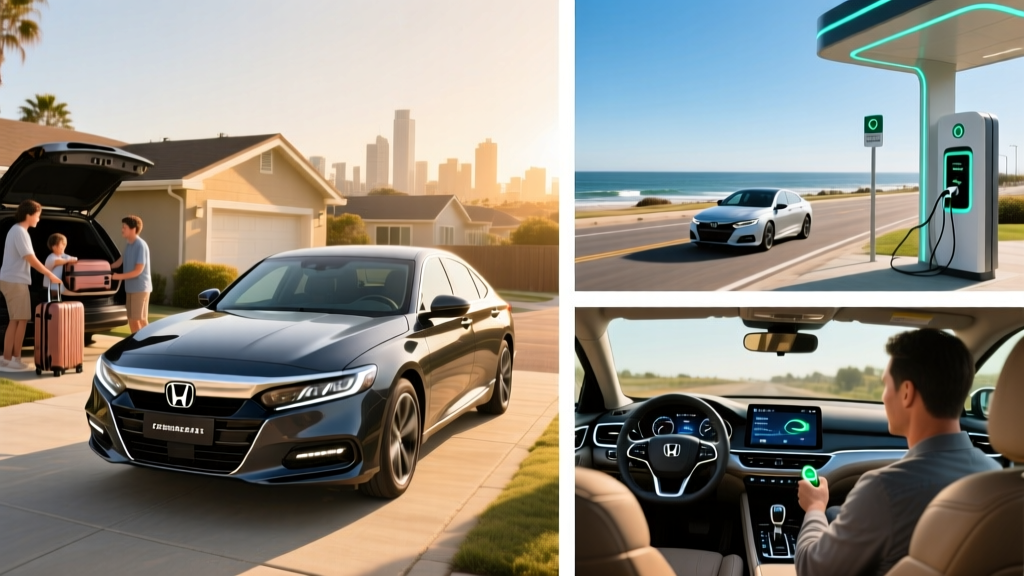
The 2025 Honda Accord EX-L Hybrid sits in a sweet spot for buyers who want sedan comfort, strong fuel economy, and zero plug-in hassle. As a conventional hybrid electric vehicle (HEV), it requires no charging infrastructure, no behavior changes, and no range planning — you just fill it with gas and drive. But with Honda's two-motor hybrid system delivering 192 combined horsepower and an EPA-estimated 48 MPG combined, the question isn't whether it's efficient. It's whether the EX-L trim is the right hybrid Accord for you, and how it stacks up against plug-in hybrids and full EVs in 2025.
This guide breaks down every spec that matters — real-world MPG versus EPA stickers, the powertrain engineering under the hood, battery longevity and replacement costs, federal tax credit eligibility, and a clear framework for deciding between this HEV, a PHEV, or a full battery-electric vehicle.
HEV vs PHEV: Where the Accord Hybrid Fits
Before diving into specs, it's essential to clarify what the 2025 Accord EX-L Hybrid is — and what it isn't. Honda does not offer a plug-in hybrid (PHEV) version of the Accord in the U.S. market. This is a conventional hybrid (HEV), meaning its small lithium-ion battery is charged entirely through regenerative braking and the gasoline engine. You never plug it in.
HEV vs PHEV vs BEV — Quick Distinction
| Feature | HEV (Accord Hybrid) | PHEV (e.g., Toyota Prius Prime) | BEV (e.g., Tesla Model 3) |
|---|---|---|---|
| Plug-in charging? | No | Yes (Level 1/2) | Yes (Level 1/2/DC) |
| Electric-only range | ~1 mi (low-speed only) | 25–45 mi typical | 250–360 mi typical |
| Battery size | ~1.1 kWh | 10–18 kWh | 55–82 kWh |
| Fuel needed? | Yes (always) | Yes (after EV range) | No |
| Federal tax credit (§30D)? | No | Up to $7,500 (if eligible) | Up to $7,500 (if eligible) |
The Accord HEV trades electric-only range for simplicity: no charger installation, no plug-in routine, and a lower purchase price than most PHEVs or BEVs.
Powertrain & Performance Specs
The 2025 Accord Hybrid uses Honda's fourth-generation two-motor hybrid system. Here's exactly what's under the hood:
| Specification | 2025 Accord EX-L Hybrid |
|---|---|
| Engine | 2.0L DOHC 4-cylinder Atkinson-cycle |
| Engine output | 146 hp @ 6,100 rpm / 134 lb-ft torque |
| Electric drive motor | 181 hp / 247 lb-ft torque |
| Combined system horsepower | 204 hp (combined peak) |
| Transmission | e-CVT (single-speed direct drive w/ lock-up clutch) |
| Drivetrain | Front-wheel drive |
| 0–60 mph (est.) | ~7.5 seconds |
| Hybrid battery | Lithium-ion, ~1.1 kWh (not plug-in) |
| Fuel tank | 12.8 gallons (regular unleaded, 87 octane) |
| Curb weight | ~3,477 lbs |
Honda's hybrid system is series-dominant, meaning the electric drive motor powers the wheels most of the time. The 2.0L engine primarily acts as a generator to feed electricity to the drive motor. At steady highway speeds (typically above 45 mph), a lock-up clutch mechanically connects the engine directly to the wheels for improved efficiency — this is where Honda's system outperforms many competitor e-CVTs that rely solely on generator-based power transfer.
Fuel Economy: EPA Ratings vs Real-World MPG
| Driving Condition | EPA Estimate | Real-World Expectation |
|---|---|---|
| City | 51 MPG | 49–55 MPG |
| Highway | 44 MPG | 39–44 MPG |
| Combined | 48 MPG | 44–50 MPG |
Source: EPA Fuel Economy Guide — fueleconomy.gov
The Accord Hybrid is one of those rare vehicles where real-world city MPG can actually exceed the EPA estimate. This is because hybrid systems recapture energy through regenerative braking — the stop-and-go traffic that tanks a conventional gas car's city MPG actually helps the Accord Hybrid recharge its battery and rely more on electric drive. On city-heavy commutes, owners regularly report 50–55 MPG over multiple fill-ups.
Highway driving tells a different story. At sustained 75–80 mph speeds, the aerodynamic drag penalty and reduced regenerative braking opportunity bring real-world highway economy down to the low-to-mid 40s. In cold weather (below 35°F), expect a 5–10% drop across the board as the engine runs more frequently to generate cabin heat and maintain battery temperature.
With the 12.8-gallon tank and 48 MPG combined, the Accord EX-L Hybrid delivers approximately 614 miles of total range per fill-up — a figure that neither most PHEVs nor BEVs can match without planning charging stops.
Pricing, Trim Value & Tax Credit Eligibility
The 2025 Honda Accord EX-L Hybrid carries an MSRP of approximately $34,990 (including destination charge). The EX-L sits above the Sport-L Hybrid ($34,395) and below the Sport Touring Hybrid ($38,890) in Honda's hybrid-only Accord lineup for 2025.
EX-L key features include leather-trimmed seats, a 10-way power driver's seat, heated front seats, a 12.3-inch touchscreen with wireless Apple CarPlay and Android Auto, a 10-speaker audio system, and Honda Sensing (the brand's Level 2 driver-assistance suite including adaptive cruise control, lane-keeping assist, and collision mitigation braking).
Federal Tax Credit: Does the Accord Hybrid Qualify?
No. Under the IRS §30D Clean Vehicle Credit, only plug-in electric vehicles (BEVs and PHEVs) with a battery capacity of at least 7 kWh are eligible for the up-to-$7,500 federal tax credit. The Accord Hybrid's ~1.1 kWh battery does not meet this threshold. It is classified as a conventional HEV, which does not qualify for §30D credits.
Some states offer separate incentives for conventional hybrids, but these vary widely. Check your state energy office or the Alternative Fuels Data Center for local programs. Always consult a tax professional for personal eligibility.
Battery Longevity, Warranty & Replacement Cost
Battery reliability is the number-one concern for hybrid buyers, and Honda addresses this with strong warranty coverage:
2025 Accord Hybrid Battery Warranty
- Hybrid battery warranty: 8 years / 100,000 miles (10 years / 150,000 miles in CARB states including CA, NY, MA, and others that follow California emissions standards)
- Hybrid system components: 8 years / 100,000 miles (covers the IPU, electric motors, and power control unit)
- Powertrain warranty: 5 years / 60,000 miles
- Limited vehicle warranty: 3 years / 36,000 miles
Honda's hybrid battery packs have proven durable in practice. The Accord and Insight hybrid taxis and high-mileage commuter vehicles routinely surpass 200,000 miles without battery replacement. The lithium-ion cells are small (~1.1 kWh) and operate within a conservative state-of-charge window — Honda's battery management system never fully charges or fully depletes the pack, which dramatically extends cycle life.
If replacement is needed out of warranty, expect to pay approximately $2,500–$4,500 for a new OEM hybrid battery pack including labor. Refurbished packs are available from third-party suppliers for $1,200–$2,000. This is a fraction of the $10,000–$20,000+ replacement cost for a full BEV traction battery — another advantage of the small-battery HEV design.
Who Should Choose the Accord EX-L Hybrid?
The 2025 Accord EX-L Hybrid is purpose-built for a specific buyer profile. Here's how it stacks up against the alternatives:
✓ Choose the Accord HEV If
- You want 48+ MPG with zero behavior changes — no plugging in, no charger installation
- Your commute is city-heavy (stop-and-go maximizes regen braking and MPG)
- You need 600+ miles of range per fill-up for road trips without charging stops
- You live in an apartment or lack access to home charging
- You want a mid-size sedan with a spacious trunk (16.7 cu ft) and proven reliability
- Budget is $32K–$36K and you don't qualify for EV tax credits
✗ Look at a PHEV or BEV If
- You want electric-only driving for a 20–40 mile commute (PHEV) or zero gas use (BEV)
- You have home charging access and want to minimize fuel costs
- You qualify for the §30D federal tax credit (income and sourcing requirements met) — a PHEV/BEV could net $3,750–$7,500 back
- You want one-pedal driving, instant torque, or performance-oriented acceleration
- Local HOV lane access requires a plug-in vehicle in your state
- Environmental impact is a top priority and your grid electricity is increasingly renewable
Compared to the Toyota Camry Hybrid (51 MPG combined, ~$30,000 base), the Accord EX-L Hybrid trades a few MPG for a more premium interior, larger trunk, and Honda's well-regarded driving dynamics. Compared to a PHEV like the Toyota Prius Prime (44 MPG combined, 44 miles EV range, ~$33,445 base), the Accord sacrifices electric-only commuting but avoids the nightly plug-in requirement and delivers more rear-seat and cargo space.
Real-World Ownership Costs
At 48 MPG combined and $3.25/gallon regular unleaded (2025 national average), the Accord EX-L Hybrid costs roughly $0.068 per mile in fuel. Over 15,000 miles per year, that's about $1,013 annually in fuel — roughly $600–$800 less than a comparable 30 MPG gas-only mid-size sedan.
Insurance premiums for the Accord Hybrid tend to run 5–10% higher than the gas-only Accord due to the higher MSRP and hybrid-specific repair costs, but remain significantly lower than most BEV insurance rates. Honda Sensing's standard active safety features help keep rates reasonable.
Maintenance is straightforward: oil changes every 7,500–10,000 miles (the engine runs less than in a conventional car, so oil degrades more slowly), standard brake service (regenerative braking extends pad life significantly — many hybrid owners report 80,000+ miles on original pads), and tire rotation. There is no transmission fluid to change in the traditional sense; Honda recommends inspection at intervals.
Frequently Asked Questions
How many MPG does the 2025 Honda Accord EX-L Hybrid get?
The EPA rates the 2025 Accord Hybrid at 51 MPG city, 44 MPG highway, and 48 MPG combined. In real-world driving, city-heavy commuters often see 50–55 MPG thanks to regenerative braking, while sustained highway driving at 75+ mph typically yields 39–44 MPG. Cold weather can reduce these figures by 5–10%.
Does the Accord Hybrid need to be plugged in?
No. The 2025 Accord Hybrid is a conventional HEV, not a plug-in hybrid. Its small lithium-ion battery charges through regenerative braking and the gasoline engine. You never plug it in — simply refuel with regular 87-octane gasoline.
Is the 2025 Accord Hybrid reliable, and what does a battery replacement cost?
Honda's hybrid system has an excellent reliability track record, with many examples surpassing 200,000 miles without battery issues. The hybrid battery is warranted for 8 years/100,000 miles (10 years/150,000 miles in CARB states). Out-of-warranty replacement costs approximately $2,500–$4,500 for a new OEM pack — far less than a full EV battery replacement.
Does the 2025 Accord Hybrid qualify for any federal tax credit?
No. The IRS §30D Clean Vehicle Credit applies only to plug-in vehicles (BEVs and PHEVs) with battery packs of at least 7 kWh. The Accord Hybrid's ~1.1 kWh pack does not qualify. Some states may offer separate hybrid incentives — check the Alternative Fuels Data Center for your state's programs.
Hybrid vs PHEV vs EV — which should I choose?
Choose the Accord Hybrid (HEV) if you want maximum range (614 mi), zero plug-in routine, and lower upfront cost — ideal for apartment dwellers, road-trippers, and city commuters. Choose a PHEV if you have home charging and want 25–45 miles of electric-only commuting with a gas backup for longer trips. Choose a full EV (BEV) if you want zero tailpipe emissions, the lowest per-mile fuel cost, home charging access, and qualify for the §30D tax credit. See the HEV vs PHEV vs BEV comparison table above for a detailed breakdown.
What's the difference between the Accord EX-L Hybrid and Sport Touring Hybrid?
The EX-L ($34,990) emphasizes comfort with leather seats, heated front seats, and a premium 10-speaker audio system. The Sport Touring ($38,890) adds a sport-tuned suspension, 19-inch alloy wheels, Bose 12-speaker audio, navigation, wireless phone charging, heated rear seats, and a head-up display. Both share the identical 204 hp hybrid powertrain and 48 MPG combined rating — the price difference is entirely about features and styling.
Sources: EPA Fuel Economy | Honda Accord Hybrid Official Page | IRS Clean Vehicle Tax Credits