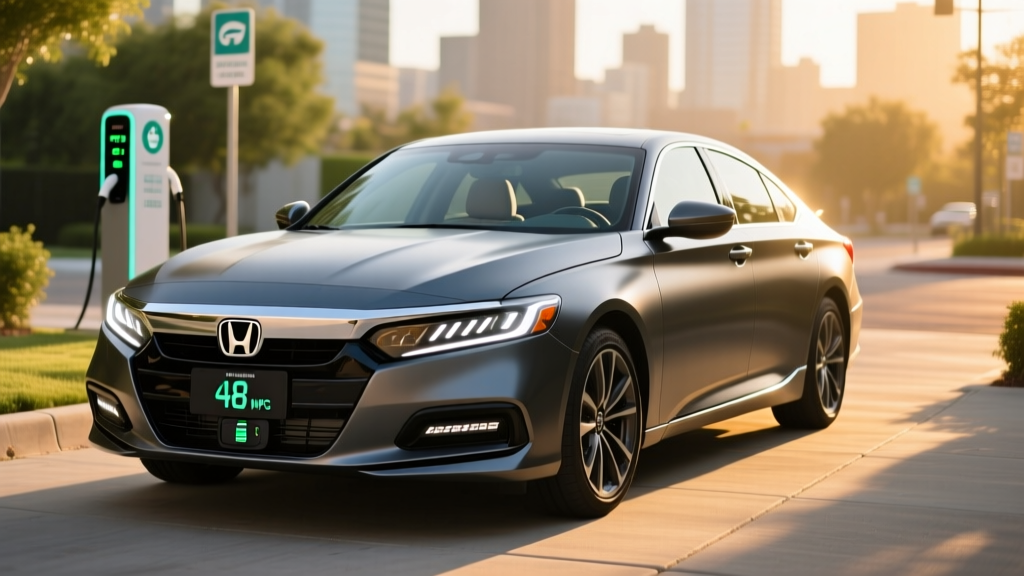
The 2025 Honda Accord EX-L Hybrid occupies a specific niche: a midsize sedan that delivers exceptional city fuel economy without requiring a plug, a charging routine, or any change in driving habits. For buyers weighing the Accord Hybrid against plug-in hybrids and full battery-electric vehicles, the EX-L trim sits at the value sweet spot—leather upholstery, a 12.3-inch infotainment touchscreen, and Honda Sensing driver-assistance bundled into a package that starts under $36,000.
This guide breaks down the 2025 Honda Accord EX-L Hybrid's powertrain, real-world fuel economy, battery longevity, and total cost picture so you can decide whether a conventional hybrid (HEV), a plug-in hybrid (PHEV), or a full EV is the right call for your commute.
HEV vs PHEV vs EV: Where the Accord Hybrid Fits
Before examining the numbers, it is essential to distinguish the three electrified powertrain types, because Honda markets the Accord only as a conventional hybrid—there is no plug-in variant for 2025.
| Powertrain Type | Plug Required? | Electric-Only Range | Example |
|---|---|---|---|
| HEV (Conventional Hybrid) | No — regenerative braking and engine charge the small battery | ~1 mile at low speed | 2025 Accord Hybrid |
| PHEV (Plug-In Hybrid) | Yes — plug in to access 25–45 mi electric range | 25–45 miles typical | Toyota Prius Prime, Chrysler Pacifica Hybrid |
| BEV (Battery Electric) | Yes — sole propulsion source | 200–400+ miles | Tesla Model 3, Hyundai Ioniq 6 |
The Accord Hybrid is a series-parallel HEV. Its lithium-ion battery pack (approximately 1.3 kWh usable capacity) is never plugged in. Instead, the gasoline engine and regenerative braking keep it charged. You fuel it like a normal car and never think about charging infrastructure. This makes the Accord Hybrid ideal for apartment dwellers, street parkers, and anyone without reliable access to a Level 2 home charger.
Powertrain Specs: Two-Motor Hybrid System
Honda's fourth-generation two-motor hybrid system powers all 2025 Accord Hybrid trims, including the EX-L. The setup pairs a 2.0-liter Atkinson-cycle inline-four with two electric motors and an electronic continuously variable transmission (e-CVT).
| Specification | 2025 Accord EX-L Hybrid |
|---|---|
| Engine | 2.0L DOHC Atkinson-cycle I-4 |
| Engine Output | 146 hp / 134 lb-ft torque |
| Drive Motor Output | 181 hp / 247 lb-ft torque |
| Combined System Output | 204 hp / 247 lb-ft torque |
| Transmission | e-CVT (direct drive + engine clutch) |
| Drivetrain | Front-wheel drive |
| Hybrid Battery | ~1.3 kWh lithium-ion (NMC chemistry) |
| 0–60 mph | ~7.2 seconds (est.) |
| Curb Weight | ~3,488 lbs |
Most driving is done in EV Drive or Hybrid Drive mode, where the propulsion motor handles acceleration and the engine acts as a generator. At steady highway speeds (roughly 55–80 mph), a lock-up clutch connects the engine directly to the wheels for efficiency—this is Engine Drive mode. The transitions between modes are nearly imperceptible from the driver's seat.
Fuel Economy: EPA Ratings and Real-World MPG
The 2025 Accord Hybrid carries identical EPA ratings across all hybrid trims, including the EX-L:
| Driving Cycle | EPA Rating | Real-World Expectation |
|---|---|---|
| City | 51 MPG | 48–54 MPG (hybrids excel in stop-and-go) |
| Highway | 44 MPG | 39–44 MPG (engine direct-drive lessens hybrid advantage) |
| Combined | 48 MPG | 43–50 MPG depending on driving mix |
Source: fueleconomy.gov
Why City MPG Beats Highway MPG
This is a hallmark of conventional hybrids. In city driving, the engine shuts off frequently, regenerative braking recaptures energy at every stop, and the electric motor handles low-speed propulsion where gasoline engines are least efficient. On the highway, the engine runs more continuously and aerodynamic drag dominates, narrowing the gap between hybrid and non-hybrid efficiency.
In real-world mixed driving, owners on forums like AccordHybridForum and Fuelly commonly report 45–50 MPG combined, with some hypermilers exceeding the EPA city figure in warm weather. Cold-weather driving (below 35°F) can reduce fuel economy by 5–10 MPG as the engine runs more often to heat the cabin and maintain battery temperature.
Fuel Cost Comparison
At 15,000 miles per year and $3.50 per gallon (regular unleaded, which the Accord Hybrid requires):
- Accord Hybrid (48 MPG combined): ~$1,094/year in fuel
- Non-hybrid Accord 1.5T (32 MPG combined): ~$1,641/year
- Midsize gasoline SUV (25 MPG combined): ~$2,100/year
That is roughly $547 in annual fuel savings over the non-hybrid Accord, and the hybrid premium on the EX-L trim pays for itself in approximately 2–3 years of typical driving.
2025 Accord EX-L Hybrid Pricing and Tax Credit Eligibility
The 2025 Honda Accord EX-L Hybrid carries a starting MSRP of $35,690 (including destination charge). Key standard equipment on the EX-L includes:
- Leather-trimmed seats (heated front, heated rear outboard)
- 12.3-inch touchscreen with wireless Apple CarPlay and Android Auto
- Wireless phone charger
- 10-speaker audio system
- Honda Sensing suite (adaptive cruise, lane-keeping, collision mitigation, traffic sign recognition)
- Blind-spot information with rear cross-traffic alert
Federal Tax Credit: Does the Accord Hybrid Qualify?
No. The 2025 Honda Accord Hybrid is a conventional HEV and does not qualify for the federal §30D Clean Vehicle Credit (up to $7,500 for new EVs and PHEVs). The IRS restricts this credit to plug-in vehicles with a battery capacity of at least 7 kWh. The Accord Hybrid's ~1.3 kWh pack falls far short of this threshold.
Some states offer their own hybrid incentives—check your state energy office or AFDC state incentive database for current programs. However, most state incentives have also shifted toward plug-in vehicles.
Battery Warranty, Lifespan, and Replacement Cost
Hybrid battery longevity is consistently the top concern among prospective hybrid buyers. Honda addresses this with a robust warranty:
| Coverage | Term |
|---|---|
| Hybrid Battery (IMA Battery) | 8 years / 100,000 miles (10 years / 150,000 miles in CARB states*) |
| Hybrid System Components | 8 years / 100,000 miles |
| Powertrain (engine, transmission) | 5 years / 60,000 miles |
| Bumper-to-Bumper | 3 years / 36,000 miles |
*CARB states include California, Colorado, Connecticut, Maine, Maryland, Massachusetts, Minnesota, Nevada, New Jersey, New York, Oregon, Rhode Island, Vermont, Virginia, and Washington.
How Long Do Accord Hybrid Batteries Actually Last?
Honda's hybrid battery packs are designed to last the life of the vehicle under normal use. Real-world data from prior-generation Accord Hybrids (2014–2022) shows that most original batteries remain functional well past 150,000 miles with minimal capacity degradation. Unlike full EVs where a 10–15% degradation is noticeable as range loss, the Accord Hybrid's small battery is rarely cycled to its full depth—the hybrid system keeps it in a narrow state-of-charge window (roughly 40–80%), which dramatically extends cell life.
Battery Replacement Cost
If a hybrid battery does fail outside of warranty, replacement costs for the Accord Hybrid typically range from $2,000 to $4,000 for a new OEM pack installed at a Honda dealer. Refurbished or aftermarket packs are available for $1,000–$2,500. This is significantly less than EV battery replacements ($8,000–$20,000+) because the pack is small (~1.3 kWh vs. 60–100 kWh in an EV).
Driving Impressions and Daily Practicality
The 2025 Accord EX-L Hybrid drives like a well-sorted midsize sedan, not like a science experiment. The electric motor's 247 lb-ft of torque is available from near-zero RPM, giving it responsive off-the-line acceleration that feels quicker than its 7.2-second 0–60 time suggests. The e-CVT avoids the rubber-band feeling of older CVTs thanks to Honda's simulated shift points under hard acceleration.
Ride quality is composed, with a multi-link rear suspension that absorbs highway imperfections competently. Cabin noise levels are low for the segment, aided by active noise cancellation and acoustic glass.
Cargo and Interior Space
The hybrid battery pack is mounted under the rear seats, preserving the full 16.7 cubic feet of trunk space—identical to the non-hybrid Accord. The rear seatbacks fold in a 60/40 split for longer cargo. Rear legroom is a generous 40.8 inches, making this one of the most spacious midsize sedans available.
Who Should Choose the Accord Hybrid vs. a PHEV or EV?
Choose the 2025 Accord EX-L Hybrid If:
- You lack access to home or workplace charging (apartment, street parking, no garage)
- Your commute involves heavy stop-and-go traffic where hybrid efficiency shines
- You want EV-like city MPG without range anxiety or charging logistics
- You drive 15,000+ miles/year and want to minimize fuel costs without a plug
- You prefer a proven, low-complexity powertrain with strong resale value
Consider a PHEV Instead If:
- You can install a Level 2 charger at home and your daily commute is under 30 miles
- You want electric-only driving for most trips with gas backup for road trips
- You qualify for the $7,500 federal tax credit (PHEVs like the Prius Prime may qualify)
Consider a Full EV Instead If:
- You have reliable Level 2 home charging and your daily driving is under 250 miles
- You want zero tailpipe emissions and minimal maintenance (no oil changes, fewer brake replacements)
- You qualify for federal and state EV incentives that offset the higher purchase price
Pros
- 51 MPG city — among the best in the midsize sedan segment
- No plug-in required; zero lifestyle adjustment from a gas car
- Spacious interior with 16.7 cu ft trunk (no hybrid penalty)
- Strong 8-year/100,000-mile hybrid battery warranty
- Responsive low-end torque from electric motor (247 lb-ft)
- Comprehensive Honda Sensing ADAS standard
Cons
- No federal tax credit eligibility (HEV, not PHEV/EV)
- Highway MPG (44) trails city figure significantly
- FWD only — no AWD option unlike Toyota Camry Hybrid
- e-CVT lacks the engagement of a geared transmission
- Modest 204 hp — adequate but not sporty for a 3,500-lb sedan
Frequently Asked Questions
How many MPG does the 2025 Honda Accord EX-L Hybrid get?
The EPA rates the 2025 Accord Hybrid at 51 MPG city, 44 MPG highway, and 48 MPG combined. Real-world results typically fall between 43–50 MPG combined depending on your driving mix and climate. City-heavy commutes in warm weather can exceed the EPA city rating.
Does the Accord Hybrid need to be plugged in?
No. The 2025 Accord Hybrid is a conventional hybrid (HEV), not a plug-in hybrid (PHEV). Its small battery is charged by the gasoline engine and regenerative braking. You simply fill it with regular unleaded gasoline.
Is the Accord Hybrid available as a plug-in hybrid (PHEV)?
Not for the 2025 model year. Honda discontinued the previous-generation Accord Plug-In Hybrid after the 2015 model year. If you need a plug-in Honda, the Clarity PHEV was discontinued in 2021, and Honda currently does not offer a PHEV sedan in the U.S. market.
How reliable is the Accord Hybrid and what does battery replacement cost?
The Accord Hybrid has a strong reliability track record. Honda covers the hybrid battery for 8 years/100,000 miles (10 years/150,000 miles in CARB states). Most batteries last well beyond 150,000 miles. Out-of-warranty replacement runs $2,000–$4,000 for an OEM pack.
Does the 2025 Accord Hybrid qualify for any tax credit?
No federal tax credit applies. The IRS §30D Clean Vehicle Credit requires a plug-in vehicle with at least 7 kWh of battery capacity; the Accord Hybrid has ~1.3 kWh and no plug. Check your state's incentive database at afdc.energy.gov for any local hybrid rebates, though most have shifted to plug-in vehicles.
How does the Accord Hybrid compare to the Toyota Camry Hybrid?
The 2025 Toyota Camry Hybrid (redesigned for 2025) offers 51/49/50 MPG (city/highway/combined) and standard AWD, giving it a slight highway efficiency edge and an all-weather advantage. The Accord Hybrid counters with more rear legroom (40.8 vs. 38.0 inches), a larger trunk, and a more premium interior on the EX-L trim. Both are excellent choices; the decision often comes down to AWD preference vs. interior space.
What maintenance does the Accord Hybrid require?
The same routine maintenance as a gasoline Accord: oil changes (every 7,500–10,000 miles with synthetic), tire rotations, brake fluid, coolant, and air filters. Hybrids actually experience less brake wear because regenerative braking handles much of the deceleration. There is no hybrid-specific routine maintenance beyond periodic system health checks during normal service visits.