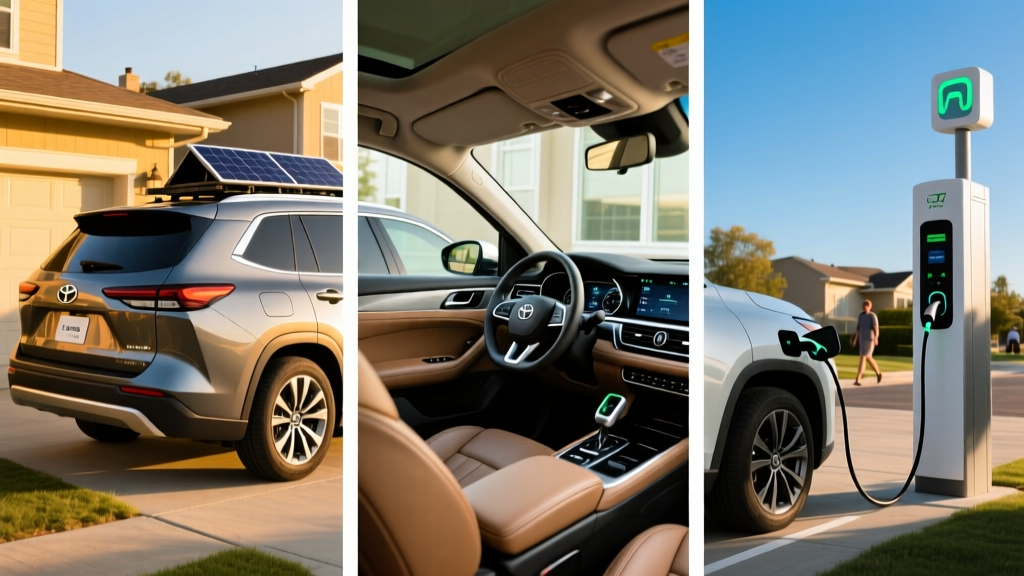
The three-row hybrid SUV segment has no shortage of contenders, but the 2025 Highlander Hybrid remains one of the most practical choices for families who want meaningful fuel savings without plugging in. Toyota pairs a 2.5-liter four-cylinder engine with a pair of electric motors in a self-charging hybrid system that delivers up to 35 MPG combined — roughly double what a comparable gas-only midsize SUV achieves. This guide breaks down the real-world efficiency, powertrain details, battery longevity, and ownership economics you need before signing on the dotted line.
HEV vs PHEV: What the 2025 Highlander Hybrid Actually Is
Before we get into the numbers, it's critical to understand what you're buying. The 2025 Toyota Highlander Hybrid is a conventional hybrid electric vehicle (HEV) — not a plug-in hybrid. That distinction matters for your daily routine and your wallet.
Conventional Hybrid (HEV) — Highlander Hybrid
- No plug, no charging cable required
- Battery recharges via regenerative braking and the gas engine
- Electric motors assist the engine; cannot drive on electricity alone for meaningful distances
- No federal EV tax credit eligibility under IRS §30D
Plug-In Hybrid (PHEV) — e.g., Toyota RAV4 Prime, Chrysler Pacifica Hybrid
- Has a larger battery (typically 12–20 kWh) and a charge port
- Can drive 25–45 miles on electric-only power before the gas engine kicks in
- Requires plug-in charging to capture the electric-range benefit
- May qualify for up to $7,500 federal tax credit if it meets §30D sourcing, MSRP, and income requirements
Toyota does not offer a Highlander PHEV (or "Highlander Prime") for the 2025 model year. If you want three-row plug-in capability from Toyota, you'd look at the Sienna (also HEV-only) or step outside the Toyota lineup entirely. The Highlander Hybrid is purely a self-charging system — you fill it with gas and drive.
Fuel Economy: EPA Ratings and Real-World MPG
The headline number for the 2025 Highlander Hybrid is 35 MPG combined on the LE trim with front-wheel drive. All-wheel drive drops that figure by one MPG across the board. Higher trims (XLE, Limited, Platinum) carry the same powertrain but may see marginal differences due to weight and wheel size.
| Drivetrain | City MPG | Highway MPG | Combined MPG |
|---|---|---|---|
| FWD (LE) | 36 | 35 | 36 |
| AWD (LE, XLE, Limited) | 35 | 34 | 35 |
Source: EPA Fuel Economy
Real-World MPG vs. EPA Sticker
Toyota's hybrid system excels in city driving, where regenerative braking and low-speed electric assist do the heavy lifting. Owners frequently report 37–39 MPG in city and suburban driving, beating the EPA city estimate. Highway driving at 70–80 MPH is a different story: expect 30–33 MPG on long interstate trips, as the gasoline engine carries more of the load at sustained high speeds. In cold weather (below 30°F), fuel economy typically drops 5–10% as the engine runs more frequently for cabin heat and battery warmup.
For a family driving 15,000 miles per year at a blended 34 MPG, you'll burn roughly 441 gallons annually. At $3.40/gallon, that's approximately $1,500/year in fuel — compared to roughly $2,550 for a gas-only three-row SUV averaging 22 MPG combined.
Powertrain and Performance Specs
The 2025 Highlander Hybrid uses Toyota's fourth-generation hybrid system, pairing a 2.5-liter inline-four Atkinson-cycle engine with two electric motor-generators (one front, one rear for AWD models) through an electronically controlled continuously variable transmission (eCVT).
| Specification | 2025 Highlander Hybrid |
|---|---|
| Engine | 2.5L 4-cylinder Atkinson-cycle |
| Combined Net Horsepower | 243 hp |
| Electric Motors | Front motor-generator + rear motor-generator (AWD) |
| Transmission | eCVT (planetary gearset) |
| Drivetrain | FWD or electronic AWD (AWD-i) |
| Hybrid Battery | ~1.6 kWh nickel-metal hydride (NiMH) |
| 0–60 MPH | ~7.9 seconds |
| Towing Capacity | 3,500 lbs |
| Seating | 7 or 8 passengers (trim-dependent) |
| Cargo (behind 3rd row) | 16.1 cu ft |
The 243 combined horsepower is adequate for family duty — merging onto highways and climbing grades won't leave you stranded, but this isn't a quick SUV. The eCVT delivers seamless, shift-free acceleration, though it can drone under heavy throttle as the engine holds at peak RPM. The AWD-i system uses the rear electric motor to send torque to the rear wheels when slip is detected; there's no mechanical driveshaft connecting the front and rear axles.
Battery Warranty, Lifespan, and Replacement Cost
Hybrid battery anxiety is the number-one concern we hear from prospective buyers. Here's what Toyota provides and what the data shows.
Toyota Hybrid Battery Warranty
- Coverage: 10 years / 150,000 miles (whichever comes first)
- What's covered: Hybrid battery pack, hybrid control module, and related components
- Applies to: 2020 and newer Toyota hybrids, including the 2025 Highlander Hybrid
- Transferable: Yes, warranty transfers to subsequent owners
The Highlander Hybrid uses a relatively small ~1.6 kWh nickel-metal hydride (NiMH) battery pack. NiMH chemistry is less energy-dense than the lithium-ion packs in full EVs, but it's proven extraordinarily durable in Toyota's hybrid lineup. The Prius taxi fleet data, spanning hundreds of thousands of miles, demonstrates that Toyota's hybrid battery management — which keeps the pack in a narrow state-of-charge window (roughly 40–80%) — minimizes degradation.
Replacement cost if out of warranty: A new OEM hybrid battery for the Highlander Hybrid currently runs $3,000–$4,500 installed at a Toyota dealer. Third-party refurbished packs are available for $1,500–$2,500. Given the 10-year/150,000-mile warranty and the track record of NiMH longevity, most owners will never face this expense.
Pricing, Trims, and Tax Credit Eligibility
The 2025 Highlander Hybrid is offered in LE, XLE, XLE Nightshade, Limited, and Platinum trims. Pricing starts around $42,000 for the LE FWD and climbs to roughly $52,000 for the Platinum AWD before destination charges and options.
| Trim | Drivetrain | MSRP (approx.) |
|---|---|---|
| LE | FWD | $42,000 |
| LE | AWD | $43,600 |
| XLE | AWD | $46,600 |
| Limited | AWD | $49,500 |
| Platinum | AWD | $52,000 |
Does the 2025 Highlander Hybrid Qualify for a Federal Tax Credit?
No. The federal §30D Clean Vehicle Credit applies only to plug-in electric vehicles (BEVs and PHEVs) with battery capacities of at least 7 kWh and that meet critical-mineral and battery-component sourcing requirements set by the IRS. The Highlander Hybrid's ~1.6 kWh NiMH pack and conventional HEV architecture make it ineligible.
Some states and utilities offer rebates for conventional hybrids, but these are increasingly rare as incentive programs shift toward plug-in vehicles. Check your state energy office or utility provider for any local hybrid incentives, but don't count on them.
2025 Highlander Hybrid vs. Three-Row PHEVs and EVs
The real question for most shoppers is whether the Highlander Hybrid is the right electrified choice, or whether a PHEV or full EV makes more sense. Here's a decision framework based on your driving patterns and charging access.
Choose the Highlander Hybrid (HEV) If:
- You can't charge at home (apartment, street parking, no garage outlet)
- You want fuel savings with zero behavior change — just gas up and go
- Your annual mileage is moderate (10,000–15,000 miles) and mostly mixed driving
- You need three rows and want a proven, low-risk powertrain
Choose a Three-Row PHEV (e.g., Kia Sorento PHEV) If:
- You can install a Level 2 home charger
- Your daily commute is under 30 miles and you want electric-only weekday driving
- You want to reduce gas consumption significantly but keep the flexibility for long road trips
- You may qualify for the §30D tax credit (check fueleconomy.gov for eligible models)
Choose a Three-Row EV (e.g., Kia EV9, Rivian R1S) If:
- You have reliable home Level 2 charging and access to DC fast-charging corridors
- You want the lowest per-mile fuel cost (electricity at $0.13/kWh ≈ $4.50 per "gallon equivalent")
- You're ready to plan charging stops on road trips and accept 20–30 minute DC fast-charge breaks
- You want maximum §30D tax credit benefit and the lowest long-term operating cost
Ownership Costs: 5-Year Estimate
Let's put real numbers behind the Highlander Hybrid's value proposition versus the gas-only Highlander and a comparable three-row EV.
| Cost Category | Highlander Hybrid AWD | Highlander Gas AWD (22 MPG) | Kia EV9 Long Range AWD |
|---|---|---|---|
| Purchase Price (MSRP) | $43,600 | $41,000 | $59,900 |
| Federal Tax Credit | $0 | $0 | Up to $7,500* |
| Fuel/Energy (5 yr, 75K mi) | $7,500 | $12,750 | $4,875 |
| Maintenance (5 yr) | $2,800 | $3,500 | $1,800 |
| Estimated Depreciation | $18,000 | $17,500 | $25,000 |
| Approx. 5-Yr Total | $35,900 | $40,750 | $41,075 |
*EV tax credit eligibility depends on income, MSRP caps, and battery sourcing rules. Verify at irs.gov.
The Highlander Hybrid saves roughly $4,850 over five years compared to the gas Highlander, primarily through fuel and maintenance reductions. The EV9 edges it out on operating costs, but the higher purchase price and steeper depreciation narrow the gap considerably — and that's before factoring in home charger installation ($500–$2,000).
Pros, Cons, and the Bottom Line
Pros
- 35 MPG combined — nearly double a gas-only three-row SUV
- No plug-in charging required; zero lifestyle adjustment
- 10-year/150,000-mile hybrid battery warranty
- Proven Toyota hybrid reliability with deep NiMH track record
- 3,500-lb towing capacity (best in hybrid three-row class)
- Strong resale value and low depreciation
Cons
- No electric-only driving capability
- No federal tax credit eligibility
- 243 hp is adequate but not brisk for a 4,500-lb SUV
- eCVT drone under hard acceleration
- Third row is tight for adults on long trips
- Infotainment system lags behind competitors in responsiveness
The 2025 Highlander Hybrid occupies a specific and valuable niche: it's the default choice for families who want three-row practicality, strong fuel economy, and the simplicity of a gas-and-go ownership experience. It won't give you the silence and instant torque of an EV, and it won't let you commute on electric power like a PHEV. But if you can't charge at home or simply don't want to think about charging, it's one of the most rational vehicles you can buy.
Frequently Asked Questions
How many MPG does the 2025 Highlander Hybrid get?
The EPA rates the AWD Highlander Hybrid at 35 MPG combined (35 city / 34 highway). The FWD LE model earns 36 MPG combined. In real-world city driving, many owners report 37–39 MPG; highway driving at 75+ MPH typically yields 30–33 MPG.
Does the Highlander Hybrid need to be plugged in?
No. The Highlander Hybrid is a conventional (self-charging) hybrid. Its small battery recharges through regenerative braking and the gasoline engine. There is no charge port and no plug-in capability.
Is there a Highlander PHEV or plug-in version?
Not for the 2025 model year. Toyota has not announced a Highlander Prime or plug-in variant. If you need a three-row Toyota with plug-in capability, no current model offers it; you'd need to look at competitors like the Kia Sorento PHEV or Mitsubishi Outlander PHEV (which has a small third row).
How long will the Highlander Hybrid battery last?
Toyota covers the hybrid battery for 10 years or 150,000 miles. Real-world data from Toyota's NiMH hybrid fleet suggests these packs routinely last 150,000–200,000+ miles with minimal degradation, thanks to the battery management system that avoids deep charge/discharge cycles. If replacement is needed out of warranty, expect $3,000–$4,500 at a dealer.
Is the Highlander Hybrid reliable?
Toyota's hybrid powertrain is among the most proven in the industry. The 2.5L Atkinson-cycle engine is under-stressed (it produces modest power and runs at efficient RPM ranges), and the eCVT has no traditional belts, clutches, or friction bands to wear out. IIHS and long-term owner surveys consistently rate the Highlander Hybrid as above-average for reliability.
Does the 2025 Highlander Hybrid qualify for any tax credit?
No federal tax credit applies. The IRS §30D Clean Vehicle Credit requires a plug-in vehicle with at least 7 kWh of battery capacity. The Highlander Hybrid's ~1.6 kWh NiMH pack doesn't qualify. Some state or utility incentives may apply — check local programs — but most hybrid-specific rebates have been phased out in favor of EV and PHEV incentives.
How does the Highlander Hybrid compare to the Sienna Hybrid?
The Toyota Sienna (minivan) uses a similar 243-hp hybrid powertrain but is standard AWD-available and achieves 36 MPG combined. It offers more interior volume and a lower step-in height but lacks the SUV styling and ground clearance some buyers prefer. If maximum passenger and cargo space is the priority, the Sienna wins on utility. If you need an SUV form factor and 3,500-lb towing, the Highlander Hybrid is the better fit.