Quick Verdict: The Three-Row Hybrid Benchmark
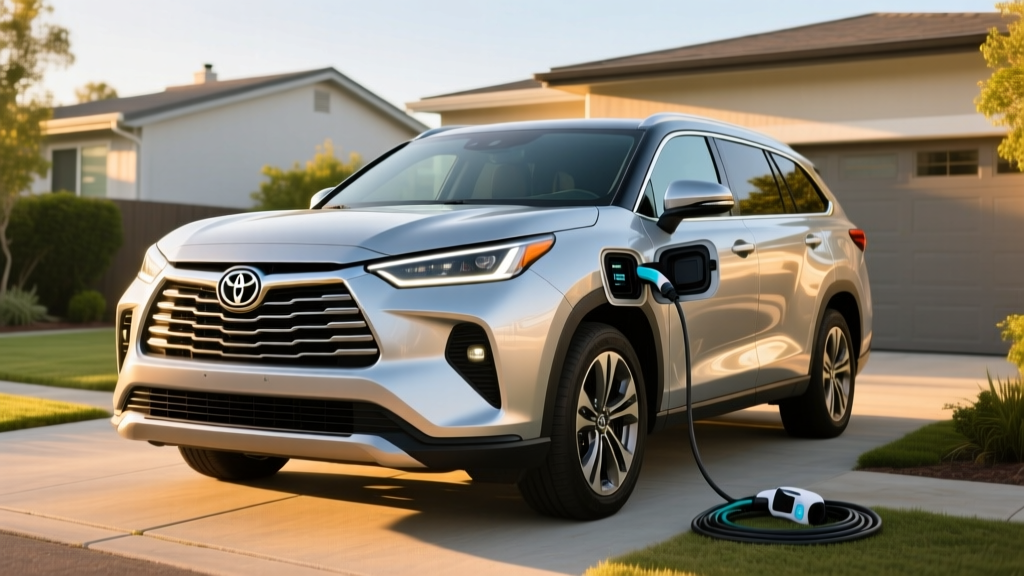
If you need three rows of seating but refuse to pay the fuel penalty of a conventional gas SUV, the 2025 Toyota Highlander Hybrid remains the default answer. With an EPA-estimated 35 MPG combined, it undercuts nearly every midsize three-row competitor at the pump — and it does so without requiring you to plug in, change your routine, or worry about charging infrastructure. For families who want electrified efficiency with zero lifestyle compromise, this is the template.
But sticker MPG and real-world MPG are rarely identical. Below, we break down what you can actually expect on your commute, the highway, and in cold weather, plus everything you need to know about the powertrain, battery longevity, and whether a full EV might serve you better.
2025 Highlander Hybrid MPG: EPA Numbers vs. Real World
The 2025 Highlander Hybrid pairs a 2.5-liter four-cylinder engine with Toyota's fourth-generation hybrid system. Here is the official EPA fuel economy breakdown by drivetrain configuration:
| Configuration | City MPG | Highway MPG | Combined MPG |
|---|---|---|---|
| FWD (LE, XLE, Limited, Platinum) | 36 | 35 | 36 |
| AWD (all trims with electronic AWD) | 35 | 34 | 35 |
Toyota's hybrid system excels in stop-and-go city driving, where regenerative braking and electric-motor assist do the heavy lifting. In mixed suburban commuting, owners routinely report 33–37 MPG in FWD models. On sustained highway trips at 70+ mph, expect 29–32 MPG — the four-cylinder engine carries more load without electric assist at steady speeds. In cold weather (below 30°F), plan for a 5–10% drop due to reduced battery efficiency and increased engine warm-up cycles.
The Highlander Hybrid's city MPG advantage over its highway figure is typical of Toyota's series-parallel hybrid architecture. At low speeds, the electric motors handle most propulsion; at highway speeds, the 2.5L engine operates more directly. This is the opposite of a conventional gas vehicle, which is always less efficient in the city.
Powertrain Specs: How Toyota's Hybrid System Delivers 243 HP
The 2025 Highlander Hybrid uses a well-proven powertrain shared across Toyota's midsize lineup:
| Specification | Detail |
|---|---|
| Engine | 2.5L DOHC 4-cylinder (186 hp / 186 lb-ft) |
| Front Electric Motor | 134 hp / 199 lb-ft |
| Rear Electric Motor (AWD) | 54 hp / 89 lb-ft |
| Net Combined System Output | 243 hp |
| Transmission | eCVT (electronically controlled continuously variable) |
| 0–60 mph | ~7.8 seconds (AWD) |
| Towing Capacity | 3,500 lbs |
| Drivetrain | FWD or electronic AWD (rear motor engages on demand) |
The eCVT is not a traditional belt-and-pulley CVT. It uses a planetary gearset to blend engine and motor power seamlessly, which is why Toyota hybrids feel smooth rather than rubbery under acceleration. The electronic AWD system is noteworthy: there is no mechanical driveshaft to the rear wheels. Instead, the rear electric motor engages independently when the system detects slip or during hard acceleration from a stop.
HEV vs. PHEV: Why the Highlander Hybrid Is a Conventional Hybrid (Not Plug-In)
A common question: can you plug in the Highlander Hybrid? The answer is no. This is a conventional hybrid electric vehicle (HEV), meaning its 1.6 kWh nickel-metal hydride (NiMH) battery charges exclusively through regenerative braking and the gasoline engine. You never plug it in, and it cannot drive on electric power alone for more than about a mile at very low speeds.
- HEV (Highlander Hybrid): No plug. Small battery (~1.6 kWh). Regenerative braking recharges it. Electric motor assists the engine but doesn't replace it. No electric-only range to speak of. MPG is the efficiency metric.
- PHEV (e.g., Toyota RAV4 Prime): Plugs in. Larger battery (~18 kWh). Can drive 25–42 miles on electric power alone before the gas engine engages. Once the battery depletes, it operates as a conventional hybrid. MPGe + MPG are the efficiency metrics.
Toyota does not currently offer a Highlander PHEV in the US market. If you want a three-row Toyota plug-in, the closest option is the Toyota Grand Highlander Hybrid (HEV, up to 36 MPG combined) or stepping outside Toyota to the Kia Sorento PHEV (32 miles electric-only, then 34 MPG combined as a hybrid).
The advantage of HEV simplicity is significant: no home charger installation, no public-charging dependency, no range planning. You refuel at any gas station and the hybrid system handles the rest. For buyers without reliable home-charging access (apartment dwellers, street parkers), this is a decisive advantage over PHEVs and BEVs.
Pricing, Trims, and Tax Credit Eligibility
| Trim | Drivetrain | MSRP (2025) |
|---|---|---|
| LE | FWD | $42,220 |
| LE | AWD | $43,820 |
| XLE | FWD | $46,070 |
| XLE | AWD | $47,670 |
| Limited | FWD | $50,470 |
| Limited | AWD | $52,070 |
| Platinum | AWD | $54,920 |
No. Under current IRS §30D rules, the federal clean vehicle credit ($3,750–$7,500) applies only to battery electric vehicles (BEVs) and plug-in hybrids (PHEVs) that meet battery-capacity, critical-mineral sourcing, MSRP cap, and buyer income requirements. Conventional hybrids like the Highlander Hybrid do not qualify for any federal purchase incentive.
Some states and municipalities offer their own hybrid incentives or HOV-lane access — check your local DMV or energy office. However, these vary widely and change frequently.
Battery Warranty, Longevity, and Replacement Cost
- Hybrid Battery: 10 years / 150,000 miles (whichever comes first)
- Hybrid System Components: 8 years / 100,000 miles
- Basic Warranty: 3 years / 36,000 miles
- Powertrain Warranty: 5 years / 60,000 miles
The Highlander Hybrid uses a nickel-metal hydride (NiMH) battery pack — not the lithium-ion chemistry found in EVs. NiMH is less energy-dense but extremely durable and well-understood. Toyota has been refining this technology since the original Prius in 1997, and real-world data consistently shows these packs lasting well beyond 150,000 miles with minimal degradation.
Toyota's hybrid battery warranty (10 years/150,000 miles) is among the strongest in the industry. If the battery does fail under warranty, replacement is covered at no cost. Out of warranty, a replacement hybrid battery pack from Toyota typically runs $3,000–$5,000 including labor at a dealership. Independent hybrid specialists often offer refurbished packs for $2,000–$3,500. For context, most Highlander Hybrids will never need a battery replacement during typical ownership.
Real-World Ownership: 5-Year Fuel Cost Savings
Here is a practical comparison of what you will spend on fuel over five years and 75,000 miles, assuming $3.50/gallon regular unleaded:
| Vehicle | Combined MPG | Gallons Used (75k mi) | 5-Year Fuel Cost |
|---|---|---|---|
| 2025 Highlander Hybrid (AWD) | 35 | 2,143 | $7,500 |
| 2025 Highlander Gas (AWD, 2.4T) | 24 | 3,125 | $10,938 |
| 2025 Kia Telluride (AWD, V6) | 21 | 3,571 | $12,500 |
The hybrid saves roughly $3,400–$5,000 over five years versus comparable gas-only three-row SUVs. If you drive more than 15,000 miles per year or live in a state with higher fuel prices (California, Washington, New York), the savings widen considerably. At 20,000 miles/year and $4.50/gallon, five-year savings over the gas Highlander jump to approximately $6,000.
Highlander Hybrid vs. Full EV vs. Gas: Which Is Right for You?
- You need three rows but want to minimize fuel costs without changing your routine
- You don't have access to home Level 2 charging (apartment, condo, street parking)
- You take frequent long road trips and don't want to plan around DC fast chargers
- You want proven reliability with a 10-year/150,000-mile battery warranty
- You tow occasionally (3,500-lb capacity is adequate for small trailers and boats)
- You have reliable home Level 2 charging
- Your daily driving is under 250 miles and you can charge overnight
- You want the $7,500 federal tax credit (subject to §30D eligibility rules)
- You prioritize instant torque, quiet operation, and near-zero maintenance
- You want to eliminate fuel costs entirely and your electricity rates are favorable
- Upfront purchase price is your primary constraint (gas models start ~$4,000 lower)
- You tow heavy loads regularly (5,000+ lbs — hybrid towing is limited to 3,500 lbs)
- You drive very few miles per year and fuel savings won't offset the hybrid premium
Pros and Cons at a Glance
- 35–36 MPG combined EPA — best-in-class for three-row SUVs
- No plugging in required — zero lifestyle change from a gas car
- 10-year/150,000-mile hybrid battery warranty
- Smooth eCVT powertrain with no traditional gear shifts
- Strong Toyota resale value and reliability track record
- Standard Toyota Safety Sense 2.5+ suite (adaptive cruise, lane keeping, AEB)
- No federal tax credit eligibility (HEV, not PHEV/BEV)
- Four-cylinder engine can sound strained under hard acceleration or when towing
- Third row is tight for adults on longer trips
- AWD towing limited to 3,500 lbs (some gas rivals tow 5,000 lbs)
- Infotainment interface lags behind competitors in responsiveness
- No PHEV variant available for electric-only commuting
Frequently Asked Questions
How many MPG does the 2025 Highlander Hybrid actually get?
The EPA rates the FWD model at 36 city / 35 highway / 36 combined, and the AWD model at 35/34/35. In real-world mixed driving, most owners see 33–37 MPG depending on conditions. Highway-only driving at 75+ mph will drop to roughly 29–31 MPG, while city-heavy commutes can push toward 38 MPG thanks to the hybrid system's regenerative braking advantage.
Does the Highlander Hybrid need to be plugged in?
No. The Highlander Hybrid is a conventional hybrid (HEV). Its battery charges through regenerative braking and the gasoline engine. You simply fill up at a gas station like any other vehicle. There is no plug, no charging cable, and no electric-only driving range to manage.
Is there a Highlander plug-in hybrid (PHEV) version?
Toyota does not offer a Highlander PHEV in the United States as of the 2025 model year. The RAV4 Prime is Toyota's only PHEV currently sold in the US. If you want a three-row plug-in hybrid, consider the Kia Sorento PHEV (32 miles electric-only, ~$51,000 MSRP) or the Mitsubishi Outlander PHEV (38 miles electric-only, ~$42,000 MSRP).
How reliable is the Highlander Hybrid battery, and what does replacement cost?
Toyota's NiMH hybrid batteries have an exceptional reliability record, with many lasting 200,000+ miles. The battery is covered by a 10-year/150,000-mile warranty. Out-of-warranty replacement runs $3,000–$5,000 at a dealership, or $2,000–$3,500 from independent hybrid specialists using refurbished packs. Battery failure before 150,000 miles is uncommon.
Does the 2025 Highlander Hybrid qualify for any tax credit?
No federal tax credit applies to conventional hybrids under current IRS §30D rules. The federal clean vehicle credit is reserved for battery electric vehicles and plug-in hybrids meeting specific battery-sourcing, MSRP, and buyer-income thresholds. Check your state energy office for any local hybrid incentives, though these are increasingly rare as states redirect funds toward BEVs.
How does the Highlander Hybrid compare to the Grand Highlander Hybrid?
The Grand Highlander Hybrid is larger (more third-row and cargo space) and offers up to 36 MPG combined in FWD form. It starts around $45,000 and uses a similar but slightly updated hybrid powertrain with 245 hp. If third-row comfort and cargo volume are priorities, the Grand Highlander is the better choice. If you want a slightly lower price and don't need maximum interior space, the standard Highlander Hybrid remains excellent. Both are HEVs with no plug-in option.