Quick Verdict: A Three-Row Hybrid That Actually Delivers
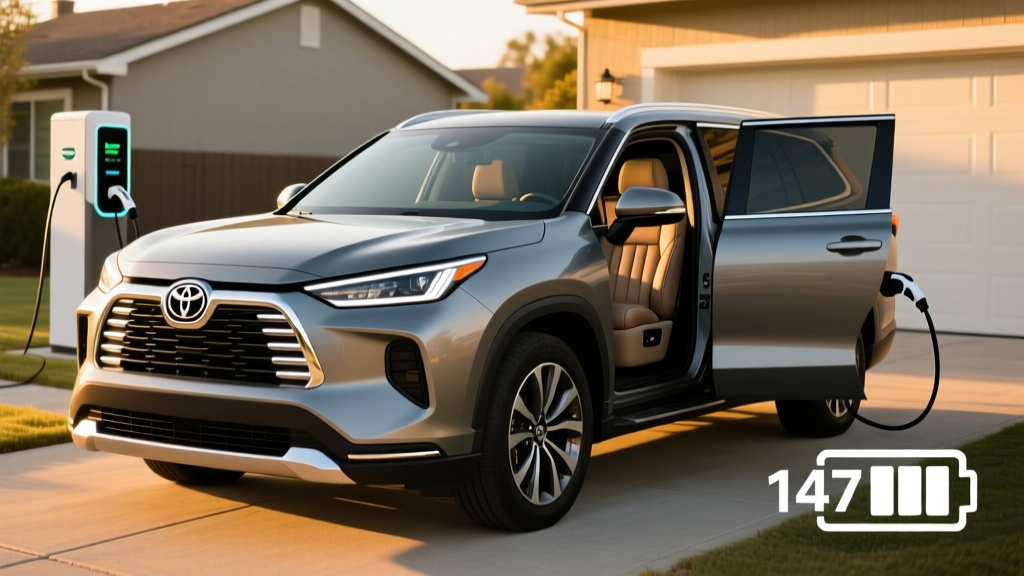
The 2025 Toyota Grand Highlander Hybrid Limited sits at the intersection of family hauler and fuel-sipper — a rare combination in the three-row SUV segment. With an EPA-estimated 36 MPG combined, standard all-wheel drive, and seating for up to seven, it undercuts nearly every competitor at the pump without requiring a plug. For buyers who want electrified efficiency but aren't ready to manage charging logistics, this is one of the most pragmatic vehicles on the market.
But the Limited trim carries a premium over the base LE Hybrid, and real-world highway driving won't always match the EPA sticker. Below, we break down every spec that matters — fuel economy, powertrain output, battery longevity, pricing, and how this conventional hybrid (HEV) compares to plug-in hybrids and full EVs for three-row family duty.
Fuel Economy: EPA Numbers vs. Real-World MPG
The 2025 Grand Highlander Hybrid is a conventional hybrid electric vehicle (HEV). It generates all its electricity from the gasoline engine and regenerative braking — there is no plug, no charging cable, and no electric-only driving mode. This is a critical distinction from plug-in hybrids (PHEVs) like the Chrysler Pacifica Hybrid or the Toyota RAV4 Prime, which offer 20–40 miles of electric-only range before the gas engine engages.
| Trim / Drivetrain | City MPG | Highway MPG | Combined MPG |
|---|---|---|---|
| LE / XLE (FWD) | 37 | 34 | 36 |
| LE / XLE / Limited (AWD-i) | 35 | 34 | 35 |
| Hybrid MAX (AWD) | 27 | 28 | 27 |
Source: fueleconomy.gov
The Limited trim comes exclusively with the 2.5-liter four-cylinder hybrid system and electronic on-demand AWD (AWD-i), yielding an EPA-estimated 35 MPG combined. That's roughly 5–6 MPG better than the non-hybrid Grand Highlander gas turbo (24 MPG combined AWD) and nearly double what a body-on-frame three-row SUV like the Chevy Tahoe delivers.
Real-World MPG: What to Actually Expect
Toyota's hybrid synergy drive system excels in stop-and-go city traffic, where the electric motor handles low-speed propulsion and regenerative braking recaptures energy. In real-world suburban and city driving, many owners report matching or slightly exceeding the 35 MPG city EPA figure — a rarity in the auto industry where EPA estimates are often optimistic.
Highway driving tells a different story. At sustained 75–80 MPH speeds, the aerodynamic profile of a large three-row SUV works against efficiency. Expect 30–33 MPG on the highway during road trips, particularly with a full load of passengers and cargo. Cold-weather driving (below 35°F) typically drops observed economy by 2–4 MPG due to increased engine idling for cabin heat and reduced battery efficiency.
Real-World Range Estimate: With a 17.9-gallon fuel tank and observed mixed-driving economy of ~33 MPG, expect approximately 540–590 miles per tank in mixed conditions. Highway-heavy road trips may yield 490–530 miles before refueling.
Powertrain Specs: Hybrid System Output and Drivetrain
The Grand Highlander Hybrid Limited uses Toyota's fourth-generation hybrid system, pairing a 2.5-liter inline-four Atkinson-cycle gasoline engine with two electric motor-generators (front and rear) and a sealed nickel-metal hydride (NiMH) traction battery.
| Specification | Value |
|---|---|
| Engine | 2.5L I4 Atkinson-cycle |
| Combined System Horsepower | 245 hp |
| Front Electric Motor | 134 hp / 199 lb-ft |
| Rear Electric Motor (AWD-i) | 54 hp / 89 lb-ft |
| Transmission | eCVT (planetary gearset) |
| Drivetrain | Electronic AWD (AWD-i) |
| 0–60 MPH | ~7.8 seconds |
| Towing Capacity | 3,500 lbs |
| Seating Capacity | 7 (standard) or 8 (bench option) |
| Cargo Volume (behind 3rd row) | 20.6 cu ft |
| Cargo Volume (all rows folded) | 97.5 cu ft |
The 245 hp combined output is adequate for family driving but not sporty. Merge onto a fast-moving freeway with a full cabin and you'll notice the engine drone as the eCVT holds high RPMs — a characteristic of planetary-gear hybrid transmissions, not a defect. The Hybrid MAX powertrain (362 hp) available on lower trims offers more punch but sacrifices fuel economy to 27 MPG combined, defeating the purpose for most hybrid buyers.
The rear electric motor provides AWD traction by powering the rear axle when slip is detected or during hard acceleration. There's no mechanical driveshaft connecting the front and rear axles — the system is entirely electronic, which reduces weight and drivetrain losses.
HEV vs. PHEV vs. Full EV: Which Three-Row Setup Fits You?
Choosing between a conventional hybrid, a plug-in hybrid, and a battery-electric vehicle (BEV) depends on your daily driving pattern, charging access, and budget. Here's how the Grand Highlander Hybrid stacks up against electrified alternatives in the three-row segment.
| Factor | Grand Highlander Hybrid (HEV) | Kia Sorento PHEV | Kia EV9 (BEV) |
|---|---|---|---|
| Plug Required? | No | Yes (Level 2 recommended) | Yes (Level 2 + DC fast) |
| Electric-Only Range | None (motor assists at low speed) | 32 miles (EPA) | 270–304 miles (EPA) |
| Combined Efficiency | 35 MPG | 79 MPGe / 34 MPG (gas) | 89 MPGe |
| Total Range | ~560 miles | ~430 miles | 270–304 miles |
| Home Charging Needed | No | Yes (240V for best experience) | Yes (essential) |
| Starting MSRP (AWD) | ~$46,000 | ~$52,000 | ~$60,000 |
| Federal Tax Credit | Not eligible (§30D BEV/PHEV only) | Up to $7,500* | Up to $7,500* |
*PHEV and BEV credit eligibility subject to IRS §30D rules including MSRP caps, buyer income limits, and battery component sourcing. Consult irs.gov and a tax professional.
Choose the Grand Highlander Hybrid (HEV) if:
- You lack reliable access to Level 2 home charging (apartment, street parking, no garage)
- You take frequent road trips exceeding 300+ miles where charging stops add friction
- You want electrified efficiency without changing any habits — just fill up with gas
- Third-row space is a priority (Grand Highlander's third row is notably roomier than the Sorento PHEV)
Choose a PHEV or full EV if:
- You have a garage or dedicated parking spot where you can install a Level 2 charger
- Your daily commute is under 30 miles (a PHEV can run entirely on electricity)
- You want to minimize or eliminate gasoline purchases and qualify for federal tax credits
- You're comfortable planning DC fast-charging stops on road trips (BEV)
Pricing and Tax Credit Eligibility
The 2025 Toyota Grand Highlander Hybrid Limited carries an MSRP starting at approximately $49,810 (including destination charge). Options like the panoramic roof, captain's chairs, and premium JBL audio can push the as-tested price past $54,000.
Because the Grand Highlander Hybrid is a conventional HEV — not a plug-in hybrid or battery-electric vehicle — it does not qualify for the federal §30D clean vehicle tax credit. That credit is reserved for BEVs and PHEVs that meet battery component and critical mineral sourcing requirements, MSRP caps ($80,000 for SUVs), and buyer income limits ($300,000 joint / $150,000 single for new vehicles).
Some states offer their own incentives for hybrid vehicles, though these are less common and typically smaller than EV incentives. Check your state's energy office or department of environmental quality for current programs. Toyota Financial Services occasionally offers lease cash or APR promotions on hybrid trims — worth checking at purchase time.
§30D Federal Tax Credit — Quick Reference:
- HEVs (like this Grand Highlander Hybrid): Not eligible
- PHEVs and BEVs: Potentially up to $7,500
- MSRP cap: $80,000 for SUVs, vans, pickups; $55,000 for sedans
- Income cap: $300K joint / $225K head of household / $150K single (modified AGI)
- Battery sourcing: Must meet critical mineral and component requirements (changes annually)
- Point-of-sale transfer: Eligible buyers can apply credit at the dealership as a down payment reduction
- Always verify current rules at irs.gov and consult a tax professional
Battery Warranty, Reliability, and Replacement Costs
Hybrid battery longevity is consistently the top concern among first-time hybrid buyers. Toyota addresses this with one of the most robust hybrid battery warranties in the industry.
2025 Toyota Hybrid Battery Warranty:
- Coverage: 10 years / 150,000 miles (whichever comes first)
- Applies to: Hybrid traction battery and all hybrid system components (inverter, motor-generators, eCVT)
- Transferable: Yes, to subsequent owners at no cost
- Capacity retention: Toyota warrants against defects and abnormal degradation; no specific percentage threshold is published (unlike EV battery warranties)
Toyota's hybrid battery track record is among the best in the industry. The Prius, now in its fifth generation, has demonstrated that Toyota's NiMH and lithium-ion hybrid batteries routinely last 150,000–200,000+ miles with minimal degradation. The hybrid system's relatively small battery (approximately 1.6 kWh usable in the Grand Highlander) undergoes shallow charge-discharge cycles — typically operating between 40% and 80% state of charge — which dramatically reduces cell stress compared to a full EV battery that cycles from 10% to 90%.
If the hybrid battery does eventually require replacement outside of warranty, expect a cost of approximately $3,000–$5,000 for a new OEM battery pack from a Toyota dealer, including labor. Refurbished or aftermarket cells may be available for $2,000–$3,500. For context, most hybrid battery failures occur well beyond the 150,000-mile warranty window, and many Toyota hybrids exceed 200,000 miles on the original battery.
Reliability data from Consumer Reports and J.D. Power consistently ranks Toyota's hybrid powertrains among the most dependable. The eCVT transmission, which uses a planetary gearset rather than belts or clutches, has virtually no wearable friction components and rarely requires service beyond standard fluid maintenance.
Safety, Tech, and Interior: The Limited Trim Advantage
The Limited trim adds meaningful features over the XLE Hybrid: ventilated front seats, a panoramic moonroof, a 12.3-inch digital gauge cluster, heated second-row seats, and Toyota's panoramic view monitor (360-degree camera). Safety tech is standardized across all trims via Toyota Safety Sense 3.0:
- Pre-Collision System with Pedestrian Detection
- Full-Speed Range Dynamic Radar Cruise Control
- Lane Departure Alert with Steering Assist and Lane Tracing Assist
- Automatic High Beams
- Road Sign Assist
- Proactive Driving Assist (gentle braking/deceleration when approaching slower traffic or curves)
The Grand Highlander earned the IIHS Top Safety Pick+ designation for the 2024 model year (the first year of production), with top marks in all crashworthiness tests. NHTSA ratings for the 2025 model year can be verified at nhtsa.gov/ratings.
One practical note: the hybrid battery is mounted under the second-row seat, which preserves cargo space and keeps the center of gravity low. There is no cargo floor hump or reduced trunk volume compared to the gas-only Grand Highlander — a packaging win.
Pros, Cons, and the Bottom Line
Pros
- 35 MPG combined AWD — best-in-class for a true three-row SUV
- No plug required — zero lifestyle change from a gas vehicle
- Genuine adult-capable third row with 20.6 cu ft cargo behind it
- 10-year / 150,000-mile hybrid battery warranty
- Strong Toyota resale value and reliability track record
- Toyota Safety Sense 3.0 standard on all trims
Cons
- No federal tax credit eligibility (HEV, not PHEV/BEV)
- 245 hp feels adequate, not quick — especially loaded with passengers
- eCVT drone under hard acceleration is noticeable
- Limited trim at ~$50K is a significant investment without luxury-badge cachet
- Highway MPG drops to ~30–33 in real-world 75+ MPH driving
- Hybrid MAX powertrain (more power) sacrifices the efficiency advantage
Frequently Asked Questions
How many MPG does the 2025 Grand Highlander Hybrid Limited get?
The EPA rates the AWD-i hybrid system at 35 MPG city / 34 MPG highway / 35 MPG combined. Real-world city driving often matches or slightly exceeds 35 MPG, while sustained highway driving at 75+ MPH typically yields 30–33 MPG.
Does the Grand Highlander Hybrid need to be plugged in?
No. This is a conventional hybrid (HEV), not a plug-in hybrid (PHEV). The battery charges entirely through the gasoline engine and regenerative braking. You fuel it like any other gas vehicle — no charging cable, no home charger installation required.
How far can the Grand Highlander Hybrid drive on electric power alone?
It cannot. The hybrid system uses the electric motor to assist the gas engine and enable brief low-speed electric-only movement (such as creeping in a parking lot), but there is no meaningful electric-only driving range. If electric-only commuting is a priority, consider a PHEV like the Chrysler Pacifica Hybrid (32 miles electric-only) or a full BEV.
Is the hybrid battery reliable, and what does replacement cost?
Toyota's hybrid batteries have an excellent longevity record, routinely lasting 150,000–200,000+ miles. The battery is covered by a 10-year / 150,000-mile warranty. Out-of-pocket replacement, if ever needed, typically runs $3,000–$5,000 for a new OEM pack.
Does the 2025 Grand Highlander Hybrid qualify for any tax credit?
It does not qualify for the federal §30D clean vehicle tax credit, which is reserved for plug-in hybrids (PHEVs) and battery-electric vehicles (BEVs). Some states may offer hybrid-specific incentives — check your state energy office. Toyota may also offer manufacturer incentives or favorable financing at purchase time.
How does the Grand Highlander Hybrid compare to the non-hybrid Grand Highlander?
The gas-only Grand Highlander 2.4L turbo AWD gets an EPA-estimated 24 MPG combined — roughly 11 MPG less than the hybrid. Over 15,000 miles per year at $3.50/gallon, the hybrid saves approximately $690 annually in fuel costs. The hybrid also delivers smoother low-speed driving thanks to electric motor torque fill. The trade-off is a higher purchase price (roughly $3,000–$4,000 more than a comparable gas trim) and slightly less peak horsepower.
Can the Grand Highlander Hybrid tow?
Yes. The standard hybrid (245 hp) is rated for up to 3,500 pounds of towing capacity — sufficient for a small boat, utility trailer, or a pair of jet skis. The Hybrid MAX variant increases towing to 5,000 pounds but drops fuel economy to 27 MPG combined.
Specifications and pricing based on Toyota's published 2025 model-year data and EPA estimates. Always verify current pricing, incentives, and tax credit rules with your local Toyota dealer, fueleconomy.gov, and irs.gov before purchasing.