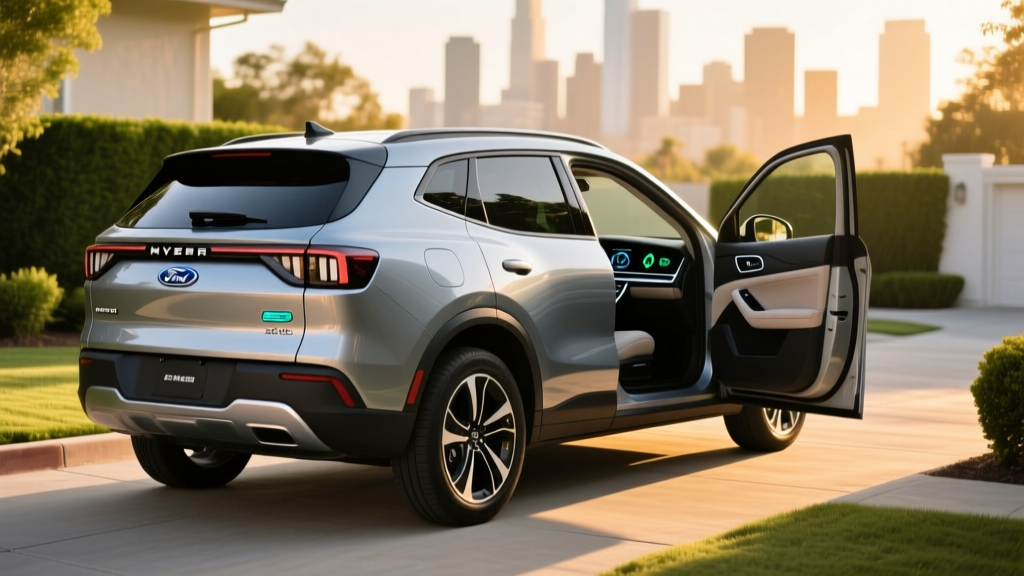
The 2025 Ford Maverick Hybrid XL remains one of the most fuel-efficient new trucks you can buy in America, pairing a compact pickup footprint with sedan-rivaling city mileage. At a starting MSRP of $28,140 (including destination), it undercuts most midsize trucks by thousands while delivering 42 MPG city on the EPA cycle. But spec sheets and real-world pavement don't always agree. This guide breaks down exactly what the Maverick Hybrid XL powertrain delivers, what you'll actually see at the pump, and whether a conventional hybrid truck makes more sense than stepping up to a plug-in hybrid or full battery-electric vehicle.
HEV vs PHEV vs EV: Where the Maverick Hybrid Fits
Before digging into the numbers, it's critical to understand what the 2025 Ford Maverick Hybrid XL is — and what it isn't. The Maverick Hybrid is a conventional hybrid electric vehicle (HEV). It has a small lithium-ion battery pack that charges exclusively through regenerative braking and the gasoline engine. There is no plug, no charging port, and no electric-only driving mode of any meaningful distance.
| Feature | HEV (Maverick Hybrid) | PHEV (e.g., Toyota RAV4 Prime) | BEV (e.g., Ford F-150 Lightning) |
|---|---|---|---|
| Plug-in charging | No — self-charging | Yes — Level 1/2 | Yes — Level 1/2/DC fast |
| Electric-only range | ~1 mi at low speed | 35–42 mi typical | 230–400 mi (full range) |
| Battery size | ~1.1 kWh | 14–18 kWh usable | 70–130 kWh usable |
| Federal tax credit (§30D) | Not eligible | Up to $7,500 if eligible | Up to $7,500 if eligible |
| Requires home charging | No | Recommended | Essential for most owners |
| Best for | No-plug buyers, city driving | Short commutes + road trips | Home-charging access, low TCO |
The Maverick Hybrid's value proposition is simplicity: you fill it with gas and drive. The hybrid system handles the rest, using the electric motor to assist acceleration, recapture braking energy, and enable engine-off coasting at low speeds. If you want plug-in electric range or full battery-electric operation, you'll need to look at vehicles like the Ford Escape PHEV or the F-150 Lightning instead.
Fuel Economy: EPA Ratings and Real-World MPG
The headline number for the 2025 Ford Maverick Hybrid XL is its EPA-estimated fuel economy. Ford pairs the hybrid powertrain exclusively with front-wheel drive (FWD); all-wheel drive is not available on the hybrid, which is a key distinction from the turbo gas model.
| Driving Cycle | EPA Estimate | Real-World Expectation |
|---|---|---|
| City | 42 MPG | 40–45 MPG (hybrids often exceed EPA in stop-and-go) |
| Highway | 33 MPG | 29–33 MPG (aerodynamic drag and sustained speed reduce hybrid advantage) |
| Combined | 37 MPG | 34–39 MPG depending on driving mix |
Why city MPG is higher than highway: Conventional hybrids recapture energy during braking and low-speed driving, where the electric motor does the most work. On the highway, the 2.5-liter four-cylinder engine runs continuously, and the hybrid system provides minimal assist. This is the opposite pattern from conventional gas vehicles, which typically get better highway mileage.
In mixed real-world driving — suburban errands, some highway cruising, and moderate climate-control use — owners commonly report 35–38 MPG combined. Heavy highway driving at 75+ MPH or frequent cold-weather short trips (where the engine runs to heat the cabin) can push that figure closer to 30–32 MPG. According to fueleconomy.gov, the Maverick Hybrid's combined 37 MPG gives it an estimated annual fuel cost of approximately $1,400 based on 15,000 miles per year and national average gas prices — roughly $600–$800 less per year than the turbocharged 2.0L gas Maverick AWD.
Powertrain Specs: What's Under the Hood
| Specification | 2025 Ford Maverick Hybrid XL |
|---|---|
| Engine | 2.5L Atkinson-cycle 4-cylinder |
| Engine horsepower | 162 HP @ 5,600 RPM |
| Electric motor output | 126 HP (94 kW) |
| Combined system output | 191 HP |
| Transmission | eCVT (planetary gearset, not a belt-driven CVT) |
| Drivetrain | Front-wheel drive (FWD only) |
| Hybrid battery | ~1.1 kWh lithium-ion (self-charging) |
| 0–60 MPH | ~7.8 seconds (est.) |
| Max towing capacity | 2,000 lbs (hybrid; 4,000 lbs with gas + 4K Tow pkg) |
| Payload capacity | ~1,500 lbs |
| Bed length | 4.5 feet (54.4 inches) |
| Fuel tank | 16.5 gallons |
| Total range (est.) | ~610 miles (at combined EPA) |
The Maverick Hybrid uses Ford's fourth-generation hybrid system, shared in concept with the Escape Hybrid. The eCVT is a power-split device — a planetary gearset that blends engine and motor output seamlessly. Unlike the rubber-belt CVTs found in some competitors, this design has no belts or cones to wear, contributing to long-term durability.
One trade-off to note: the hybrid's 2,000-lb towing capacity is half what the turbo gas Maverick achieves with the optional 4K Tow Package. If you regularly tow a small boat, utility trailer, or camper, the gas powertrain is the stronger choice. For light-duty hauling — bikes, mulch, furniture — the hybrid's payload and bed handle the work fine.
2025 Maverick Hybrid XL Pricing and Trim Value
The XL is the base trim of the Maverick Hybrid lineup, and it punches well above its price point in terms of standard equipment.
| Trim | MSRP (incl. destination) | Key Standard Features |
|---|---|---|
| XL Hybrid FWD | $28,140 | 8" touchscreen, wireless Apple CarPlay/Android Auto, Ford Co-Pilot360, LED headlights |
| XLT Hybrid FWD | $30,275 | Alloy wheels, keyless entry, rear USB ports, upgraded interior trim |
| Lariat Hybrid FWD | $33,560 | Leatherette seats, power driver seat, ambient lighting, remote start |
Options that can push the XL's price higher include the Ford Co-Pilot360 Assist package (adaptive cruise control, lane centering), the bed cargo management system, and spray-in bedliner. A well-equipped XL can land in the $31,000–$32,000 range before any incentives.
Federal and State Tax Credit Eligibility
The 2025 Ford Maverick Hybrid XL does not qualify for the federal §30D Clean Vehicle Credit. That credit — up to $7,500 — is reserved for plug-in electric vehicles (PHEVs and BEVs) that meet battery sourcing, critical minerals, MSRP cap, and buyer income requirements as defined by the IRS. Conventional hybrids like the Maverick Hybrid are excluded.
Some states offer their own incentives for hybrid vehicles, though these are less common than EV rebates. Check your state's energy or environmental agency for current programs. In most cases, the Maverick Hybrid's value comes from its low purchase price and ongoing fuel savings rather than upfront incentive reductions.
Battery Warranty, Reliability, and Replacement Cost
Ford Hybrid Battery Warranty: The Maverick Hybrid's lithium-ion battery pack is covered for 8 years or 100,000 miles (whichever comes first). In California Air Resources Board (CARB) states, that extends to 10 years or 150,000 miles. This warranty covers defects and capacity loss that causes the battery to fall below a functional threshold.
Ford's hybrid system is now in its fourth generation, and the company has accumulated well over a decade of real-world durability data from the Escape Hybrid (used extensively in taxi fleets) and the Fusion Hybrid. The 1.1 kWh battery pack is small and operates within a narrow state-of-charge window — the hybrid system never fully charges or fully depletes it, which dramatically reduces cell stress and extends lifespan.
Realistic battery replacement cost: If the hybrid battery fails outside of warranty, expect a replacement cost in the range of $2,500–$4,500 for the battery pack itself, plus labor. This is significantly less than a full EV battery replacement ($8,000–$20,000+) because the pack is much smaller. Third-party refurbishers also offer reconditioned hybrid batteries for $1,500–$2,500 in some markets.
Based on long-term data from Ford's hybrid fleet vehicles, most hybrid batteries last well beyond the warranty period. Failures before 150,000 miles are uncommon, and many taxi-fleet Escape Hybrids have exceeded 200,000 miles on the original pack.
Who Should Buy the Maverick Hybrid XL — And Who Shouldn't
Choose the 2025 Ford Maverick Hybrid XL if:
- You don't have access to home or workplace charging and can't use a plug-in vehicle
- Your driving is predominantly city and suburban, where the hybrid system delivers maximum MPG benefit
- You want a truck bed for occasional hauling but don't need heavy towing (over 2,000 lbs)
- You want the lowest possible purchase price for a new hybrid truck
- You prioritize fuel savings over all-wheel-drive capability
Look elsewhere if:
- You need AWD — the Maverick Hybrid is FWD only; the gas Maverick offers AWD
- You tow more than 2,000 lbs regularly — the gas Maverick with 4K Tow Package handles 4,000 lbs
- You want electric-only commuting — consider a PHEV like the Ford Escape PHEV or Toyota RAV4 Prime
- You want the lowest total cost of ownership and have home charging — a BEV like the Tesla Model Y or Ford F-150 Lightning (used) may save more over 5 years
- You frequently drive long highway stretches — the hybrid advantage shrinks to ~33 MPG, and a diesel or efficient gas truck may compete
Hybrid vs PHEV vs EV: Which Truck or SUV Fits Your Life?
The Maverick Hybrid occupies a specific niche: maximum efficiency for buyers who can't or won't plug in. Here's how it compares to the adjacent options in practical terms.
| Factor | Maverick Hybrid (HEV) | Compact PHEV SUV | Electric Pickup (BEV) |
|---|---|---|---|
| Example | 2025 Maverick Hybrid XL | Toyota RAV4 Prime | Ford F-150 Lightning |
| Starting MSRP | ~$28,140 | ~$44,000 | ~$55,000+ |
| Electric-only range | None (assist only) | 42 mi | 230–320 mi |
| Fuel cost per mile | ~$0.09 (gas) | ~$0.04 (electric) / $0.09 (gas) | ~$0.04 (electric) |
| Home charging needed | No | Recommended | Essential |
| Federal tax credit | None | Up to $7,500* | Up to $7,500* |
| Best 5-year TCO scenario | Low-mileage, no-plug buyers | Short commute + road trips | Home solar, high mileage |
*Tax credit eligibility depends on MSRP caps, buyer income, battery sourcing, and point-of-sale transfer rules under §30D. See IRS guidance.
For buyers cross-shopping within Ford's lineup: the Escape PHEV offers 37 miles of electric-only range and qualifies for a partial federal credit, but it's an SUV, not a truck. The F-150 Lightning delivers full electric operation with a truck bed, but at nearly double the Maverick's price and with a charging requirement that doesn't suit apartment dwellers or street-parkers.
Pros, Cons, and the Bottom Line
Pros
- 42 MPG city EPA — among the best of any new truck sold in the US
- $28,140 starting price — undercuts most compact and midsize trucks
- No plug-in charging required; works like a conventional gas truck
- Strong 8 yr / 100,000 mi hybrid battery warranty (10/150k in CARB states)
- Standard Ford Co-Pilot360 safety suite
- Useful 4.5-foot bed with 1,500-lb payload
Cons
- FWD only — no all-wheel-drive option on the hybrid
- 2,000-lb max towing (gas Maverick tows up to 4,000 lbs)
- No federal tax credit eligibility
- Highway MPG drops to 33 — less advantage on long trips
- Modest 191 HP — adequate, not quick, especially loaded
- Dealer markups have been common; availability varies by region
The 2025 Ford Maverick Hybrid XL is the right truck for buyers who need a bed, want excellent city fuel economy, and don't want to think about charging. It's not the right truck for heavy towing, off-road driving, or buyers who need AWD. If your lifestyle supports plugging in, a PHEV or BEV will deliver lower per-mile operating costs and potential tax credits — but at a higher purchase price and with charging logistics to manage.
Frequently Asked Questions
How many MPG does the 2025 Ford Maverick Hybrid XL get?
The EPA rates the Maverick Hybrid at 42 MPG city, 33 MPG highway, and 37 MPG combined. Real-world mixed driving typically yields 34–39 MPG combined, with city-heavy routes pushing toward or above the 42 MPG sticker and sustained highway driving at 75+ MPH returning closer to 29–32 MPG.
Does the Maverick Hybrid need to be plugged in?
No. The Maverick Hybrid is a conventional hybrid (HEV), not a plug-in hybrid (PHEV). Its small battery charges through regenerative braking and the gasoline engine. You simply fill the 16.5-gallon fuel tank and drive — no charging cable, no outlet, no change in routine.
Does the 2025 Maverick Hybrid qualify for any tax credit?
It does not qualify for the federal §30D Clean Vehicle Credit, which is limited to plug-in electric vehicles (PHEVs and BEVs) meeting battery sourcing and income requirements. Some states may offer separate hybrid incentives — check your state energy office. The Maverick Hybrid's savings come primarily from its low MSRP and strong fuel economy.
How long will the Maverick Hybrid battery last, and what does replacement cost?
Ford warranties the hybrid battery for 8 years / 100,000 miles (10 years / 150,000 miles in CARB states). Based on fleet data from Ford's earlier hybrid models, most packs last 150,000+ miles without significant issues. Out-of-warranty replacement costs approximately $2,500–$4,500 for the battery plus labor, with refurbished options available for less.
Can the Maverick Hybrid tow?
Yes, but with limits. The hybrid is rated for 2,000 lbs maximum towing capacity — enough for a small utility trailer, a pair of dirt bikes, or a light pop-up camper. If you need to tow up to 4,000 lbs, you'll need the gas-engine Maverick with the 4K Tow Package, which is not available on the hybrid.
Is AWD available on the Maverick Hybrid?
No. The 2025 Maverick Hybrid is front-wheel drive only. All-wheel drive is available exclusively with the 2.0L EcoBoost gasoline engine. If AWD is a requirement for snow or off-road conditions, the hybrid powertrain is not currently an option.
How does the Maverick Hybrid compare to a full EV truck?
The Maverick Hybrid costs roughly half what a Ford F-150 Lightning or Rivian R1T costs and requires no charging infrastructure. However, EV trucks offer dramatically lower per-mile energy costs (~$0.04/mi vs ~$0.09/mi), instant torque, and zero tailpipe emissions. The right choice depends on your budget, charging access, and how you use the truck. For budget-conscious buyers without home charging, the Maverick Hybrid is the more practical path.