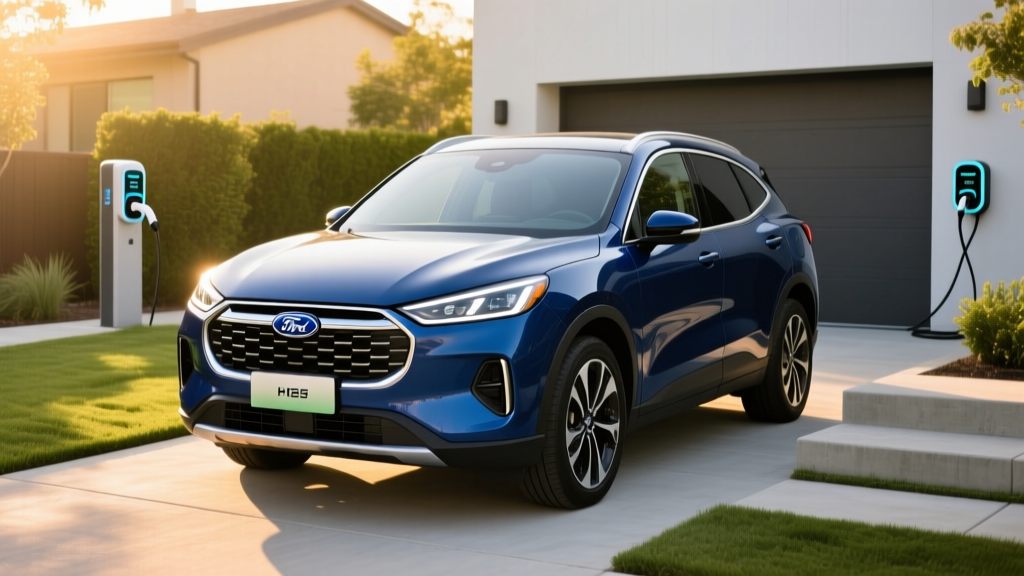
The 2025 Ford Escape PHEV occupies a narrow but practical lane: a compact crossover that handles most daily commutes on electricity alone while keeping a gas engine for longer hauls. With 37 miles of EPA-rated electric-only range and a combined 105 MPGe, it targets buyers who want EV-like city driving without committing to a charging-dependent lifestyle. But does the math work in real-world conditions, and how does it stack up against a conventional hybrid Escape or a full battery-electric alternative?
HEV vs PHEV: Which Escape Is Right for You?
Before diving into specs, it is critical to separate the two electrified Escape variants Ford offers. The conventional Escape Hybrid (HEV) uses a small battery recharged entirely through regenerative braking and the engine — you never plug it in. The Escape Plug-In Hybrid (PHEV) carries a much larger battery that you charge from a wall outlet or public station, enabling genuine electric-only driving before the gas engine kicks in.
| Feature | 2025 Escape Hybrid (HEV) | 2025 Escape PHEV |
|---|---|---|
| Plug-in required? | No — self-charging | Yes — plug in for EV range |
| Electric-only range | ~1-2 mi at low speed | 37 mi (EPA) |
| Combined MPG / MPGe | 39 MPG combined | 105 MPGe (EV+gas combined) |
| Battery capacity | ~1.1 kWh | 14.4 kWh (usable) |
| Drivetrain | AWD available | FWD only |
| Base MSRP | ~$34,490 | $40,490 |
| Federal tax credit | None | Eligible — up to $3,750* |
*Credit amount depends on current-year IRS §30D rules, battery sourcing, and buyer income. See tax credit section below.
The trade-off is straightforward: the PHEV gives you a meaningful electric commute but sacrifices all-wheel drive and costs roughly $6,000 more before incentives. If you live where winters demand AWD and you lack home charging, the conventional HEV is the more pragmatic choice.
EPA MPG, MPGe, and Real-World Efficiency
The EPA rates the 2025 Ford Escape PHEV at 105 MPGe combined when operating in electric mode and 40 MPG combined once the battery is depleted and the gas engine takes over. Here is the full breakdown from fueleconomy.gov:
| Mode | City | Highway | Combined |
|---|---|---|---|
| Electric (MPGe) | 110 | 99 | 105 |
| Gas-only (MPG) | 42 | 37 | 40 |
Real-world expectations: Hybrid and PHEV powertrains typically outperform their EPA city numbers in stop-and-go traffic because regenerative braking recaptures energy that a gas car wastes as heat. In mixed suburban driving with moderate regen use, owners commonly report 43-46 MPG after the battery depletes. Highway driving at 75+ mph, however, tends to drop to 34-36 MPG because the Atkinson-cycle 2.5-liter engine is optimized for efficiency, not high-speed power. In cold weather (below 30°F), expect electric-only range to shrink by 20-30% — roughly 26-30 miles instead of the rated 37 — because battery chemistry slows and cabin heating draws significant energy.
Electric-Only Range and Total Driving Range
The 2025 Escape PHEV's 14.4 kWh battery (usable capacity) delivers an EPA-rated 37 miles of electric-only range. For context, the average American one-way commute is roughly 16 miles according to the U.S. Census Bureau, meaning most PHEV owners can complete a round-trip commute without burning a drop of gasoline — provided they charge at home overnight.
When you combine a full battery with the 11.1-gallon fuel tank, total system range reaches approximately 430-460 miles depending on driving conditions. That eliminates the range anxiety that deters some buyers from full EVs while still delivering meaningful fuel savings for daily use.
Total Range Estimate: 37 mi (electric) + ~390-420 mi (gas at 40 MPG combined) ≈ 430-460 miles total
Powertrain and Performance Specs
| Specification | 2025 Ford Escape PHEV |
|---|---|
| Engine | 2.5L Atkinson-cycle I-4 |
| Electric motor | Permanent-magnet synchronous (integrated in transaxle) |
| Combined system output | 210 hp |
| Transmission | eCVT (planetary gearset, not a belt CVT) |
| Drivetrain | Front-wheel drive only |
| 0-60 mph | ~8.0 seconds (estimated) |
| Battery chemistry | NMC (nickel-manganese-cobalt) lithium-ion |
| Battery capacity (usable) | 14.4 kWh |
| EV-only top speed | ~85 mph |
| Cargo volume (behind 2nd row) | 34.4 cu ft |
| Towing capacity | 1,500 lbs |
The eCVT in the Escape PHEV is a power-split device using planetary gears — fundamentally different from the rubber-belt CVTs found in some competitors. This design is proven durable in millions of Toyota and Ford hybrid vehicles over two decades. The 210 combined horsepower is adequate for highway merging but not sporty; the Escape PHEV prioritizes efficiency over acceleration.
One notable limitation: AWD is not available on the PHEV variant. Ford reserves all-wheel drive for the conventional Escape Hybrid. If you need all-weather traction and electrified efficiency, you will need to weigh this carefully against competitors like the Toyota RAV4 Prime, which offers AWD with its PHEV powertrain.
Charging: Speeds, Connectors, and Home Setup
The 2025 Escape PHEV charges via a standard J1772 connector (the universal Level 1/Level 2 plug for non-Tesla EVs in North America). Here is what to expect at each charging level:
| Level | Power Source | Charge Rate | 0-100% Time | Notes |
|---|---|---|---|---|
| Level 1 | 120V household outlet | ~1.4 kW | ~10-11 hours | Adequate for overnight if you start below 50% |
| Level 2 | 240V home/public station | ~3.3 kW (onboard charger max) | ~3.5-4 hours | Recommended for daily use |
| DC Fast Charge | Public DC station | N/A | N/A | No DC fast charging capability |
Critical detail: The Escape PHEV's onboard charger is limited to 3.3 kW. Even if you plug into a 7.2 kW or 11.5 kW Level 2 station, the car will only accept 3.3 kW. This is common among PHEVs — the smaller battery simply does not need rapid charging — but it means a full charge from empty still takes about 3.5 hours on Level 2.
The lack of DC fast charging is typical for the PHEV segment. With only 14.4 kWh to fill, the infrastructure investment for DC capability adds cost without proportional benefit. Most PHEV owners charge overnight at home on Level 1 or Level 2 and never use public charging infrastructure.
Home charging cost: At the U.S. average residential electricity rate of ~$0.17/kWh (EIA, 2025), a full 14.4 kWh charge costs approximately $2.45. That powers 37 miles of electric driving — roughly equivalent to $0.066 per mile, compared to ~$0.13 per mile for a 30 MPG gas vehicle at $3.80/gallon.
Pricing, Trims, and Federal Tax Credit Eligibility
The 2025 Ford Escape PHEV is offered in a single well-equipped trim:
- Escape PHEV (base): MSRP $40,490 (including destination)
Standard equipment includes Ford Co-Pilot360 assistive technology, a 13.2-inch touchscreen with SYNC 4, wireless Apple CarPlay and Android Auto, a power liftgate, and heated front seats. Available packages add a panoramic sunroof, adaptive cruise control with stop-and-go, and a premium B&O audio system.
Federal tax credit (IRS §30D): The Escape PHEV is eligible for a partial federal tax credit — currently up to $3,750 based on the critical-minerals and battery-component sourcing requirements under the Inflation Reduction Act. The full $7,500 credit requires meeting both the critical-minerals threshold and the battery-component threshold; as of the 2025 model year, the Escape PHEV meets one of the two prongs. Per IRS §30D guidelines, eligibility also depends on:
- Buyer income caps: Modified AGI ≤ $150,000 (single) or ≤ $300,000 (joint)
- MSRP cap: Vehicle MSRP must not exceed $80,000 for SUVs (Escape qualifies)
- Point-of-sale transfer: Buyers can transfer the credit to the dealer at purchase for an immediate price reduction, rather than waiting to claim it on their tax return
- Battery sourcing: Specific critical-mineral and component sourcing thresholds tighten annually
Always verify current eligibility on the IRS Clean Vehicle credit page before purchasing, as sourcing requirements and credit amounts can shift with model-year updates. Consult a tax professional for your specific situation.
Effective price after federal credit (estimated): $40,490 − $3,750 = ~$36,740 (before state incentives, dealer discounts, or destination adjustments)
Battery Warranty, Reliability, and Replacement Cost
2025 Ford Escape PHEV Hybrid Battery Warranty:
- Coverage: 8 years / 100,000 miles (whichever comes first)
- Capacity retention threshold: Ford warrants the high-voltage battery against failure and excessive capacity loss. If the battery drops below approximately 70% of original capacity within the warranty period, Ford will repair or replace it.
- Standard powertrain warranty: 5 years / 60,000 miles
- Bumper-to-bumper: 3 years / 36,000 miles
Ford's hybrid battery track record is strong. The Escape Hybrid has been in production since the 2005 model year, and the power-split eCVT architecture is one of the most proven in the industry. Independent fleet data and owner surveys consistently show hybrid battery packs lasting 150,000-200,000+ miles before significant degradation. The 14.4 kWh pack in the PHEV is larger than the conventional hybrid's battery but operates under similar thermal management and charge-window controls that limit stress.
Battery replacement cost (out of warranty): If the high-voltage battery requires replacement beyond the warranty window, expect a dealer-installed cost in the range of $5,000-$8,000 including parts and labor. Independent hybrid-battery specialists often offer refurbished packs for $3,000-$4,500. Individual module replacement (rather than a full pack swap) can reduce costs further if only a subset of cells has degraded. According to Ford's official specs page, the PHEV battery is serviced through Ford's hybrid-certified dealer network.
General reliability: The 2025 Escape PHEV benefits from the fourth-generation Escape platform, which has seen incremental quality improvements since its 2020 redesign. The eCVT eliminates the traditional automatic transmission — one of the most common failure points in gas vehicles — and regenerative braking extends the life of friction brake pads, often lasting 80,000+ miles.
Who Should Choose the Escape PHEV — and Who Should Not?
Choose the 2025 Ford Escape PHEV if:
- Your round-trip commute is under 35 miles and you can charge at home overnight
- You want EV-like daily driving but regularly take road trips exceeding 200 miles
- You prefer a compact SUV footprint with car-like ride quality
- You want to reduce fuel costs without depending on public charging infrastructure
- You live in a mild climate where FWD is sufficient year-round
Consider alternatives if:
- You need AWD — look at the Escape Hybrid (HEV), Toyota RAV4 Prime, or Subaru Crosstrek Hybrid
- Your commute exceeds 40 miles one-way — a longer-range PHEV or full EV may serve you better
- You want DC fast charging for public-station convenience — consider a full BEV like the Hyundai Ioniq 5 or Tesla Model Y
- You cannot charge at home or at work — a conventional HEV avoids the wasted investment in a battery you cannot fill
Pros
- 37-mile EV range covers most daily commutes
- 40 MPG combined after battery depletion is genuinely efficient
- No range anxiety — 430+ miles total system range
- Proven eCVT powertrain with strong long-term reliability data
- Eligible for partial federal tax credit (up to $3,750)
- Quiet, smooth electric-mode driving in city traffic
Cons
- FWD only — no AWD option
- 3.3 kW onboard charger limits Level 2 speed
- No DC fast charging capability
- Premium over conventional Escape Hybrid (~$6,000 before credit)
- Cargo space slightly reduced vs. gas Escape due to battery placement
- Cold-weather EV range drops 20-30%
Frequently Asked Questions
How many MPG does the 2025 Ford Escape PHEV get?
The EPA rates it at 105 MPGe combined in electric mode and 40 MPG combined (42 city / 37 highway) after the battery is depleted. In real-world suburban driving, many owners report 43-46 MPG in gas-only mode thanks to regenerative braking. Highway-only driving at higher speeds will return closer to 34-36 MPG.
How far can the 2025 Escape PHEV go on electric only?
The EPA rates it at 37 miles of electric-only range. In mild weather (50-80°F) with moderate driving, you can expect 34-38 miles. In freezing temperatures with cabin heat running, expect 26-30 miles. Highway speeds above 65 mph also reduce electric range because the motor works harder against aerodynamic drag.
Hybrid vs PHEV vs EV — which fits my lifestyle?
A conventional hybrid (HEV) is best if you cannot charge at home and want better MPG with zero behavioral change. A PHEV like the Escape PHEV is ideal if you can charge at home, have a commute under 35 miles, and want EV-like daily driving with gas-engine backup for road trips. A full EV (BEV) makes sense if you have reliable home charging, rarely drive more than 250 miles in a day, and want to eliminate gasoline entirely. The PHEV is the bridge between the two — lower risk than a BEV, greater savings potential than an HEV.
Is the Escape PHEV reliable, and what does battery replacement cost?
Ford's hybrid powertrain is among the most proven in the industry, with two decades of Escape Hybrid production. The high-voltage battery is warranted for 8 years/100,000 miles, and real-world data suggests these packs routinely last 150,000-200,000+ miles. Out-of-warranty replacement costs range from $5,000-$8,000 at a dealer, or $3,000-$4,500 through independent hybrid specialists.
Does the 2025 Escape PHEV qualify for a federal tax credit?
Yes, it is eligible for a partial credit of up to $3,750 under IRS §30D, subject to the buyer's income (≤$150K single / ≤$300K joint), the vehicle's MSRP cap ($80K for SUVs — the Escape qualifies), and current battery-sourcing requirements. The credit can be transferred to the dealer at point of sale for an immediate price reduction. Verify current eligibility on the IRS Clean Vehicle page and consult a tax professional before purchasing.
Can I charge the Escape PHEV at a Tesla Supercharger?
Not directly. The Escape PHEV uses a J1772 connector for Level 1 and Level 2 charging. Tesla Superchargers use the NACS connector. While adapters exist (J1772-to-NACS), the Escape PHEV does not support DC fast charging, so even with an adapter, it cannot use Supercharger stalls, which are DC-only. You can use any public Level 2 J1772 station — ChargePoint, EVgo, Blink, and similar networks.
How much does it cost to charge the Escape PHEV at home?
At the U.S. average electricity rate of ~$0.17/kWh, a full 14.4 kWh charge costs about $2.45 and delivers 37 miles of range. Over a year of 12,000 miles with 70% electric-mode driving, annual electricity cost is roughly $390, compared to ~$1,140 in gasoline for a 25 MPG vehicle at $3.80/gallon — a savings of approximately $750 per year.