Quick Verdict: The Escape Hybrid's Efficiency, By the Numbers
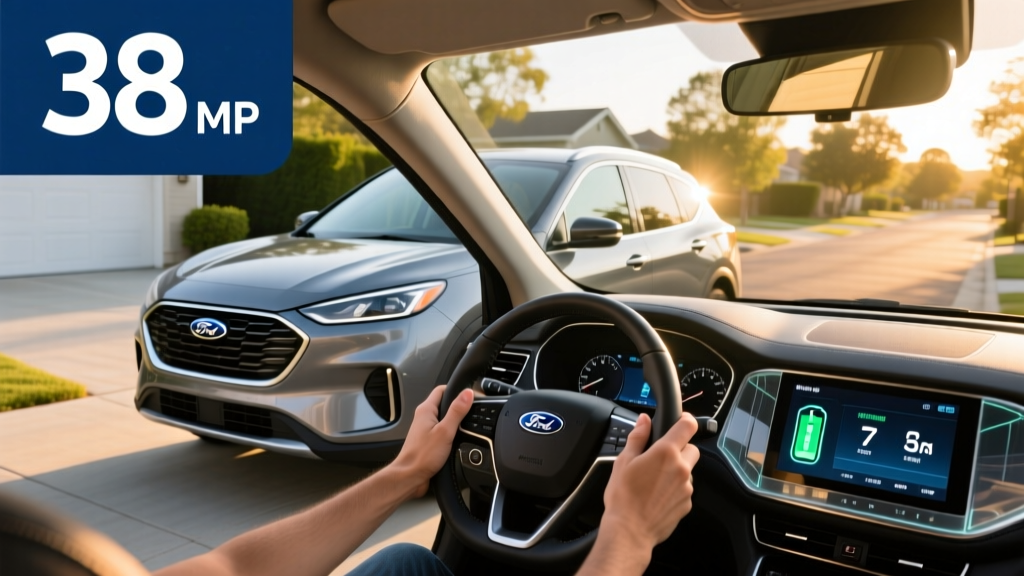
The 2025 Ford Escape Hybrid remains one of the most fuel-efficient compact SUVs on the market, delivering an EPA-estimated 42 MPG city / 36 MPG highway / 39 MPG combined in front-wheel-drive form. For buyers searching for the 2025 Ford Escape Hybrid MPG figures, those numbers translate to roughly 550 miles of total range from a single 14.2-gallon tank — fewer fuel stops, lower running costs, and zero plug-in infrastructure required.
Ford also offers the Escape Plug-In Hybrid (PHEV), which adds 37 miles of electric-only driving and a combined MPGe of 105. We cover both powertrains in detail below, including real-world MPG observations, battery longevity, warranty coverage, and whether you should choose the HEV, the PHEV, or go full EV.
HEV vs PHEV: Which Escape Hybrid Is Right for You?
| Attribute | 2025 Escape Hybrid (HEV) | 2025 Escape Plug-In Hybrid (PHEV) |
|---|---|---|
| Powertrain Type | Self-charging hybrid — no plug | Plug-in hybrid — charges via outlet/charger |
| Engine | 2.5L Atkinson-cycle 4-cyl + electric motor | 2.5L Atkinson-cycle 4-cyl + electric motor |
| Combined Horsepower | 192 hp | 210 hp |
| Battery Capacity | 1.1 kWh (nickel-metal hydride) | 14.4 kWh (lithium-ion) |
| EPA Combined MPG / MPGe | 39 MPG | 40 MPG (gas) / 105 MPGe (combined) |
| Electric-Only Range | N/A | 37 miles |
| Total Range | ~554 miles | ~520 miles (gas + electric) |
| DC Fast Charging | No | No — Level 2 AC only |
| Level 2 Charge Time (0–100%) | N/A (regenerative only) | ~3.5 hours at 240V / 32A |
| Level 1 Charge Time (120V) | N/A | ~10–12 hours |
| Base MSRP | ~$33,000 | ~$40,000 |
The distinction matters: the conventional hybrid (HEV) never plugs in. It recharges its small battery through regenerative braking and the gasoline engine. The plug-in hybrid (PHEV) has a much larger battery that you charge at home or at a public Level 2 station, giving you a meaningful electric-only commute before the gas engine ever starts.
Fuel Economy Breakdown: EPA Estimates vs Real-World MPG
Here's the full EPA-estimated fuel economy picture for every 2025 Escape Hybrid configuration, sourced from fueleconomy.gov:
| Trim / Drivetrain | City MPG | Highway MPG | Combined MPG | Annual Fuel Cost* |
|---|---|---|---|---|
| HEV FWD | 42 | 36 | 39 | ~$1,550 |
| HEV AWD | 42 | 36 | 39 | ~$1,550 |
| PHEV FWD (gas only) | 42 | 38 | 40 | ~$1,500 |
| PHEV FWD (electric + gas) | 105 MPGe combined | ~$900 | ||
*Based on 15,000 miles/year at $3.50/gallon regular unleaded. PHEV cost assumes regular home charging.
Real-World MPG: What Owners Actually Report
The Escape Hybrid's Atkinson-cycle engine and generous regenerative braking mean real-world city MPG often exceeds the EPA estimate. In mixed suburban driving with frequent stops, owners on Fuelly and Edmunds report averages between 40–45 MPG in warm weather. Highway driving at 70+ MPH tends to drop to 33–36 MPG due to aerodynamic drag — a common trait for all hybrid SUVs.
In cold weather (below 30°F), expect a 5–10% reduction as the engine runs more frequently for cabin heat and battery conditioning. That still puts winter city MPG around 37–40, which is exceptional for a compact SUV.
Powertrain Deep Dive: How the Escape Hybrid Makes Its Power
Both hybrid variants use Ford's 2.5-liter inline-four Atkinson-cycle engine paired with an electric motor integrated into the eCVT (electronically controlled continuously variable transmission). The eCVT is not a belt-driven CVT — it uses a planetary gearset that blends engine and motor torque seamlessly, which is why hybrid Escapes feel smooth rather than rubber-bandy under acceleration.
| Specification | HEV | PHEV |
|---|---|---|
| Engine | 2.5L iVCT Atkinson I-4 | 2.5L iVCT Atkinson I-4 |
| Engine Output | 163 hp / 155 lb-ft | 163 hp / 155 lb-ft |
| Electric Motor Output | 131 hp | 143 hp |
| Net Combined Horsepower | 192 hp | 210 hp |
| Transmission | eCVT (planetary gearset) | eCVT (planetary gearset) |
| 0–60 MPH (est.) | ~7.5 sec | ~7.0 sec |
| Drivetrain Options | FWD or AWD | FWD only |
| Towing Capacity | 1,500 lbs | 1,500 lbs |
The PHEV's larger electric motor and higher-voltage battery give it a modest performance edge, particularly in EV mode where acceleration is instant and silent. However, the PHEV is available only in front-wheel drive — if you need AWD, the conventional HEV is your option.
PHEV Electric-Only Range and Charging Details
The 2025 Escape PHEV's 14.4 kWh lithium-ion battery pack delivers an EPA-estimated 37 miles of electric-only range. That covers most daily commutes and errands without burning a drop of gasoline. When the battery depletes, the vehicle seamlessly transitions to hybrid mode at 40 MPG combined.
Charging the Escape PHEV is straightforward but limited to AC power:
| Charging Level | Voltage / Amperage | Power (kW) | 0–100% Time | Miles Added per Hour |
|---|---|---|---|---|
| Level 1 (household outlet) | 120V / 12A | ~1.4 kW | ~10–12 hours | ~3–4 mi/hr |
| Level 2 (home/public AC) | 240V / 32A | ~7.7 kW (vehicle-limited) | ~3.5 hours | ~11 mi/hr |
| DC Fast Charging | Not supported | N/A | N/A | N/A |
The Escape PHEV does not support DC fast charging — a common limitation in this segment. The onboard charger caps at roughly 7.7 kW, so even if you plug into a 48A Level 2 station, the vehicle won't accept more than 32A. For overnight home charging, a standard 240V outlet (like a dryer circuit) with a Level 2 EVSE fully replenishes the battery before morning.
Pricing, Trims, and Tax Credit Eligibility
The 2025 Escape Hybrid lineup starts around $33,000 MSRP for the base HEV FWD, climbing to approximately $40,000 for the PHEV in its available Premium trim. Ford typically restricts the hybrid powertrain to mid-and-upper trims (ST-Line Select, ST-Line Elite, Premium), so the entry-level S and Base trims are gas-only.
Federal Tax Credit: What You Need to Know
- HEV (conventional hybrid): Does not qualify for the federal §30D Clean Vehicle Credit. That credit applies only to plug-in vehicles with a battery capacity of at least 7 kWh.
- PHEV: May qualify for up to $7,500 under §30D, but eligibility depends on multiple conditions that change frequently.
- MSRP cap: SUVs must be under $80,000 MSRP — the Escape PHEV clears this easily.
- Income cap: Modified adjusted gross income must not exceed $150,000 (single) / $300,000 (joint).
- Battery sourcing & critical minerals: A percentage of battery components must be manufactured or assembled in North America, and critical minerals must be sourced from the U.S. or a free-trade-agreement country. These thresholds increase annually — consult the IRS §30D guidance for current-year requirements.
- Point-of-sale transfer: As of 2024, you can transfer the credit to the dealer at purchase, reducing the sale price directly rather than waiting for a tax refund.
Given the annual tightening of sourcing rules, always verify eligibility on the IRS website or with a tax professional before relying on the credit in your purchase math.
Battery Longevity, Reliability, and Replacement Costs
Hybrid battery anxiety is common among first-time hybrid buyers, but the data is reassuring. Ford's eCVT-based hybrid system (shared with the Maverick Hybrid and Lincoln Corsair) has proven reliable since its introduction, with no widespread battery-failure campaigns.
The HEV's 1.1 kWh NiMH battery is small and shallow-cycled — it never fully charges or fully depletes, which dramatically reduces wear. These packs routinely last 150,000–200,000+ miles with minimal degradation. The PHEV's 14.4 kWh lithium-ion pack experiences deeper cycles but benefits from active thermal management and a conservative usable buffer.
Replacement Cost Estimates
If a hybrid battery does fail outside warranty:
- HEV battery replacement: Approximately $2,500–$4,000 including labor. Third-party remanufactured packs are available for less.
- PHEV battery replacement: Approximately $8,000–$12,000 at a dealership, reflecting the larger lithium-ion pack. Refurbished options may reduce this over time.
For context, a conventional automatic transmission replacement on a gas vehicle often costs $3,000–$5,000 — and the hybrid system eliminates the traditional transmission entirely.
The 2025 Escape carries favorable reliability ratings. Check NHTSA for any active recalls and IIHS for crash-test performance, as the Escape has historically performed well in moderate overlap and side-impact testing.
Escape Hybrid vs Full EV vs Gas: Decision Framework
Choose the Escape HEV if:
- You want maximum MPG with zero lifestyle change — no plug, no app, no charging planning
- Your budget is under $36,000
- You drive a mix of city and highway and want 500+ miles between fill-ups
- You need AWD for snow or rain
Choose the Escape PHEV if:
- Your daily round-trip commute is under 35 miles and you can charge at home
- You want near-EV daily driving with gas flexibility for road trips
- You can access the §30D tax credit, narrowing the price gap with the HEV
Choose a full EV (like the Ford Mustang Mach-E or Hyundai Ioniq 5) if:
- You have reliable home Level 2 charging
- Your typical trips fall within 250–300 miles, or you're willing to plan DC fast-charging stops
- You want the lowest per-mile energy cost (electricity at $0.13/kWh ≈ $4.00 per 100 miles vs ~$9.00 for the HEV)
- You want to eliminate oil changes and spark plugs entirely
Pros
- Best-in-class city MPG for a compact SUV (42 EPA)
- Real-world MPG often exceeds EPA in stop-and-go driving
- No plug-in required — works with existing gas-station infrastructure
- Smooth eCVT with no shift shock or turbo lag
- Strong 8-year/100k-mile hybrid battery warranty
- AWD available on HEV
Cons
- Highway MPG drops noticeably at 75+ MPH
- Hybrid trims start at mid-range pricing (~$33K+)
- HEV does not qualify for federal EV tax credit
- PHEV lacks DC fast charging
- PHEV is FWD only — no AWD option
- Modest 1,500-lb towing capacity
Frequently Asked Questions
How many MPG does the 2025 Ford Escape Hybrid get?
The 2025 Ford Escape Hybrid (HEV) earns an EPA-estimated 42 MPG city, 36 MPG highway, and 39 MPG combined in both FWD and AWD configurations. Real-world city driving often yields 40–45 MPG thanks to regenerative braking. The PHEV version achieves 42/38/40 MPG on gasoline and 105 MPGe when using its electric range.
How far can the Escape PHEV go on electric only?
The 2025 Escape Plug-In Hybrid delivers an EPA-estimated 37 miles of electric-only range on a full charge of its 14.4 kWh battery. This covers most daily commutes without engaging the gasoline engine. After the battery is depleted, it operates as a conventional hybrid at 40 MPG combined.
Does the 2025 Ford Escape Hybrid qualify for a tax credit?
The conventional HEV does not qualify for the federal §30D Clean Vehicle Credit — that credit requires a plug-in vehicle with at least 7 kWh of battery capacity. The Escape PHEV may qualify for up to $7,500, subject to income limits, MSRP caps, and battery-sourcing requirements that change annually. Check the IRS Clean Vehicle Credit page for current eligibility rules.
Is the Ford Escape Hybrid reliable, and what does battery replacement cost?
Ford's 2.5L hybrid powertrain has demonstrated strong reliability since its introduction across multiple models. The HEV battery is covered for 8 years/100,000 miles (10 years/150,000 in CARB states). Out-of-warranty HEV battery replacement runs approximately $2,500–$4,000; PHEV replacement is roughly $8,000–$12,000. Most hybrid batteries last well beyond 150,000 miles.
Do I need to plug in the Escape Hybrid?
No. The conventional Escape Hybrid (HEV) never needs to be plugged in. It charges its small battery through regenerative braking and the gasoline engine. Only the Escape Plug-In Hybrid (PHEV) benefits from plugging in — and even the PHEV operates perfectly as a regular hybrid if you never charge it.
Should I get the Escape Hybrid or a full electric SUV?
If you lack reliable home charging or frequently drive more than 300 miles without stopping, the Escape Hybrid offers flexibility and excellent MPG with zero infrastructure requirements. If you can charge at home and your daily driving stays under 250 miles, a full EV like the Mustang Mach-E or Hyundai Ioniq 5 will deliver lower per-mile energy costs, stronger acceleration, and near-zero routine maintenance.