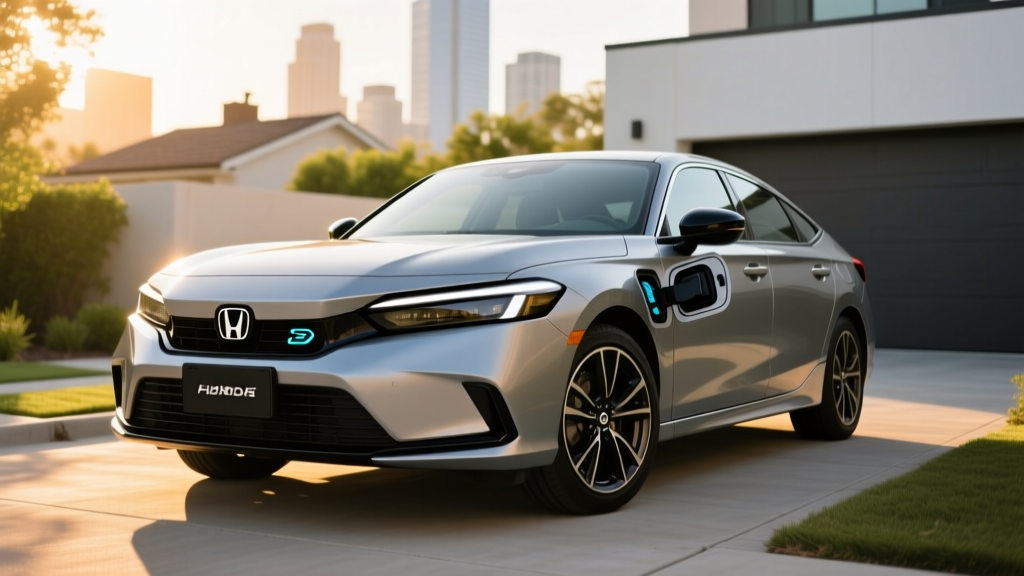
Quick Verdict: Honda's Most Complete Civic Yet
The 2025 Civic Sport Touring Hybrid sits at the top of Honda's compact hybrid lineup, pairing a 200-horsepower two-motor hybrid system with a 49/47/50 MPG EPA city/highway/combined rating. At $32,750 MSRP (including destination), it undercuts most compact crossover hybrids while delivering more usable power and a more refined cabin than its non-hybrid siblings. For buyers who want EV-like city efficiency without plug-in infrastructure, this is one of the most compelling conventional hybrids on the market.
| Spec | Value |
|---|---|
| Powertrain | 2.0L Atkinson-cycle 4-cyl + two-motor hybrid system |
| Combined Horsepower | 200 hp |
| Combined Torque | 232 lb-ft (electric motor) |
| EPA Fuel Economy | 50 city / 47 highway / 49 combined MPG |
| Drivetrain | Front-wheel drive (FWD) |
| 0–60 mph | ~7.2 seconds (est.) |
| Cargo Volume | 14.8 cu ft (trunk) |
| Base MSRP | $32,750 (incl. $1,150 destination) |
| Hybrid Battery Warranty | 8 years / 100,000 miles |
| Federal Tax Credit | Not eligible (§30D requires plug-in capability) |
HEV vs. PHEV: What the Civic Sport Touring Hybrid Actually Is
A common point of confusion in hybrid shopping is the difference between a conventional hybrid (HEV) and a plug-in hybrid (PHEV). The 2025 Civic Sport Touring Hybrid is an HEV — it has a small lithium-ion battery (approximately 1.0 kWh usable capacity) that charges exclusively through regenerative braking and the gasoline engine. You never plug it in.
| Feature | Conventional Hybrid (HEV) | Plug-In Hybrid (PHEV) |
|---|---|---|
| Plug-in charging | No — self-charging via regen + engine | Yes — Level 1/2 AC charging |
| Battery size | ~1–2 kWh | ~10–25 kWh |
| Electric-only range | Less than 1 mile at low speed | 20–50 miles typical |
| Fuel economy (charge-depleted) | 40–55 MPG combined | 25–45 MPG combined (gas-only mode) |
| Federal tax credit (§30D) | Not eligible | Up to $7,500 (if requirements met) |
| Example | 2025 Civic Sport Touring Hybrid | Toyota RAV4 Prime, Hyundai Tucson PHEV |
The trade-off is straightforward: a PHEV like the Toyota RAV4 Prime gives you 42 miles of electric-only driving before the engine kicks in, but it costs more ($44,900+), requires a dedicated charging circuit to realize its benefits, and loses efficiency once the battery depletes. The Civic Sport Touring Hybrid gives you consistently excellent fuel economy with zero behavioral change — just fill up and drive.
Fuel Economy: EPA Ratings vs. Real-World MPG
The EPA rates the 2025 Civic Sport Touring Hybrid at 50 MPG city, 47 MPG highway, and 49 MPG combined per fueleconomy.gov. These are sedan figures; the Civic Hybrid is not offered as a hatchback for 2025 with the same powertrain in all markets.
| Driving Condition | EPA Rating | Real-World Expectation |
|---|---|---|
| City | 50 MPG | 48–54 MPG (hybrids often exceed EPA in stop-and-go) |
| Highway | 47 MPG | 42–47 MPG (sustained 75+ mph reduces regen benefit) |
| Combined | 49 MPG | 45–50 MPG (mixed driving) |
| Cold weather (below 30°F) | N/A | 38–44 MPG (engine runs more for cabin heat and warmup) |
Why Hybrids Often Beat Their EPA City Rating
Honda's two-motor hybrid system operates primarily in EV mode at low speeds, with the gasoline engine acting as a generator rather than directly driving the wheels. This means city driving — with frequent stops that trigger regenerative braking — actually maximizes the hybrid system's advantage. Owners on forums and fuel-tracking apps like Fuelly consistently report 50–54 MPG in warm-weather urban commuting. Highway driving, by contrast, relies more heavily on the engine at sustained speeds where regenerative braking opportunities are minimal.
The Cold-Weather Penalty
Expect a 10–15% fuel economy reduction in winter conditions. The 2.0L Atkinson-cycle engine must run more frequently to provide cabin heat (the Civic Hybrid uses engine coolant for warmth, not a heat pump) and to maintain battery temperature. Short-trip winter driving — where the engine never fully warms up — produces the worst efficiency, sometimes dipping into the mid-30s MPG on trips under 5 miles in freezing temperatures.
Powertrain Deep Dive: 200 HP From Honda's Two-Motor System
The Civic Sport Touring Hybrid uses Honda's fourth-generation two-motor hybrid system, the same architecture found in the Accord Hybrid and CR-V Hybrid. Here is how the power flows:
- 2.0L Atkinson-cycle inline-4: Produces 146 hp and 134 lb-ft of torque, but primarily serves as a generator to charge the battery or power the electric drive motor. At highway cruising speeds, a lock-up clutch connects the engine directly to the wheels for efficiency.
- Primary drive motor: 184 hp, 232 lb-ft of torque. This motor drives the front wheels in most driving conditions, delivering the instant torque response that makes the Civic Hybrid feel quicker than its 0–60 time suggests.
- Generator motor: Works with the engine to produce electricity or acts as a starter.
- Lithium-ion battery pack: Approximately 1.0 kWh usable capacity, mounted under the rear seats. Small enough to avoid cargo compromise but sufficient to buffer energy for EV-mode driving at low speeds.
The combined system output is 200 horsepower — a significant 22-hp advantage over the non-hybrid Civic Sport Touring's 1.5L turbocharged engine (178 hp). The electric motor's 232 lb-ft of torque is available from near-zero RPM, which eliminates the turbo lag you feel in the conventional Civic and makes passing maneuvers and highway merging noticeably more confident.
Pricing, Trims, and Tax Credit Eligibility
The 2025 Civic Sport Touring Hybrid is the top trim in the Civic Hybrid lineup. Honda prices it at $32,750 including the $1,150 destination charge. Standard equipment at this trim level includes:
- Leather-trimmed seats with heated front seats
- 9-inch touchscreen with wireless Apple CarPlay and Android Auto
- Bose premium audio system (12 speakers)
- Wireless phone charger
- Honda Sensing suite (adaptive cruise control, lane-keeping assist, collision mitigation braking, road departure mitigation)
- 18-inch alloy wheels
- LED headlights and taillights
- Smart entry with walk-away auto lock
Federal Tax Credit: Not Eligible
The Civic Sport Touring Hybrid does not qualify for the IRS §30D federal tax credit. Under current IRS rules, only plug-in electric vehicles (BEVs and PHEVs with at least 7 kWh of battery capacity and plug-in charging capability) are eligible for the credit up to $7,500. As a conventional HEV, the Civic Hybrid does not meet this requirement.
Some states offer their own incentives for high-efficiency vehicles, but these vary widely by jurisdiction. Check your state's department of revenue or energy office for current programs. A few states have historically offered rebates or reduced registration fees for vehicles exceeding 45 MPG combined, but these programs change frequently.
Reliability, Battery Lifespan, and Replacement Costs
Honda's hybrid system has a strong track record dating back to the early-2000s Insight and Civic Hybrid. The fourth-generation two-motor system used in the 2025 Civic is simpler than older parallel-hybrid designs — the engine and motor operate mostly independently, reducing mechanical complexity and wear points.
Hybrid Battery Warranty
Honda covers the hybrid battery pack for 8 years or 100,000 miles, whichever comes first. In California Air Resources Board (CARB) states — which include California, New York, Massachusetts, and approximately 15 other states that follow CARB emissions rules — the warranty extends to 10 years or 150,000 miles. This covers battery capacity loss that causes a malfunction indicator or failure to hold sufficient charge for hybrid operation.
What Does Replacement Cost?
If the hybrid battery fails outside the warranty window, replacement costs typically range from $2,000 to $4,000 for parts and labor at a Honda dealership. Third-party hybrid battery specialists can sometimes refurbish or replace individual cells within the pack for $1,000–$2,000. For context, the lithium-ion hybrid battery in the Civic is far smaller and less expensive to replace than a full EV traction battery ($5,000–$20,000+). Most Honda hybrid batteries last 150,000–200,000+ miles based on long-term fleet data, with degradation manifesting as slightly reduced fuel economy rather than sudden failure.
General Reliability
The conventional components — the 2.0L engine, CVT-like direct-drive transmission, and suspension — share parts commonality with other Honda models, which supports long-term serviceability. The electric motors have no brushes or wear items. Historically, Honda hybrids have ranked well in Consumer Reports and J.D. Power reliability surveys, though individual model-year data for the 2025 Civic Hybrid is still accumulating.
Who Should Buy the Civic Sport Touring Hybrid vs. an EV or PHEV?
The Civic Sport Touring Hybrid occupies a specific niche. Here is a practical decision framework:
Choose the Civic Sport Touring Hybrid If:
- You cannot install a Level 2 home charger (apartment, street parking, landlord restrictions)
- Your daily commute is under 50 miles with mixed city/highway driving
- You want near-EV city efficiency (50+ MPG) without any plug-in requirement
- You take road trips of 300+ miles regularly and want zero range or charging-desert anxiety
- Your budget is $30,000–$35,000 and you want a well-equipped compact sedan
Choose a PHEV (e.g., Toyota Prius Prime, Hyundai Tucson PHEV) If:
- You can charge at home (Level 2, 240V) and your daily commute is under 40 miles
- You want to drive on electricity most days but need a gas engine for occasional long trips
- You want to qualify for the §30D federal tax credit (up to $7,500, subject to income/MSRP/sourcing rules)
Choose a Full EV (e.g., Tesla Model 3, Hyundai Ioniq 6) If:
- You have reliable home charging and your typical trips fit within 250–300 miles
- You want zero tailpipe emissions and minimal maintenance (no oil changes, no engine)
- You qualify for the full $7,500 §30D credit and your state offers additional EV incentives
For buyers who drive 12,000–15,000 miles per year in mixed conditions and lack access to plug-in charging, the Civic Sport Touring Hybrid's 49 MPG combined rating translates to roughly $1,100–$1,300 per year in fuel costs (at $3.30/gallon and 13,500 miles/year). A comparable non-hybrid Civic (1.5T, 33 MPG combined) would cost approximately $1,650 per year — a difference of about $400 annually, or $2,000 over five years. The hybrid premium at the Sport Touring trim is partially offset by this fuel savings, plus the additional power and smoother acceleration the hybrid system provides.
Pros, Cons, and the Bottom Line
Pros
- 49 MPG combined with no plug-in required
- 200 hp and instant electric torque — noticeably quicker than the 1.5T Civic
- Well-equipped Sport Touring trim with Bose audio, leather, and full Honda Sensing suite
- 8-year/100,000-mile hybrid battery warranty (10/150k in CARB states)
- Refined ride quality and low cabin noise for the compact segment
- No behavioral change from a gas car — fuel at any station, no charging logistics
Cons
- Not eligible for the $7,500 federal §30D tax credit
- FWD only — no AWD option for snow-belt buyers (the CR-V Hybrid offers AWD)
- Trunk space (14.8 cu ft) is slightly reduced vs. non-hybrid Civic sedan
- Highway MPG advantage over the 1.5T is modest (~47 vs ~36 MPG) — biggest gains are in city driving
- No spare tire — tire repair kit only
- Honda Sensing adaptive cruise can be overly conservative in heavy traffic
Frequently Asked Questions
How many MPG does the 2025 Civic Sport Touring Hybrid get?
The EPA rates it at 50 MPG city, 47 MPG highway, and 49 MPG combined. Real-world city driving often yields 50–54 MPG in warm weather thanks to regenerative braking. Highway driving at sustained speeds above 70 mph typically returns 42–47 MPG. Cold weather reduces efficiency by 10–15%.
Does the 2025 Civic Hybrid need to be plugged in?
No. The Civic Sport Touring Hybrid is a conventional hybrid (HEV). Its lithium-ion battery charges through regenerative braking and the gasoline engine. You fuel it like any other car at any gas station.
Does the Civic Sport Touring Hybrid qualify for a tax credit?
It does not qualify for the federal §30D clean vehicle credit, which is limited to plug-in vehicles (BEVs and PHEVs). Some states may offer incentives for high-MPG vehicles, but these vary by location and change frequently. Consult your state's energy or revenue department for current programs.
How long will the hybrid battery last?
Honda covers the hybrid battery for 8 years/100,000 miles (10 years/150,000 miles in CARB states). Based on historical data from Honda hybrid fleets, most batteries last 150,000–200,000+ miles before significant degradation. Replacement costs range from $2,000–$4,000 at a dealership, or $1,000–$2,000 through third-party hybrid specialists.
Is the hybrid faster than the regular Civic Sport Touring?
Yes. The hybrid produces 200 hp and 232 lb-ft of electric motor torque, compared to 178 hp and 177 lb-ft from the 1.5L turbo. The hybrid's 0–60 time is approximately 7.2 seconds vs. roughly 7.5 seconds for the turbo. More importantly, the electric motor's instant torque makes the hybrid feel more responsive in everyday driving, particularly from stops and during passing maneuvers.
Hybrid vs. PHEV vs. EV — which should I choose?
If you lack home charging access, the Civic Hybrid (HEV) is the clear choice — it requires zero infrastructure. If you can charge at home and your daily commute is under 40 miles, a PHEV lets you drive on electricity most days while keeping a gas engine for road trips, and may qualify for up to $7,500 in federal credits. If you have reliable home charging and your trips rarely exceed 250 miles, a full EV offers the lowest operating costs, zero tailpipe emissions, and the strongest incentive eligibility.
Does the Civic Hybrid come with AWD?
No. The 2025 Civic Sport Touring Hybrid is front-wheel drive only. If all-wheel drive is a priority, Honda offers the CR-V Hybrid with AWD (40 MPG combined), or you could consider the Toyota Prius AWD (54 MPG combined, 196 hp) as an alternative compact hybrid.
Sources: EPA Fuel Economy — 2025 Honda Civic Hybrid, Honda Civic Official Specifications, IRS §30D Clean Vehicle Credit Rules.