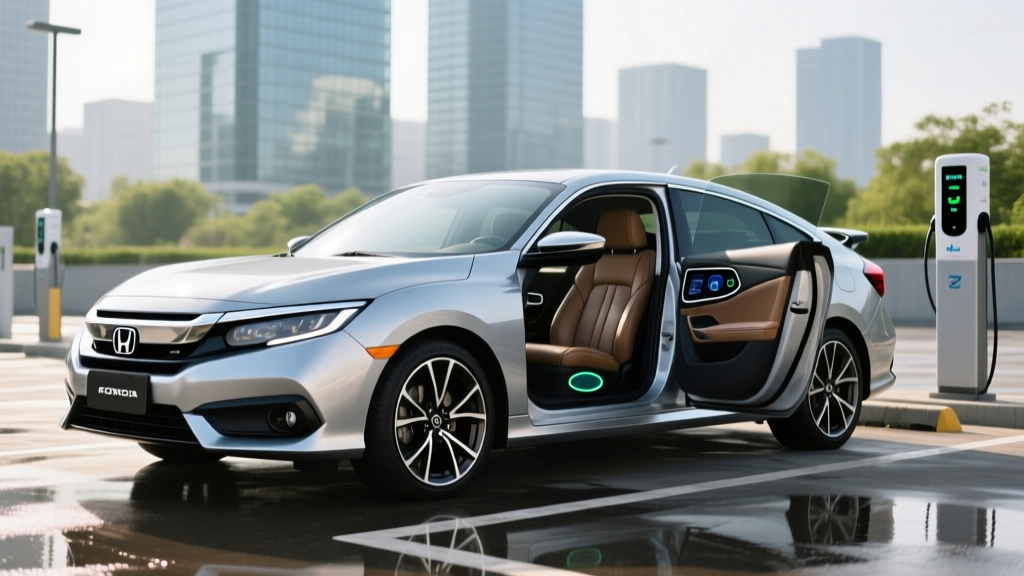
The 2025 Honda Civic Hybrid Sport Touring sits at the intersection of efficiency and everyday practicality. It delivers 49 MPG combined without ever needing a plug, pairs a two-motor hybrid system with 200 horsepower, and undercuts most plug-in hybrids and EVs on price. For buyers who want dramatic fuel savings without changing their fueling habits, this trim is one of the strongest conventional hybrid (HEV) options on the market.
This guide breaks down the real-world fuel economy you can expect, the powertrain engineering behind those numbers, battery longevity and warranty coverage, and how the Civic Hybrid stacks up against PHEVs and full battery-electric vehicles for different driving lifestyles.
2025 Civic Hybrid Sport Touring: Core Specifications
| Attribute | Specification |
|---|---|
| Powertrain Type | Conventional Hybrid (HEV) — no plug |
| Engine | 2.0L Atkinson-cycle 4-cylinder |
| Combined System Output | 200 hp / 232 lb-ft torque |
| EPA City MPG | 50 |
| EPA Highway MPG | 47 |
| EPA Combined MPG | 49 |
| Fuel Tank Capacity | 12.4 gallons |
| Total Driving Range | ~607 miles (EPA est.) |
| 0–60 mph | ~6.5 seconds (est.) |
| Drivetrain | Front-wheel drive (FWD) |
| Starting MSRP (Sport Touring) | $31,950 (incl. destination) |
| Federal Tax Credit (§30D) | Not eligible (HEV, not PHEV/BEV) |
| Hybrid Battery Warranty | 8 years / 100,000 miles (10 yr/150k in CARB states) |
Fuel Economy: EPA Sticker vs. Real-World MPG
The EPA rates the 2025 Civic Hybrid at 50 city / 47 highway / 49 combined MPG. These are among the highest numbers in the compact sedan segment, rivaling the Toyota Prius and significantly outperforming the gas-only Civic (which tops out around 36 MPG combined).
| Driving Condition | EPA Rating | Real-World Expectation |
|---|---|---|
| City / Stop-and-Go | 50 MPG | 50–55 MPG (regenerative braking excels here) |
| Highway (70+ mph) | 47 MPG | 42–46 MPG (aero drag, less regen benefit) |
| Combined | 49 MPG | 46–52 MPG depending on route mix |
| Cold Weather (below 32°F) | — | 40–45 MPG (engine runs more for cabin heat) |
Conventional hybrids like the Civic tend to exceed their EPA city rating in real-world stop-and-go driving. Honda's two-motor system can propel the car on electric power alone at low speeds, and every braking event recaptures energy. Highway driving is where you'll see slightly lower numbers — the gasoline engine carries more of the load at sustained speeds, and aerodynamic drag increases exponentially above 65 mph.
On a mixed 40-mile suburban commute with moderate temperatures, owners consistently report 48–53 MPG. In extreme cold or sustained mountain driving, expect that to drop into the low-to-mid 40s — still exceptional by any standard.
Powertrain: How Honda's Two-Motor Hybrid System Works
The 2025 Civic Hybrid uses Honda's fourth-generation two-motor hybrid system. A 2.0-liter Atkinson-cycle four-cylinder engine produces 143 hp on its own, but the combined system output with two electric motors reaches 200 horsepower and 232 lb-ft of torque.
Here's how it differs from a traditional hybrid setup:
- EV Drive: At low speeds and light loads, the propulsion motor drives the wheels using battery energy alone — the gas engine stays off.
- Hybrid Drive: Under moderate acceleration, the engine acts as a generator, feeding electricity to the propulsion motor. This is fundamentally a series-hybrid operation.
- Engine Drive: At steady highway cruising speeds, a lock-up clutch connects the engine directly to the wheels for maximum efficiency.
- Regenerative Braking: Deceleration and braking spin the motor in reverse, converting kinetic energy back into stored battery energy.
The result is seamless, responsive acceleration — the 200 hp and instant electric torque make the Civic Hybrid Sport Touring genuinely quick off the line. The 0–60 mph time of approximately 6.5 seconds puts it ahead of many turbocharged gas-only compacts. There is no traditional transmission; Honda's e-CVT manages the power split electronically with none of the rubber-band feel that older CVTs exhibited.
HEV vs. PHEV vs. BEV: Which Powertrain Fits Your Life?
The Civic Hybrid Sport Touring is a conventional hybrid (HEV). It has no plug, no electric-only range to manage, and no charging infrastructure dependency. Here's how it compares to the alternatives:
HEV vs. PHEV vs. BEV — Decision Framework
| Factor | HEV (Civic Hybrid) | PHEV (e.g., Prius Prime) | BEV (e.g., Tesla Model 3) |
|---|---|---|---|
| Needs a plug? | No | Yes (for EV range) | Yes (always) |
| Electric-only range | 0 miles (EV assist only) | 30–45 miles typical | 250–360+ miles |
| Fuel/energy cost per mile | ~$0.08–0.10 | ~$0.04 (EV) / $0.09 (gas) | ~$0.03–0.05 |
| Home charging needed? | No | Recommended | Essential |
| Upfront price premium | Low ($1,000–$2,000 over gas) | Moderate ($4,000–$7,000) | High ($5,000–$15,000+) |
| Federal tax credit (§30D) | Not eligible | Up to $7,500 (if eligible) | Up to $7,500 (if eligible) |
| Best for | No home charging, long trips, simplicity | Short commutes + road trips | Home charging, low-cost daily driving |
Choose the Civic Hybrid HEV if: You don't have access to home or workplace charging, you drive long highway miles regularly, or you want maximum simplicity with zero behavioral change from a gas car.
Choose a PHEV if: You have Level 2 charging at home and a commute under 40 miles round-trip, but you also take road trips and want gas backup.
Choose a BEV if: You have reliable home charging, want the lowest per-mile energy cost, and your daily driving plus road-trip tolerance aligns with current charging infrastructure.
Pricing, Trim Details, and Tax Credit Eligibility
The 2025 Civic Hybrid is offered in two trims. The Sport Touring is the fully loaded version:
| Trim | MSRP (incl. destination) | Key Features |
|---|---|---|
| Sport | $29,845 | Hybrid powertrain, 18" wheels, sport pedals, heated front seats |
| Sport Touring | $31,950 | All Sport features + Bose 12-speaker audio, wireless CarPlay/Android Auto, leather-trimmed seats, Honda Sensing suite, navigation, wireless phone charger |
Federal tax credit status: The Civic Hybrid does not qualify for the IRS §30D Clean Vehicle Credit. That credit applies only to plug-in vehicles (PHEVs and BEVs) meeting battery-sourcing, MSRP cap, and buyer income requirements. As a conventional hybrid with no plug, the Civic Hybrid falls outside §30D eligibility.
Some states offer rebates or reduced registration fees for hybrids, but these vary widely by jurisdiction. Check your state's energy office or Alternative Fuels Data Center state law lookup for local incentive details.
The Sport Touring's $31,950 price tag includes Honda Sensing (adaptive cruise control, lane-keeping assist, collision mitigation braking, traffic sign recognition), a 9-inch touchscreen, Bose premium audio, and wireless smartphone integration. Compared to similarly equipped compact sedans, it's competitively priced — especially when factoring in the fuel savings over ownership.
Battery Longevity, Warranty, and Replacement Costs
Hybrid Battery Warranty — What Honda Covers
Standard coverage: 8 years / 100,000 miles
CARB-state coverage: 10 years / 150,000 miles (CA, NY, MA, WA, OR, CO, and other states adopting California emissions standards)
Honda warrants the hybrid battery pack against defects and excessive capacity loss. If the battery degrades below a functional threshold during the warranty period, Honda will repair or replace it at no cost.
The Civic Hybrid uses a relatively small lithium-ion battery pack (approximately 1.0 kWh usable capacity — far smaller than a PHEV or BEV battery). This is by design: HEV batteries are shallow-cycled, meaning they rarely charge above ~80% or discharge below ~20%. This narrow state-of-charge window dramatically reduces degradation compared to batteries that undergo deep daily cycles.
Real-world longevity data: Honda's hybrid systems have proven highly durable. Third-generation Civic and Insight hybrids routinely surpass 150,000–200,000 miles on the original battery pack. Failure before 100,000 miles is uncommon based on long-term owner reports.
Replacement cost if out of warranty: A replacement hybrid battery pack for the Civic Hybrid typically costs between $2,000 and $4,000 (parts and labor) at a Honda dealer. Independent hybrid specialists may offer refurbished packs for $1,500–$2,500. This is a fraction of BEV battery replacement costs ($8,000–$20,000+), which is one reason HEVs carry lower long-term anxiety for battery-wary buyers.
Sport Touring Feature Highlights: What You Get for the Money
The Sport Touring trim consolidates Honda's best technology into a single package. Notable features include:
- Honda Sensing suite: Adaptive cruise control with low-speed follow, lane-keeping assist, road departure mitigation, collision mitigation braking, and traffic jam assist — all standard, not optional.
- Bose 12-speaker audio system: One of the better factory audio setups in the compact segment.
- Wireless Apple CarPlay and Android Auto: On a 9-inch touchscreen with physical volume knob.
- Leather-trimmed heated front seats: With 8-way power adjustment on the driver's side.
- Dual-zone automatic climate control: With rear-seat HVAC vents.
- LED headlights and taillights: With auto high-beam functionality.
What it doesn't include: all-wheel drive (FWD only), a sunroof (not offered on the Civic Hybrid), or any form of automated or hands-free driving capability. Honda Sensing is a competent SAE Level 2 driver-assistance system — it requires your hands on the wheel and eyes on the road at all times.
Pros
- 49 MPG combined — among the best in any non-plug-in vehicle
- 200 hp makes it genuinely quick and responsive
- No charging infrastructure needed — fill up at any gas station
- Sport Touring is well-equipped at $31,950
- Proven hybrid reliability with strong battery warranty
- Over 600 miles of total range per tank
Cons
- No federal tax credit (HEV, not PHEV/BEV)
- FWD only — no AWD option for snow-belt buyers
- No sunroof available on any Civic Hybrid trim
- Highway MPG drops to low 40s at 75+ mph
- Smaller trunk than gas Civic (battery packaging, ~14.8 cu ft)
- Rear seat headroom slightly reduced vs. non-hybrid
5-Year Ownership Cost Estimate
Here's how the Civic Hybrid Sport Touring stacks up on running costs versus the gas-only Civic and a comparable BEV over five years and 75,000 miles:
| Cost Category | Civic Hybrid ($31,950) | Civic Gas 1.5T ($30,550) | Comparable BEV (~$40,000) |
|---|---|---|---|
| Fuel / Energy | ~$5,400 | ~$7,800 | ~$2,600 (home charging) |
| Maintenance | ~$2,200 | ~$2,800 | ~$1,200 |
| Insurance (avg.) | ~$7,500 | ~$7,000 | ~$8,500 |
| Federal Tax Credit | $0 | $0 | Up to –$7,500 |
| Est. 5-Year Depreciation | ~$12,000 | ~$11,500 | ~$16,000 |
| Net 5-Year Cost | ~$47,050 | ~$49,650 | ~$40,800 |
The Civic Hybrid saves roughly $2,600 over the gas version over five years, primarily through fuel savings. A comparable BEV (if eligible for the full tax credit and charged primarily at home) can undercut both on total cost, but requires home charging access and a higher upfront investment. For buyers without charging infrastructure, the Civic Hybrid is the lowest-friction path to major fuel savings.
Frequently Asked Questions
How many MPG does the 2025 Civic Hybrid actually get?
The EPA rates it at 50 city / 47 highway / 49 combined. In real-world mixed driving, most owners report 46–53 MPG. City driving often exceeds the EPA rating thanks to regenerative braking; sustained highway driving at 75+ mph may drop into the low-to-mid 40s.
Does the 2025 Civic Hybrid need to be plugged in?
No. The Civic Hybrid is a conventional hybrid (HEV), not a plug-in hybrid (PHEV). It charges its small battery pack through regenerative braking and the gasoline engine. You fuel it exclusively at gas stations, just like a conventional car.
How far can the Civic Hybrid go on electric power alone?
The Civic Hybrid can drive on electric power alone for very short distances (typically under 1 mile) at low speeds (under 25 mph). It is not designed for meaningful electric-only range — that's the role of a PHEV or BEV. The hybrid system uses electric assist to boost efficiency continuously, not to replace gasoline entirely.
Is the 2025 Civic Hybrid reliable?
Honda's hybrid systems have a strong reliability track record. The two-motor architecture has fewer wear components than a traditional automatic transmission (no torque converter, no multi-speed gearset). The hybrid battery is warranted for 8 years/100,000 miles (10 years/150,000 miles in CARB states), and historical data from prior-generation Honda hybrids suggests battery packs commonly last 150,000–200,000+ miles.
What does a Civic Hybrid battery replacement cost?
Out of warranty, expect to pay approximately $2,000–$4,000 for a new OEM hybrid battery pack including labor at a Honda dealer. Refurbished or aftermarket packs from hybrid specialists may cost $1,500–$2,500. This is significantly less than a PHEV or BEV battery replacement.
Does the 2025 Civic Hybrid qualify for any tax credit?
No. The IRS §30D Clean Vehicle Credit applies only to plug-in electric vehicles (PHEVs and BEVs) that meet battery sourcing, MSRP cap, and buyer income requirements. As a conventional hybrid, the Civic Hybrid is not eligible. Some state or local incentives may apply — check your jurisdiction's energy office.
Should I buy the Civic Hybrid or wait for a PHEV Civic?
Honda has not announced a plug-in hybrid Civic for the U.S. market. If you need electric-only commuting range and have home charging, consider the Toyota Prius Prime (PHEV, ~44 miles EV range) or a compact BEV like the Chevrolet Equinox EV. If you want simplicity, no plug dependency, and excellent fuel economy today, the Civic Hybrid Sport Touring is a strong buy at its price point.