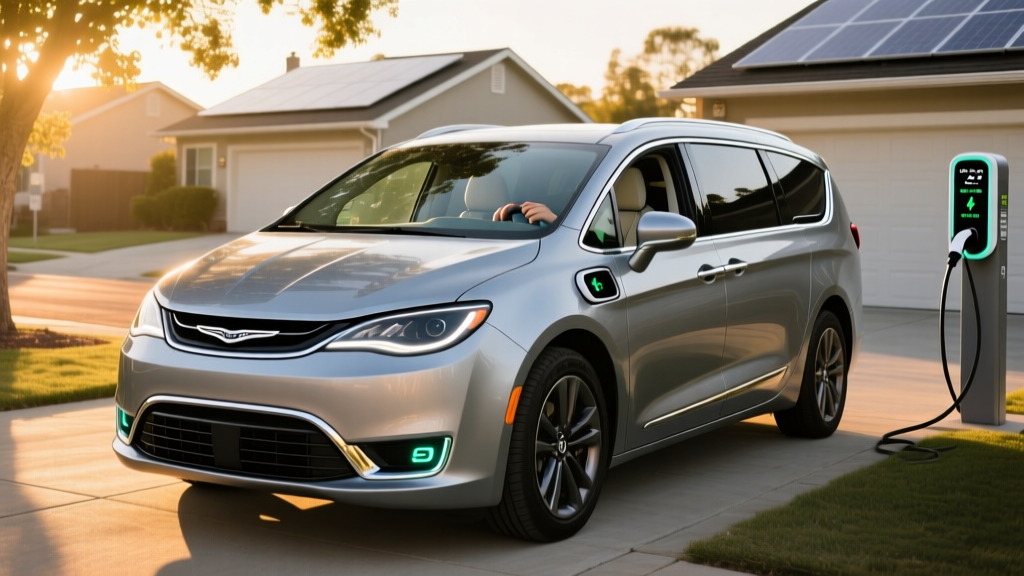
The minivan segment has exactly one plug-in hybrid option, and it's been that way for years. The 2025 Chrysler Pacifica Plug-In Hybrid occupies a unique lane: a three-row family hauler that can handle school runs and grocery trips on pure electricity, then switch to a conventional hybrid powertrain for road trips without any range anxiety. For families not ready to commit to a full battery-electric vehicle but eager to cut fuel consumption, the Pacifica PHEV remains a compelling proposition — with some important caveats around charging speed, all-electric range, and pricing that buyers need to understand before signing.
This guide covers every number that matters: EPA-verified electric range and MPGe, real-world fuel economy expectations, the 16 kWh battery system, Level 2 charging times, powertrain output, trim pricing, federal tax credit eligibility under current IRS §30D rules, and long-term battery reliability. We'll also help you decide whether this PHEV minivan, a conventional hybrid, or a full EV makes the most sense for your household.
HEV vs PHEV: Understanding the Two Pacifica Hybrid Options
Before diving into specs, it's worth clarifying what Chrysler actually sells. The 2025 Pacifica lineup includes the Pacifica Hybrid, which is a plug-in hybrid (PHEV). Chrysler previously offered a conventional hybrid variant in earlier model years, but for 2025, the electrified Pacifica is exclusively the plug-in version. That said, understanding the distinction matters because many shoppers confuse the two.
| Feature | Conventional Hybrid (HEV) | Plug-In Hybrid (PHEV) |
|---|---|---|
| Plug-in charging | No — charges via regenerative braking and engine | Yes — plug in to maximize electric miles |
| Electric-only range | 1–2 miles at low speed | 32 miles (EPA, Pacifica PHEV) |
| Battery size | ~1–2 kWh | 16 kWh (Pacifica PHEV) |
| Fuel savings potential | Moderate — engine always runs | High — daily commutes can be zero-gas |
| Tax credit eligibility | Generally no | Potentially, subject to §30D rules |
The practical implication: if you can charge at home overnight and your daily driving falls under 30–35 miles round trip, the Pacifica PHEV can operate as a daily electric vehicle with a gasoline safety net. If you never plan to plug in, you're carrying 500+ pounds of dead battery weight and paying a price premium for electric range you won't use — in that case, a conventional hybrid minivan like the Toyota Sienna would be the smarter buy.
Range, MPGe, and Real-World Fuel Economy
The 2025 Chrysler Pacifica Plug-In Hybrid carries an EPA-estimated 32 miles of all-electric range and a combined 82 MPGe (miles per gallon equivalent) when operating in electric mode. Once the battery depletes to its buffer threshold, the van operates as a conventional hybrid, returning an EPA-estimated 30 MPG combined.
| Metric | EPA Estimate | Real-World Expectation |
|---|---|---|
| Electric-only range | 32 miles | 25–30 miles (highway/cold); 30–35 miles (city/moderate weather) |
| Combined MPGe (electric mode) | 82 MPGe | 70–85 MPGe depending on driving style |
| Hybrid mode — City | 29 MPG | 30–33 MPG (regenerative braking helps in stop-and-go) |
| Hybrid mode — Highway | 30 MPG | 27–30 MPG (aerodynamic drag at 70+ mph) |
| Hybrid mode — Combined | 30 MPG | 28–31 MPG |
| Total combined range | 460 miles | 420–470 miles depending on conditions |
A few real-world factors shape these numbers. In warm weather with city driving, many Pacifica PHEV owners report squeezing 33–35 miles from a full charge thanks to regenerative braking at lower speeds. Cold weather (below 40°F) cuts electric range by 15–25% because the battery is less efficient and cabin heating draws significant energy. Highway driving at 75 mph also reduces electric range to roughly 25–27 miles, as the van's boxy aerodynamics work against it.
Once the battery buffer is reached, the 3.6-liter V6 and electric motors operate as a hybrid system. City MPG tends to exceed the EPA estimate because the hybrid system recovers energy in stop-and-go traffic. Highway MPG can dip slightly below 30, especially when loaded with passengers and cargo or climbing grades. According to fueleconomy.gov, the Pacifica Hybrid's combined 30 MPG in charge-sustaining mode still significantly outperforms the gas-only Pacifica's 22 MPG combined.
Battery, Charging, and Powertrain Specifications
The Pacifica PHEV's electrified powertrain centers on a 16 kWh lithium-ion battery pack (approximately 13 kWh usable, with the remainder serving as a protective buffer to prevent deep discharge and extend battery life). This battery feeds two electric motors integrated into the vehicle's eFlite continuously variable transmission.
| Specification | Detail |
|---|---|
| Battery capacity (total) | 16 kWh |
| Battery capacity (usable) | ~13 kWh |
| Battery chemistry | Lithium-ion (NMC) |
| Engine | 3.6L V6 Pentastar (Atkinson cycle) |
| Electric motors | Dual motors integrated in eFlite CVT |
| Combined system horsepower | 260 hp |
| 0–60 mph | ~7.1 seconds |
| Drivetrain | Front-wheel drive (FWD only) |
| DC fast charging | Not supported |
| Level 2 (240V) charge time | ~2 hours (with 32A charger) |
| Level 1 (120V) charge time | ~14 hours (with included cordset) |
| Onboard charger | 7.2 kW |
| Charge connector | J1772 |
The most important charging detail: the Pacifica PHEV cannot DC fast charge. There is no CCS or CHAdeMO port. All charging happens through the J1772 AC port, either on a standard 120V household outlet (Level 1) or a 240V Level 2 home or public charger. At Level 2 (7.2 kW onboard charger), a full charge takes roughly two hours. On a standard 120V outlet, expect about 14 hours — meaning overnight charging on Level 1 will fully replenish the battery, but a quick top-up during the day isn't practical without Level 2 access.
For most PHEV owners, a Level 2 home charger is the ideal setup. A 240V/32A circuit delivers the full 7.2 kW the van can accept, and a nightly plug-in ensures you start every morning with a full 32-mile electric budget. The cost of a Level 2 home installation typically runs $500–$1,500 for the charger and electrician work, depending on your panel capacity and the distance from your electrical panel to the garage or driveway.
Pricing, Trims, and Federal Tax Credit Eligibility
The 2025 Chrysler Pacifica Plug-In Hybrid is offered in three trims, and pricing reflects the premium that PHEV technology commands over the gas-only Pacifica:
| Trim | MSRP (approx.) | Key Features |
|---|---|---|
| Hybrid Select | $51,095 | Leatherette seats, 10.1" Uconnect 5, power liftgate |
| Hybrid Premium S | $53,595 | S appearance package, Nappa leather, panoramic sunroof |
| Hybrid Limited | $57,400 | Hands-free liftgate, ventilated front seats, premium audio |
All trims include the PHEV powertrain, 16 kWh battery, and the same 32-mile electric range. Destination charges add approximately $1,595.
Federal Tax Credit (§30D) Eligibility
The federal plug-in vehicle tax credit under IRS §30D is one of the most confusing aspects of PHEV ownership, and the Pacifica Hybrid's eligibility has shifted with evolving battery sourcing rules. Here's what you need to know for 2025–2026:
- Maximum credit: Up to $7,500 for qualifying PHEVs, but the actual amount depends on battery component and critical mineral sourcing requirements.
- MSRP cap: Vans, SUVs, and pickup trucks must have an MSRP at or below $80,000. All Pacifica Hybrid trims qualify.
- Income cap: Modified adjusted gross income must not exceed $150,000 (single), $225,000 (head of household), or $300,000 (joint filers).
- Battery sourcing: The credit is split into two halves ($3,750 each) — one tied to battery component manufacturing in North America, the other to critical minerals sourced from the U.S. or free-trade partners. Chrysler's battery supply chain determines how much of the $7,500 the Pacifica qualifies for in any given model year.
- Point-of-sale transfer: As of 2024, qualifying buyers can transfer the credit to the dealer at purchase, reducing the purchase price upfront rather than waiting for a tax refund.
Because battery sourcing requirements tighten annually, the exact credit amount for the 2025 Pacifica Hybrid may differ from prior years. Always verify current eligibility on fueleconomy.gov's tax credit page or consult a tax professional before relying on a specific credit figure in your purchase decision.
Battery Reliability, Warranty, and Replacement Costs
For PHEV buyers, battery longevity is a top concern — and rightfully so. A replacement battery pack represents the single largest potential repair cost on any electrified vehicle.
• Duration: 10 years / 100,000 miles (whichever comes first)
• Coverage: Defects and capacity loss below a specified threshold (typically ~60–70% of original capacity)
• Powertrain warranty: 5 years / 60,000 miles
• Hybrid system components: Covered under the 10-year/100,000-mile warranty, including electric motors, eFlite transmission, and power electronics
Chrysler's 10-year/100,000-mile battery warranty is among the strongest in the minivan segment and aligns with the industry standard for PHEV and EV battery coverage. The warranty covers not just outright failure but also degradation — if the battery loses capacity beyond a manufacturer-specified threshold during the warranty period, Chrysler will repair or replace it at no cost.
In practice, Pacifica PHEV battery degradation has been modest. Early model-year (2017–2019) Pacifica Hybrids have shown approximately 10–15% capacity loss over 6–8 years and 80,000–100,000 miles, meaning a van that originally delivered 32 electric miles might deliver 27–29 miles after several years. This is consistent with NMC lithium-ion chemistry behavior in PHEV applications, where the battery buffer prevents the deep charge cycles that accelerate wear.
If you're buying used and the battery is out of warranty, replacement costs typically range from $5,000 to $8,000 including parts and labor at a dealership. Third-party hybrid battery rebuild services can sometimes reduce this to $3,000–$5,000. Given the 10-year warranty window, most original owners will never face this expense.
General reliability for the Pacifica PHEV has been mixed across model years. The early 2017–2018 models experienced some electrical system issues and a recall related to the 12V auxiliary battery. The 2021 refresh addressed many of these concerns, and the 2025 model benefits from several years of powertrain refinement. Chrysler's NHTSA page lists any active recalls and service bulletins — always check this before purchasing.
Who Should Choose the Pacifica PHEV vs. a Full EV or Gas Minivan?
Choose the Pacifica PHEV if:
- You have home Level 2 charging and your daily driving is under 30–35 miles round trip
- You need three rows and minivan cargo space but want to reduce fuel costs
- You take regular road trips and don't want to plan around DC fast charging stops
- You want electric daily driving without committing to a full EV's range limitations
Choose a full EV (e.g., Kia EV9, Tesla Model X) if:
- You want zero tailpipe emissions and lower per-mile energy costs
- You have reliable home charging and access to DC fast charging for road trips
- You don't need the minivan sliding-door convenience or are willing to trade it for an electric SUV
Choose a conventional hybrid (e.g., Toyota Sienna) if:
- You cannot charge at home (apartment, street parking, no garage outlet)
- You want hybrid fuel savings without the PHEV price premium
- Your daily driving far exceeds 32 miles and you'd rarely use the electric range
The Pacifica PHEV's sweet spot is families with predictable short commutes (school drop-off, activities, grocery runs) who also need the flexibility for 300-mile weekend road trips. If that describes your household, the ability to burn zero gasoline Monday through Friday and then drive cross-state on Saturday without route-planning is genuinely valuable.
If you can't plug in at home, the math changes dramatically. Without daily charging, the Pacifica operates as a heavy conventional hybrid getting ~30 MPG — respectable, but the Toyota Sienna hybrid achieves 36 MPG combined without needing a plug, and starts at a significantly lower price. The PHEV premium only pays off if you're actually using the electric miles.
Pros and Cons at a Glance
Pros
- Only PHEV minivan on the market — no direct competitor
- 32-mile electric range covers most daily family driving
- 460+ miles total range eliminates road-trip range anxiety
- 10-year/100,000-mile battery warranty
- Stow 'n Go second-row seating (unique to Pacifica Hybrid; third row folds flat)
- Quiet, smooth electric operation around town
- Federal tax credit potential reduces effective price
Cons
- No DC fast charging — road-trip top-ups not practical
- Starting MSRP above $51,000 before options
- FWD only — no AWD option unlike the gas Pacifica
- Electric range drops to ~25 miles in cold weather or at highway speed
- Stow 'n Go second row doesn't fold into the floor (battery occupies the well)
- Level 1 charging takes 14 hours — Level 2 strongly recommended
- Tax credit eligibility subject to annual sourcing rule changes
Frequently Asked Questions
How many MPG does the 2025 Chrysler Pacifica Plug-In Hybrid get?
In charge-sustaining (hybrid) mode after the battery is depleted, the Pacifica PHEV achieves an EPA-estimated 29 MPG city, 30 MPG highway, and 30 MPG combined. Real-world city driving often yields 30–33 MPG thanks to regenerative braking, while highway driving at 75+ mph may return 27–30 MPG. When factoring in electric-only miles from regular plug-in use, many owners report effective fuel economy well above 50 MPGe on typical weekly driving patterns.
How far can the Pacifica PHEV go on electric only?
The EPA rates the 2025 Pacifica Hybrid at 32 miles of all-electric range. In real-world conditions, expect 25–30 miles on highway commutes or in cold weather, and 30–35 miles during warm-weather city driving with frequent regenerative braking. Once the battery reaches its buffer, the gasoline engine engages seamlessly and the van operates as a conventional hybrid.
Does the 2025 Pacifica Hybrid qualify for a federal tax credit?
It may qualify for a portion or all of the $7,500 federal plug-in vehicle tax credit under IRS §30D, depending on current battery sourcing requirements, your income level, and MSRP thresholds. The Pacifica's MSRP falls well below the $80,000 van cap. However, critical mineral and battery component sourcing rules tighten annually, so the exact credit amount varies. Check fueleconomy.gov and consult a tax professional before purchase. The credit can be transferred to the dealer at point of sale, reducing your upfront cost.
Is the Pacifica PHEV reliable, and what does battery replacement cost?
The Pacifica PHEV powertrain has proven generally reliable since its 2021 refresh, with the battery covered by a 10-year/100,000-mile warranty. Real-world degradation data from earlier model years suggests approximately 10–15% capacity loss over 8 years, which is normal for NMC lithium-ion PHEV batteries. Out-of-warranty battery replacement costs $5,000–$8,000 at a dealer, or $3,000–$5,000 through third-party rebuild services. Most original owners will never face this cost within the warranty period.
Can the Pacifica PHEV charge at public DC fast chargers?
No. The Pacifica Plug-In Hybrid supports only AC charging via a J1772 connector. It cannot use DC fast chargers (CCS, CHAdeMO, or Tesla Superchargers). Level 2 charging at 7.2 kW fills the battery in about 2 hours, while a standard 120V Level 1 outlet takes approximately 14 hours. For daily use, overnight home charging on Level 2 is the intended workflow.
Does the Pacifica Hybrid have all-wheel drive?
No. The 2025 Pacifica Plug-In Hybrid is front-wheel drive only. Chrysler offers AWD on the gas-only Pacifica, but the PHEV powertrain's packaging does not accommodate the rear drive unit. If AWD is a priority and you need a hybrid minivan, the Toyota Sienna (which offers AWD on its conventional hybrid powertrain) is the alternative to consider.
How does the Pacifica PHEV compare to the Toyota Sienna Hybrid?
The Sienna hybrid is a conventional HEV — it doesn't plug in and has no meaningful electric-only range, but it achieves 36 MPG combined (vs. the Pacifica's 30 MPG in hybrid mode) and starts at a lower price (~$38,000). The Pacifica PHEV wins if you can charge at home and want zero-gas daily driving for short trips. The Sienna wins if you can't charge at home, want lower upfront cost, prefer AWD availability, or value higher hybrid-mode fuel economy for long drives. They solve different problems.
The 2025 Chrysler Pacifica Plug-In Hybrid remains the only electrified minivan that lets you drive on pure electricity for daily errands while keeping a gasoline engine for longer hauls. Its 32-mile electric range, strong battery warranty, and minivan practicality make it a uniquely practical choice for plug-in-capable families — provided the $51,000+ starting price and lack of DC fast charging align with your budget and driving patterns.