Quick Verdict: The 2025 Camry Hybrid at a Glance
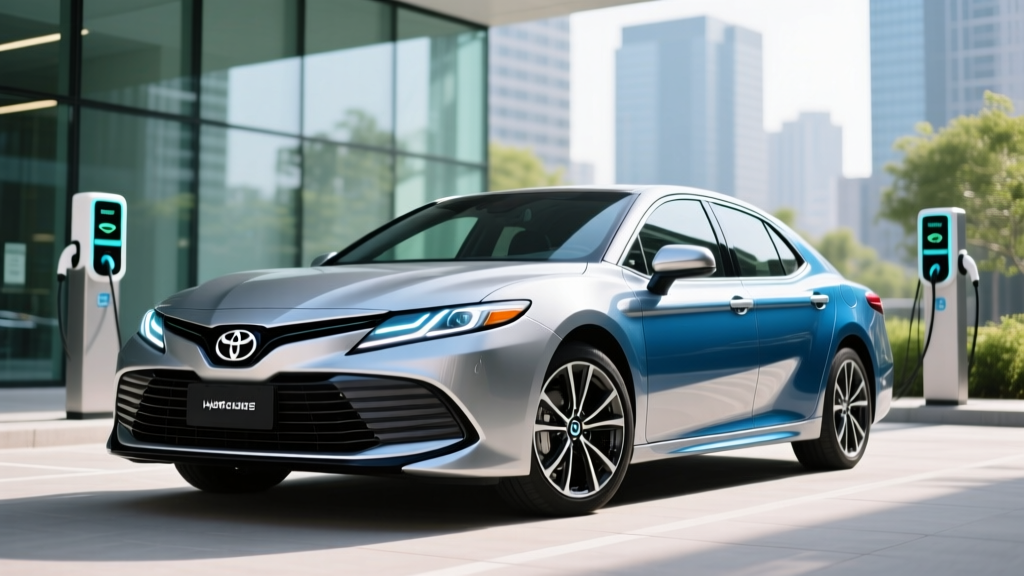
The ninth-generation Toyota Camry arrived for 2025 with a significant powertrain change: every trim is now a hybrid. Gone are the four-cylinder and V6 gas-only options. In their place sits Toyota's fifth-generation hybrid system, pairing a 2.5-liter four-cylinder engine with electric motors to produce 225 horsepower on front-wheel-drive models and 232 horsepower on all-wheel-drive trims. It's the most powerful base Camry hybrid Toyota has ever offered, while simultaneously achieving up to 51 MPG combined.
For buyers cross-shopping the midsize sedan segment, the 2025 Camry Hybrid occupies a compelling position: it delivers more power than the outgoing hybrid, sips fuel like a compact, and requires zero plug-in infrastructure. Below, we break down every number that matters — from horsepower curves to battery warranty coverage — so you can decide if this is the right electrified sedan for your driveway.
| Specification | FWD Models | AWD Models |
|---|---|---|
| Combined Horsepower | 225 hp | 232 hp |
| Engine | 2.5L 4-cyl hybrid (184 hp engine + 134 hp front motor) | |
| Rear Motor (AWD only) | — | 40 hp |
| 0–60 mph (est.) | ~7.2 sec | ~6.9 sec |
| EPA City / Hwy / Combined MPG | 53 / 50 / 51 (LE) | 51 / 49 / 50 (LE AWD) |
| Drivetrain | Front-wheel drive | Electronic AWD |
| Hybrid Battery | Lithium-ion, ~1.6 kWh (self-charging HEV) | |
| Base MSRP | $29,495 (LE) – $35,495 (XSE) | |
2025 Camry Hybrid Horsepower: Where the Power Comes From
The headline number — 225 hp (FWD) or 232 hp (AWD) — represents combined system output from Toyota's fifth-generation hybrid synergy drive. Here's how that breaks down:
- Gas engine: A 2.5-liter Dynamic Force four-cylinder producing 184 horsepower and 163 lb-ft of torque on its own. This is a high-compression (14:1) Atkinson-cycle engine optimized for efficiency, not peak power.
- Front electric motor: A permanent-magnet motor integrated into the transaxle, contributing 134 horsepower. Electric motors deliver peak torque instantly from zero RPM, which is what gives the Camry Hybrid its responsive off-the-line feel.
- Rear electric motor (AWD trims only): A 40-hp motor on the rear axle provides electronic all-wheel drive without a mechanical driveshaft. It activates during acceleration and low-traction conditions.
The combined system output isn't a simple sum of these figures — the engine and motors reach peak output at different RPM points, so Toyota rates the net system output at 225 or 232 hp depending on configuration. The result is a 0–60 mph time in the low 7-second range, which is meaningfully quicker than the outgoing Camry Hybrid's 208 hp / ~7.6-second run. For context, the 2025 Honda Accord Hybrid produces 204 hp, and the Hyundai Sonata Hybrid delivers 192 hp.
Fuel Economy: EPA Numbers and Real-World MPG
The 2025 Camry Hybrid's efficiency is where it truly separates from the pack. Toyota publishes the following EPA estimates on fueleconomy.gov:
| Trim | Drivetrain | City MPG | Highway MPG | Combined MPG |
|---|---|---|---|---|
| LE | FWD | 53 | 50 | 51 |
| LE | AWD | 51 | 49 | 50 |
| SE / XLE | FWD | 48 | 47 | 47 |
| SE / XLE / XSE | AWD | 46 | 46 | 46 |
The LE trim's advantage comes from lighter 16-inch wheels, lower rolling-resistance tires, and slightly different aerodynamic tuning. The sport-oriented SE and XSE trims ride on 18- or 19-inch wheels that reduce efficiency by 4–5 MPG.
Real-World MPG: What to Actually Expect
Hybrids are one of the few vehicle categories where real-world city driving often exceeds the EPA city number. That's because stop-and-go traffic maximizes regenerative braking and electric-motor usage. In mixed suburban driving, owners commonly report 48–54 MPG in the LE trim during warmer months. Highway-only road trips at 75+ mph typically return 42–46 MPG in the LE, as the gas engine carries more of the load at sustained speed.
Cold weather impacts all hybrids. Expect a 5–10% fuel economy reduction in winter months (roughly 2–4 MPG lower) due to the engine running more frequently to provide cabin heat and maintain battery temperature. This is far less severe than the 20–30% range loss EVs experience in cold weather, but it's worth budgeting for if you live in a northern climate.
HEV vs. PHEV vs. EV: Where Does the Camry Fit?
The 2025 Camry is a conventional hybrid electric vehicle (HEV), meaning it generates all its electricity internally through the gas engine and regenerative braking. You never plug it in. This is fundamentally different from a plug-in hybrid (PHEV) or a battery electric vehicle (BEV). Here's how these three electrified paths compare:
| Factor | HEV (Camry Hybrid) | PHEV (e.g., Prius Prime) | BEV (e.g., Tesla Model 3) |
|---|---|---|---|
| Plug-in required? | No | Yes (Level 1 or 2) | Yes (Level 2 or DC fast) |
| Electric-only range | ~1 mi at low speed | 25–44 mi typical | 250–360 mi |
| Total range | 550–620 mi | 400–500 mi (gas + electric) | 250–360 mi (electric only) |
| Fueling/charging time | 5 min at gas station | 4–6 hr Level 2 / 5 min gas | 15–30 min DC fast / 8+ hr L2 |
| Federal tax credit (§30D) | Not eligible | Up to $7,500 (if eligible) | Up to $7,500 (if eligible) |
| Best for | No home charging; want simplicity | Home charging + road trips | Home charging; daily commute |
The Camry Hybrid's advantage is simplicity. There's no charging cable to manage, no range to monitor, and no dependence on charging infrastructure. You drive it exactly like a gas car — just less often to the pump. The trade-off is that it doesn't qualify for the federal §30D tax credit, which is reserved for plug-in vehicles with battery capacities of at least 7 kWh.
Pricing, Trims, and Tax Credit Eligibility
The 2025 Camry Hybrid is offered in four trims. Here's the MSRP breakdown at launch (destination charge included):
- LE: $29,495 (FWD) / $30,895 (AWD)
- SE: $31,995 (FWD) / $33,395 (AWD)
- XLE: $34,295 (FWD) / $35,695 (AWD)
- XSE: $35,495 (AWD only)
Does the Camry Hybrid Qualify for a Tax Credit?
No. Under current IRS §30D rules, the federal clean vehicle credit applies only to plug-in electric vehicles and fuel cell vehicles. Conventional hybrids like the Camry Hybrid are not eligible for the $7,500 federal credit or the point-of-sale transfer option.
Some states offer their own incentives for hybrids, though these are increasingly rare as state programs shift focus to plug-in vehicles. A handful of states may offer reduced registration fees, HOV lane access, or modest rebates for hybrids — check your state's energy office or department of environmental quality for current programs. The Camry Hybrid's value proposition rests on fuel savings and a low entry price, not incentive stacking.
Battery Warranty, Lifespan, and Replacement Cost
Toyota equips the 2025 Camry Hybrid with a lithium-ion hybrid battery pack (approximately 1.6 kWh capacity). This is a small battery by EV standards — it's designed for frequent shallow cycling (absorbing regen energy, deploying it for acceleration) rather than deep discharge cycles.
Toyota Hybrid Battery Warranty
- Hybrid battery warranty: 10 years / 150,000 miles (whichever comes first)
- Hybrid system components: 8 years / 100,000 miles
- Basic vehicle warranty: 3 years / 36,000 miles
- Powertrain warranty: 5 years / 60,000 miles
Toyota's 10-year/150,000-mile hybrid battery warranty is among the longest in the industry and applies nationwide regardless of state emissions regulations.
How Long Does a Toyota Hybrid Battery Last?
Real-world data from Toyota's hybrid fleet (over 25 million vehicles sold globally since 1997) shows that most hybrid batteries outlast their warranty period. It's common for Prius and Camry Hybrid batteries to reach 180,000–250,000 miles before significant degradation. The shallow charge/discharge cycles and active thermal management contribute to longevity far beyond what early hybrid owners experienced.
Hybrid Battery Replacement Cost
If a replacement is needed out of warranty, a new OEM hybrid battery for the Camry Hybrid typically costs between $2,500 and $4,000 including labor. Third-party refurbished batteries are available for $1,500–$2,500. This is a fraction of EV battery replacement costs, which can exceed $10,000–$15,000, because the hybrid battery is much smaller.
Reliability and Ownership Costs
Toyota's hybrid powertrain is among the most thoroughly proven in the automotive industry. The 2025 Camry uses the same fundamental hybrid architecture that has powered millions of Prius, RAV4 Hybrid, and Highlander Hybrid vehicles with consistently strong reliability records. The e-CVT transaxle has no traditional gears, belts, or clutches to wear out — it uses a planetary gearset that Toyota rates for the life of the vehicle.
According to IIHS testing, the 2025 Camry is expected to earn top safety ratings, continuing the model's history as an IIHS Top Safety Pick. Standard Toyota Safety Sense 3.0 includes pre-collision braking, lane departure alert, dynamic radar cruise control, and lane tracing assist — all Level 2 driver-assistance features that require active driver supervision.
5-Year Cost of Ownership Snapshot
At 15,000 miles per year and $3.20/gallon regular unleaded, a Camry Hybrid LE (51 MPG combined) would spend approximately $2,820 on fuel over 5 years. A comparable gas-only midsize sedan averaging 30 MPG combined would spend roughly $4,800 — a savings of nearly $2,000 with the hybrid. Factor in the Camry Hybrid's strong resale value and modest insurance costs, and the total cost of ownership is competitive with vehicles costing thousands less at purchase.
Pros
- 225–232 hp is the most powerful Camry hybrid yet
- 51 MPG combined (LE) beats every non-plug-in midsize sedan
- No plug-in charging required — zero infrastructure dependency
- 10-year/150,000-mile hybrid battery warranty
- Standard AWD availability across trims
- Strong resale value and proven reliability
Cons
- Not eligible for the $7,500 federal §30D tax credit
- SE/XLE/XSE trims drop to 46–47 MPG (wheel/tire penalty)
- No PHEV option — can't drive on electric-only for commutes
- Cargo space slightly reduced vs. gas-only predecessors
- Infotainment learning curve for first-time Toyota users
Who Should Buy the 2025 Camry Hybrid?
Choose the Camry Hybrid If:
- You want maximum fuel efficiency without plugging in
- You live in an apartment or lack access to home/workplace charging
- You regularly take long road trips and don't want to plan around charging stops
- You want a proven, low-maintenance powertrain with a long warranty
- Your daily commute is over 50 miles and you want to minimize fuel costs
Consider a PHEV Instead If:
- You have reliable Level 2 home charging and a commute under 40 miles
- You want to drive most days on electricity alone and use gas only for road trips
- You qualify for the §30D federal tax credit (income and sourcing requirements apply)
- Look at the Toyota Prius Prime (44 mi electric range, up to $7,500 credit)
Consider a Full EV Instead If:
- You have home Level 2 charging and rarely drive over 250 miles without stopping
- You want zero tailpipe emissions and the lowest per-mile energy cost
- You're eligible for federal and state EV incentives that offset the higher purchase price
- Look at the Tesla Model 3, Hyundai Ioniq 6, or Chevrolet Equinox EV
Frequently Asked Questions
How many MPG does the 2025 Camry Hybrid get?
The Camry Hybrid LE achieves 53 city / 50 highway / 51 combined MPG. The SE, XLE, and XSE trims with larger wheels drop to 46–47 combined MPG. Real-world city driving often matches or slightly exceeds the EPA city estimate, while sustained highway driving above 75 mph typically returns 5–8 MPG below the highway rating.
How much horsepower does the 2025 Camry Hybrid have?
The 2025 Camry Hybrid produces 225 horsepower in FWD trims and 232 horsepower in AWD trims. This is a combined system rating from the 2.5L gas engine (184 hp) and electric motor(s). It's a 17 hp increase over the previous-generation Camry Hybrid.
Is the 2025 Camry Hybrid a plug-in?
No. The 2025 Camry Hybrid is a conventional hybrid (HEV). It charges its own battery through the gas engine and regenerative braking. You never plug it in. If you want a plug-in Toyota sedan, the Prius Prime offers 44 miles of electric-only range and qualifies for federal tax credits.
Is the Camry Hybrid battery reliable, and what does replacement cost?
Toyota's hybrid batteries are among the most reliable in the industry, commonly lasting 180,000+ miles. The 2025 Camry Hybrid battery is covered by a 10-year/150,000-mile warranty. Out-of-warranty replacement costs approximately $2,500–$4,000 for an OEM battery, significantly less than an EV battery replacement.
Does the 2025 Camry Hybrid qualify for any tax credit?
The Camry Hybrid does not qualify for the federal §30D clean vehicle credit, which is limited to plug-in electric and fuel cell vehicles. Some states may offer minor incentives for hybrids — check your state's energy office. The Camry Hybrid's financial advantage comes from fuel savings, not tax credits.
How does the Camry Hybrid compare to the Accord Hybrid?
The 2025 Camry Hybrid (225 hp, 51 MPG combined) outperforms the Honda Accord Hybrid (204 hp, 48 MPG combined) on both power and efficiency. The Accord Hybrid offers a slightly more spacious rear seat and a more traditional driving feel, while the Camry Hybrid delivers better fuel economy and a longer hybrid battery warranty (10 years vs. Honda's 8 years/100,000 miles on hybrid components).
Does the 2025 Camry Hybrid come with AWD?
Yes. AWD is available on every trim. It uses a dedicated 40-hp rear electric motor rather than a mechanical driveshaft, adding approximately 100 lbs and reducing fuel economy by 1–2 MPG. The system engages automatically during acceleration and low-traction conditions.