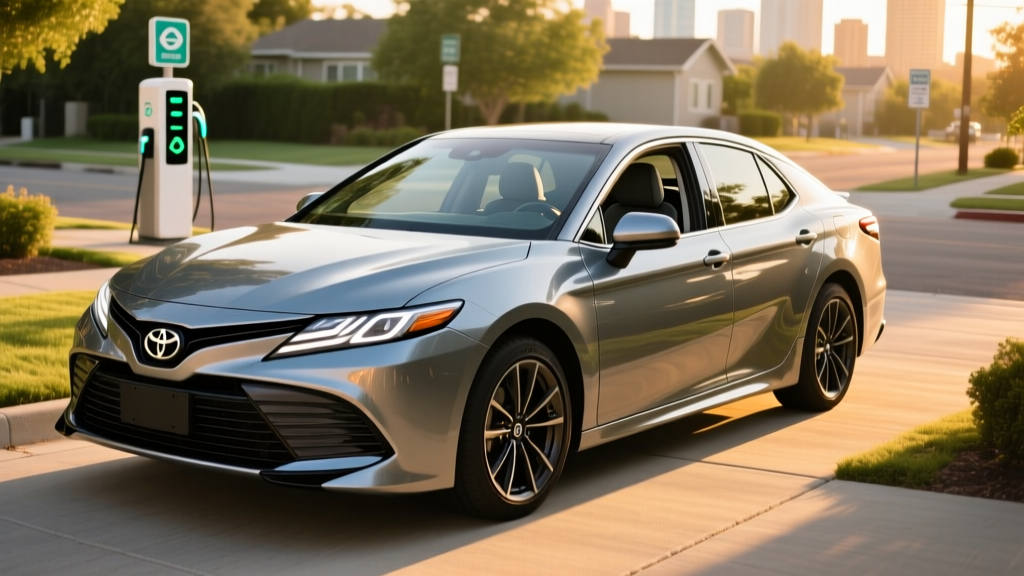
The 2025 Toyota Camry arrives with a significant powertrain shift: every model is now a hybrid. For buyers navigating rain, snow, or loose gravel, the 2025 Camry Hybrid AWD adds an independent rear electric motor for all-weather traction without the fuel-economy penalty of a traditional mechanical AWD system. This guide breaks down the exact specs, real-world efficiency expectations, ownership costs, and how this hybrid sedan stacks up against PHEVs and full EVs.
2025 Camry Hybrid AWD Powertrain and Performance
Toyota's fifth-generation Toyota Hybrid System (THS) pairs a 2.5-liter Dynamic Force four-cylinder engine with two front-mounted motor-generators and a third, independent 40-hp electric motor driving the rear axle. The result is seamless AWD engagement that activates automatically when slip is detected — there's no mechanical driveshaft connecting the engine to the rear wheels.
| Specification | Value |
|---|---|
| Combined Horsepower | 232 hp (AWD) |
| Gas Engine | 2.5L 4-cyl, 184 hp / 163 lb-ft |
| Front Electric Motors | Two motor-generators (MG1 + MG2) |
| Rear Electric Motor (AWD) | 40 hp / 89 lb-ft (independent) |
| Transmission | eCVT (planetary gearset) |
| 0–60 mph | ~7.1 seconds (est.) |
| Drivetrain | Electronic On-Demand AWD |
| Hybrid Battery | 1.0 kWh lithium-ion (sealed, self-charging) |
| Base MSRP (LE AWD) | $29,790 (incl. destination) |
The AWD system adds roughly 120 pounds compared to the front-wheel-drive variant. The rear motor engages in fractions of a second during acceleration from a stop, wet-road cornering, or light snow — and disengages during steady-state cruising to avoid parasitic drag. This is fundamentally different from a mechanical AWD system that constantly spins a rear differential.
Fuel Economy: EPA Ratings vs. Real-World MPG
The EPA rates the 2025 Camry Hybrid AWD at 51 city / 49 highway / 50 combined MPG on the LE trim. The SE and XSE trims, equipped with larger 19-inch wheels and a sport-tuned suspension, drop to 46/44/45 MPG combined. These figures represent a substantial improvement over the outgoing eighth-generation Camry Hybrid AWD, which was rated at 44 combined MPG.
| Trim | City MPG | Highway MPG | Combined MPG |
|---|---|---|---|
| LE AWD | 51 | 49 | 50 |
| SE AWD | 46 | 44 | 45 |
| XSE AWD | 46 | 44 | 45 |
| XLE AWD | 48 | 46 | 47 |
Real-world expectation: Toyota hybrids tend to meet or slightly exceed their EPA city ratings because regenerative braking recaptures more energy in stop-and-go traffic than the test cycle assumes. On the highway, expect results closer to the sticker — or slightly below — especially at speeds above 70 mph where aerodynamic drag dominates. In cold weather (below 30°F), anticipate a 5–10% MPG reduction as the engine runs longer to heat the cabin and warm the hybrid battery to optimal operating temperature.
Source: fueleconomy.gov — 2025 Toyota Camry Hybrid AWD
Hybrid (HEV) vs. Plug-In Hybrid (PHEV): Where the Camry Fits
The 2025 Camry is a conventional hybrid electric vehicle (HEV), not a plug-in hybrid. This distinction matters for buyers comparing it against vehicles like the Toyota RAV4 Prime or Hyundai Tucson PHEV.
| Feature | HEV (Camry Hybrid) | PHEV (e.g., RAV4 Prime) |
|---|---|---|
| Plug-in Charging Required? | No — self-charging via regen + engine | Yes — plug in for electric-only range |
| Electric-Only Range | ~1 mile at low speed | 25–42 miles typical |
| Battery Capacity | ~1.0 kWh | 13–18 kWh typical |
| DC Fast Charging | N/A | Rarely available (most PHEVs are Level 2 only) |
| Federal Tax Credit (§30D) | Not eligible | Up to $7,500 (if eligible) |
| Best For | No home charging access, long commutes | Short commutes + home Level 2 charger |
The Camry Hybrid's small 1.0 kWh battery is charged entirely by the gasoline engine and regenerative braking. You never plug it in. This makes it ideal for apartment dwellers, street parkers, or anyone without reliable access to a Level 2 home charger. The trade-off is that you can't drive meaningful distances on electricity alone — the electric motors assist the engine but don't replace it.
Pricing, Trims, and Tax Credit Eligibility
The 2025 Camry Hybrid AWD lineup starts at $29,790 for the LE trim (including the $1,150 destination charge). Here's the full AWD pricing breakdown:
- LE AWD: $29,790
- SE AWD: $31,290
- XLE AWD: $34,490
- XSE AWD: $35,590
Battery Longevity, Warranty, and Replacement Costs
Hybrid battery anxiety is understandable but largely overstated for modern Toyota systems. The 2025 Camry Hybrid's lithium-ion traction battery is covered by Toyota's hybrid battery warranty: 10 years or 150,000 miles (whichever comes first), transferable to subsequent owners. The broader hybrid system — including the inverter, motor-generators, and eCVT — carries the same 10-year/150,000-mile coverage.
Real-world degradation data: Toyota's hybrid batteries are designed with a large buffer — you typically use only 40–60% of total capacity in normal driving, which dramatically reduces cell stress. Fleet data from Prius taxis routinely shows 200,000+ miles on original batteries. When replacement is needed (usually well past the warranty period), a refurbished Camry hybrid battery currently runs $2,000–$3,500 installed, while a new OEM unit from Toyota lists around $3,500–$4,500 before labor.
The 12V auxiliary battery (a standard lead-accent or AGM unit that powers accessories and boots the hybrid system) is a separate, conventional maintenance item — expect replacement every 4–6 years at $150–$250.
Who Should Buy the Camry Hybrid AWD vs. a PHEV or EV?
Pros
- 50 MPG combined (LE AWD) — best in class for AWD sedans
- No plug-in charging required — ideal for renters and street parkers
- On-demand electronic AWD for snow/rain without fuel penalty
- 10-year/150,000-mile hybrid battery warranty
- ~$29,800 starting price undercuts most AWD competitors
- Proven Toyota hybrid reliability with massive service network
Cons
- No federal tax credit (HEV, not a plug-in vehicle)
- No meaningful electric-only driving range
- eCVT drone under hard acceleration (no simulated gear shifts)
- Rear motor adds weight; slightly less trunk space than FWD variant
- SE/XSE trims lose 5 MPG to larger wheels and sport tuning
- No DC fast charging (not applicable to HEVs)
Choose the Camry Hybrid AWD if: You want maximum fuel economy without changing your fueling habits. You don't have reliable access to a home charger. You drive long highway commutes where PHEV electric range would be exhausted quickly. You need AWD for winter weather but don't want an SUV.
Consider a PHEV instead if: You have a garage or driveway with Level 2 charging access, your daily commute is under 30 miles round-trip, and you want to drive on electricity most days while keeping a gas engine for road trips. The RAV4 Prime (42 miles electric-only) or a Prius Prime (44 miles) would fit this use case — and both qualify for the §30D tax credit if eligibility requirements are met.
Consider a full EV (BEV) if: You have home charging, want zero tailpipe emissions, and your typical trips fall within a 250–300 mile range. Vehicles like the Tesla Model 3 or Hyundai Ioniq 6 offer lower per-mile energy costs and qualify for the full $7,500 federal credit (subject to income, MSRP, and battery-sourcing rules).
Real-World Ownership Costs: 5-Year Estimate
At 15,000 miles per year and a national gas average of ~$3.30/gallon, a Camry Hybrid AWD LE (50 MPG combined) would consume roughly 300 gallons annually — about $990/year in fuel. Compare this to a typical non-hybrid AWD midsize sedan averaging 28 MPG combined, which would burn ~536 gallons and cost roughly $1,769/year. That's a fuel savings of approximately $780 per year, or $3,900 over five years, before factoring in any maintenance differences.
Hybrid maintenance is generally lower than conventional vehicles: regenerative braking significantly extends brake pad life (60,000–100,000 miles is common), there's no traditional transmission fluid to change (the eCVT uses a sealed gear oil), and the engine operates under less stress due to electric motor assist. Toyota's maintenance plan covers 2 years/25,000 miles of scheduled service.
2025 Camry Hybrid AWD FAQ
How many MPG does the 2025 Camry Hybrid AWD actually get?
The EPA rates the LE AWD at 51 city / 49 highway / 50 combined MPG. In real-world driving, most owners report meeting or slightly exceeding the city figure thanks to aggressive regenerative braking in traffic. Highway MPG tends to track closely with the EPA estimate at speeds under 70 mph but drops at higher speeds. Expect a 5–10% reduction in very cold weather.
Does the Camry Hybrid AWD need to be plugged in?
No. The 2025 Camry is a conventional hybrid (HEV). Its small lithium-ion battery charges entirely through regenerative braking and the gasoline engine. You fuel it like any other car — there is no plug, no charging cable, and no electric-only driving range to manage.
Does the 2025 Camry Hybrid qualify for any tax credit?
Not at the federal level. The IRS §30D Clean Vehicle Credit requires a plug-in vehicle with at least 7 kWh of battery capacity. The Camry Hybrid's ~1.0 kWh battery does not qualify. Some state programs, utility companies, or local governments may offer separate hybrid incentives — check your state's energy office or utility provider for current programs.
How reliable is the Camry Hybrid AWD, and what does a battery replacement cost?
Toyota's hybrid systems have a strong long-term reliability record, with many Prius and Camry Hybrids exceeding 200,000 miles on original batteries. The hybrid battery is warrantied for 10 years / 150,000 miles. If replacement is needed out of warranty, expect $2,000–$3,500 for a refurbished unit or $3,500–$4,500 for a new OEM battery, plus labor.
How does the AWD system work on the Camry Hybrid?
The AWD system uses an independent 40-hp electric motor mounted on the rear axle — there is no mechanical driveshaft from the engine. The rear motor engages automatically when the system detects front-wheel slip during acceleration, cornering on wet surfaces, or driving in light snow. It disengages during steady cruising to maximize fuel economy. This is an on-demand system, not a permanent AWD setup like you'd find on a Subaru.
Camry Hybrid AWD vs. RAV4 Hybrid AWD — which gets better MPG?
The Camry Hybrid AWD LE (50 MPG combined) outperforms the RAV4 Hybrid AWD (approximately 39–41 MPG combined) due to its lower, more aerodynamic sedan profile and lighter curb weight. If you need cargo space and higher ground clearance, the RAV4 is the practical choice. If fuel economy is your top priority, the Camry wins by a significant margin.
Sources: EPA fuel economy data from fueleconomy.gov; MSRP and specifications from Toyota Motor Corporation; federal tax credit rules from IRS.gov §30D. Pricing and incentive rules are subject to change — verify current figures before purchase.