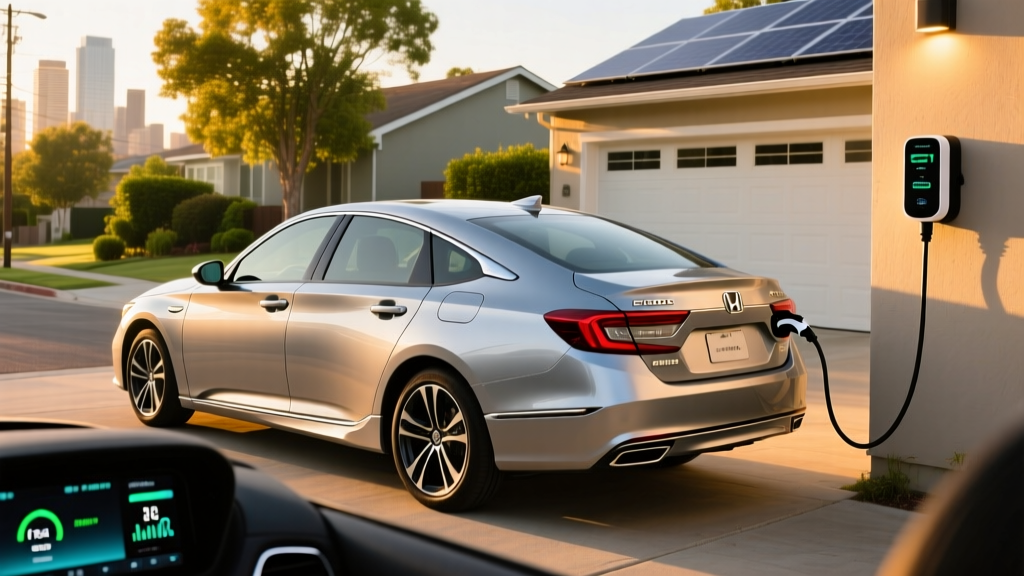
The 2025 Honda Accord Hybrid Touring sits at the top of Honda's hybrid sedan lineup, pairing a 2.0-liter Atkinson-cycle four-cylinder with a two-motor hybrid system for a combined 204 horsepower. Unlike plug-in hybrids or full electric vehicles, the Accord Hybrid is a conventional hybrid (HEV) — it never needs to be plugged in. Instead, it recovers energy through regenerative braking and its gasoline engine to keep a small lithium-ion battery charged. For buyers who want EV-like city efficiency without charging infrastructure, the Touring trim delivers premium features alongside 48 MPG combined on the EPA cycle.
This guide breaks down the exact powertrain specs, real-world fuel economy expectations, battery longevity, warranty coverage, and whether the Accord Hybrid Touring qualifies for any federal tax incentives in 2025.
2025 Accord Hybrid Touring: Powertrain & Key Specs
| Specification | Value |
|---|---|
| Powertrain Type | Conventional Hybrid (HEV) — no plug-in required |
| Engine | 2.0L Atkinson-cycle inline-4 + two-motor hybrid system |
| Combined Horsepower | 204 HP |
| Combined Torque | 247 lb-ft (electric motor peak) |
| Transmission | eCVT (electronic continuously variable) |
| Drivetrain | Front-wheel drive |
| Hybrid Battery | Lithium-ion, ~1.0 kWh (buffer-limited, not plug-in) |
| 0–60 mph | ~7.2 seconds (est.) |
| EPA Fuel Economy | 48 city / 47 highway / 48 combined MPG |
| Fuel Tank | 12.8 gallons |
| Total Driving Range | ~614 miles (EPA est.) |
| Base MSRP (Touring trim) | ~$39,990 (incl. destination) |
| Hybrid Battery Warranty | 8 years / 100,000 miles (10 yr/150,000 mi in CARB states) |
The Accord Hybrid uses Honda's fourth-generation two-motor hybrid system. In most city driving scenarios, the gasoline engine acts as a generator, powering the electric drive motor that actually turns the wheels. At highway cruising speeds, a lock-up clutch connects the engine directly to the front axle for efficiency. This series-parallel architecture is why the Accord Hybrid achieves nearly identical city and highway MPG — a rarity among conventional hybrids.
Fuel Economy: EPA Ratings vs. Real-World MPG
| Driving Scenario | EPA Estimate | Real-World Expectation |
|---|---|---|
| City | 48 MPG | 50–55 MPG (hybrids excel in stop-and-go) |
| Highway (70 mph) | 47 MPG | 42–46 MPG (aero drag, engine direct-drive) |
| Combined | 48 MPG | 44–50 MPG (varies by driving mix) |
| Cold Weather (below 32°F) | — | 38–43 MPG (engine runs more for cabin heat) |
The EPA rates the 2025 Accord Hybrid Touring at 48 city / 47 highway / 48 combined MPG per fueleconomy.gov. Real-world results depend heavily on your driving profile:
- City-dominant commuters frequently report 50–55 MPG. The hybrid system recovers energy during every stop, and the engine shuts off at lights. In warm weather with gentle acceleration, some owners see the trip computer read above 55 MPG on short urban loops.
- Highway-dominant drivers should expect 42–46 MPG at sustained 70–75 mph speeds. The engine operates in direct-drive mode at highway speeds, losing the electric-motor efficiency advantage that benefits city driving. Higher speeds and headwinds further reduce economy.
- Cold weather hits all hybrids. Below freezing, the engine runs more frequently to generate cabin heat (there's no electric heater drawing from a large battery, as in a PHEV or EV). Expect a 10–15% MPG reduction in winter, landing around 38–43 MPG combined.
HEV vs. PHEV vs. EV: Which Powertrain Fits You?
The Accord Hybrid is a conventional hybrid (HEV), not a plug-in hybrid. Honda does not currently offer a plug-in variant of the 11th-generation Accord in the US market. Here's how the three electrified powertrain types compare for a buyer considering this car:
| Factor | HEV (Accord Hybrid) | PHEV (e.g., Toyota Prius Prime) | BEV (e.g., Tesla Model 3) |
|---|---|---|---|
| Needs a plug? | No — gas only | Yes, for max EV range | Yes — always |
| Electric-only range | ~1 mile (low-speed creep) | 25–44 miles typical | 250–360+ miles |
| Home charging needed? | No | Recommended (120V or 240V) | Required (240V ideal) |
| City MPG / MPGe | 48 MPG | 50 MPG + EV miles | 130+ MPGe |
| Fuel cost per mile | ~$0.08 (gas at $3.50/gal) | ~$0.04–0.08 (varies) | ~$0.03–0.05 (electricity) |
| Upfront cost | Lower (~$40K) | Mid (~$33–43K) | Higher (~$39–53K) |
| Federal tax credit (§30D) | Not eligible | Up to $7,500 if eligible | Up to $7,500 if eligible |
| Best for | No home charging, long trips | Short commute + home plug | Home charging + mostly under 300 mi |
- You lack access to home or workplace charging (apartment, street parking, no 240V outlet)
- You regularly drive 400+ miles on road trips and don't want to plan around charging stops
- You want a near-50 MPG sedan with premium features without behavioral changes
- You want lower upfront cost and no charging installation expense
- You have a garage or driveway with a 240V outlet and a commute under 40 miles (PHEV covers it on electricity alone)
- You want to maximize federal tax credits — the Accord Hybrid does not qualify for the §30D credit
- You want to minimize per-mile fuel cost and your electricity rate is below $0.15/kWh
Tax Credit Eligibility: Does the Accord Hybrid Qualify?
The 2025 Honda Accord Hybrid Touring does not qualify for the federal §30D new clean vehicle tax credit (up to $7,500). The §30D credit under the Inflation Reduction Act applies only to plug-in electric vehicles — battery electric vehicles (BEVs) and plug-in hybrids (PHEVs) with a minimum battery capacity of 7 kWh. Because the Accord Hybrid is a conventional HEV with a small ~1 kWh battery that cannot be plugged in, it falls outside the credit's scope.
There is no separate federal tax credit for conventional hybrids in 2025. Some states or local utilities may offer rebates for hybrid purchases, but these vary widely by jurisdiction. Check your state's energy office or utility provider for current programs. For authoritative federal credit rules, consult the IRS §30D page.
- §30D Credit: Not eligible — Accord Hybrid is a conventional HEV, not a plug-in vehicle
- State/local hybrid rebates: Vary by jurisdiction — check your state energy office
- Used hybrid credit (§25E): Not applicable to new purchases; applies to qualifying used EVs/PHEVs only
- Employer or utility incentives: Some utilities offer rebates for any electrified vehicle — check locally
Battery Warranty, Longevity & Replacement Cost
- Hybrid Battery: 8 years / 100,000 miles nationwide
- CARB States (CA, NY, MA, and others adopting CARB rules): 10 years / 150,000 miles
- Powertrain (engine, transmission, motors): 5 years / 60,000 miles
- Bumper-to-Bumper: 3 years / 36,000 miles
- Warranty Coverage Threshold: Honda replaces the hybrid battery if capacity drops below ~70% of original within the warranty period
Honda's hybrid battery packs have proven durable across multiple generations. The Accord Hybrid's lithium-ion pack is relatively small (~1 kWh total capacity, with only a fraction usable due to software buffers that prevent full charge or full depletion). This shallow cycling — the battery never fully charges or fully depletes — significantly extends its lifespan compared to a full EV battery that cycles through deeper states of charge.
Real-world longevity data: Third-generation Accord Hybrids (2014–2017) routinely exceed 150,000 miles on the original hybrid battery. Taxi and rideshare fleet data from high-mileage Honda hybrids shows battery replacements typically occurring between 150,000 and 200,000 miles, with many units lasting longer. The 10th-generation Accord Hybrid (2018–2022) is too new for comprehensive end-of-life data, but early reports show minimal degradation.
Battery replacement cost: If the hybrid battery fails outside warranty, a new OEM replacement pack for the Accord Hybrid currently costs between $2,000 and $4,000 including labor at a Honda dealer. Third-party refurbished or reconditioned packs are available for $1,000–$2,500. This is substantially less than EV battery replacements ($5,000–$20,000+) because the hybrid pack is much smaller.
Touring Trim Features & Interior Technology
The Touring is the top-tier Accord Hybrid trim, and for 2025 it carries a premium over the Sport-L and EX-L hybrid trims. Key Touring-specific features include:
- 12.3-inch touchscreen with wireless Apple CarPlay and Android Auto
- 12-speaker Bose premium audio system
- Google built-in (Google Assistant, Google Maps, Play Store)
- Wireless phone charging pad
- Heated and ventilated front seats; heated rear outboard seats
- Heated steering wheel
- Low-speed braking control and front/rear parking sensors
- Honda Sensing suite: adaptive cruise control, lane-keeping assist, collision mitigation, traffic sign recognition
- Head-up display (HUD)
- Rain-sensing wipers and auto-dimming side mirrors
Honda Sensing is a SAE Level 2 driver-assistance system. It provides steering and acceleration/braking support on highways, but the driver must remain fully engaged — hands on the wheel, eyes on the road. It is not a self-driving system and does not relieve the driver of responsibility.
Honda Sensing on the 2025 Accord Hybrid Touring provides combined longitudinal (adaptive cruise) and lateral (lane-centering) assistance. This is SAE Level 2 — partial driving automation. The driver must continuously supervise the system and be prepared to take full control at any moment. This is fundamentally different from Level 4 robotaxi services (Waymo, Zoox) that operate without a human driver in geofenced areas.
Pricing, Value & Ownership Economics
| Trim | MSRP (approx.) | Key Additions over Base Hybrid |
|---|---|---|
| Sport | ~$33,990 | Sport styling, 19-inch wheels, paddle shifters |
| Sport-L | ~$35,490 | Leather-trimmed seats, power passenger seat |
| EX-L | ~$36,490 | Heated front seats, moonroof, upgraded audio |
| Sport-L Touring | ~$38,490 | Bose audio, navigation, ventilated seats |
| Touring | ~$39,990 | Full feature set — HUD, Google built-in, rear heated seats |
At roughly $39,990 for the Touring, the Accord Hybrid undercuts most premium-brand midsize sedans while offering comparable technology and comfort. The absence of a federal tax credit means the out-of-pocket cost is the sticker price minus any dealer negotiation and state/local incentives.
5-year fuel cost estimate: At 48 MPG combined, 15,000 miles/year, and $3.50/gallon regular unleaded, annual fuel cost is approximately $1,094. Over five years, that's roughly $5,470 in fuel. A comparable gasoline-only midsize sedan at 30 MPG combined would cost about $8,750 over the same period — a fuel savings of roughly $3,280 over five years for the hybrid.
| Cost Factor | Accord Hybrid Touring | Gas Sedan (30 MPG) |
|---|---|---|
| Purchase Price (MSRP) | ~$39,990 | ~$35,000 |
| Federal Tax Credit | $0 | $0 |
| Fuel (5 yr / 75K mi) | ~$5,470 | ~$8,750 |
| Estimated Insurance (5 yr) | ~$8,500 | ~$7,800 |
| Maintenance (5 yr) | ~$2,800 | ~$3,500 |
| Estimated Depreciation (5 yr) | ~$16,000 | ~$15,000 |
| Estimated 5-Yr Total | ~$72,760 | ~$70,050 |
Estimates based on national averages. Actual costs vary by region, driving habits, and insurance profile. Source: Author calculations using EPA MPG data and industry depreciation averages.
The hybrid's fuel savings partially offset its higher purchase price over five years. The gap narrows further if gas prices rise above $3.50/gallon. Honda's strong resale value also helps — the Accord consistently ranks among the best-retaining midsize sedans per industry data.
Reliability & Safety Ratings
Honda's hybrid powertrain has accumulated over a decade of real-world data, and the Accord Hybrid benefits from that maturity. The two-motor system has fewer wear components than a traditional automatic transmission — there are no gear shifts, torque converter, or multi-speed planetary gearsets. The eCVT is fundamentally simpler.
The 2025 Accord carries strong safety credentials. The 11th-generation Accord earned the IIHS Top Safety Pick+ designation (the highest honor) when tested, with Good ratings across all crashworthiness categories. NHTSA ratings for the current Accord include a 5-star overall score. For the latest crash-test results, check NHTSA.gov.
Common owner-reported concerns for the Accord Hybrid are minor: occasional infotainment lag, road noise on coarse surfaces, and the CVT's drone under hard acceleration (though Honda's system is among the smoothest in the segment). No widespread hybrid battery or powertrain failure patterns have emerged for the 11th generation.
Pros, Cons & Final Verdict
- 48 MPG combined — outstanding efficiency with no plug-in required
- Real-world city MPG often exceeds EPA (50–55 MPG)
- 204 HP provides confident highway merging and passing
- Touring trim loaded with premium features at under $40K
- IIHS Top Safety Pick+ and 5-star NHTSA ratings
- Proven hybrid reliability with 8–10 year battery warranty
- 614-mile total range eliminates refueling stops on most road trips
- Low maintenance costs — no plug, no charging equipment, standard oil changes
- No federal tax credit eligibility (HEV, not plug-in)
- Highway MPG drops below EPA at sustained 75+ mph speeds
- Cold-weather efficiency loss of 10–15% (engine runs for cabin heat)
- FWD only — no all-wheel-drive option
- Touring trim price approaches luxury sedan territory without the badge
- eCVT drone under heavy acceleration (mitigated by Sport mode)
- No spare tire — tire inflation kit only
The 2025 Accord Hybrid Touring is one of the most efficient, well-equipped midsize sedans available without requiring any charging infrastructure. If your priority is premium features, proven reliability, and near-50 MPG fuel economy with zero lifestyle adjustments, it remains a benchmark choice. Buyers who can install a home charger and want to access the $7,500 federal tax credit should cross-shop PHEV alternatives or full EVs — but for the no-plug buyer, the Accord Hybrid Touring is hard to beat.
Frequently Asked Questions
How many MPG does the 2025 Accord Hybrid Touring get?
The EPA rates it at 48 city / 47 highway / 48 combined MPG. In real-world city driving, many owners report 50–55 MPG thanks to the hybrid system's regenerative braking. Highway driving at 70–75 mph typically yields 42–46 MPG. Cold weather reduces efficiency by roughly 10–15%.
Does the Accord Hybrid need to be plugged in?
No. The Accord Hybrid is a conventional hybrid (HEV), not a plug-in hybrid. It charges its small lithium-ion battery through regenerative braking and the gasoline engine. You only need to refuel at a gas station — exactly like a conventional car.
How far can the Accord Hybrid go on electric only?
Less than one mile at very low speeds (under 25 mph) in EV mode. The battery is too small for meaningful electric-only driving. For substantial EV range (25–44 miles), you would need a plug-in hybrid like the Toyota Prius Prime. For 250+ miles of electric driving, a full BEV is required.
Is the Accord Hybrid reliable and what does battery replacement cost?
Honda's hybrid system has a strong long-term reliability record. The hybrid battery is warranted for 8 years/100,000 miles (10 years/150,000 miles in CARB states). Real-world data from previous generations shows batteries routinely lasting 150,000–200,000+ miles. Out-of-warranty replacement costs $2,000–$4,000 at a dealer, or $1,000–$2,500 with a refurbished pack.
Does the 2025 Accord Hybrid qualify for any tax credit?
No. The federal §30D clean vehicle tax credit (up to $7,500) applies only to plug-in electric vehicles — BEVs and PHEVs with at least 7 kWh of battery capacity. The Accord Hybrid is a conventional HEV and does not qualify. Some state or utility programs may offer hybrid-specific rebates, but these vary by location.
How does the Accord Hybrid compare to a full EV like the Tesla Model 3?
The Accord Hybrid costs less upfront (~$40K vs. $39–53K for Model 3), doesn't require home charging installation, and never needs route planning around charging stations. The Model 3 offers lower per-mile energy cost (~$0.04/mile vs. ~$0.08/mile for the hybrid), qualifies for the $7,500 federal credit (if eligible), and provides faster acceleration. If you have reliable home charging and most trips are under 300 miles, the EV saves more money long-term. If you lack charging access or frequently drive 400+ miles, the Accord Hybrid is the more practical choice.
What is the difference between the Accord Hybrid and a plug-in hybrid?
A conventional hybrid like the Accord Hybrid has a small battery (~1 kWh) charged by the engine and regenerative braking. It cannot be plugged in and offers minimal electric-only driving. A plug-in hybrid (PHEV) has a larger battery (typically 10–20 kWh), can be plugged into a wall outlet or charger, and provides 25–44 miles of electric-only range before the gasoline engine engages. Honda does not currently offer a plug-in Accord in the US market.