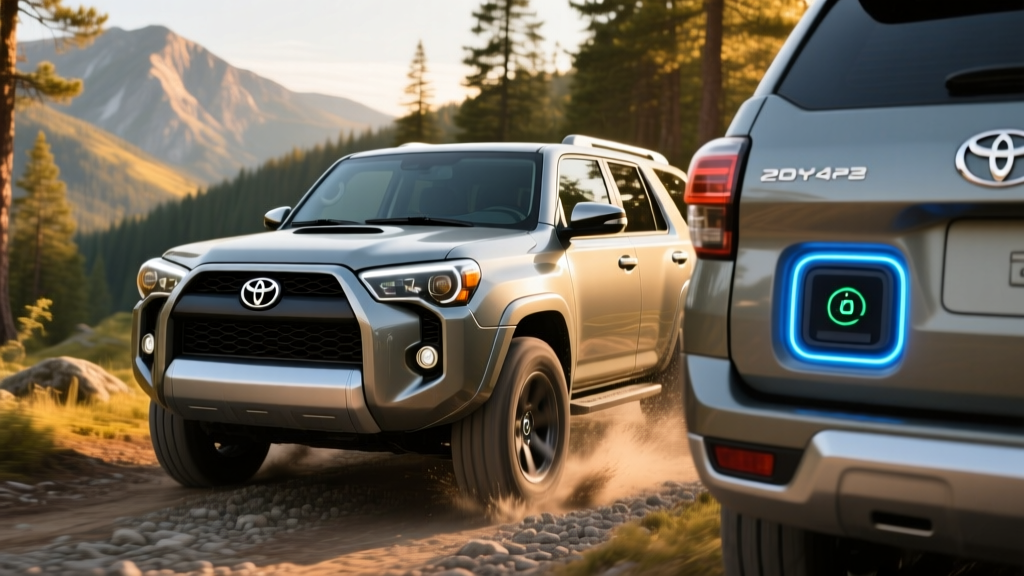
The sixth-generation Toyota 4Runner finally ditched its ancient V6 for something far more modern: the i-FORCE MAX turbocharged hybrid powertrain. For the 2025 model year, Toyota offers this hybrid system across nearly every 4Runner trim, delivering a massive torque upgrade and a modest but meaningful fuel-economy bump over the outgoing generation. If you've been searching for a 4Runner hybrid 2025 model and wondering whether the hybrid badge translates to real-world savings at the pump — or just more towing grunt — this guide covers every number that matters.
Before we get into the specs, an important distinction: the 2025 4Runner Hybrid is a conventional hybrid (HEV), not a plug-in hybrid (PHEV). You never plug it in. The small battery recharges through regenerative braking and the gasoline engine. This matters because it changes the fuel-economy expectations, eliminates any federal EV tax credit eligibility, and simplifies ownership — no home charger required.
HEV vs. PHEV: What the 4Runner Hybrid Actually Is
| Feature | HEV (4Runner Hybrid) | PHEV (e.g., RAV4 Prime) |
|---|---|---|
| Plug in to charge? | No — self-charging | Yes — plug in for EV range |
| Battery size | ~1.87 kWh (small) | 18–20+ kWh (large) |
| Electric-only driving | Very limited, low speed only | 25–42 miles typical |
| Federal tax credit (§30D) | Not eligible | Eligible (if requirements met) |
| Home charger needed? | No | Yes, for meaningful EV range |
| Primary benefit | Better MPG + more torque | Gas-free daily commuting |
The 4Runner's hybrid system is designed for torque multiplication and efficiency improvement — not electric-only commuting. If you need 30+ miles of zero-emission driving before the engine kicks on, you'd be looking at a PHEV like the Toyota RAV4 Prime or a full battery-electric vehicle. The 4Runner Hybrid is for buyers who want the body-on-frame SUV capability without the fuel penalty of the old 4.0L V6.
i-FORCE MAX Powertrain: 463 HP and 583 lb-ft of Torque
The heart of the 2025 4Runner Hybrid is Toyota's i-FORCE MAX powertrain, which pairs a 2.4-liter turbocharged inline-four gasoline engine with an electric motor integrated between the engine and the eight-speed automatic transmission. Here's the spec breakdown:
| Specification | Detail |
|---|---|
| Engine | 2.4L turbocharged inline-4 |
| Electric motor | Integrated motor-generator (sandwiched between engine and transmission) |
| Combined horsepower | 463 hp |
| Combined torque | 583 lb-ft |
| Transmission | 8-speed automatic |
| Hybrid battery | ~1.87 kWh, nickel-metal hydride (NiMH) |
| Drivetrain | RWD or 4WD (part-time or full-time depending on trim) |
| Towing capacity | Up to 6,000 lbs (4WD models) |
| 0–60 mph (est.) | ~5.8 seconds (4WD) |
For context, the outgoing 2024 4Runner's 4.0L V6 produced just 270 hp and 278 lb-ft. The i-FORCE MAX nearly doubles the torque output, which transforms both acceleration and towing confidence. The electric motor fills in the low-end torque gap that turbocharged engines typically suffer from, delivering immediate thrust off the line. This is the same powertrain architecture found in the Toyota Tacoma i-FORCE MAX and Tundra, proven in heavier-duty applications.
Fuel Economy: EPA MPG and Real-World Expectations
This is where practicality-minded buyers focus. The 2025 4Runner Hybrid's EPA fuel economy varies by drivetrain configuration:
| Configuration | City MPG | Highway MPG | Combined MPG |
|---|---|---|---|
| 4WD (most trims) | 23 | 24 | 23 |
| RWD (SR5, where available) | 24 | 25 | 24 |
Source: fueleconomy.gov (EPA estimates).
While 23–24 MPG combined might not sound revolutionary next to a Prius, context is everything. The outgoing 4Runner V6 4WD managed roughly 17 MPG combined. That's a 35% improvement in fuel economy from a vehicle that's also producing nearly 200 more horsepower. On a 15,000-mile annual driving cycle, the hybrid saves roughly 190 gallons of fuel per year compared to the old V6 — approximately $600–$750 in annual savings at $3.50/gallon.
Real-World MPG vs. EPA Sticker
Conventional hybrids like the 4Runner tend to match or slightly exceed their EPA city estimates in stop-and-go driving, where regenerative braking and electric-motor assist do the most work. Highway driving is a different story: at sustained 75–80 mph speeds, the turbo engine carries most of the load, and the aerodynamic profile of a body-on-frame SUV works against efficiency. Expect highway MPG to dip to roughly 21–22 MPG in real-world conditions, particularly with roof racks, larger tire packages (TRD Pro/Trailhunter), or heavy cargo loads.
In cold weather (below 30°F), hybrid fuel economy typically drops 5–10% as the engine runs more frequently to maintain cabin heat and battery temperature. The 4Runner's small NiMH battery is less thermally sensitive than large lithium-ion packs, but you'll still see a modest winter penalty.
Trims, Pricing, and the Tax Credit Question
For the 2025 model year, the i-FORCE MAX hybrid is available across most of the 4Runner lineup. Here's a look at approximate MSRPs for hybrid-equipped trims (destination included):
| Trim | Approx. MSRP (4WD) |
|---|---|
| TRD Off-Road Hybrid | ~$53,000 |
| Limited Hybrid | ~$58,000 |
| TRD Pro Hybrid | ~$65,000 |
| Trailhunter Hybrid | ~$63,000 |
| Platinum Hybrid | ~$61,000 |
Pricing varies by dealer and options. Check Toyota's official configurator for the latest MSRP data.
Does the 2025 4Runner Hybrid Qualify for a Federal Tax Credit?
No. The 4Runner Hybrid is a conventional HEV, not a plug-in vehicle. Under IRS §30D rules, only battery-electric vehicles (BEVs) and plug-in hybrids (PHEVs) with sufficient battery capacity qualify for the federal Clean Vehicle Credit (up to $7,500). The 4Runner Hybrid's ~1.87 kWh battery is far below the §30D minimum threshold. There is no federal income tax credit for conventional hybrids as of the current tax year.
Some states offer their own incentives for hybrid vehicles, though these are uncommon and vary by jurisdiction. Check your state's energy office or department of environmental quality for local programs.
Hybrid Battery Warranty and Long-Term Reliability
Battery longevity is the number-one concern for hybrid buyers, and Toyota has the deepest track record in the industry. The 2025 4Runner Hybrid's hybrid battery and related components are covered under Toyota's Hybrid Battery Warranty: 10 years or 150,000 miles (whichever comes first), transferable to subsequent owners. The broader Hybrid System warranty covers the inverter, control module, and related components for the same 10-year/150,000-mile period.
| Component | Warranty |
|---|---|
| Hybrid battery | 10 years / 150,000 miles |
| Hybrid system (inverter, control module) | 10 years / 150,000 miles |
| Powertrain (engine, transmission) | 5 years / 60,000 miles |
| Basic (bumper-to-bumper) | 3 years / 36,000 miles |
Toyota's hybrid systems have demonstrated exceptional longevity in real-world use. The Prius, Camry Hybrid, and Highlander Hybrid have accumulated billions of fleet miles, with many original hybrid batteries lasting well beyond 200,000 miles. The 4Runner's NiMH battery chemistry is the same proven technology used in millions of Toyota hybrids — it trades energy density (irrelevant in a small HEV pack) for cycle-life durability and thermal stability.
Should the hybrid battery need replacement outside of warranty, expect a cost in the range of $3,000–$5,000 for a new OEM unit, though refurbished options and third-party cell-replacement services can reduce this to $1,500–$2,500. Given Toyota's reliability history, most owners will never face this expense.
4Runner Hybrid vs. Full EV vs. Gas: Which Fits Your Life?
Choose the 4Runner Hybrid If:
- You need body-on-frame capability (towing, off-road, ground clearance) and can't compromise
- You don't have reliable access to home or workplace charging for a PHEV or EV
- You want better fuel economy than a gas SUV without changing your refueling habits
- You frequently tow 4,000–6,000 lbs and want the torque advantage of hybrid assist
- You plan to own the vehicle 8–12+ years and value Toyota's reliability reputation
Consider a PHEV Instead If:
- Your daily commute is under 35 miles round-trip and you can charge at home
- You want to drive most weekdays on electricity alone (zero gas use for commuting)
- Federal tax credit eligibility (up to $7,500) meaningfully affects your purchase math
- You don't need body-on-frame towing or serious off-road capability
Consider a Full EV If:
- You have Level 2 home charging and your daily driving is under 250 miles
- You want the lowest per-mile "fuel" cost (~$0.04–0.06/mile on home electricity vs. ~$0.18/mile for the 4Runner Hybrid at 23 MPG)
- You don't need to tow more than ~3,500 lbs regularly
- You want to minimize maintenance (no oil changes, no transmission fluid, fewer moving parts)
The honest assessment: the 4Runner Hybrid is the right choice for a narrow but passionate buyer. If you need a midsize body-on-frame SUV with real off-road chops and towing capacity, the hybrid powertrain is strictly better than the non-hybrid i-FORCE turbo-four (which produces 278 hp and 317 lb-ft, and returns roughly 21 MPG combined). The hybrid costs roughly $2,000–$3,000 more depending on trim, but the fuel savings, torque advantage, and likely stronger resale value close the gap within a few years of ownership.
Pros and Cons at a Glance
Pros
- Massive 583 lb-ft of torque transforms acceleration and towing
- ~35% better fuel economy than the outgoing V6 4Runner
- No plug-in required — zero change to refueling habits
- 10-year/150,000-mile hybrid battery warranty
- Proven i-FORCE MAX architecture shared with Tacoma/Tundra
- Strong off-road capability retained (TRD Pro, Trailhunter trims)
Cons
- 23 MPG combined is still thirsty compared to crossover SUVs
- No federal tax credit eligibility (HEV, not PHEV/BEV)
- Highway MPG drops further with aggressive tires and roof accessories
- Premium pricing on TRD Pro and Trailhunter trims ($63K–$65K+)
- No electric-only driving mode for meaningful zero-emission miles
- Hybrid battery adds weight low in the chassis but still ~4,800+ lbs curb weight
Frequently Asked Questions
How many MPG does the 2025 4Runner Hybrid get?
The EPA rates the 4Runner Hybrid 4WD at 23 city / 24 highway / 23 combined MPG. The RWD configuration (where available) earns 24/25/24 MPG. Real-world highway driving at 75+ mph may return 21–22 MPG, while city driving often matches or slightly exceeds the EPA estimate thanks to regenerative braking.
Do I need to plug in the 4Runner Hybrid?
No. The 2025 4Runner Hybrid is a conventional hybrid (HEV). Its small battery recharges automatically through regenerative braking and the gasoline engine. You fuel it like any other gas vehicle — no charging cable, no home charger installation, no range planning.
Does the 4Runner Hybrid qualify for a federal tax credit?
No. Under current IRS §30D rules (irs.gov), only plug-in electric vehicles (BEVs and PHEVs) with battery capacities of at least 7 kWh qualify. The 4Runner Hybrid's ~1.87 kWh battery makes it ineligible. No federal credit is available for conventional hybrids.
How long will the 4Runner Hybrid battery last?
Toyota covers the hybrid battery for 10 years or 150,000 miles. Based on Toyota's extensive hybrid fleet data (Prius, Camry, Highlander), many NiMH hybrid batteries last 200,000+ miles before significant degradation. The 4Runner's small pack undergoes shallow charge cycles, which further extends lifespan.
What does a 4Runner Hybrid battery replacement cost?
Out of warranty, expect $3,000–$5,000 for a new OEM hybrid battery. Refurbished units or cell-level repairs can reduce the cost to $1,500–$2,500. Given the 10-year warranty and Toyota's track record, most original owners will never need a replacement.
Is the i-FORCE MAX hybrid reliable?
The i-FORCE MAX shares its core architecture with the Tundra and Tacoma hybrids, which have been on sale since 2022–2024. Toyota's hybrid systems are among the most proven in the industry, with over two decades of continuous refinement. The 2.4L turbo engine is newer, but the hybrid components (motor, inverter, NiMH battery) use well-established technology. Long-term reliability data specific to the 4Runner will mature over the 2025–2027 ownership cycle.
Hybrid vs. PHEV vs. EV — which should I choose?
If you need body-on-frame towing, off-road ground clearance, and no charging infrastructure, the 4Runner Hybrid is your best fit. If you can charge at home and commute under 35 miles daily, a PHEV lets you drive most weekdays on electricity. If you don't need serious off-road or towing capability, a full EV delivers the lowest operating cost and smoothest driving experience. The right answer depends entirely on your daily driving pattern and charging access.