Quick Verdict: The Sporty Hybrid SUV That Doesn't Need a Plug
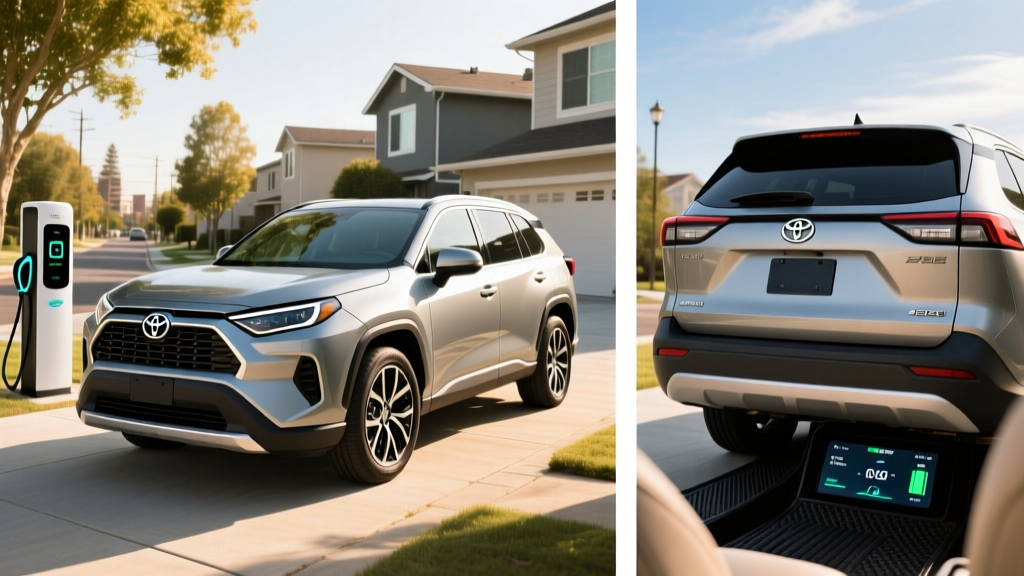
The 2024 Toyota RAV4 Hybrid XSE occupies a precise niche: buyers who want the fuel-economy upside of a hybrid powertrain without ever searching for a charger. As a conventional hybrid electric vehicle (HEV), it generates its own electricity through regenerative braking and engine-driven generation — no plug, no range anxiety, no home electrical upgrades required. The XSE trim specifically adds sport-tuned suspension, a blacked-out exterior appearance package, and SofTex-trimmed seats over the more comfort-oriented XLE and SE trims.
With an EPA-rated 41 city / 38 highway / 39 combined MPG, the RAV4 Hybrid XSE delivers numbers that make a 300-mile fill-up routine under $45 at current national gas prices. But the real story is how those numbers hold up outside the laboratory — and whether the XSE's sporty pretensions justify its $37,000+ starting price over the mechanically identical XLE.
HEV vs PHEV: What the RAV4 Hybrid Actually Is
Conventional Hybrid (HEV) — RAV4 Hybrid: A small battery (1.6 kWh) works alongside the gasoline engine. The battery recharges itself through regenerative braking and the engine. You never plug it in. Electric-only driving is limited to brief low-speed bursts (under ~1 mile). Fuel economy is consistently excellent in all conditions.
Plug-In Hybrid (PHEV) — RAV4 Prime: A much larger battery (18.1 kWh) provides up to 42 miles of pure electric range before the gasoline engine engages. You plug it in at home to recharge. When the battery depletes, it operates as a conventional hybrid at 38 MPG combined. Requires access to charging to realize full benefit.
Full EV (BEV): No gasoline engine. 200-350+ mile range from a large battery pack (60-100 kWh). Requires regular plug-in charging. Zero tailpipe emissions but demands home or reliable public charging access.
The 2024 RAV4 Hybrid XSE is strictly an HEV. Toyota sells the plug-in variant under the separate RAV4 Prime nameplate, which is a distinct model with different pricing, a 2.5-liter engine producing 302 combined horsepower, and federal tax credit eligibility. If you're specifically searching for a RAV4 you can plug in, you want the Prime — not the Hybrid XSE covered here.
Fuel Economy: EPA Ratings vs Real-World MPG
| Driving Condition | EPA Estimate | Real-World Expectation |
|---|---|---|
| City | 41 MPG | 40–44 MPG |
| Highway | 38 MPG | 35–38 MPG |
| Combined | 39 MPG | 37–41 MPG |
According to fueleconomy.gov, the 2024 RAV4 Hybrid AWD earns a 39 MPG combined rating. All RAV4 Hybrid trims, including the XSE, share the same powertrain and EPA figures — the sport-tuned suspension and larger 18-inch wheels on the XSE do not reduce its rated efficiency compared to the XLE or SE.
Real-world note: Toyota hybrids consistently match or exceed their EPA city estimates because stop-and-go traffic maximizes regenerative braking. Owners in the EPA's own owner-reported data frequently log 40+ MPG in mixed suburban driving. Highway fuel economy, however, tends to run 2–3 MPG below the EPA sticker at sustained speeds above 70 mph, where the gasoline engine does more of the work and aerodynamic drag increases. In cold weather (below 30°F), expect a 5–10% reduction across the board as the engine runs longer to heat the cabin and warm the catalytic converter.
For context, the non-hybrid 2024 RAV4 AWD with the 2.5-liter gas engine rates at 27 city / 34 highway / 30 combined — a 9 MPG gap that translates to roughly $400–$500 in annual fuel savings for a driver covering 15,000 miles per year at $3.40/gallon.
Powertrain and Performance Specs
| Specification | 2024 RAV4 Hybrid XSE |
|---|---|
| Engine | 2.5L 4-cylinder Atkinson-cycle |
| Electric Motors | Front motor + rear motor (eAWD) |
| Combined Horsepower | 219 HP |
| 0–60 mph | ~7.4 seconds |
| Drivetrain | Electronic AWD (eAWD) |
| Transmission | Continuously Variable (eCVT) |
| Battery Capacity | 1.6 kWh (nickel-metal hydride) |
| Towing Capacity | 1,750 lbs |
| Cargo Volume | 37.5 cu ft (rear seats up) / 69.8 cu ft (folded) |
The RAV4 Hybrid's 219 combined horsepower comes from Toyota's Hybrid Synergy Drive system: the 2.5-liter four-cylinder engine produces 176 HP on its own, supplemented by a 118 HP front electric motor and a 54 HP rear motor that provides electronic all-wheel drive. There is no mechanical driveshaft to the rear wheels — the rear motor engages independently when the system detects slip or during hard acceleration.
The eCVT transmission is not a traditional belt-and-cone CVT. It uses a planetary gearset to seamlessly blend engine and motor power, which eliminates the "rubber-band" feel that plagues some competitors. Acceleration is brisk and linear from a stop — the electric motor's instant torque masks the modest displacement engine — but highway passing above 60 mph reveals the engine's natural power ceiling. This is a powertrain optimized for efficiency first, with 219 HP providing adequate rather than thrilling performance.
Pricing, Trims, and Tax Credit Eligibility
The 2024 Toyota RAV4 Hybrid XSE starts at an MSRP of approximately $37,445 (including destination charge). Key standard equipment on the XSE includes:
- 18-inch black alloy wheels
- Sport-tuned shock absorbers
- Black roof and exterior accent trim
- SofTex-trimmed heated front seats
- 8-inch Toyota Audio Multimedia touchscreen with wireless Apple CarPlay/Android Auto
- Toyota Safety Sense 2.5+ (pre-collision, lane-departure, adaptive cruise, blind-spot monitor)
- LED headlights and taillights
Popular options that push the price toward $40,000–$42,000 include the Weather Package (heated steering wheel, rain-sensing wipers), Premium Audio with JBL speakers, and the Technology Package (panoramic view monitor, front and rear parking assist with automatic braking).
Federal Tax Credit: The 2024 RAV4 Hybrid XSE does NOT qualify for the IRS §30D Clean Vehicle Credit. Under current IRS rules, only plug-in electric vehicles (BEVs and PHEVs) with sufficient battery capacity are eligible. Conventional hybrids like the RAV4 Hybrid are excluded. The RAV4 Prime (PHEV) may qualify for up to $7,500 depending on battery sourcing, buyer income, and MSRP caps — but that is a separate model.
State incentives: Some states offer rebates or HOV-lane access for hybrids. Check your state's energy office or DMV for current programs, as these vary widely and change frequently.
Battery Warranty, Lifespan, and Replacement Cost
Hybrid Battery Warranty: Toyota covers the RAV4 Hybrid's battery pack for 10 years or 150,000 miles (whichever comes first) in all 50 states, effective for 2020 and newer model years. This applies to the hybrid traction battery, not the separate 12V auxiliary battery.
Hybrid System Warranty: All hybrid-system components (inverter, electric motors, control modules) carry the same 10-year/150,000-mile coverage.
Real-World Longevity: Toyota's hybrid battery packs have a well-documented track record spanning the Prius lineage back to 2000. Data from high-mileage fleets and owner surveys indicates that the nickel-metal hydride (NiMH) packs in the RAV4 Hybrid routinely exceed 150,000–200,000 miles before significant capacity loss. Unlike BEV batteries, the RAV4 Hybrid's 1.6 kWh pack operates within a narrow state-of-charge window (roughly 40–80%), which dramatically reduces degradation stress.
Replacement cost: If the hybrid battery does fail outside warranty, a new OEM replacement pack from Toyota costs approximately $3,000–$4,000 including labor at a dealership. Refurbished or aftermarket packs are available for $1,500–$2,500 installed. Individual module replacement (only the degraded cells) can reduce cost to under $1,000 at a hybrid-specialist shop. For context, this is a fraction of BEV battery replacement costs, which can exceed $10,000–$20,000.
Toyota's hybrid reliability data, tracked by organizations like IIHS and J.D. Power, consistently places the RAV4 Hybrid among the top-rated compact SUVs for predicted reliability. The hybrid system adds complexity but has proven remarkably durable over two decades of real-world use.
Who Should Buy the RAV4 Hybrid XSE — and Who Shouldn't
Pros
- 39 MPG combined with no plug-in requirement — works for apartment dwellers and those without garage access
- Standard eAWD provides confident traction in rain and light snow
- 10-year/150,000-mile hybrid battery warranty
- Strong resale value and proven long-term reliability
- XSE sport trim adds visual differentiation and firmer ride without sacrificing comfort
- Toyota Safety Sense 2.5+ is standard, not upsold
Cons
- No federal tax credit (HEV exclusion under §30D)
- 1,750-lb towing capacity limits utility for boat/camper owners
- Highway MPG drops to ~35 at sustained 75+ mph speeds
- Not a PHEV — cannot drive on electric-only power for meaningful distances
- XSE sport tuning is cosmetic and suspension-only; same 219 HP as all RAV4 Hybrids
- 8-inch screen feels small for 2024; competitors offer 10–12 inches standard
Choose the RAV4 Hybrid XSE if:
- You lack home charging access (apartment, street parking, no garage outlet)
- You drive 12,000–20,000 miles/year and want maximum fuel savings without behavioral changes
- You want AWD capability for snow or rain without the fuel penalty of a traditional AWD SUV
- You plan to own the vehicle 8–12 years and value long-term reliability data
Look at the RAV4 Prime (PHEV) instead if:
- You can install a Level 2 home charger and want 42 miles of electric-only commuting
- You want to qualify for the $7,500 federal tax credit (subject to sourcing and income rules)
- You want 302 HP for more spirited performance
Look at a full EV (BEV) instead if:
- You have reliable home charging and drive under 250 miles between charges
- You want zero tailpipe emissions and the lowest per-mile energy cost
- You're eligible for the full $7,500 federal credit and state rebates that make BEVs price-competitive
Frequently Asked Questions
How many MPG does the 2024 Toyota RAV4 Hybrid XSE get?
The EPA rates it at 41 city / 38 highway / 39 combined MPG. In real-world mixed driving, most owners report 37–41 MPG depending on driving style, terrain, and climate. City driving tends to match or exceed the EPA figure thanks to regenerative braking, while sustained highway speeds above 70 mph can reduce economy to 34–36 MPG.
Does the RAV4 Hybrid XSE need to be plugged in?
No. The RAV4 Hybrid is a conventional hybrid (HEV). Its 1.6 kWh battery recharges automatically through regenerative braking and the gasoline engine. You fuel it exclusively at a gas station. If you want a RAV4 that plugs in, you need the RAV4 Prime (PHEV), which is a separate, more expensive model.
Does the 2024 RAV4 Hybrid qualify for a federal tax credit?
No. Under IRS §30D rules, only plug-in electric vehicles (BEVs and PHEVs) qualify for the Clean Vehicle Credit. Conventional hybrids are explicitly excluded. The RAV4 Prime PHEV may qualify, but the RAV4 Hybrid does not. Some states offer separate hybrid incentives — check your local programs.
How long will the RAV4 Hybrid battery last?
Toyota warranties the hybrid battery for 10 years or 150,000 miles in all states. Real-world data from Toyota's hybrid fleet (Prius, Camry Hybrid, RAV4 Hybrid) shows these NiMH packs routinely lasting 150,000–200,000+ miles. The battery operates in a narrow charge window that minimizes degradation, and the system is thermally managed. Failures before 100,000 miles are rare.
What does it cost to replace the RAV4 Hybrid battery?
A new OEM battery from Toyota costs approximately $3,000–$4,000 installed at a dealership. Refurbished packs run $1,500–$2,500 installed, and individual cell-module replacement at a hybrid specialist can be under $1,000. This is significantly less than BEV battery replacement costs.
Is the XSE trim worth the premium over the XLE?
The XSE adds sport-tuned suspension, 18-inch black wheels, black roof and trim accents, and SofTex seats. Mechanically, it is identical to the XLE Hybrid — same 219 HP, same 39 MPG combined, same eAWD system. If the sporty appearance and slightly firmer ride appeal to you, the ~$2,000 premium over the XLE is reasonable. If you prioritize value, the XLE Hybrid delivers the same fuel economy and powertrain for less.
How does the RAV4 Hybrid compare to a full EV for total cost of ownership?
The RAV4 Hybrid saves roughly $400–$600/year in fuel versus the gas-only RAV4 but still requires gasoline. A comparable BEV (like the Hyundai Ioniq 5 or Tesla Model Y) can save $1,000–$1,500/year in fuel and eliminate oil changes, but costs $5,000–$15,000 more upfront (before tax credits), requires home charging installation ($500–$2,000), and may carry higher insurance premiums. The RAV4 Hybrid's advantage is zero behavioral change — no charging planning, no range monitoring, no installation costs — making it the pragmatic choice for buyers who want efficiency without infrastructure dependency.