Quick Verdict: The Family Hauler That Sips Fuel Like a Sedan
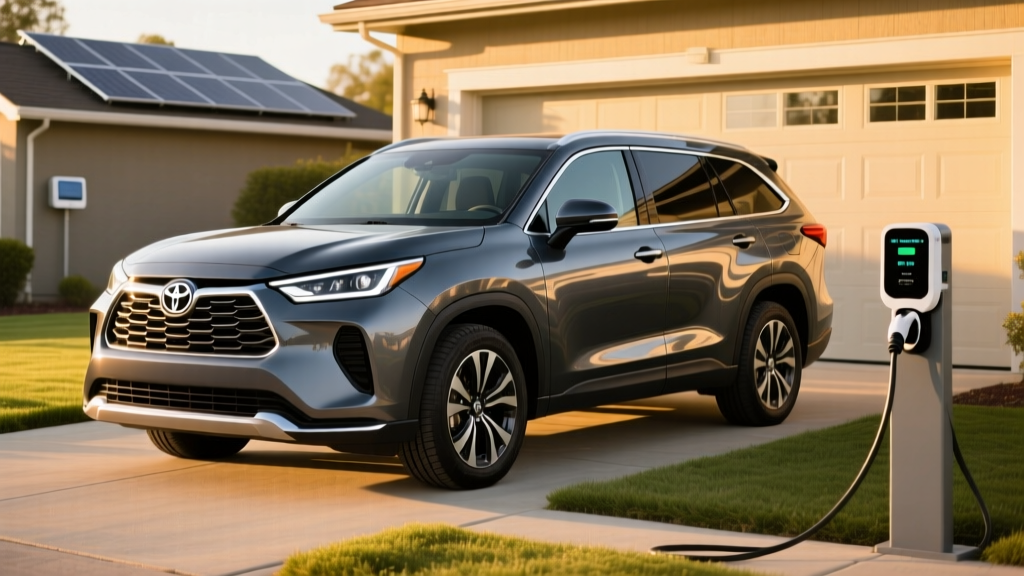
The 2024 Toyota Highlander Hybrid occupies a specific niche that few competitors can match: a three-row SUV delivering midsize-sedan fuel economy without requiring a plug, a charging routine, or any change in driving habits. With an EPA-rated 36 MPG combined, it undercuts nearly every rival in its class while offering Toyota's proven hybrid reliability. But it's not without compromises — namely modest power output and a third row that's best reserved for children.
If you're cross-shopping this against a plug-in hybrid (PHEV) or a full battery-electric vehicle (BEV), the calculus comes down to one question: do you want zero behavioral change with excellent efficiency, or are you willing to plug in nightly for electric-only driving? This guide breaks down every number that matters.
HEV vs. PHEV vs. EV: Where the Highlander Hybrid Fits
Conventional Hybrid (HEV) — The Highlander Hybrid is a self-charging hybrid. It uses a small battery (1.6 kWh nickel-metal hydride) that recharges through regenerative braking and the gasoline engine. You never plug it in. You simply fuel it with regular unleaded and drive. Electric-only operation is limited to brief low-speed bursts.
Plug-In Hybrid (PHEV) — Vehicles like the Toyota RAV4 Prime or Chrysler Pacifica Hybrid have larger batteries (18–26 kWh) that you plug in to charge, offering 30–42 miles of electric-only range before the gas engine engages. Toyota does not currently offer a Highlander PHEV in the U.S. market.
Battery Electric (BEV) — Vehicles like the Kia EV9 or Tesla Model X run entirely on electricity, require regular charging, and have no gasoline engine. They offer the lowest per-mile fuel cost but demand access to home or workplace charging infrastructure.
The Highlander Hybrid is strictly an HEV. There is no plug-in variant, and Toyota has not announced a PHEV version for the U.S. If you want plug-in capability in a Toyota three-row, you'll need to look at the Grand Highlander Hybrid (also HEV-only) or wait for future product announcements.
Fuel Economy: EPA Ratings and Real-World MPG
| Drivetrain | City MPG | Highway MPG | Combined MPG |
|---|---|---|---|
| FWD (LE, XLE, Limited) | 36 | 35 | 36 |
| AWD (all trims available) | 35 | 34 | 35 |
Source: EPA Fuel Economy
Real-World MPG Expectations: Toyota's hybrid system excels in stop-and-go city driving, where the electric motor handles low-speed propulsion and regenerative braking recaptures energy. In real-world testing, many owners report 37–40 MPG in city and suburban driving, exceeding the EPA city estimate. Highway driving at sustained 70–80 MPH typically yields 30–33 MPG, falling below the EPA highway number — a common pattern for hybrids, which benefit less from regenerative braking at constant speed. In cold weather (below 32°F), expect a 5–10% reduction as the engine runs more frequently to heat the cabin and warm the catalytic converter.
At 12,000 miles per year and $3.50/gallon regular unleaded, the AWD Highlander Hybrid costs roughly $1,200 annually in fuel. A comparable gas-only Highlander AWD (EPA 24 MPG combined) would cost approximately $1,750 — a savings of about $550 per year with the hybrid.
Powertrain and Performance Specifications
| Specification | Detail |
|---|---|
| Engine | 2.5L inline-4 Atkinson cycle |
| Engine Output | 186 HP / 186 lb-ft torque |
| Electric Motors | Front: 134 kW / Rear (AWD): 40 kW |
| Combined System Output | 243 HP |
| Transmission | eCVT (planetary gearset) |
| Hybrid Battery | 1.6 kWh NiMH (sealed, no plug) |
| 0–60 MPH | ~7.8 seconds (AWD) |
| Towing Capacity | 3,500 lbs |
| Curb Weight | 4,390–4,595 lbs |
| Fuel Tank | 17.9 gallons (regular unleaded) |
| Total Driving Range | ~625–645 miles (EPA combined) |
The 243-horsepower combined output is adequate for daily driving but not enthusiastic. Merging onto fast-moving highways requires planning, and the eCVT produces the characteristic drone under hard acceleration. The AWD system uses a dedicated rear electric motor rather than a mechanical driveshaft — it engages automatically when slip is detected and does not require driver input. This is a part-time AWD system suited for rain and light snow, not off-road duty.
Trims, Pricing, and Tax Credit Eligibility
| Trim | Drivetrain | MSRP (incl. destination) |
|---|---|---|
| LE | FWD / AWD | $40,720 / $42,320 |
| XLE | FWD / AWD | $43,920 / $45,520 |
| Limited | FWD / AWD | $48,970 / $50,570 |
| Platinum | AWD | $53,470 |
Federal Tax Credit: The Highlander Hybrid is a conventional HEV, not a plug-in vehicle. Under IRS §30D rules, the federal clean vehicle credit (up to $7,500) applies only to BEVs and PHEVs that meet battery-sourcing, critical-mineral, MSRP cap, and buyer income requirements. The Highlander Hybrid does not qualify for the §30D new-vehicle credit or the §25E used-vehicle credit.
Some states may offer rebates or HOV-lane access for hybrid vehicles independently of federal rules. Check your state's energy or DMV website for current programs, as these vary by jurisdiction and change frequently.
Reliability, Battery Warranty, and Replacement Costs
Hybrid Battery Warranty: Toyota covers the hybrid battery and all hybrid system components for 10 years or 150,000 miles (whichever comes first) on 2024 models. This applies to the original owner and is transferable to subsequent owners. The powertrain warranty covers the engine and eCVT for 5 years / 60,000 miles.
Toyota's hybrid system is among the most proven in the industry, with over two decades of real-world deployment since the original Prius. The 1.6 kWh NiMH battery in the Highlander Hybrid is small, operates within a conservative state-of-charge window (roughly 40–80%), and experiences minimal thermal stress compared to larger BEV or PHEV packs. Degradation is slow — most Toyota hybrid batteries outlast the warranty period without issue.
Replacement Cost: If the hybrid battery fails outside warranty, a new OEM replacement from Toyota typically costs $3,000–$4,500 including labor at a dealership. Refurbished or aftermarket NiMH modules are available from independent hybrid specialists for $1,500–$2,500 installed. Given the conservative operating parameters and Toyota's track record, most owners will never face this expense.
For broader reliability context, the Highlander consistently earns strong marks from IIHS and Toyota ranks near the top of J.D. Power's vehicle dependability studies year over year.
Who Should Choose the Highlander Hybrid vs. a PHEV or EV?
Reasons to Choose the Highlander Hybrid
- You want three rows and excellent fuel economy without plugging in
- You lack home or workplace charging access
- You take frequent long road trips and don't want to plan around chargers
- You value Toyota's hybrid reliability track record
- You want to reduce fuel costs by ~30% vs. the gas Highlander
Reasons to Look Elsewhere
- You want electric-only driving for short commutes (choose a PHEV like the Chrysler Pacifica Hybrid)
- You want maximum acceleration — 243 HP is modest for a 4,500-lb SUV
- You need a spacious adult-friendly third row (the Kia Telluride or Hyundai Palisade are roomier)
- You want zero tailpipe emissions (only a BEV delivers this)
- You want federal tax credit eligibility (BEVs and PHEVs may qualify)
Choose the Highlander Hybrid if: You prioritize hassle-free efficiency in a three-row package, have no reliable charging access, and drive a mix of city and highway miles. It's the default recommendation for families who want lower fuel bills without changing their routine.
Choose a PHEV (e.g., Chrysler Pacifica Hybrid) if: You have home charging, your daily commute is under 32 miles, and you want electric-only weekday driving with gas-engine flexibility for weekend road trips.
Choose a BEV (e.g., Kia EV9) if: You have Level 2 home charging, want zero tailpipe emissions, can accept a higher purchase price, and your daily driving is under 250 miles with occasional longer trips planned around DC fast charging.
Frequently Asked Questions
How many MPG does the 2024 Toyota Highlander Hybrid get?
The EPA rates the FWD model at 36 city / 35 highway / 36 combined MPG, and the AWD model at 35/34/35 MPG. In real-world driving, city and suburban MPG often exceeds the EPA estimate (37–40 MPG), while sustained highway driving at 75+ MPH typically drops to 30–33 MPG.
Does the Highlander Hybrid need to be plugged in?
No. The Highlander Hybrid is a conventional (self-charging) hybrid. Its 1.6 kWh NiMH battery recharges through regenerative braking and the gasoline engine. You fuel it normally at any gas station with regular 87-octane unleaded.
Is there a plug-in hybrid (PHEV) version of the Highlander?
Toyota does not offer a Highlander PHEV in the U.S. market. The closest Toyota PHEV is the RAV4 Prime (42 miles electric-only range), but it is a two-row compact SUV. If you need three rows with plug-in capability, the Chrysler Pacifica Hybrid (32 miles electric-only) is the primary alternative.
Does the Highlander Hybrid qualify for any federal tax credit?
No. Under current IRS §30D rules, only battery-electric vehicles and plug-in hybrids are eligible for the federal clean vehicle credit. Conventional hybrids like the Highlander Hybrid do not qualify. Some states may offer separate incentives — check your state's energy office for current programs.
How long will the hybrid battery last and what does replacement cost?
Toyota covers the hybrid battery for 10 years or 150,000 miles. Based on Toyota's long history with NiMH hybrid batteries, most units last well beyond the warranty period. If replacement is needed out of warranty, expect $3,000–$4,500 for a new OEM battery or $1,500–$2,500 for a refurbished unit from an independent specialist.
Is the Highlander Hybrid reliable?
Toyota's hybrid powertrain is among the most reliable in the automotive industry. The 2.5L Atkinson-cycle engine, eCVT, and NiMH battery are all proven technologies with millions of units in service globally. The Highlander earns top safety ratings from IIHS and NHTSA, and Toyota consistently ranks highly in long-term dependability surveys.
How does the Highlander Hybrid compare to the gas-only Highlander?
The gas-only 2024 Highlander uses a 2.4L turbocharged four-cylinder producing 265 HP and is rated at 22 city / 29 highway / 25 combined MPG (FWD). The hybrid sacrifices 22 HP but gains 11 combined MPG — a 44% improvement in fuel economy. The hybrid also costs roughly $2,500–$3,000 more at base trim, with the fuel savings paying back that premium in approximately 4–5 years at 12,000 miles/year and $3.50/gallon.