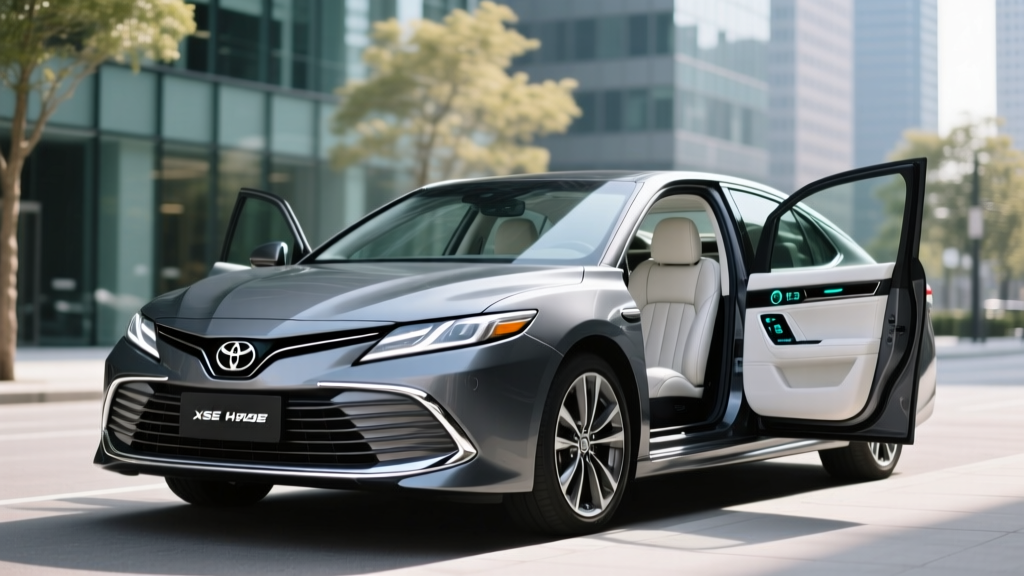
The 2024 Toyota Camry XSE Hybrid occupies a specific niche: sporty styling and sharper handling wrapped around one of the most proven hybrid powertrains on the market. As the final model year of the XV70 generation before Toyota's redesign, the 2024 Camry XSE Hybrid offers buyers a mature, well-debugged package with EPA-estimated 44 city / 47 highway / 46 combined MPG. For drivers not ready to commit to a plug-in hybrid or full EV but who want meaningful fuel savings over a gas-only midsize sedan, this is one of the strongest options available on the used and certified-pre-owned market heading into 2026.
This guide covers everything you need to evaluate the 2024 Camry XSE Hybrid as a purchase today — real-world fuel economy, powertrain specs, battery longevity, ownership costs, and how it stacks up against PHEV and EV alternatives.
HEV vs PHEV: Where the Camry XSE Hybrid Fits
Before diving into specs, it's critical to understand what this car is — and what it isn't. The 2024 Camry Hybrid is a conventional hybrid electric vehicle (HEV). It has no plug, no electric-only driving range, and no external charging capability. The hybrid battery recharges exclusively through regenerative braking and the gasoline engine.
| Feature | HEV (Camry Hybrid) | PHEV (e.g., Prius Prime) | BEV (e.g., Tesla Model 3) |
|---|---|---|---|
| Plug-in charging | No | Yes | Yes |
| Electric-only range | None (motor assists engine) | 25–44 miles typical | 250–360+ miles |
| Gasoline engine | Yes (primary power + charging) | Yes (backup + highway) | No |
| Federal tax credit (§30D) | Not eligible | Up to $7,500 (if eligible) | Up to $7,500 (if eligible) |
| Home charging needed | No | Recommended (Level 2) | Essential (Level 2) |
| Typical starting MSRP | ~$28,000–$34,000 | ~$33,000–$40,000 | ~$38,000–$55,000+ |
If you have access to home or workplace charging and a commute under 40 miles, a PHEV like the Toyota Prius Prime may save more fuel on a daily basis. If you lack charging access or frequently drive long distances without stopping, the Camry HEV's no-plug-needed simplicity is a genuine advantage.
Powertrain Specs: 208 HP From Toyota's Fourth-Gen Hybrid System
The 2024 Camry XSE Hybrid uses Toyota's fourth-generation hybrid synergy drive, pairing a 2.5-liter inline-4 Atkinson-cycle engine with two motor-generators and a lithium-ion hybrid battery pack. The XSE trim specifically gets a sport-tuned suspension, paddle shifters, and a slightly more aggressive throttle map compared to the LE and SE Hybrid trims.
| Engine | 2.5L 4-cyl Atkinson-cycle |
| Engine output | 176 HP / 163 lb-ft torque |
| Electric motor output | 118 HP (front motor) |
| Net combined horsepower | 208 HP |
| Hybrid battery | ~1.6 kWh lithium-ion (sealed NiMH on some early builds; Li-ion standard for 2024) |
| Transmission | eCVT (planetary gearset, no belt) |
| Drivetrain | FWD (AWD-e available on LE/SE, not XSE) |
| 0–60 mph | ~7.1 seconds |
| Curb weight | ~3,572 lbs |
| EPA fuel economy | 44 city / 47 highway / 46 combined MPG |
| Fuel tank | 13.2 gallons |
| Total range | ~607 miles (EPA est.) |
| Base MSRP (2024) | $33,495 (incl. $1,095 destination) |
The 208 combined HP figure places the XSE Hybrid ahead of most competing midsize hybrid sedans. The eCVT uses a planetary gearset rather than a belt-and-cone design, which is a key reason Toyota's hybrid transmissions have earned a reputation for exceptional longevity — there are no friction bands or clutch packs to wear out.
Fuel Economy: EPA Numbers vs Real-World MPG
According to fueleconomy.gov, the 2024 Camry XSE Hybrid achieves 44 city / 47 highway / 46 combined MPG. These are strong numbers for a midsize sedan, but the real-world picture deserves nuance.
| Condition | Expected MPG | Notes |
|---|---|---|
| EPA city | 44 MPG | Hybrids excel in stop-and-go (regen braking) |
| EPA highway | 47 MPG | Slightly higher than city — unusual for hybrids |
| EPA combined | 46 MPG | Weighted 55% city / 45% highway |
| Real-world mixed driving | 42–48 MPG | Owner-reported; varies by climate and terrain |
| Cold weather (below 32°F) | 36–42 MPG | Engine runs more for cabin heat; battery less efficient |
| Sustained 75+ mph highway | 38–43 MPG | Aero drag dominates; hybrid advantage diminishes |
| City-heavy commuting | 45–52 MPG | Low-speed regen maximizes electric assist |
The Camry Hybrid's highway MPG exceeding its city figure is somewhat unusual for hybrids, which typically shine in stop-and-go traffic. This is partly because Toyota's aerodynamic tuning and the XSE's 18-inch wheels (lower rolling resistance than expected for the size) help at speed. However, in real-world driving at 75–80 mph on flat interstate, expect a dip to the high 30s or low 40s. Cold weather further reduces efficiency because the engine must run more frequently to provide cabin heat and maintain battery temperature.
For comparison, the gas-only 2024 Camry with the same 2.5L engine (non-hybrid) rates at 28 city / 39 highway / 32 combined — a significant 14 MPG gap in combined driving.
Battery Warranty, Lifespan, and Replacement Cost
Battery longevity is the single most common concern among hybrid buyers, and it's one where Toyota has the longest track record in the industry.
| Hybrid battery warranty | 10 years / 150,000 miles (whichever comes first) |
| Hybrid system components | 8 years / 100,000 miles |
| Powertrain warranty | 5 years / 60,000 miles |
| Basic (bumper-to-bumper) | 3 years / 36,000 miles |
| Warranty transferable | Yes — fully transferable to subsequent owners |
Toyota's 10-year/150,000-mile hybrid battery warranty applies in all 50 states (previously it was 10 years/150,000 miles only in CARB states and 8 years/100,000 miles elsewhere, but Toyota unified this starting with the 2020 model year). The warranty covers the hybrid battery pack against defects and capacity loss below a defined threshold.
Real-world lifespan data: Toyota's hybrid batteries in the Camry and Prius have demonstrated remarkable longevity. Multiple fleet and taxi studies, along with owner surveys on platforms like NHTSA, show that the majority of Toyota hybrid battery packs last well beyond 150,000 miles without replacement. It's not uncommon to see Camry Hybrids reaching 200,000–250,000 miles on the original battery.
Replacement cost if out of warranty: Should the hybrid battery fail outside the warranty period, a new OEM replacement from Toyota costs approximately $2,500–$3,500 including labor at a dealership. Refurbished or aftermarket options are available for $1,200–$2,000. Individual battery modules can sometimes be replaced for $300–$600 if only a few cells have degraded — a repair some independent hybrid specialists offer. This is a fraction of the cost of a full EV battery replacement, which can exceed $10,000–$15,000.
Pricing, Tax Credits, and Ownership Economics
The 2024 Camry XSE Hybrid carried an MSRP of $33,495 including destination. Popular options like the panoramic glass roof, JBL audio, and navigation pushed well-equipped examples to $36,000–$38,000. As a previous model year, certified pre-owned (CPO) and used examples in 2026 typically list between $24,000 and $31,000 depending on mileage and condition.
Federal Tax Credit Eligibility
The 2024 Camry Hybrid does not qualify for the federal §30D Clean Vehicle Credit. Under current IRS rules, the §30D credit of up to $7,500 applies only to plug-in electric vehicles (BEVs and PHEVs) that meet battery sourcing, critical minerals, MSRP cap, and buyer income requirements. Conventional hybrids like the Camry HEV are explicitly excluded.
Some states may offer modest incentives for hybrid purchases — check your state's energy office or department of environmental quality for current programs. However, these are typically smaller ($500–$1,500) and less common than EV incentives.
Five-Year Fuel Cost Comparison
The economic case for the Camry Hybrid rests on fuel savings. At 15,000 miles per year and $3.40/gallon regular unleaded:
| Camry XSE Hybrid (46 MPG) | Camry XSE Gas (26 MPG combined) | |
|---|---|---|
| Annual fuel use | 326 gallons | 577 gallons |
| Annual fuel cost | $1,109 | $1,962 |
| 5-year fuel cost | $5,545 | $9,810 |
| 5-year savings (Hybrid) | $4,265 saved | |
That ~$4,265 fuel savings over five years helps offset the Hybrid's typical $1,500–$2,000 price premium over the gas-only XSE. Factoring in slightly higher insurance premiums for the hybrid (typically 3–7% more), the net savings still favor the hybrid for most buyers who keep the car beyond three years.
Who Should Choose the 2024 Camry XSE Hybrid?
Choose the Camry XSE Hybrid if:
- You lack access to home or workplace EV charging
- Your commute is mixed city/highway and exceeds 40 miles daily
- You want lower fuel costs without changing any driving or fueling habits
- You value Toyota's long-term reliability track record and strong resale value
- You want a sport-tuned suspension and 208 HP without the fuel penalty of a turbocharged gas sedan
Look at a PHEV instead if:
- You have home Level 2 charging and a commute under 40 miles (consider the Prius Prime)
- You want some electric-only driving for short errands while retaining gas range for road trips
- You want to qualify for the $7,500 federal tax credit (subject to income and sourcing rules)
Look at a full EV instead if:
- You have reliable home charging and rarely drive more than 250 miles between stops
- You want zero tailpipe emissions and the lowest per-mile "fuel" cost
- You want to maximize federal and state incentives
Pros and Cons
Pros
- 46 MPG combined EPA — real-world often matches or exceeds in city driving
- 208 HP provides confident passing power; sport-tuned suspension on XSE
- No plug needed — zero infrastructure requirements
- 10-year/150,000-mile hybrid battery warranty, fully transferable
- Proven eCVT planetary gearset — one of the most reliable transmissions in the industry
- Strong resale value; Camry Hybrids hold value well in the used market
- Over 600 miles of total range per tank
Cons
- No electric-only driving mode — always uses some gasoline
- No federal tax credit eligibility (§30D excludes conventional hybrids)
- XSE trim unavailable with AWD-e (AWD limited to LE and SE Hybrid)
- Highway MPG drops noticeably at sustained 75+ mph speeds
- Cabin noise under hard acceleration (4-cylinder drone through eCVT)
- Final year of this generation — 2025+ redesign offers updated tech and styling
Frequently Asked Questions
How many MPG does the 2024 Toyota Camry XSE Hybrid get?
The EPA rates the 2024 Camry XSE Hybrid at 44 city / 47 highway / 46 combined MPG. In real-world driving, owners commonly report 42–48 MPG in mixed conditions. City-heavy commutes can push into the low 50s, while sustained high-speed highway driving and cold weather can drop it to 36–43 MPG.
Does the Camry Hybrid need to be plugged in?
No. The 2024 Camry Hybrid is a conventional HEV, not a plug-in hybrid. The lithium-ion battery recharges through regenerative braking and the gasoline engine. You never plug it in — you simply fill it with gas like any other car.
Is the 2024 Camry XSE Hybrid reliable, and what does a battery replacement cost?
Toyota's hybrid system is among the most reliable powertrains in the automotive industry. The hybrid battery is covered by a 10-year/150,000-mile warranty, and real-world data shows most packs last 180,000+ miles without issue. If replacement is needed out of warranty, expect $2,500–$3,500 for a new OEM battery, or $1,200–$2,000 for a refurbished unit.
Does the 2024 Camry Hybrid qualify for any tax credit?
No. The federal §30D Clean Vehicle Credit applies only to plug-in vehicles (BEVs and PHEVs). Conventional hybrids like the Camry HEV are not eligible. Some states may offer small hybrid incentives — check your local programs.
How does the Camry Hybrid compare to a PHEV like the Prius Prime?
The Prius Prime (PHEV) offers up to 44 miles of electric-only range and qualifies for up to $7,500 in federal tax credits, but requires home charging to realize its benefits. The Camry Hybrid needs no plug, offers more interior space and a more traditional sedan driving experience, and is simpler to own if you lack charging access. If you can charge at home and commute under 40 miles, the Prius Prime will use less gasoline day-to-day.
Can I get AWD on the 2024 Camry XSE Hybrid?
No. The AWD-e system (which uses a rear-mounted electric motor for all-wheel drive) is available only on the LE and SE Hybrid trims for 2024. The XSE Hybrid is front-wheel drive only. If AWD is essential, you'll need to step down to the SE Hybrid or look at the upcoming redesigned generation.