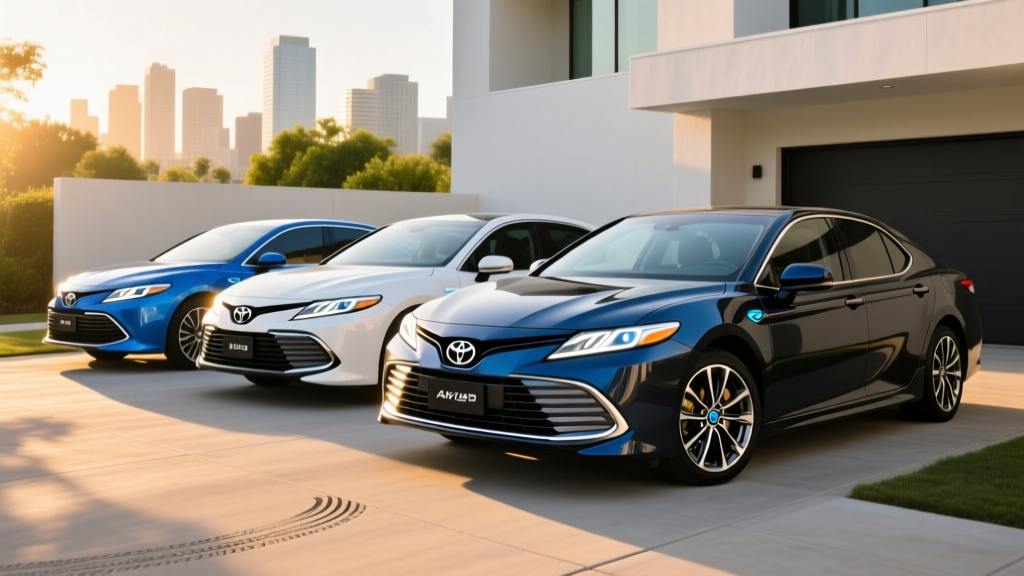
The 2024 Toyota Camry Hybrid remains one of the best-selling electrified sedans in the U.S., and for good reason: it delivers diesel-rivaling fuel economy without requiring a plug, a price change, or a lifestyle adjustment. But Toyota offers four distinct trim levels — LE, SE, XLE, and XSE — each with different powertrain outputs, drivetrain options, and efficiency ratings. Choosing the right configuration depends on whether you prioritize maximum MPG, sportier handling, or premium features.
This guide breaks down every 2024 Toyota Camry Hybrid configuration with exact EPA numbers, real-world efficiency expectations, battery warranty coverage, and how it stacks up against both plug-in hybrids and full EVs.
All 2024 Camry Hybrid Trim Levels at a Glance
Toyota offers the Camry Hybrid in four trims. The LE, XLE, and XSE are available with either front-wheel drive (FWD) or electronic all-wheel drive (eAWD). The SE is FWD only. All trims share the same 2.5-liter four-cylinder hybrid powertrain, but tuning and wheel sizes shift the EPA ratings by a few MPG.
| Trim | Drivetrain | Combined HP | EPA City / Hwy / Combined | Base MSRP |
|---|---|---|---|---|
| LE | FWD or eAWD | 208 hp (FWD) / 219 hp (AWD) | 51 / 53 / 52 (FWD) 44 / 43 / 44 (AWD) | $28,855 (FWD) $30,255 (AWD) |
| SE | FWD | 208 hp | 44 / 47 / 44 | $30,490 |
| XLE | FWD or eAWD | 208 hp (FWD) / 219 hp (AWD) | 44 / 47 / 44 (FWD) 44 / 43 / 44 (AWD) | $33,295 (FWD) $34,695 (AWD) |
| XSE | FWD or eAWD | 208 hp (FWD) / 219 hp (AWD) | 44 / 47 / 44 (FWD) 44 / 43 / 44 (AWD) | $35,195 (FWD) $36,595 (AWD) |
The LE FWD is the efficiency king of the lineup at 52 MPG combined, thanks to lighter weight, smaller 16-inch wheels, and lower rolling-resistance tires. Every other trim rides on 18- or 19-inch wheels with stickier rubber, dropping the combined figure to 44 MPG — still exceptional for a midsize sedan.
EPA MPG vs Real-World Fuel Economy
Toyota's hybrid synergy drive system excels in stop-and-go traffic, where the electric motor handles low-speed propulsion and the gas engine shuts off at stops. This means Camry Hybrid owners often exceed EPA city estimates in real-world driving — the opposite of what happens with most gas-only cars.
| Driving Scenario | EPA Estimate | Real-World Expectation |
|---|---|---|
| City (stop-and-go) | 51 MPG | 52–58 MPG |
| Highway (steady 70 mph) | 53 MPG | 45–50 MPG |
| Combined (mixed driving) | 52 MPG | 48–54 MPG |
| Cold weather (below 35°F) | — | 42–48 MPG |
Highway driving is where the Camry Hybrid loses its advantage relative to the EPA sticker. At sustained speeds above 65 mph, the gasoline engine does nearly all the work, and aerodynamic drag dominates. In EPA testing data from fueleconomy.gov, the LE FWD posts 53 highway MPG, but expect 45–50 on a flat interstate in moderate temperatures. Cold weather further reduces efficiency because the engine runs more often to provide cabin heat and warm the catalytic converter.
Hybrid (HEV) vs Plug-In Hybrid (PHEV): What's the Difference?
The 2024 Camry Hybrid is a conventional hybrid (HEV). It does not have a plug and cannot be charged from an external source. The small 1.6 kWh nickel-metal hydride (NiMH) traction battery charges exclusively through regenerative braking and the gasoline engine. Toyota does not currently offer a Camry plug-in hybrid in the U.S. market.
| Feature | HEV (Camry Hybrid) | PHEV (e.g., Prius Prime) | BEV (e.g., Tesla Model 3) |
|---|---|---|---|
| Plug required? | No | Yes (optional) | Yes (mandatory) |
| Electric-only range | ~1 mile at low speed | 25–44 miles | 250–360 miles |
| Battery capacity | 1.6 kWh (NiMH) | 13.6 kWh (Li-ion) | 50–82 kWh (Li-ion) |
| Home charging | Not needed | Level 1 or Level 2 | Level 2 recommended |
| DC fast charging | No | No (Prius Prime) | Yes |
| Federal tax credit (§30D) | Not eligible | Up to $7,500* | Up to $7,500* |
* §30D credit eligibility depends on MSRP caps, buyer income limits, and battery-component/critical-mineral sourcing. See IRS clean vehicle credit rules for current-year requirements.
If you want electric-only commuting without range anxiety on road trips, the Toyota Prius Prime (44 miles electric-only, ~500 miles total range) fills the PHEV role Toyota used to offer on the Camry in select Asian markets. But for buyers who simply want excellent fuel economy without changing their refueling habits, the Camry HEV is the right tool.
Powertrain Deep Dive: 208 vs 219 Horsepower
Every 2024 Camry Hybrid pairs a 2.5-liter Dynamic Force inline-four (176 hp, 163 lb-ft) with one or two electric motor-generators through Toyota's eCVT planetary-gear transmission.
- FWD trims (LE, SE, XLE, XSE FWD): Single front motor-generator adds 88 kW (118 hp). Net system output: 208 hp. 0–60 mph in approximately 7.6 seconds.
- eAWD trims (LE, XLE, XSE AWD): A second 30 kW (40 hp) motor drives the rear axle when slip is detected or under hard acceleration. Net system output: 219 hp. 0–60 mph in approximately 7.3 seconds.
The eAWD system is not a traditional mechanical AWD with a driveshaft. The rear motor engages from standstill through approximately 43 mph and can reactivate at higher speeds if the front wheels lose traction. It adds roughly 165 lbs to the curb weight and costs $1,400 across all trims — a reasonable premium for all-weather traction without the MPG penalty of a conventional AWD system.
Hybrid Battery Warranty and Replacement Cost
Toyota Hybrid Battery Warranty: 10 years / 150,000 miles (whichever comes first) on the hybrid traction battery and all hybrid-system components, including the inverter, motor-generators, and eCVT. This warranty applies to all 50 states and is fully transferable to subsequent owners.
Toyota's hybrid battery track record is among the best in the industry. The Camry Hybrid uses a proven nickel-metal hydride (NiMH) pack — less energy-dense than lithium-ion but extremely durable and thermally stable. Real-world data from fleet operators and high-mileage owners shows these packs routinely exceed 200,000 miles with minimal capacity loss.
If replacement is ever needed out of warranty, a new OEM hybrid battery from Toyota runs approximately $2,500–$3,800 installed at a dealer. Third-party refurbished packs are available for $1,500–$2,200. Compare that to a full EV battery replacement at $8,000–$20,000, and the hybrid's long-term cost advantage becomes clear.
The 12V auxiliary battery (a separate, smaller battery that powers electronics when the car is off) is a standard AGM unit and typically lasts 4–6 years. Replacement costs $200–$350 — same as any conventional car.
Does the 2024 Camry Hybrid Qualify for a Tax Credit?
No. The 2024 Camry Hybrid is a conventional HEV and does not qualify for the federal §30D Clean Vehicle Credit. That credit applies only to plug-in electric vehicles (BEVs and PHEVs) with a minimum 7 kWh battery capacity, which the Camry Hybrid's 1.6 kWh pack does not meet.
However, a few financial considerations remain relevant:
- State incentives: A handful of states offer rebates or HOV-lane access for hybrids, though most have shifted incentives toward PHEVs and BEVs. Check your state's energy office for current programs.
- Fuel savings: At 52 MPG combined and $3.50/gallon gas, a Camry Hybrid LE driver covering 15,000 miles/year spends roughly $1,010 on fuel annually. A comparable 30 MPG gas sedan costs $1,750 — a $740/year savings that adds up to $3,700 over five years.
- Lower insurance: Hybrid Camrys typically carry insurance premiums comparable to gas versions, unlike some EVs that see 15–25% higher rates.
2024 Camry Hybrid vs the Alternatives
Pros
- Best-in-class 52 MPG combined (LE FWD)
- No plug or charging infrastructure required
- 10-year / 150,000-mile hybrid battery warranty
- Strong resale value and Toyota reliability reputation
- eAWD available on three of four trims
- Proven NiMH battery chemistry with 200k+ mile track record
Cons
- Only 208–219 hp — adequate, not quick
- AWD trims drop to 44 MPG combined
- No PHEV variant available in the U.S.
- eCVT drone under hard acceleration
- No federal tax credit eligibility
- SE and sport trims sacrifice 8 MPG for larger wheels
Choose the Camry Hybrid if: You want maximum fuel economy with zero behavior change, you lack home charging access, or you frequently drive in areas with sparse EV charging infrastructure.
Choose a PHEV (Prius Prime) if: You have home Level 2 charging and a short commute (under 40 miles) that you want to drive mostly on electricity, while keeping gas capability for road trips.
Choose a full EV (Model 3, Ioniq 6) if: You have reliable home charging, want the lowest per-mile energy cost (~$0.04/mile vs $0.07/mile for the Camry Hybrid), and qualify for the $7,500 federal credit that narrows the price gap.
Frequently Asked Questions
How many MPG does the 2024 Camry Hybrid actually get?
The EPA rates the LE FWD at 51 city / 53 highway / 52 combined. Real-world city driving often yields 52–58 MPG thanks to regenerative braking. Highway driving typically returns 45–50 MPG. AWD and sport trims are rated at 44 combined.
Does the Camry Hybrid need to be plugged in?
No. The 2024 Camry Hybrid is a conventional (self-charging) hybrid. Its 1.6 kWh battery charges through regenerative braking and the gasoline engine. There is no plug, no charging cable, and no home charger required.
Is the Camry Hybrid battery expensive to replace?
Out-of-warranty replacement costs $2,500–$3,800 for a new OEM pack, or $1,500–$2,200 for a refurbished unit. However, Toyota's NiMH hybrid batteries routinely last 200,000+ miles, and the 10-year / 150,000-mile warranty covers most owners through the vehicle's prime lifespan.
Does the 2024 Camry Hybrid qualify for any federal tax credit?
No. The §30D Clean Vehicle Credit requires a minimum 7 kWh battery and plug-in capability. The Camry Hybrid's 1.6 kWh NiMH battery does not qualify. Only BEVs and PHEVs (like the Prius Prime) are eligible for federal credits.
What's the difference between FWD and eAWD on the Camry Hybrid?
eAWD adds a 40 hp rear electric motor that engages automatically for improved traction in rain, snow, and hard acceleration. It costs $1,400 extra, adds 219 total system horsepower, but drops combined MPG from 52 to 44 on the LE trim.
Is the 2024 Camry Hybrid reliable?
Toyota's hybrid powertrain is one of the most proven in the industry, with over 25 years of production history since the original Prius. The Camry Hybrid consistently earns high reliability scores from Consumer Reports and Top Safety Pick+ recognition from IIHS. The hybrid battery, inverter, and eCVT are covered for 10 years / 150,000 miles.