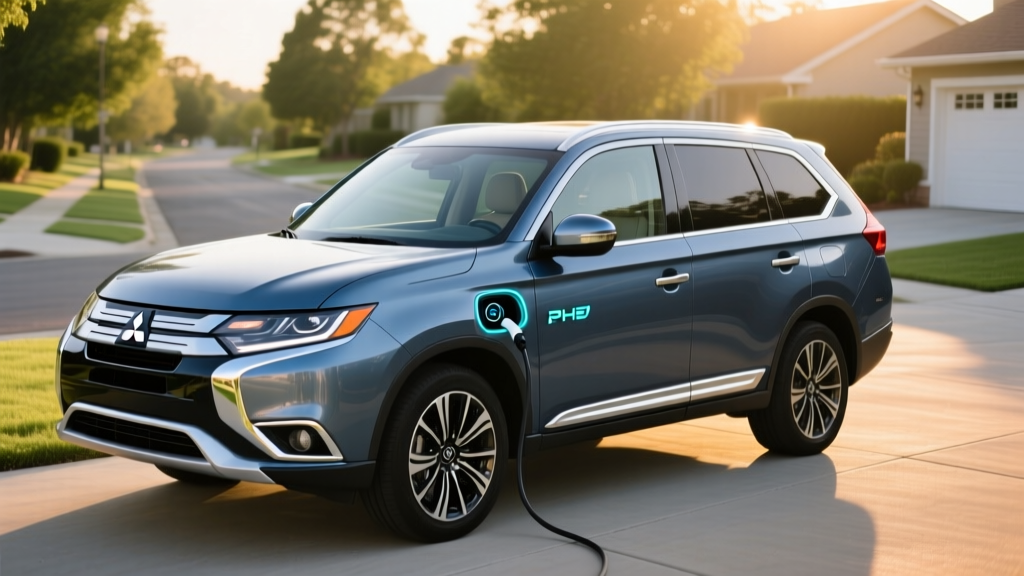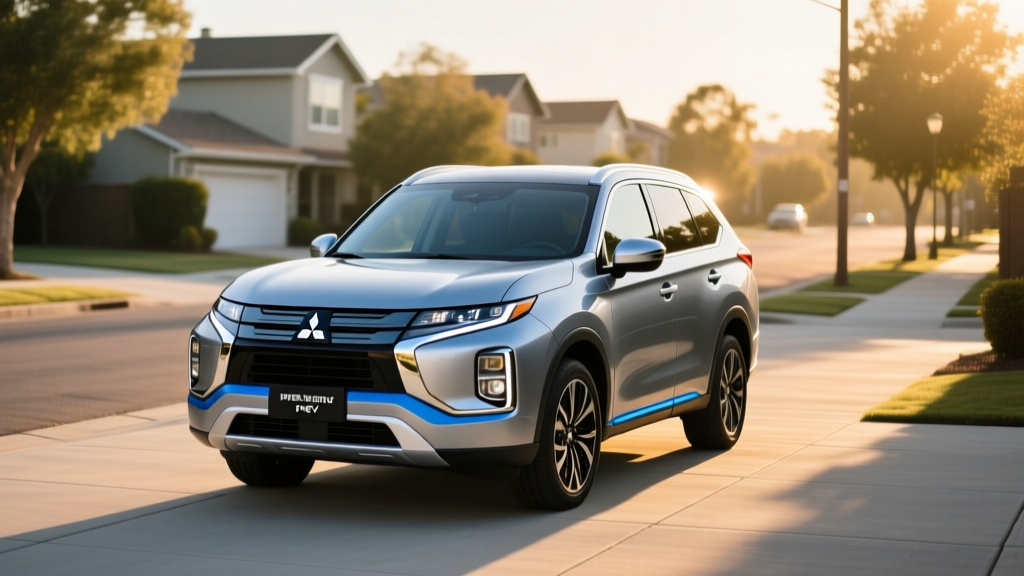
The Mitsubishi Outlander PHEV occupies a specific niche: a three-row plug-in hybrid SUV that undercuts rivals on price while delivering genuine electric-only commuting capability. The 2024 model year carries over the redesigned platform introduced in 2023, pairing a 2.4-liter Atkinson-cycle four-cylinder with twin electric motors and a 20 kWh battery pack. For buyers weighing whether a PHEV bridges the gap between a conventional hybrid and a full battery-electric vehicle, the Outlander PHEV provides a concrete test case with published EPA numbers, known charging behavior, and a price point that starts at $34,695.
This guide breaks down the 2024 Outlander PHEV's efficiency, powertrain, charging, ownership costs, and tax-credit eligibility with exact figures — so you can decide whether it fits your commute, your garage, and your budget.
HEV vs PHEV: What the Outlander Actually Is
Before evaluating specs, it is essential to distinguish between a conventional hybrid (HEV) and a plug-in hybrid (PHEV), because the Outlander is sold only as a PHEV in the United States. Mitsubishi does not offer a non-plug-in hybrid Outlander for the US market.
| Feature | Conventional Hybrid (HEV) | Plug-In Hybrid (PHEV) |
|---|---|---|
| Battery size | 1–2 kWh | 13–20+ kWh |
| Plug-in charging | No — charges via regen & engine | Yes — Level 1, Level 2, some DC |
| Electric-only range | 0–2 miles at low speed | 20–50 miles typical |
| Gas engine role | Primary propulsion + battery charging | Backup after battery depletes; can drive wheels directly |
| Federal tax credit | Generally not eligible | May qualify for up to $7,500 (§30D) |
The 2024 Outlander PHEV's 20 kWh battery (gross capacity) enables it to operate as a short-range EV for daily commuting, then seamlessly switch to hybrid mode for longer trips. This dual nature is the defining advantage — and the defining complexity — of the PHEV segment.
EPA Range, MPGe, and Fuel Economy
The EPA rates the 2024 Outlander PHEV at 64 MPGe combined when operating on electricity and 26 MPG combined once the battery is depleted and the vehicle runs as a conventional hybrid.
| Metric | City | Highway | Combined |
|---|---|---|---|
| Charge-depleting (EV mode) | 64 MPGe combined | ||
| Charge-sustaining (hybrid mode) | 25 MPG | 27 MPG | 26 MPG |
| Electric-only range | 38 miles (EPA) | ||
| Total range (EV + gas) | ~420 miles | ||
| Fuel tank | 14.8 gallons | ||
Real-World Range Expectations: The EPA's 38-mile electric range assumes moderate temperatures and mixed driving. In our experience with PHEVs of this battery size, expect 30–35 miles of electric range in summer highway driving and 22–28 miles in winter conditions (below 40°F), where cabin heating draws heavily from the pack. City driving at moderate speeds can match or slightly exceed the EPA figure. Once the battery depletes, the 26 MPG combined figure is realistic for mixed use — though highway-only cruising at 75+ mph may yield 24–25 MPG.
Powertrain and Performance Specs
| Engine | 2.4L Atkinson-cycle 4-cylinder (126 hp, 147 lb-ft) |
| Front electric motor | 114 hp (85 kW), 188 lb-ft |
| Rear electric motor | 134 hp (100 kW), 144 lb-ft |
| Combined system output | 248 hp |
| Drivetrain | S-AWC (all-wheel drive, standard on all trims) |
| Battery (gross / usable) | 20 kWh / ~17.5 kWh usable |
| Battery chemistry | NMC (nickel manganese cobalt) |
| Transmission | Single-speed reduction gear (no traditional transmission) |
| 0–60 mph | ~7.1 seconds |
| Towing capacity | 1,500 lbs |
| Seating | 3 rows / 7 passengers |
| Cargo (behind 3rd row) | 10.9 cu ft |
The Outlander PHEV's powertrain uses Mitsubishi's twin-motor layout with the gasoline engine primarily serving as a generator in EV and Series Hybrid modes. At highway speeds, a clutch engages to let the engine drive the front wheels directly (Parallel Hybrid mode), which improves efficiency over pure generator operation. This multi-mode approach is similar to what Honda uses in its two-motor hybrid system, though Mitsubishi adds the rear motor for standard all-wheel drive.
The 248 combined horsepower figure is competitive for the segment, though the Outlander's ~4,700-lb curb weight means acceleration feels adequate rather than brisk. The S-AWC system provides genuine all-weather capability, distributing torque between front and rear axles via the independent motors.
Charging: Speeds, Connectors, and Times
Charging is where the Outlander PHEV distinguishes itself from most competitors: it supports DC fast charging, which is uncommon in the PHEV segment.
| Level | Power | Connector | Time (0–100% / 0–80%) | Miles of EV Range Added |
|---|---|---|---|---|
| Level 1 (120V household) | ~1.4 kW | J1772 | ~14 hours (full) | ~3 mi/hr |
| Level 2 (240V home/public) | ~3.3 kW (onboard charger limit) | J1772 | ~6.5 hours (full) | ~11 mi/hr |
| DC Fast Charge | Up to 22 kW peak | CHAdeMO | ~38 min (0–80%) | N/A (burst charging) |
Critical note on the onboard charger: The Outlander PHEV's onboard AC charger is limited to 3.3 kW. Even if you plug into a 48-amp Level 2 station capable of delivering 11.5 kW, the vehicle will accept only 3.3 kW. This means a full charge from empty takes roughly 6.5 hours on any Level 2 source — overnight charging works fine, but you will not top up quickly during a midday stop.
The CHAdeMO caveat: Mitsubishi uses the CHAdeMO DC fast-charging standard, not the CCS1 or NACS connectors now dominant in North America. CHAdeMO infrastructure is shrinking — Electrify America and most new networks have standardized on CCS1 or NACS. While the Outlander's 22 kW DC fast-charge rate is modest by full-EV standards, it can add roughly 20 miles of EV range in 25 minutes at a compatible CHAdeMO station, which is useful for errands. Just verify CHAdeMO availability on your routes via apps like PlugShare before relying on it.
Pricing, Trims, and Tax Credit Eligibility
| Trim | MSRP | Key Features |
|---|---|---|
| ES | $34,695 | 7-passenger, S-AWC, 8" display, heated front seats |
| SE | $37,295 | Synthetic leather, power liftgate, dual-zone climate |
| SEL | $39,795 | Genuine leather, Bose audio, 9" display, panoramic roof available |
| SEL Platinum (40th Anniversary) | $41,595 | Unique badging, premium interior, black chrome accents |
| GT-Premium | $43,595 | Quilted leather, heated steering wheel, ventilated front seats, 10.8" HUD |
All prices include destination. The Outlander PHEV is one of the most affordable three-row PHEVs available, undercutting the Toyota RAV4 Prime (which seats five) and the Kia Sorento PHEV by several thousand dollars at the base trim.
Federal Tax Credit (§30D) Eligibility
The 2024 Outlander PHEV may qualify for a partial or full federal tax credit under IRS §30D rules. Eligibility depends on multiple factors:
- Vehicle MSRP cap: SUVs must be below $80,000 — all Outlander PHEV trims qualify.
- Buyer income cap: Modified AGI must not exceed $150,000 (single), $225,000 (head of household), or $300,000 (joint filers).
- Battery sourcing requirements: The credit is split into two $3,750 halves — one for critical-minerals sourcing and one for battery-component manufacturing. PHEVs with smaller batteries often qualify for one half but not both, depending on supply-chain compliance for the model year.
- Point-of-sale transfer: As of 2024, eligible buyers can transfer the credit to the dealer at purchase, reducing the out-of-pocket price immediately rather than waiting for a tax return.
Bottom line: Verify current eligibility on fueleconomy.gov and consult a tax professional. The Outlander PHEV's battery sourcing has historically qualified for at least $3,750, but rules tighten annually and final credit amounts can change.
Real-World Efficiency: What Owners Actually See
EPA numbers provide a baseline, but PHEV real-world efficiency depends heavily on how you use the vehicle. The Outlander PHEV rewards a specific usage pattern: plug in nightly, commute within the 38-mile EV envelope, and let the hybrid system handle occasional long trips.
Optimal scenario (daily plug-in, short commute): Owners who charge nightly and drive fewer than 35 miles per day may go months without buying gas. Mitsubishi's own data suggests that consistent plug-in users average the equivalent of 50–80+ MPGe over thousands of miles, because the gasoline engine rarely runs.
Suboptimal scenario (never plugging in): If you buy the Outlander PHEV but never charge it, you are carrying ~600 lbs of dead battery weight and will see the charge-sustaining 26 MPG combined — worse than some conventional hybrid SUVs like the Toyota Highlander Hybrid (35 MPG combined). A PHEV that is never plugged in is simply a heavier, more expensive hybrid.
Highway road trips: On a 500-mile interstate drive at 75 mph, expect the first 30–35 miles on electric, then 24–26 MPG for the remaining distance on gasoline. Total fuel cost will be comparable to a mid-efficiency gas SUV, not dramatically better. The PHEV advantage is overwhelmingly in city and suburban driving where regenerative braking and electric-only operation shine.
Cold-weather impact: Below freezing, the gasoline engine may start automatically to provide cabin heat (unless you precondition while plugged in, which uses grid power instead). Winter electric range typically drops to 22–28 miles. This is normal PHEV behavior, not a defect.
Reliability, Battery Warranty, and Replacement Cost
Battery & Powertrain Warranty Coverage
- Drive battery: 10 years / 100,000 miles (capacity retention warranty — Mitsubishi covers repair or replacement if the battery falls below a specified capacity threshold, typically ~70%)
- Powertrain (engine, motors, transaxle): 10 years / 100,000 miles
- Bumper-to-bumper: 5 years / 60,000 miles
- Roadside assistance: 5 years / unlimited miles
Mitsubishi's warranty coverage is among the strongest in the industry, which partially offsets the brand's mixed reputation for long-term reliability. The 10-year/100,000-mile powertrain and battery warranty provides genuine peace of mind for PHEV buyers concerned about battery degradation.
Real-world degradation data: PHEV batteries, being smaller and cycled more frequently than full-EV batteries, can show measurable degradation over time. However, the Outlander PHEV's battery management system maintains a generous buffer (roughly 2.5 kWh reserved at the top and bottom of the pack) to protect cell health. Owner reports from earlier-generation Outlander PHEVs (2018–2022 with smaller 13.8 kWh packs) suggest 10–15% capacity loss after 5 years / 60,000 miles — meaning a vehicle that originally delivered 24 EV miles might deliver 20–22 after five years. The larger 2023+ 20 kWh pack has less real-world track record, but the buffer strategy should yield similar proportional retention.
Battery replacement cost: If the drive battery requires replacement outside of warranty coverage, expect a parts-and-labor cost in the $8,000–$12,000 range based on current Mitsubishi dealer pricing for the 20 kWh pack. This is a significant expense, though the 10-year warranty means most original owners will never face it. For secondhand buyers, verifying remaining warranty coverage is essential.
NHTSA safety ratings for the 2024 Outlander PHEV should be checked directly on their site, as crash-test results are updated throughout the model year.
Who Should Choose the Outlander PHEV (vs. a Full EV or Gas Car)
Pros
- Genuine 38-mile EV range covers most commutes without gas
- Standard AWD on every trim — rare at this price point
- Three-row seating (7 passengers) — unique in the PHEV segment under $45k
- DC fast charging capability (CHAdeMO) uncommon for PHEVs
- 10-year/100,000-mile battery and powertrain warranty
- Base MSRP of $34,695 undercuts most PHEV rivals
Cons
- 3.3 kW onboard AC charger limits Level 2 speed
- CHAdeMO DC connector is losing infrastructure support to CCS/NACS
- 26 MPG charge-sustaining is mediocre for a hybrid — no better than many gas SUVs
- Third row is tight for adults; cargo space limited with all rows up
- Towing capacity just 1,500 lbs
- No conventional HEV version available in the US
Decision Framework
Choose the Outlander PHEV if: You have home charging access (even a standard 120V outlet works overnight), your daily round-trip commute is under 35 miles, you need three rows occasionally, and you want AWD without committing to a full EV. The Outlander PHEV is ideal as a one-vehicle household solution that eliminates most daily fuel use while preserving road-trip flexibility.
Choose a full EV (like a Tesla Model Y or Kia EV9) if: You have reliable home Level 2 charging, rarely drive more than 250 miles in a single day, and want the lowest per-mile operating cost and minimal maintenance. A full EV eliminates oil changes, exhaust repairs, and transmission service entirely.
Choose a conventional hybrid (like a Toyota Highlander Hybrid) if: You cannot charge at home or at work, you primarily drive long highway distances, or you want the simplicity of a gas-and-go vehicle with no plug-in routine. A conventional HEV delivers 35+ MPG without any behavioral change.
Choose a gas SUV if: You drive very few miles annually (under 8,000), where the fuel savings of electrification will never offset the higher purchase price, or you regularly tow more than 3,500 lbs.
Ownership Costs: 5-Year Snapshot
| Cost Category | Outlander PHEV SEL | Comparable Gas SUV (AWD, 3-row) |
|---|---|---|
| MSRP | $39,795 | $37,500 |
| Est. federal tax credit | −$3,750 (partial, verify eligibility) | $0 |
| Effective purchase price | $36,045 | $37,500 |
| Fuel / electricity (60,000 mi, 70% EV driving) | ~$2,800 | ~$7,200 (at 24 MPG avg, $3.60/gal) |
| Maintenance (oil, filters, brakes) | ~$1,600 | ~$3,200 |
| Insurance (5-yr estimate) | ~$7,500 | ~$6,800 |
| Estimated 5-yr total cost | ~$47,945 | ~$54,700 |
The Outlander PHEV's fuel savings are substantial if you plug in regularly. The 70% EV-driving assumption reflects a household that charges nightly and takes a handful of long road trips per year. If you never plug in, fuel costs rise to roughly $5,500 over 60,000 miles — still a savings over the gas baseline, but far less compelling. Insurance tends to run slightly higher for PHEVs due to repair complexity; get quotes before purchasing.
Home Charging Setup for the Outlander PHEV
Because the Outlander PHEV's onboard charger maxes out at 3.3 kW, you do not need an expensive high-amperage home charger. A basic 16-amp, 240V Level 2 unit (delivering ~3.8 kW, of which the car uses 3.3 kW) is sufficient. Popular options like the Emporia Vue or ChargePoint Home Flex (set to 16 amps) cost $300–$500 for the unit.
| Item | Cost Range |
|---|---|
| Level 2 charger (16–32 amp, hardwired or NEMA 14-50) | $300–$550 |
| Electrician labor (240V circuit, 50-ft run average) | $500–$1,500 |
| Permit and inspection | $50–$200 |
| Electrical panel upgrade (if needed — 200A service) | $1,500–$3,500 |
| Total (no panel upgrade) | $850–$2,250 |
| Total (with panel upgrade) | $2,350–$5,750 |
Even a standard 120V household outlet (Level 1) delivers roughly 3 miles of EV range per hour of charging — enough to fully replenish the 38-mile battery in about 14 hours. For owners with short commutes who can plug in every evening, Level 1 alone may be adequate and requires zero installation cost.
Frequently Asked Questions
How many MPG does the 2024 Outlander PHEV get?
The EPA rates it at 64 MPGe combined when running on electricity and 26 MPG combined (25 city / 27 highway) once the battery is depleted. Real-world results vary: if you plug in daily and commute under 35 miles, you may average the equivalent of 50–80+ MPGe over a year. If you never plug in, expect 24–26 MPG — comparable to a mid-efficiency gas SUV but not class-leading for a hybrid.
How far can the Outlander PHEV go on electric only?
The EPA rates the 2024 Outlander PHEV at 38 miles of electric-only range. In real-world conditions, expect 30–35 miles on a warm summer day with mixed driving, and 22–28 miles in freezing winter weather. Highway driving at 75+ mph reduces EV range to roughly 28–32 miles.
Does the 2024 Outlander PHEV qualify for a federal tax credit?
It may qualify for a partial credit — up to $3,750 — under IRS §30D rules, depending on battery-component and critical-minerals sourcing for the specific build date, as well as buyer income limits ($150K single / $300K joint). The MSRP cap ($80K for SUVs) is not an issue for any trim. Always verify on fueleconomy.gov and with a tax professional before relying on the credit.
Is the Outlander PHEV reliable, and what does a battery replacement cost?
Mitsubishi covers the drive battery and powertrain for 10 years / 100,000 miles, which is among the best in the industry. Real-world degradation from earlier-generation models suggests 10–15% capacity loss over five years. Out-of-warranty battery replacement runs approximately $8,000–$12,000. Overall vehicle reliability ratings from Consumer Reports and J.D. Power have been mixed for Mitsubishi, but the generous warranty provides a substantial safety net.
Should I get a PHEV, a full EV, or a regular hybrid?
If you can charge at home and your daily driving is under 35 miles, the Outlander PHEV lets you commute on electricity while keeping gas-engine flexibility for road trips. If you can install Level 2 charging and rarely exceed 250 miles in a day, a full EV offers lower operating costs and less maintenance. If you cannot charge at home at all, a conventional hybrid (HEV) like the Toyota Highlander Hybrid delivers better fuel economy without any plug-in requirement — and without the Outlander PHEV's 26 MPG penalty when its battery is empty.
Can the Outlander PHEV charge at Tesla Superchargers?
No. The 2024 Outlander PHEV uses a J1772 connector for AC charging and CHAdeMO for DC fast charging. It is not compatible with Tesla's NACS connector or Supercharger network. Adapters for NACS-to-J1772 AC charging are emerging, but DC fast-charging compatibility with NACS or CCS1 is not available for the Outlander PHEV.
How long does it take to charge the Outlander PHEV at home?
On a standard 120V outlet (Level 1), a full charge takes approximately 14 hours. On a 240V Level 2 charger, it takes about 6.5 hours — the 3.3 kW onboard charger is the bottleneck, so paying for a higher-amperage Level 2 station will not reduce charge time.