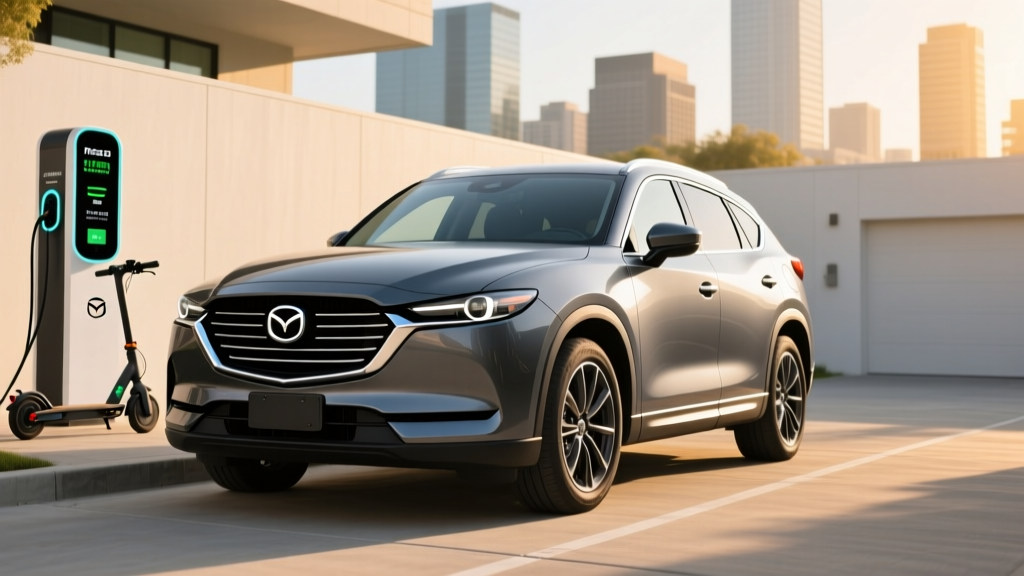
Quick Verdict: A Premium Three-Row PHEV With Real Trade-Offs
The 2024 Mazda CX-90 PHEV slots into a narrow but appealing slice of the market: families who want three rows, premium styling, and a taste of electric commuting without committing to a full BEV. Its 17.8 kWh lithium-ion battery delivers an EPA-rated 26 miles of electric-only range — enough for most school runs and short commutes — before the turbocharged inline-six takes over. Combined output of 327 hp and 369 lb-ft of torque gives it genuine passing power, and the inline-six architecture is a rarity in a segment dominated by four-cylinder hybrids.
But the CX-90 PHEV isn't without compromises. Its electric range trails rivals like the Toyota Grand Highlander Hybrid MAX, it cannot DC fast charge, and its fuel economy once the battery is depleted is merely adequate for its size. This guide breaks down every number you need to decide if it's the right electrified SUV for your household.
| Spec | Value |
|---|---|
| Powertrain | 2.5L turbocharged I4 + electric motor, 8-speed auto |
| Combined Output | 327 hp / 369 lb-ft |
| Battery (usable) | 17.8 kWh lithium-ion |
| EPA Electric Range | 26 miles |
| EPA MPGe (elec + gas) | 56 MPGe |
| EPA MPG (gas only, combined) | 25 MPG |
| Level 2 Charge Time (0–100%) | ~2.5 hours at 7.2 kW |
| DC Fast Charging | Not available |
| 0–60 mph | ~5.9 seconds (est.) |
| Towing Capacity | 3,500 lbs |
| Base MSRP | $49,945 (Preferred) |
| Battery Warranty | 8 years / 100,000 miles |
HEV vs PHEV: What the CX-90 Lineup Actually Offers
Mazda sells the CX-90 with two distinct electrified powertrains, and confusing them is a common buyer mistake. Understanding the difference is critical before you visit the dealership.
| Attribute | CX-90 Turbo (Mild HEV) | CX-90 PHEV |
|---|---|---|
| Plug-in Charging | No — self-charging only | Yes — plug in to charge battery |
| Electric-Only Driving | No (motor assists engine only) | Yes — up to 26 mi EPA |
| Engine | 3.3L turbo I6 + 48V mild-hybrid | 2.5L turbo I4 + electric motor |
| Combined HP | 280–340 hp (depending on fuel) | 327 hp |
| EPA Combined MPG | 25 MPG | 25 MPG (gas) / 56 MPGe (with charge) |
| Starting MSRP | ~$39,590 | $49,945 |
| Federal Tax Credit | None | Potentially up to $3,750* |
The mild-hybrid CX-90 uses a 48-volt system that smooths stop-start and provides minor torque assist, but it cannot drive on electricity alone. The PHEV version is a fundamentally different powertrain with a larger battery, a plug port, and meaningful electric-only capability. If you're here for electric commuting, the PHEV is the only option.
Fuel Economy Breakdown: EPA Numbers and Real-World Expectations
Plug-in hybrid fuel economy is a two-part story. Here's what the EPA rates the CX-90 PHEV at:
| Mode | City | Highway | Combined |
|---|---|---|---|
| Electric + Gas (MPGe) | — | — | 56 MPGe |
| Gas Only (MPG) | 24 | 27 | 25 |
Real-World MPG vs EPA
PHEVs are notoriously sensitive to driving habits. If you charge nightly and your commute is under 26 miles, you may burn almost no gasoline for weeks — effectively achieving triple-digit MPGe. Once the battery depletes, however, you're hauling a 4,800-lb SUV with a turbocharged four-cylinder, and real-world highway fuel economy tends to settle around 23–25 MPG. In cold weather (below 30°F), expect electric range to drop by 20–30% due to battery chemistry limitations and cabin heating demands, reducing your electric-only window to roughly 18–21 miles.
City driving in charge-depleted mode can marginally exceed the EPA's 24 MPG rating thanks to regenerative braking recapturing energy at low speeds. Highway cruising at 75+ mph will dip below the 27 MPG sticker — a common PHEV reality that marketing materials rarely highlight.
Electric-Only Range and Charging: What 26 Miles Actually Means
The CX-90 PHEV's 17.8 kWh battery pack (approximately 14.5 kWh usable, with the remainder reserved as a buffer to protect battery health) delivers an EPA-rated 26 miles of electric-only range. Total combined range — electric plus a full 18.4-gallon fuel tank — reaches approximately 490 miles.
Charging Speeds and Connectors
The CX-90 PHEV uses a J1772 connector for AC charging and does not support DC fast charging. This is typical for PHEVs in this class but worth understanding before you buy:
| Level | Power | Time (0–100%) | Notes |
|---|---|---|---|
| Level 1 (120V household) | ~1.4 kW | ~12–14 hours | Emergency/trickle only |
| Level 2 (240V home/public) | Up to 7.2 kW | ~2.5 hours | Recommended daily charging |
| DC Fast Charge | N/A | N/A | Not supported |
A Level 2 home charger is strongly recommended. At 7.2 kW, you'll fully replenish the battery in roughly 2.5 hours — meaning you can top off during the workday if you have workplace charging, or overnight at home. Relying on a standard 120V outlet (Level 1) is impractical for daily use; a full charge takes over 12 hours, which barely covers an overnight window and leaves little margin.
On the road, the lack of DC fast charging means you cannot meaningfully recharge the battery at public fast-charging stations. Once the electric range is spent on a road trip, the CX-90 PHEV operates as a conventional hybrid for the remainder of the drive.
Powertrain and Performance: The Inline-Six Is Gone, but Power Remains
The PHEV variant uses a 2.5-liter turbocharged inline-four paired with an electric motor integrated into an 8-speed automatic transmission (no traditional torque converter — Mazda uses a clutch-based system). Combined output is 327 horsepower and 369 lb-ft of torque when using premium 93-octane fuel; on regular 87-octane, output drops modestly. All-wheel drive is standard across all PHEV trims.
The 0–60 mph time of approximately 5.9 seconds places it comfortably ahead of most three-row competitors in the hybrid space. The electric motor's instant torque fills in the low-end response that a turbocharged four-cylinder typically lacks, and the transition between electric and gas power is among the smoother PHEV handoffs in the segment. Towing capacity is rated at 3,500 pounds — adequate for a small trailer or a pair of personal watercraft, but less than the mild-hybrid inline-six CX-90's 5,000-lb rating.
Pricing, Trims, and Federal Tax Credit Eligibility
The 2024 CX-90 PHEV starts at $49,945 for the Preferred trim and climbs to approximately $57,000 for the Premium Plus. Destination charges add roughly $1,375.
Federal Tax Credit: What You Actually Qualify For
Under current IRS §30D rules, the CX-90 PHEV may be eligible for a partial federal tax credit of up to $3,750, depending on battery component and critical-mineral sourcing requirements that have tightened significantly since the Inflation Reduction Act took effect. Key eligibility constraints include:
- MSRP cap: SUVs must be at or below $80,000 — the CX-90 PHEV clears this easily.
- Buyer income cap: Modified adjusted gross income must not exceed $150,000 (single), $225,000 (head of household), or $300,000 (joint).
- Battery sourcing: The percentage of critical minerals and battery components sourced from the U.S. or free-trade-agreement countries determines whether you receive the full $7,500, a partial $3,750, or nothing. The CX-90 PHEV's supply chain has historically qualified for the partial credit, but this changes as sourcing rules tighten annually.
- Point-of-sale transfer: As of 2024, buyers can transfer the credit to the dealer at purchase, reducing the purchase price directly rather than waiting for a tax refund.
Always verify current eligibility on the IRS qualified vehicles list before signing paperwork. State-level incentives vary by jurisdiction — consult your state's energy office or a tax professional for specifics.
Battery Warranty, Reliability, and Long-Term Ownership Costs
Mazda PHEV Battery Warranty: 8 years or 100,000 miles (whichever comes first), covering defects and capacity loss below a specified threshold (typically 70% state of health). In states that follow California Air Resources Board (CARB) regulations, hybrid battery coverage may extend to 10 years / 150,000 miles.
How Long Will the Battery Last?
The CX-90 PHEV's lithium-ion pack is engineered for a lifespan that typically outlasts the vehicle's economic life. PHEV batteries experience less stress than full-EV batteries because the usable window is smaller (the system buffers more aggressively at both the top and bottom of the charge cycle). Real-world data from similar Mazda hybrid systems suggests minimal degradation in the first 5–7 years — typically 5–10% capacity loss.
Battery Replacement Cost
If a battery replacement is needed out of warranty, expect a cost in the range of $6,000–$9,000 for the pack itself plus labor. This is a significant expense, but it's important to note that wholesale PHEV battery failures within the first decade are uncommon. Most buyers will sell or trade the vehicle before encountering this cost, and the 8-year/100,000-mile warranty provides substantial coverage.
General Reliability
The CX-90 is Mazda's first vehicle on the new large-platform architecture, and the PHEV powertrain is the brand's first plug-in system sold in the U.S. Early reliability data is still accumulating. IIHS has awarded the CX-90 strong crash-test ratings, which supports the platform's structural integrity. Mazda's brand-level reliability reputation is above average, but the newness of this specific powertrain warrants attention to early owner forums and long-term reviews.
CX-90 PHEV vs Full EV vs Gas SUV: Which Fits Your Life?
The decision between a PHEV, a full battery-electric vehicle, and a conventional gas SUV depends on your specific driving pattern, charging access, and budget. Here's a practical framework:
Choose the CX-90 PHEV if:
- Your daily commute is under 25 miles round-trip and you can charge at home nightly.
- You regularly take road trips exceeding 300 miles and don't want to plan around charging stops.
- You want three rows but aren't ready to commit to a full EV's charging logistics.
- You want to reduce fuel consumption without changing your driving habits.
Choose a full EV (e.g., Kia EV9, Tesla Model X) if:
- You have reliable home Level 2 charging and your daily driving rarely exceeds 200 miles.
- You want to eliminate gasoline entirely and minimize maintenance (no oil changes, fewer moving parts).
- You qualify for the full $7,500 federal tax credit on an eligible BEV.
Choose a conventional gas or HEV SUV if:
- You cannot charge at home (apartment, street parking, no garage).
- Your budget is tighter — the CX-90 mild-hybrid starts ~$10,000 lower.
- You tow frequently above 3,500 lbs (the mild-hybrid I6 tows up to 5,000 lbs).
Pros
- Premium interior materials rival European luxury SUVs at this price
- 327 hp provides confident highway merging and passing
- 26 mi electric range covers most daily commutes gas-free
- Standard AWD with competent all-weather capability
- Three-row seating with usable third row for children
- Smooth electric-to-gas powertrain transitions
Cons
- 26 mi electric range is modest — rivals like the Chrysler Pacifica PHEV offer 32 mi
- No DC fast charging — road trips are gas-only after battery depletion
- Charge-depleted fuel economy (~25 MPG) is underwhelming for a hybrid
- Premium fuel recommended for full 327 hp output
- Cargo space reduced vs. non-PHEV CX-90 due to battery placement
- New platform — long-term reliability data still limited
Frequently Asked Questions
How many MPG does the 2024 Mazda CX-90 PHEV get?
The EPA rates it at 25 MPG combined (24 city / 27 highway) when operating on gasoline alone after the battery is depleted. When factoring in electric-only driving, the combined rating is 56 MPGe. Real-world results vary significantly based on how often you charge — daily chargers with short commutes may use almost no gasoline, while road-trip-heavy drivers will see 23–25 MPG consistently.
How far can the CX-90 PHEV go on electric only?
The EPA rates it at 26 miles of electric-only range. In real-world conditions, expect 22–26 miles in mild weather with moderate speeds, and as low as 18–21 miles in cold weather or at sustained highway speeds above 70 mph. Total combined range (electric plus full gas tank) is approximately 490 miles.
Does the 2024 CX-90 PHEV qualify for a federal tax credit?
It may qualify for a partial credit of up to $3,750 under IRS §30D, subject to battery-sourcing requirements, buyer income limits ($150K single / $300K joint), and the $80,000 SUV MSRP cap. Eligibility changes as sourcing rules tighten. Verify on the IRS qualified vehicles list before purchasing, and consider consulting a tax professional.
Is the CX-90 PHEV reliable, and what does battery replacement cost?
The PHEV powertrain is new to Mazda's U.S. lineup, so long-term data is still building. Mazda's brand-level reliability is above average. The hybrid battery is warrantied for 8 years / 100,000 miles (10 years / 150,000 in CARB states). Out-of-warranty battery replacement is estimated at $6,000–$9,000, though wholesale failures within the first decade are uncommon based on similar hybrid systems.
Can I charge the CX-90 PHEV at a DC fast charger?
No. The CX-90 PHEV only supports AC charging via a J1772 connector — Level 1 (120V) at ~1.4 kW or Level 2 (240V) at up to 7.2 kW. A full Level 2 charge takes about 2.5 hours. DC fast-charging stations (Tesla Superchargers, Electrify America, etc.) cannot charge this vehicle.
How does the CX-90 PHEV compare to a full EV like the Kia EV9?
The Kia EV9 offers 230–304 miles of EPA range, DC fast charging up to 210 kW, and zero gasoline use — but starts around $54,900 and requires commitment to charging infrastructure. The CX-90 PHEV gives you gas-free commuting for short trips with the safety net of a gas engine for road trips, at a lower entry price. If you can charge at home and rarely drive over 200 miles daily, the EV9 is the more transformative choice. If road trips or charging uncertainty are concerns, the PHEV is the pragmatic bridge.