Quick Verdict: The CX-90 PHEV Premium in 2026
The 2024 Mazda CX-90 PHEV Premium remains one of the most compelling plug-in hybrid three-row SUVs on the used and certified-pre-owned market heading into 2026. Mazda paired a 2.5-liter four-cylinder engine with a 17.8 kWh battery pack and an electric motor integrated into its 8-speed automatic transmission, delivering 327 combined horsepower and an EPA-estimated 26 miles of electric-only range. For buyers who want three-row utility, premium interiors, and the ability to commute on electricity without range anxiety, the CX-90 PHEV Premium makes a strong case — especially at its original MSRP of $57,475, with certified-pre-owned examples now trading well below that.
But the real question for PHEV shoppers is whether 26 miles of electric range is enough, how the fuel economy holds up once the battery depletes, and whether this powertrain qualifies for any federal tax incentives. Let's break down every number that matters.
PHEV vs. HEV: What the CX-90 Actually Is
Conventional Hybrid (HEV): A small battery (typically 1-2 kWh) recharged by regenerative braking and the gas engine. No plug. Toyota RAV4 Hybrid is an example.
Plug-in Hybrid (PHEV): A larger battery (the CX-90 uses 17.8 kWh) that you can charge via a wall outlet or Level 2 charger, giving meaningful electric-only driving before the gas engine engages.
The CX-90 PHEV is a PHEV — it has a charge port (J1772 connector for AC charging) and delivers 26 miles of zero-emission driving before seamlessly transitioning to hybrid mode. It cannot DC fast charge.
This distinction matters because conventional hybrids like the Toyota Highlander Hybrid never plug in and offer no electric-only range beyond low-speed crawling. The CX-90 PHEV's 17.8 kWh pack gives you a genuine electric commute envelope — short, but real.
Fuel Economy and Electric Range: The Numbers
| Metric | EPA Estimate | Real-World Expectation |
|---|---|---|
| Combined MPGe (electric + gas) | 56 MPGe | 48-54 MPGe with regular charging |
| Gas-only combined MPG (charge-depleted) | 25 MPG | 23-27 MPG depending on driving style |
| City MPG (gas-only) | 24 MPG | 23-26 MPG |
| Highway MPG (gas-only) | 27 MPG | 25-28 MPG at 70 mph |
| Electric-only range | 26 miles | 20-24 miles (highway/cold weather) |
| Total combined range | 490 miles | 440-480 miles |
According to fueleconomy.gov, the 2024 CX-90 PHEV achieves 56 MPGe when operating in blended electric-gas mode and 25 MPG combined once the battery is depleted. In practice, owners who charge nightly and commute under 25 miles will rarely touch the gas engine during the work week. On a road trip where the battery depletes within the first 26 miles, expect the 2.5-liter four-cylinder to deliver 23-27 MPG — respectable for a 5,100-pound three-row SUV, but not class-leading against the Toyota Highlander Hybrid's 35 MPG combined.
Real-World Range Note: The EPA's 26-mile electric estimate assumes moderate temperatures and mixed driving. In winter conditions below 32°F, expect 18-22 miles of electric range due to cabin heating demands and reduced battery efficiency. Highway driving at 75+ mph also reduces electric range to roughly 20 miles.
Powertrain Specs: Engine, Motor, and Battery
| Specification | 2024 Mazda CX-90 PHEV Premium |
|---|---|
| Engine | 2.5L inline-4 DOHC |
| Electric motor | 132 kW (177 hp) integrated in transmission |
| Combined system output | 327 hp / 369 lb-ft torque |
| Battery capacity | 17.8 kWh (lithium-ion) |
| Usable battery capacity | ~14.5 kWh (estimated) |
| Transmission | 8-speed automatic (no torque converter) |
| Drivetrain | All-wheel drive (i-Activ AWD) |
| 0-60 mph | 5.9 seconds (est.) |
| Towing capacity | 3,500 lbs |
| Curb weight | ~5,100 lbs |
Mazda's PHEV powertrain uses a unique architecture: the electric motor sits between the engine and an 8-speed automatic that replaces the traditional torque converter with a multi-plate clutch. This means the electric motor can drive the wheels directly at low speeds, while the engine engages for higher loads or when the battery depletes. The 327 combined horsepower figure makes the CX-90 PHEV one of the most powerful vehicles in Mazda's lineup, and the instant electric torque gives it a responsive feel around town that the turbocharged gas-only CX-90 can't quite match at low RPMs.
Charging: Level 1, Level 2, and What You Need at Home
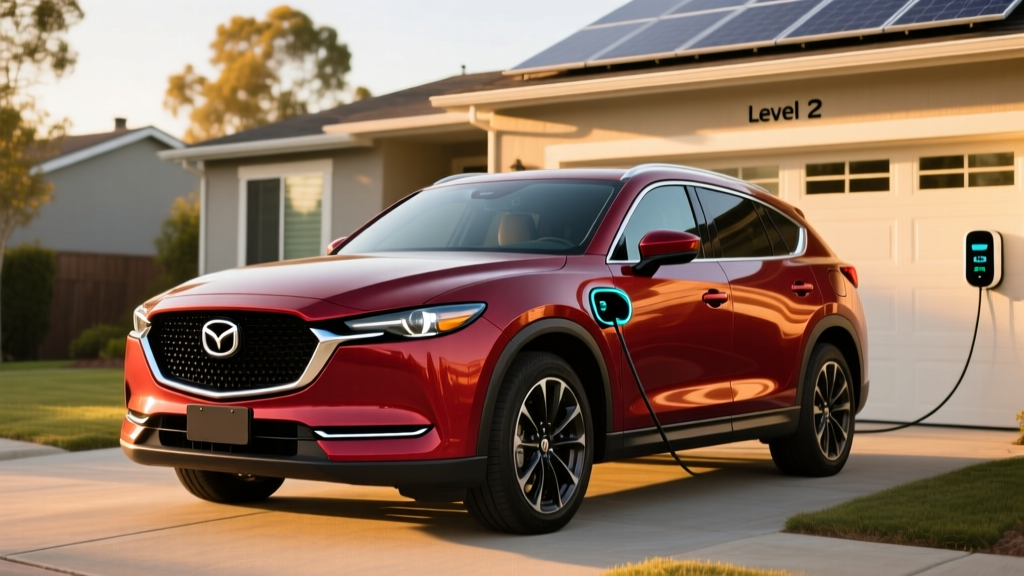
The CX-90 PHEV charges exclusively via AC — there is no DC fast charging capability, which is typical for PHEVs in this class. The onboard charger is rated at 7.2 kW (some early-build 2024 models shipped with a 3.3 kW charger; verify by VIN).
| Charging Level | Power | Time (0-100%) | Setup |
|---|---|---|---|
| Level 1 (120V household) | ~1.4 kW | ~10-11 hours | Standard outlet, included cord |
| Level 2 (240V, 32A) | 7.2 kW | ~2.5 hours | Home wall charger or public L2 |
| DC Fast Charge | N/A | N/A | Not supported |
For most PHEV owners, Level 1 charging from a standard 120V outlet overnight is sufficient — a full recharge takes about 10 hours, which easily covers a nightly top-up if you plug in when you get home. A Level 2 home charger (240V, such as a ChargePoint Home Flex or Emporia Vue) cuts that to roughly 2.5 hours, which is useful if you need a midday top-up or have a shorter parking window.
Home charging installation cost: If you already have a 240V outlet (like a dryer outlet) near your parking spot, a Level 2 charger install runs $500-$1,200 including equipment and labor. A new 240V circuit from your panel typically costs $800-$2,000 depending on wire run length and whether a panel upgrade is needed. Consult a licensed electrician for your specific situation.
Pricing, Trims, and Tax Credit Eligibility
The 2024 Mazda CX-90 PHEV was offered in three trims:
- PHEV Preferred: $49,945 MSRP
- PHEV Premium: $57,475 MSRP
- PHEV Premium Plus: $59,950 MSRP
All prices include destination. The Premium trim — our focus here — adds Nappa leather, a 12.3-inch infotainment display, panoramic moonroof, 20-inch wheels, and a 360-degree camera over the Preferred.
Federal §30D Tax Credit Status (2024 model year):
- The 2024 CX-90 PHEV was eligible for up to $3,750 in federal tax credit when purchased new (not the full $7,500 — the vehicle met critical minerals requirements but did not fully satisfy battery-component sourcing rules under IRS §30D).
- MSRP cap: PHEV SUVs must be under $80,000 MSRP — the CX-90 PHEV clears this easily.
- Buyer income cap: AGI must not exceed $150,000 (single) / $300,000 (joint).
- Point-of-sale transfer: For 2024, eligible buyers could transfer the credit to the dealer for an upfront price reduction.
Source: IRS.gov §30D guidelines. Tax rules change — consult a tax professional for your specific situation.
For 2026 buyers purchasing used or CPO: The federal used clean vehicle credit (§25E) offers up to $4,000 or 30% of the sale price (whichever is less) for qualifying used PHEVs and EVs purchased from a dealer, with buyer income caps of $75,000 (single) / $150,000 (joint). The vehicle must be at least two model years old and sell for $25,000 or less to qualify. As of 2026, CPO CX-90 PHEV pricing may still exceed the $25,000 cap, so check current market prices before counting on this credit.
Battery Warranty, Reliability, and Replacement Cost
Mazda PHEV Battery Warranty:
- Hybrid/PHEV battery: 8 years / 100,000 miles (whichever comes first)
- CARB states: 10 years / 150,000 miles in states that follow California Air Resources Board emissions rules (CA, NY, MA, WA, OR, CO, and others)
- Capacity threshold: Warranty covers defects and capacity loss below approximately 70% of original capacity
- Powertrain warranty: 5 years / 60,000 miles
PHEV battery degradation is typically modest. Unlike full EVs that cycle through a wide state-of-charge range daily, the CX-90's 17.8 kWh pack operates in a narrower window, which reduces stress on the cells. Industry data from similar PHEV architectures (Toyota, Hyundai) suggests 5-10% capacity loss over the first 5 years is typical. A full PHEV battery replacement for the CX-90 is estimated at $6,000-$9,000 including labor, though this figure is based on comparable Mazda and industry PHEV packs — exact pricing should be confirmed with a Mazda dealer.
For reliability, the 2024 CX-90 is Mazda's first vehicle on the new large-vehicle rear-drive platform, and early owner reports have noted some software-related issues with the infotainment system and transmission calibration. Mazda's overall brand reliability ratings from Consumer Reports and J.D. Power have trended positively in recent years, but the newness of this specific platform means long-term data (100,000+ miles) is still accumulating. The conventional hybrid and PHEV components (motor, inverter, battery) draw on technology Mazda has used in other markets for years.
Who Should Choose the CX-90 PHEV Premium?
Choose the CX-90 PHEV Premium if:
- Your daily commute is under 25 miles round-trip and you can charge at home
- You want a three-row SUV but don't want a minivan
- You take road trips where EV charging infrastructure is sparse
- You value premium interior materials (Nappa leather, open-pore wood on Premium Plus)
- You want AWD without the fuel penalty of a body-on-frame SUV
Consider a full EV instead if:
- Your commute is under 25 miles but you want zero gas use year-round
- You want lower maintenance costs (no oil changes, fewer moving parts)
- You have reliable home charging and access to DC fast chargers for road trips
- Models like the Kia EV9 (300 mi range) or Tesla Model X fit your budget
Consider a conventional hybrid (HEV) instead if:
- You cannot charge at home (apartment, street parking)
- You want simpler ownership with no charging cable management
- The Toyota Highlander Hybrid (35 MPG combined) or Kia Sorento Hybrid meets your space needs
Pros and Cons
Pros
- 26 miles electric covers most daily commutes
- 327 hp provides strong acceleration and confident merging
- Premium interior rivals luxury brands at a mainstream price
- AWD standard — rare for PHEV three-row SUVs
- 3,500-lb towing capacity
- 8-year/100,000-mile hybrid battery warranty
Cons
- 26-mile electric range is shorter than rivals (RAV4 Prime: 42 mi)
- No DC fast charging
- Gas-only MPG (25 combined) trails conventional hybrid competitors
- Third row is tight for adults on long trips
- New platform — limited long-term reliability data
- Premium trim price pushes close to luxury territory
Frequently Asked Questions
How many MPG does the 2024 Mazda CX-90 PHEV get?
The EPA rates the CX-90 PHEV at 56 MPGe in blended electric-gas mode and 25 MPG combined (24 city / 27 highway) once the battery is depleted. Real-world results vary: owners who charge daily and drive under 25 miles report using very little gasoline, while road-trip MPG settles around 23-27 depending on speed and terrain.
How far can the CX-90 PHEV go on electric only?
The EPA estimates 26 miles of electric-only range. In real-world conditions — especially cold weather or sustained highway speeds — expect 20-24 miles. This is enough for most daily commutes but shorter than competitors like the Toyota RAV4 Prime (42 miles) or the Chrysler Pacifica PHEV (32 miles).
Does the CX-90 PHEV qualify for a federal tax credit?
When purchased new in 2024, the CX-90 PHEV was eligible for up to $3,750 under the §30D federal clean vehicle credit (not the full $7,500 due to partial battery-sourcing compliance). For 2026 buyers purchasing a used or CPO example, the §25E used vehicle credit may apply if the sale price is $25,000 or less and buyer income limits are met. Always verify current rules at IRS.gov and consult a tax professional.
Is the CX-90 PHEV reliable? What does battery replacement cost?
The CX-90 uses Mazda's new large-vehicle platform, so long-term (100,000+ mile) data is still limited. The PHEV powertrain components draw on proven technology. Mazda covers the hybrid battery for 8 years/100,000 miles (10 years/150,000 in CARB states). A full battery replacement is estimated at $6,000-$9,000, though most PHEV batteries retain 90%+ capacity well beyond the warranty period based on industry data.
Hybrid vs PHEV vs EV — which is right for me?
If you can charge at home and your daily driving is under 25 miles, the CX-90 PHEV gives you electric commuting with gas-engine backup for road trips — the best of both worlds. If you can't charge at home, a conventional hybrid (HEV) like the Highlander Hybrid is simpler and more efficient in gas-only operation. If you have home charging, rarely drive more than 250 miles in a day, and want the lowest operating cost, a full EV like the Kia EV9 eliminates gasoline entirely.
Can the CX-90 PHEV fast charge?
No. The CX-90 PHEV supports AC charging only — Level 1 (120V, ~1.4 kW) and Level 2 (240V, up to 7.2 kW). A full Level 2 charge takes about 2.5 hours. DC fast charging is not available, which is typical for PHEVs in this price class.