Quick Verdict: The 2024 Honda CR-V Hybrid Sport at a Glance
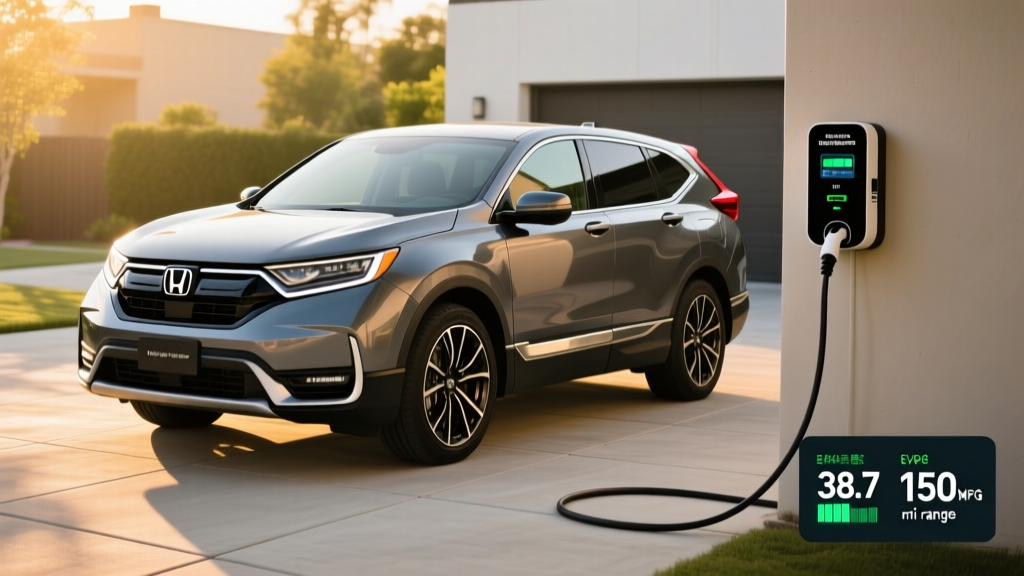
The 2024 Honda CR-V Hybrid Sport occupies a compelling middle ground for buyers who want electrified efficiency without the lifestyle changes a full EV demands. As a conventional hybrid (HEV)—not a plug-in hybrid—it requires zero changes to your fueling routine. You simply fill up with gas, and the hybrid system handles the rest. The result is an EPA-rated 40 MPG combined, a combined 204 horsepower from its two-motor hybrid system, and a starting MSRP of $34,995.
For compact crossover shoppers weighing the CR-V Hybrid Sport against the gas-only CR-V, a plug-in hybrid alternative, or a full battery-electric vehicle, this guide breaks down every number that matters—from real-world MPG expectations to battery warranty coverage and total cost of ownership.
| Specification | Value |
|---|---|
| Powertrain | 2.0L 4-cyl Atkinson-cycle + 2-motor hybrid system |
| Combined Horsepower | 204 HP |
| Combined Torque | 247 lb-ft (electric motor) |
| Drivetrain | FWD (AWD available on Sport Touring) |
| EPA City / Highway / Combined | 43 / 36 / 40 MPG |
| Fuel Tank Capacity | 14.0 gallons |
| Total Driving Range | ~560 miles |
| 0-60 MPH | ~7.6 seconds (est.) |
| Cargo Volume (rear seats up / down) | 36.3 / 76.5 cu ft |
| Base MSRP (Sport FWD) | $34,995 |
| Hybrid Battery Warranty | 8 years / 100,000 miles |
HEV vs. PHEV: Why the CR-V Hybrid Sport Is a Conventional Hybrid
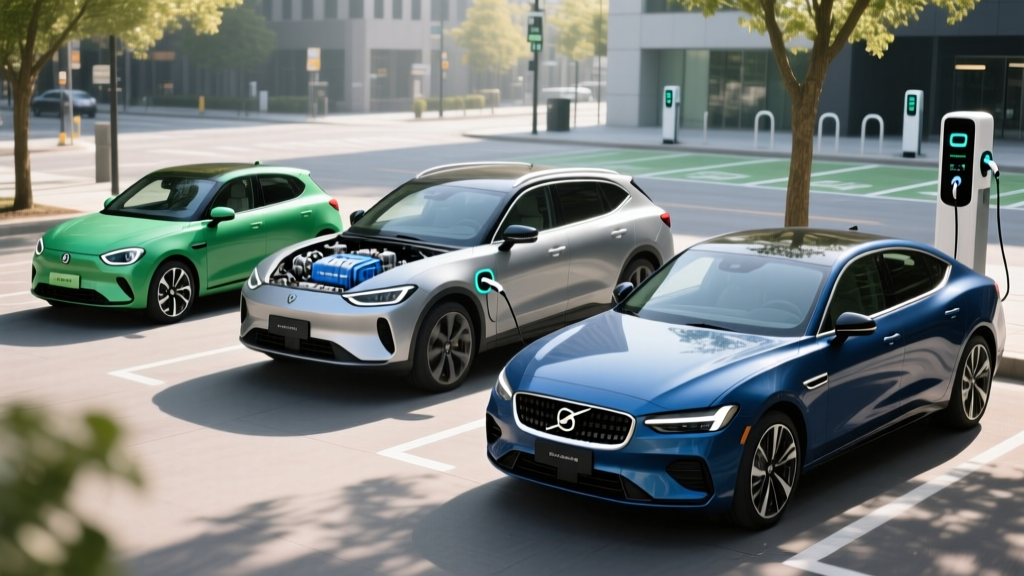
A common point of confusion among crossover shoppers is the difference between a conventional hybrid (HEV) and a plug-in hybrid (PHEV). The 2024 Honda CR-V Hybrid Sport is an HEV. That distinction carries practical consequences:
Conventional Hybrid (HEV) — How the CR-V Hybrid Sport Works
- No plug required. The small hybrid battery (approximately 1.1 kWh) charges exclusively through regenerative braking and the gasoline engine.
- No electric-only range to manage. The electric motor assists the gas engine and can propel the car at low speeds for very short distances (typically under 1 mile), but there is no meaningful EV-only driving mode.
- No home charging setup needed. If you lack garage access or cannot install a Level 2 charger, an HEV works with your existing lifestyle.
- No federal EV tax credit. HEVs do not qualify for the IRS §30D Clean Vehicle Credit, which is reserved for plug-in vehicles with batteries of at least 7 kWh.
Plug-In Hybrid (PHEV) — What the CR-V Hybrid Sport Is NOT
- PHEVs like the Toyota RAV4 Prime or Honda's own CR-V e:PHEV (not currently sold in the U.S.) feature larger batteries (15-20 kWh) and offer 30-42 miles of electric-only range.
- PHEVs require regular plug-in charging to realize their efficiency advantage.
- PHEVs with sufficient battery capacity and compliant sourcing may qualify for partial or full §30D tax credits.
Honda does not currently offer a plug-in hybrid CR-V in the United States. If electric-only commuting is a priority, you would need to look at competitors like the Toyota RAV4 Prime (42 miles EV range) or consider a full BEV.
Fuel Economy: EPA Ratings vs. Real-World MPG
The EPA rates the 2024 CR-V Hybrid Sport (FWD) at 43 MPG city / 36 MPG highway / 40 MPG combined, per fueleconomy.gov. The AWD-equipped Sport Touring Hybrid drops slightly to 40 city / 34 highway / 37 combined.
| Trim | Drivetrain | City MPG | Highway MPG | Combined MPG |
|---|---|---|---|---|
| Sport | FWD | 43 | 36 | 40 |
| Sport Touring | AWD | 40 | 34 | 37 |
Real-World MPG: What to Actually Expect
Honda's two-motor hybrid system excels in city driving, where regenerative braking and electric-motor assist do the heavy lifting. In real-world testing by multiple owners and automotive publications, the CR-V Hybrid routinely meets or slightly exceeds its EPA city rating during stop-and-go commutes—some drivers report 44-46 MPG in warm-weather urban driving.
Highway driving tells a different story. At sustained speeds above 70 MPH, the gasoline engine does most of the work, and real-world highway MPG often falls to 32-35 MPG—below the EPA sticker. Cold weather compounds this: winter highway driving can drop observed economy to 30-33 MPG as the engine runs more frequently for cabin heat and the battery's efficiency decreases in low temperatures.
Annual Fuel Cost Estimate
At 15,000 miles per year and $3.50/gallon regular unleaded, the CR-V Hybrid Sport FWD would cost approximately $1,313 per year in fuel. The gas-only CR-V (EPA 30 MPG combined) would cost about $1,750 per year under the same conditions—a savings of roughly $437 annually with the hybrid.
Powertrain Deep Dive: How Honda's Two-Motor Hybrid System Works
The 2024 CR-V Hybrid Sport uses Honda's fourth-generation two-motor hybrid system, paired with a 2.0-liter Atkinson-cycle four-cylinder engine. Here is how the components break down:
- Gasoline Engine: 2.0L DOHC Atkinson-cycle inline-4 producing 146 HP and 134 lb-ft of torque. The Atkinson cycle sacrifices peak power for superior thermal efficiency.
- Drive Motor: Electric motor generating 181 HP and 247 lb-ft of torque. This motor drives the front wheels in most driving conditions.
- Generator Motor: A second motor that acts as a generator, converting engine output to electricity to power the drive motor or charge the battery.
- Combined System Output: 204 HP. Note that this is not simply the engine and motor outputs added together—the system manages power delivery for a combined peak of 204 HP.
- Hybrid Battery: Approximately 1.1 kWh lithium-ion pack located beneath the cargo floor. This is far smaller than a PHEV or BEV battery because it serves as a buffer, not a primary energy source.
At low speeds and during light acceleration, the CR-V Hybrid operates primarily on electric power drawn from the battery (charged by the engine or regenerative braking). Under heavier loads, the engine engages to either drive the generator motor or, at highway cruising speeds, connect directly to the wheels via a lock-up clutch. This seamless handoff is managed automatically—you will not feel a transition.
The result is a 0-60 MPH time of approximately 7.6 seconds, which is competitive for the segment and noticeably quicker than the gas-only CR-V's 190-hp turbocharged 1.5L engine. The hybrid's 247 lb-ft of electric torque also provides strong low-end responsiveness that makes city merging and passing feel effortless.
Pricing, Trims, and Tax Credit Eligibility
The 2024 Honda CR-V Hybrid is offered in two trims in the U.S. market:
| Trim | Drivetrain | MSRP |
|---|---|---|
| Sport | FWD | $34,995 |
| Sport | AWD | $36,495 |
| Sport Touring | AWD (standard) | $40,895 |
Federal Tax Credit: Does the CR-V Hybrid Qualify?
No. The 2024 Honda CR-V Hybrid Sport does not qualify for the IRS §30D Clean Vehicle Credit. This credit is available only for plug-in electric vehicles (BEVs and PHEVs) with battery capacities of at least 7 kWh. As a conventional hybrid with a ~1.1 kWh battery, the CR-V Hybrid falls well below this threshold.
Per IRS guidelines, the §30D credit offers up to $7,500 for qualifying new plug-in vehicles, subject to MSRP caps ($80,000 for SUVs), buyer income limits ($150,000 single / $300,000 joint), and critical-mineral and battery-component sourcing requirements. None of this applies to the CR-V Hybrid.
Some states offer their own incentives for hybrid vehicles, though these are less common than EV incentives. Check your state's energy or environmental agency for current programs.
Value Proposition vs. Gas CR-V
The gas-only CR-V EX starts at approximately $33,695. The Hybrid Sport commands a roughly $1,300 premium at $34,995. At $437 in annual fuel savings (based on 15,000 miles/year and $3.50/gal), the hybrid pays back its price premium in approximately 3 years. Beyond that, every mile saves you money—and the hybrid also delivers more torque, a quieter low-speed driving experience, and lower tailpipe emissions.
Battery Longevity, Warranty, and Replacement Costs
Battery reliability is consistently the top concern for hybrid buyers. Here is what you need to know about the CR-V Hybrid's battery system:
How Long Will the Hybrid Battery Last?
The CR-V Hybrid's ~1.1 kWh battery is far less stressed than a BEV battery. It operates within a narrow state-of-charge window (typically 40-80%), never fully charges or fully depletes, and is managed by Honda's thermal control system. This shallow-cycling approach dramatically extends cell life.
Based on long-term data from Honda's hybrid systems (including the Accord Hybrid and Insight), hybrid battery packs routinely last 150,000-200,000+ miles before significant degradation occurs. Many first-generation Honda Insight and Civic Hybrid batteries have exceeded 200,000 miles. The smaller the battery and the shallower the cycles, the longer the expected lifespan—and the CR-V Hybrid's battery is quite small.
Battery Replacement Cost
If a hybrid battery replacement is needed out of warranty, expect a cost in the range of $2,000-$4,000 for a refurbished or new pack, including labor. This is significantly less than a BEV battery replacement (which can exceed $10,000-$20,000) because the hybrid battery is small and simpler to access. Third-party refurbished packs and independent hybrid-specialty shops can reduce this cost further.
Overall Reliability
Honda's hybrid powertrain has a strong reliability track record. The two-motor system eliminates the conventional transmission entirely—there is no multi-speed gearbox to fail. The e-CVT (which is actually a direct-drive system with a lock-up clutch, not a belt-driven CVT) has fewer moving parts than a traditional automatic. According to owner surveys and Consumer Reports data, the CR-V Hybrid has scored at or above average for predicted reliability since its introduction.
Who Should Choose the CR-V Hybrid Sport — and Who Should Look Elsewhere
Choose the 2024 Honda CR-V Hybrid Sport If:
- You cannot charge at home. No garage, no driveway outlet, no Level 2 option—the HEV works without any charging infrastructure.
- You want simple ownership. Fill up with gas, follow normal maintenance schedules, and enjoy 37-42 MPG without thinking about it.
- Your driving is city-heavy. The hybrid system delivers its best efficiency in stop-and-go traffic, where regen braking and electric assist dominate.
- You want crossover practicality. 36.3 cu ft of cargo space behind the rear seats, 76.5 cu ft with seats folded, and standard Honda Sensing safety tech.
- You tow occasionally. The CR-V Hybrid is rated for up to 1,000 lbs towing—adequate for a small trailer or bike rack.
Look at a PHEV or Full EV Instead If:
- You want electric-only commuting. A PHEV like the Toyota RAV4 Prime (42 mi EV range) or a BEV like the Hyundai Ioniq 5 (303 mi EPA range) lets you drive on electricity alone for daily trips.
- You have home charging and want to minimize gas use. A PHEV charged nightly can handle most commutes without the engine starting.
- You want a federal tax credit. Qualifying PHEVs and BEVs can receive up to $7,500 under §30D, which the CR-V Hybrid cannot access.
- You regularly drive more than 400 miles in a day. While the CR-V Hybrid can do ~560 miles on a tank, a BEV with 300+ mile range and DC fast charging may be more convenient on road trips if you have reliable charging access.
Pros and Cons
Pros
- 40 MPG combined EPA with real-world city MPG often exceeding the sticker
- 204 HP and 247 lb-ft electric torque provide confident acceleration
- No charging infrastructure required—works like a gas car
- 8-year / 100,000-mile hybrid battery warranty (10/150k in CARB states)
- Generous cargo space (36.3 cu ft) with no battery intrusion
- Standard Honda Sensing ADAS suite (adaptive cruise, lane keeping, auto emergency braking)
Cons
- No electric-only driving range—this is not a PHEV or EV
- No federal tax credit eligibility
- Highway MPG falls below EPA sticker at sustained 70+ MPH speeds
- AWD only available on Sport Touring trim ($40,895)
- 1,000-lb towing limit is below some turbocharged gas competitors
- Hybrid battery replacement, while rare, costs $2,000-$4,000 out of warranty
Frequently Asked Questions
How many MPG does the 2024 Honda CR-V Hybrid Sport get?
The FWD Sport trim is EPA-rated at 43 city / 36 highway / 40 combined MPG. The AWD Sport Touring is rated at 40 city / 34 highway / 37 combined. Real-world city driving often exceeds the EPA city number, while highway driving at 70+ MPH typically returns 32-35 MPG.
Does the CR-V Hybrid need to be plugged in?
No. The 2024 CR-V Hybrid Sport is a conventional hybrid (HEV). Its small battery charges through regenerative braking and the gasoline engine. There is no plug, no charging cable, and no need for any home electrical work.
How far can the CR-V Hybrid drive on electric only?
Under 1 mile at very low speeds. The hybrid system uses the electric motor for initial acceleration and low-speed creep, but it is not designed for sustained electric-only driving. If you need meaningful EV-only range, you need a PHEV or BEV.
Is the CR-V Hybrid reliable?
Honda's two-motor hybrid system has demonstrated strong reliability across multiple model lines over a decade of use. The e-CVT design has fewer moving parts than a conventional automatic transmission, and the hybrid battery's shallow-cycling management promotes longevity of 150,000-200,000+ miles based on historical data.
What does a CR-V Hybrid battery replacement cost?
Out-of-warranty hybrid battery replacement typically costs $2,000-$4,000 including labor. However, based on long-term data from Honda hybrid vehicles, battery replacement before 150,000 miles is uncommon. The battery is covered under warranty for 8 years/100,000 miles (10 years/150,000 miles in CARB states).
Does the 2024 Honda CR-V Hybrid qualify for a tax credit?
No. The federal §30D Clean Vehicle Credit applies only to plug-in vehicles (BEVs and PHEVs) with batteries of at least 7 kWh. The CR-V Hybrid's ~1.1 kWh battery does not qualify. Some state-level incentives may exist for hybrids—check your local energy agency.
Hybrid vs. PHEV vs. EV — which is right for me?
Choose the HEV (CR-V Hybrid) if you cannot charge at home, want zero lifestyle change, and drive a city-heavy commute. Choose a PHEV if you can install a Level 2 charger at home, want 30-42 miles of electric-only commuting, and still need gas for road trips. Choose a full BEV if you have reliable home charging, drive under 250 miles daily, and want the lowest per-mile energy cost and zero tailpipe emissions.