Quick Verdict: The 2024 Honda CR-V Hybrid Sport
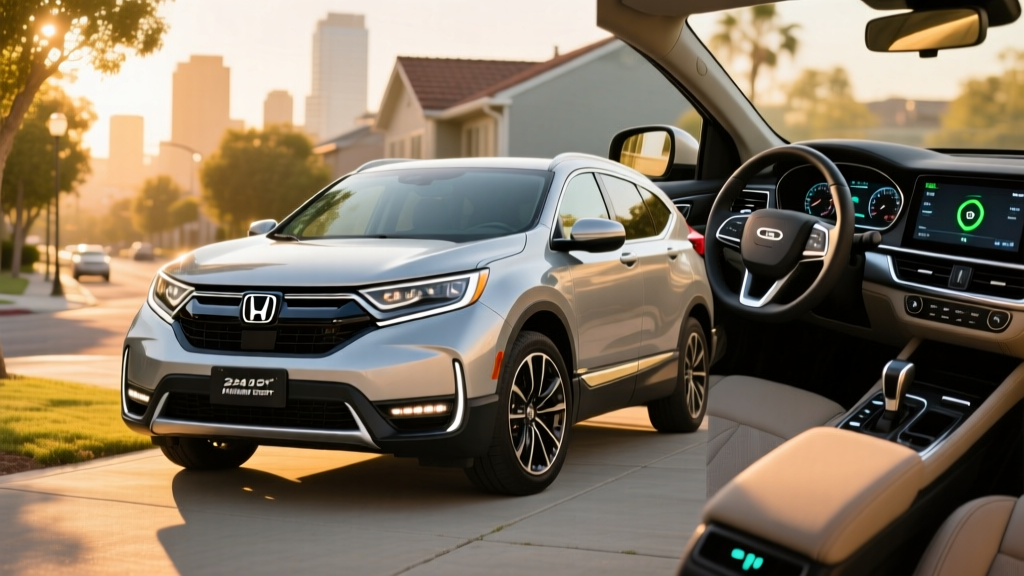
The 2024 Honda CR-V Hybrid Sport occupies a specific niche in the compact SUV segment: it's a conventional hybrid (HEV) that delivers meaningful fuel savings over the gas-only CR-V without requiring any change in driving habits. No plugs, no charging anxiety, no lifestyle adjustment. You fill it with gas and drive it like any other car — it just visits the pump less often.
For buyers who want electrified efficiency but lack access to home charging or aren't ready for a full battery-electric vehicle, the CR-V Hybrid Sport is a pragmatic choice. The two-motor hybrid system pairs a 2.0-liter Atkinson-cycle four-cylinder with dual electric motors for a combined 204 horsepower and 247 lb-ft of torque from the electric motors alone. EPA estimates come in at 40 MPG combined for the front-wheel-drive model, with real-world city driving often exceeding that figure thanks to the hybrid system's regenerative braking advantage in stop-and-go traffic.
Starting at $36,395 (including destination), the Sport trim adds styling differentiation and equipment over the base Hybrid, while remaining well within reach of family SUV budgets. The critical question this guide answers: does the real-world efficiency justify the premium over the gas CR-V, and how does it stack up against a plug-in hybrid or full EV alternative?
EPA Fuel Economy vs. Real-World MPG
| Drivetrain | City MPG | Highway MPG | Combined MPG |
|---|---|---|---|
| FWD | 43 | 36 | 40 |
| AWD | 40 | 34 | 37 |
Source: EPA fueleconomy.gov
The FWD CR-V Hybrid Sport's 43 MPG city rating is where this powertrain shines. Hybrids recapture kinetic energy during braking and use it to power the electric motor at low speeds, meaning urban driving — where a gas engine is least efficient — becomes the hybrid's best-case scenario. In real-world city commuting with frequent stops, owners regularly report 42–45 MPG, slightly above the EPA sticker.
Highway driving tells a different story. At sustained speeds above 65 mph, the gasoline engine does most of the work with less regenerative benefit, and the 36 MPG highway figure is accurate. On a flat, 70-mph interstate cruise in moderate temperatures, expect 34–37 MPG. In cold weather (below 30°F) or mountainous terrain, highway figures can dip to 30–32 MPG as the engine works harder and the cabin heater draws additional load.
HEV vs. PHEV vs. EV: Which Powertrain Fits You?
A common point of confusion is whether the CR-V Hybrid needs to be plugged in. It does not. The 2024 CR-V Hybrid Sport is a conventional hybrid electric vehicle (HEV). Its small lithium-ion battery (approximately 1.06 kWh) charges exclusively through regenerative braking and the gasoline engine. There is no plug, no electric-only driving range to manage, and no charging infrastructure dependency.
Honda does not currently offer the CR-V as a plug-in hybrid (PHEV) in the United States. If you want plug-in capability in a Honda, the closest alternative is the Clarity Plug-In Hybrid (discontinued after 2022) or waiting for future Honda PHEV offerings. Competitors like the Toyota RAV4 Prime offer PHEV capability with 42 miles of electric-only range, but at a significantly higher starting price (~$43,695).
| Factor | HEV (CR-V Hybrid) | PHEV (e.g., RAV4 Prime) | BEV (e.g., Tesla Model Y) |
|---|---|---|---|
| Plug-in Required? | No | Yes (optional benefit) | Yes (mandatory) |
| Electric-Only Range | ~1 mile at low speed | 35–42 miles | 260–330 miles |
| Home Charging Needed? | No | Recommended for full benefit | Essential |
| Fuel/Energy Cost per Mile | ~$0.11 (gas) | ~$0.04 (electric) / $0.11 (gas) | ~$0.04 (electric) |
| Upfront Price Premium | +$1,500–$2,000 vs gas | +$6,000–$9,000 vs gas | +$10,000–$15,000 vs gas |
| Federal Tax Credit | None | Up to $7,500 (if eligible) | Up to $7,500 (if eligible) |
The HEV makes the most sense if you: (1) lack reliable access to Level 2 home charging, (2) drive more than 40 miles daily making PHEV electric range insufficient, (3) want lower upfront cost with no behavioral change, or (4) live in an apartment or rental where charging installation isn't feasible.
Powertrain and Performance Specs
| Specification | Value |
|---|---|
| Engine | 2.0L DOHC Atkinson-cycle inline-4 |
| Engine Output | 145 hp @ 6,100 rpm / 134 lb-ft @ 4,500 rpm |
| Electric Motors | Dual-motor hybrid system |
| Motor Output | 181 hp / 247 lb-ft |
| Combined System Output | 204 hp |
| Transmission | Direct-drive (e-CVT) |
| Drivetrain | FWD standard, AWD available |
| 0–60 mph | ~7.6 seconds (FWD) |
| Towing Capacity | 1,000 lbs |
| Battery Type | Lithium-ion (~1.06 kWh) |
| Fuel Tank | 14.0 gallons |
| Cargo Volume | 36.3 cu ft (rear seats up) / 76.5 cu ft (folded) |
The two-motor system operates primarily in EV mode at low speeds and under light loads, seamlessly blending in the gasoline engine for acceleration and highway cruising. Unlike a traditional CVT that uses a belt and pulleys, Honda's e-CVT uses the electric motors as a power-split device, providing smooth, direct power delivery without the rubber-band sensation common in older CVT designs.
The 204 combined horsepower is adequate for daily driving and highway merging, though it won't feel quick by modern turbocharged standards. Where the hybrid system impresses is low-speed responsiveness — the 247 lb-ft of electric motor torque is available from a stop, giving the CR-V Hybrid a punchy feel around town that the gas-only 1.5L turbo (190 hp) doesn't match below 30 mph.
Pricing, Trims, and Tax Credit Eligibility
The 2024 Honda CR-V Hybrid is available in four trims, all carrying a premium over their gas-only equivalents:
| Trim | FWD MSRP | AWD MSRP |
|---|---|---|
| Hybrid (base) | $34,995 | $36,495 |
| Hybrid Sport | $36,395 | $37,895 |
| Hybrid Sport-L | $38,695 | $40,195 |
| Hybrid Sport Touring | — | $42,195 |
All prices include Honda's $1,395 destination charge.
The Sport trim adds approximately $1,400 over the base Hybrid, primarily for cosmetic upgrades: 18-inch Berlina Black alloy wheels, black exterior trim accents, a gloss black grille, and a leather-wrapped steering wheel. Mechanically and in terms of fuel economy, the Sport is identical to the base Hybrid.
Reliability, Battery Warranty, and Long-Term Costs
Honda's hybrid battery warranty is among the strongest in the segment, addressing the most common concern among hybrid buyers: what happens when the battery degrades?
Honda's hybrid system has proven durable across multiple generations. The Insight, Accord Hybrid, and previous CR-V Hybrid have shown minimal battery degradation issues in long-term ownership. The lithium-ion pack in the 2024 CR-V Hybrid is small (~1.06 kWh) and operates within a narrow state-of-charge window — the vehicle's computer never fully charges or fully depletes it, which significantly extends cell life. This partial-cycling strategy is why hybrid batteries routinely outlast 150,000 miles without replacement.
If a replacement is needed out of warranty, Honda hybrid battery replacement costs typically range from $2,500 to $4,000 including labor, depending on the dealer and whether a new or remanufactured unit is used. However, individual module replacement (rather than the full pack) is sometimes possible at independent hybrid specialists for $500–$1,200, making catastrophic cost scenarios less likely than buyers fear.
The broader powertrain — engine, e-CVT, and electric motors — carries Honda's standard 5-year/60,000-mile powertrain warranty. The e-CVT has no belts, clutches, or friction materials that wear in the traditional transmission sense, contributing to lower long-term maintenance costs versus vehicles with conventional automatic transmissions.
Who Should Buy the CR-V Hybrid Sport?
- You drive 10,000–15,000 miles/year and want fuel savings without plugging in
- You live in an apartment or lack Level 2 charging access
- You do mostly city/suburban driving where the 43 MPG city rating pays dividends
- You want AWD availability with hybrid efficiency
- You plan to keep the vehicle 8+ years (warranty coverage period)
- You want electric-only commuting — consider a PHEV like the RAV4 Prime or a BEV
- You primarily drive long highway stretches (hybrid advantage diminishes above 65 mph)
- You need towing capacity above 1,000 lbs (gas CR-V tows up to 1,500 lbs)
- You want federal tax credit eligibility — only PHEVs/BEVs qualify under §30D
- You prioritize acceleration — the 7.6-second 0–60 is adequate, not quick
For the typical family driving 12,000 miles per year with a city-heavy commute, the CR-V Hybrid Sport saves approximately $400–$550 annually in fuel costs versus the gas-only CR-V AWD (based on $3.50/gallon regular and EPA combined figures). Over a 5-year ownership period, that's $2,000–$2,750 in fuel savings — enough to offset most of the hybrid premium. Over 8–10 years, the savings become substantial.
Frequently Asked Questions
How many MPG does the 2024 Honda CR-V Hybrid Sport get?
The FWD model is EPA-rated at 43 city / 36 highway / 40 combined MPG. The AWD model drops to 40 city / 34 highway / 37 combined. Real-world city driving often yields 42–45 MPG for the FWD due to regenerative braking efficiency in stop-and-go traffic. Highway-only driving typically returns 34–37 MPG depending on speed, terrain, and temperature.
Does the CR-V Hybrid need to be plugged in?
No. The CR-V Hybrid is a conventional hybrid (HEV). The battery charges through regenerative braking and the gasoline engine. There is no plug, no charging cable, and no electric-only driving range to manage. You refuel at any gas station as normal.
How far can the CR-V Hybrid drive on electric power alone?
Less than 1 mile, and only at very low speeds (under 25 mph) with a light throttle. The hybrid system uses electric power primarily to assist the gasoline engine and enable engine-off coasting, not for sustained electric-only driving. If electric-only commuting is a priority, a PHEV or BEV is the appropriate choice.
Is the hybrid battery reliable and what does replacement cost?
Honda's hybrid battery packs have a strong reliability record across multiple model lines. The battery is warrantied for 8 years/100,000 miles (10 years/150,000 miles in CARB states). Replacement cost, if needed out of warranty, ranges from $2,500–$4,000 at a dealer, with independent hybrid specialists sometimes offering module-level repair for $500–$1,200. Most hybrid batteries outlast 150,000+ miles due to partial state-of-charge cycling.
Does the CR-V Hybrid qualify for any tax credit?
No. Under current IRS §30D rules, only plug-in vehicles (PHEVs and BEVs) with at least 7 kWh of battery capacity qualify for the federal Clean Vehicle Credit. The CR-V Hybrid's ~1.06 kWh battery and lack of plug-in capability make it ineligible. Check your state energy office for any local hybrid incentives, though these are uncommon in 2024–2026.
CR-V Hybrid Sport vs. Sport Touring — is the upgrade worth it?
The Sport Touring ($42,195 AWD-only) adds a hands-free power tailgate, heated rear seats, a Bose 12-speaker audio system, navigation, wireless Apple CarPlay/Android Auto, and a 9-inch touchscreen (vs. 7-inch on the Sport). If these features matter, the $4,300 premium is reasonable. If you primarily want fuel efficiency and the Sport's appearance, the Sport trim delivers identical mechanical performance and MPG at a lower cost.