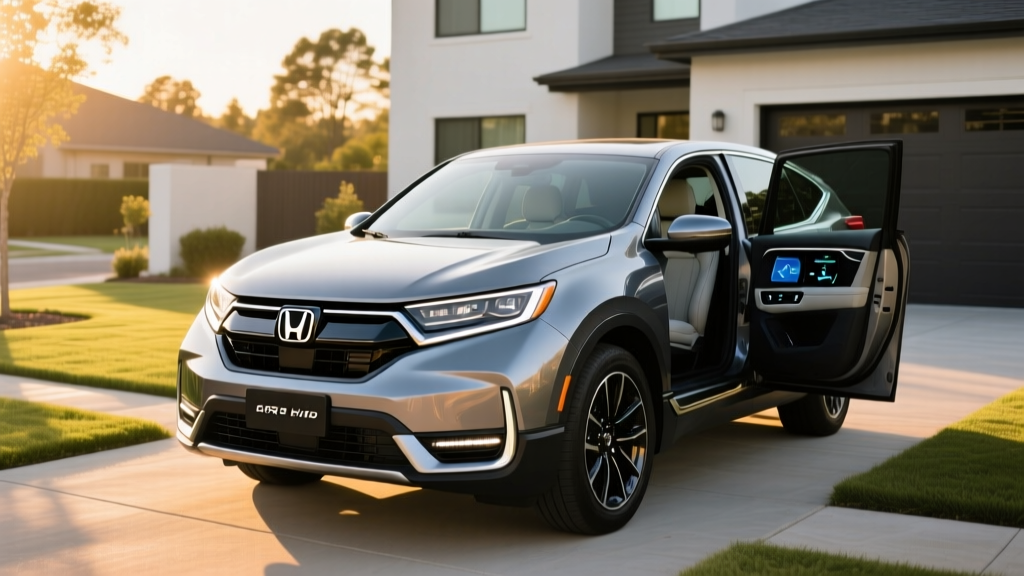
The 2024 Honda CR-V Hybrid targets buyers who want SUV practicality and strong fuel economy without plugging in. It's a conventional hybrid (HEV), meaning it generates its own electricity through regenerative braking and the gasoline engine — no charging cable required. With an EPA-estimated 40 MPG combined and a starting price around $34,000, it competes directly with the Toyota RAV4 Hybrid and Hyundai Tucson Hybrid in one of the most competitive segments in the market.
This guide covers every number that matters: real-world fuel economy, powertrain specs, battery longevity, warranty coverage, tax-credit eligibility, and how the CR-V Hybrid stacks up against plug-in hybrids and full electric vehicles.
HEV vs PHEV: What the CR-V Hybrid Actually Is
Before diving into specs, it's critical to understand what you're buying. The 2024 Honda CR-V Hybrid is a conventional hybrid (HEV), not a plug-in hybrid (PHEV). Honda does not currently offer a PHEV version of the CR-V in the United States.
| Feature | HEV (CR-V Hybrid) | PHEV (e.g., RAV4 Prime) | BEV (e.g., Ioniq 5) |
|---|---|---|---|
| Plug-in charging | No | Yes | Yes |
| Electric-only range | ~1 mile at low speed | 25–42 miles typical | 250–350+ miles |
| Battery size | ~1.1 kWh (small buffer) | 13–22 kWh | 58–84+ kWh |
| Fuel source | Gasoline only | Gasoline + grid electricity | Grid electricity only |
| Tailpipe emissions | Yes | Yes (when engine runs) | None |
| Federal tax credit (§30D) | Not eligible | Up to $7,500 (varies) | Up to $7,500 (varies) |
The CR-V Hybrid's small lithium-ion battery pack stores energy captured from braking and engine operation. The electric motor assists the gasoline engine and can propel the vehicle solo at very low speeds for brief distances — but you will never plug it in, and it cannot function as an electric commuter car. If you need electric-only commuting, look at a PHEV like the Toyota RAV4 Prime or a full BEV like the Hyundai Ioniq 5.
Fuel Economy: EPA Ratings and Real-World MPG
The EPA rates the 2024 Honda CR-V Hybrid differently depending on drivetrain. Front-wheel drive (FWD) models earn slightly higher city numbers, while all-wheel drive (AWD) trims sacrifice 1 MPG city for better traction.
| Drivetrain | City MPG | Highway MPG | Combined MPG |
|---|---|---|---|
| FWD (Sport, Sport Touring) | 43 | 36 | 40 |
| AWD (Sport, Sport Touring) | 40 | 34 | 37 |
Source: EPA fueleconomy.gov
Real-World MPG vs. EPA Estimates
Hybrids routinely outperform their EPA ratings in city driving because stop-and-go traffic maximizes regenerative braking and electric-motor usage. In real-world testing by owners and automotive journalists, the CR-V Hybrid AWD often achieves 38–42 MPG in mixed city/suburban driving. Highway-only trips at 70+ MPH typically yield 32–35 MPG, since the electric motor contributes less at sustained high speeds and the gasoline engine carries the full load.
Cold weather reduces fuel economy by roughly 5–10% due to cabin heating demands and reduced battery efficiency. Expect 33–35 MPG combined in winter for AWD models. These figures remain competitive with the Toyota RAV4 Hybrid (EPA 39 combined AWD) and significantly better than the gas-only CR-V AWD (EPA 28 combined).
Powertrain Specs: Engine, Motor, and Horsepower
The 2024 CR-V Hybrid uses Honda's two-motor hybrid system, which pairs a 2.0-liter Atkinson-cycle four-cylinder engine with two electric motors integrated into the transmission housing. This is a series-parallel hybrid system — it can operate in EV mode, hybrid mode (engine generates electricity for the drive motor), or engine-direct mode (engine mechanically drives the wheels at highway speeds via a lock-up clutch).
| Engine | 2.0L DOHC Atkinson-cycle inline-4 |
| Engine power | 145 hp @ 6,100 rpm |
| Drive motor output | 181 hp / 247 lb-ft torque |
| Combined system output | 204 hp / 247 lb-ft |
| Transmission | e-CVT (no traditional gears) |
| Drivetrain options | FWD or AWD (torque-vectoring rear motor) |
| 0–60 mph | ~7.6 seconds (AWD) |
| Towing capacity | 1,000 lbs |
| Battery type | Lithium-ion (approx. 1.1 kWh capacity) |
The 204-hp combined output gives the CR-V Hybrid adequate acceleration for merging and passing. The e-CVT delivers smooth, linear power without the shift shock of a conventional automatic. The AWD system uses a dedicated rear electric motor that can vector torque between the left and right rear wheels, improving cornering stability — a meaningful advantage over mechanical AWD systems in competitors.
Pricing, Trims, and Tax Credit Eligibility
The 2024 Honda CR-V Hybrid is available exclusively in the Sport and Sport Touring trims. Pricing reflects the hybrid premium over gas-only models.
| Trim | Drivetrain | MSRP (incl. destination) |
|---|---|---|
| Sport | FWD | $34,145 |
| Sport | AWD | $35,645 |
| Sport Touring | AWD (standard) | $39,845 |
Federal Tax Credit: Not Eligible
The 2024 Honda CR-V Hybrid does not qualify for the federal §30D Clean Vehicle Credit. Under current IRS rules, only plug-in electric vehicles (PHEVs and BEVs) with sufficient battery capacity are eligible for the up-to-$7,500 credit. Conventional hybrids like the CR-V Hybrid are excluded regardless of fuel economy.
Some states and municipalities offer their own incentives for high-efficiency hybrids, but these vary widely by jurisdiction. Check your state's energy or environmental agency website for local programs. A few states offer reduced registration fees or HOV lane access for hybrids, though many have phased out HOV privileges for non-plug-in vehicles.
Source: IRS §30D Clean Vehicle Credit rules
Battery Longevity, Warranty, and Replacement Cost
Honda Hybrid Battery Warranty: The 2024 CR-V Hybrid's lithium-ion battery pack is covered for 8 years or 100,000 miles (whichever comes first) under Honda's hybrid battery warranty. In California Air Resources Board (CARB) states, coverage extends to 10 years or 150,000 miles.
Hybrid battery degradation is a top concern for buyers, but real-world data shows it's rarely an issue within the warranty period. Honda's hybrid systems have proven durable across multiple generations of the Accord Hybrid, Insight, and CR-V Hybrid. The small battery pack in an HEV operates within a narrow state-of-charge window (roughly 40–80%), which significantly reduces stress compared to the deep cycling a BEV battery endures.
Replacement Cost if Out of Warranty
If the hybrid battery fails outside the warranty window, replacement costs typically range from $2,000 to $4,000 including parts and labor at a Honda dealer. Third-party refurbishers offer reconditioned packs for $1,200–$2,500. Given that the battery is relatively small (around 1.1 kWh), replacement is far less expensive than a BEV battery swap, which can exceed $10,000–$20,000.
The rest of the hybrid powertrain — the electric motors, inverter, and e-CVT — is covered under Honda's 5-year/60,000-mile powertrain warranty. The e-CVT has no traditional transmission fluid or clutches to replace, reducing long-term maintenance costs versus a conventional automatic.
Reliability and Ownership Costs
Honda's hybrid powertrain has built a strong reliability record over two decades of production. The CR-V Hybrid carries top safety ratings from both the IIHS (Top Safety Pick) and NHTSA (5-star overall). The hybrid system adds complexity but eliminates the traditional transmission, starter motor, and alternator — components that commonly fail in gas-only vehicles.
5-Year Cost of Ownership Estimate
| Fuel (at $3.50/gal, 37 MPG combined) | ~$7,095 |
| Maintenance (oil changes, tires, brakes) | ~$3,200 |
| Insurance (national avg) | ~$8,500 |
| Depreciation (estimated) | ~$14,000 |
| Total estimated 5-year cost | ~$32,795 |
Compared to the gas-only CR-V AWD (EPA 28 combined), the hybrid saves approximately $2,400 in fuel over 5 years at 15,000 miles/year and $3.50/gallon. The hybrid's $1,500–$2,000 price premium over a comparably equipped gas model is typically recouped within 3–4 years of average driving.
CR-V Hybrid vs PHEV vs EV: Which Should You Choose?
Choose the CR-V Hybrid (HEV) if:
- You cannot install a home charger (apartment, street parking, no garage)
- You want maximum simplicity — no charging cables, no range planning
- Your budget is $34,000–$40,000 and you need AWD
- You drive a mix of city and highway with no single commute pattern
- You want proven reliability with minimal new technology risk
Choose a PHEV (e.g., Toyota RAV4 Prime) if:
- You can charge at home and have a commute under 40 miles round-trip
- You want electric-only daily driving with gas-engine backup for road trips
- You qualify for the §30D federal tax credit (income and sourcing requirements apply)
- You're willing to pay a $40,000+ starting price for electric commuting
Choose a full EV (e.g., Hyundai Ioniq 5, Tesla Model Y) if:
- You have reliable home Level 2 charging access
- Your daily driving is under 250 miles and you can plan road-trip charging
- You want zero tailpipe emissions and the lowest per-mile fuel cost
- You want to qualify for the full §30D credit and potentially state incentives
- You're comfortable with a higher upfront cost offset by lower operating expenses
The CR-V Hybrid occupies a specific niche: it's the best choice for buyers who want excellent fuel economy without changing their refueling habits. If you have home charging and a predictable commute, a PHEV or BEV will save more money and reduce emissions further. But for apartment dwellers, frequent road-trippers, and buyers in areas with sparse charging infrastructure, the HEV remains the most practical electrified option.
Pros and Cons
Pros
- 40 MPG combined (FWD) — among the best in the compact SUV class
- No plug-in charging required; works with existing gas-station infrastructure
- Strong 204 hp output with smooth e-CVT acceleration
- Standard Honda Sensing suite (adaptive cruise, lane-keeping, auto emergency braking)
- Top safety ratings from IIHS and NHTSA
- 8-year/100,000-mile hybrid battery warranty (10yr/150k in CARB states)
- Spacious cargo area (39.3 cu ft behind rear seats, 76.5 cu ft folded)
Cons
- No PHEV option available — cannot commute on electric power alone
- Not eligible for the federal §30D tax credit
- Highway MPG drops to 34–36 (less impressive than city figures)
- Hybrid trims start at $34,145 — premium over gas-only LX ($30,850)
- 1,000-lb towing capacity is limited for an SUV
- Only available in Sport and Sport Touring trims (no base hybrid)
- Cabin noise under hard acceleration (typical of e-CVT systems)
Frequently Asked Questions
How many MPG does the 2024 Honda CR-V Hybrid get?
The EPA rates the CR-V Hybrid at 43 city / 36 highway / 40 combined MPG for FWD models, and 40 city / 34 highway / 37 combined for AWD. Real-world mixed driving typically yields 37–42 MPG depending on conditions, with city-heavy routes favoring the higher end and sustained highway driving the lower end.
Does the CR-V Hybrid need to be plugged in?
No. The 2024 CR-V Hybrid is a conventional hybrid (HEV). It charges its small battery through regenerative braking and the gasoline engine. You never plug it in — you simply fill it with gasoline like a traditional car.
Is there a plug-in hybrid (PHEV) version of the CR-V?
Not in the United States. Honda sells a CR-V e:PHEV in China and Europe, but as of the 2024 model year, there is no PHEV CR-V for the U.S. market. If you need a compact SUV PHEV, the Toyota RAV4 Prime (42 miles electric-only, EPA-rated) and Hyundai Tucson PHEV (33 miles) are the closest alternatives.
Is the CR-V Hybrid reliable, and what does battery replacement cost?
Honda's hybrid system has a strong long-term reliability record. The battery is warranted for 8 years/100,000 miles (10 years/150,000 in CARB states). Out-of-warranty replacement costs approximately $2,000–$4,000 at a dealer, or $1,200–$2,500 from a third-party refurbisher. Given the narrow state-of-charge operating window, most hybrid batteries last well beyond the warranty period.
Does the 2024 CR-V Hybrid qualify for any tax credit?
No. The federal §30D Clean Vehicle Credit applies only to plug-in vehicles (PHEVs and BEVs). Conventional hybrids are not eligible. Some states may offer minor incentives for high-efficiency vehicles, but there is no federal tax benefit for purchasing the CR-V Hybrid.
How does the CR-V Hybrid compare to the Toyota RAV4 Hybrid?
The RAV4 Hybrid AWD is EPA-rated at 41 city / 38 highway / 39 combined — slightly lower combined than the CR-V Hybrid FWD but better highway MPG. The RAV4 offers a PHEV variant (RAV4 Prime) and slightly more cargo space. The CR-V Hybrid edges ahead on city MPG and interior technology, while the RAV4 Hybrid starts at a lower price ($32,425 for the LE AWD). Both are class leaders with proven reliability.
Can the CR-V Hybrid drive on electric power alone?
Only at very low speeds (under ~25 mph) for short distances (roughly one mile or less). The system uses EV mode for parking-lot maneuvering, gentle acceleration from stops, and low-speed coasting. It is not designed for sustained electric-only driving — the gasoline engine engages frequently to maintain battery charge and provide power.