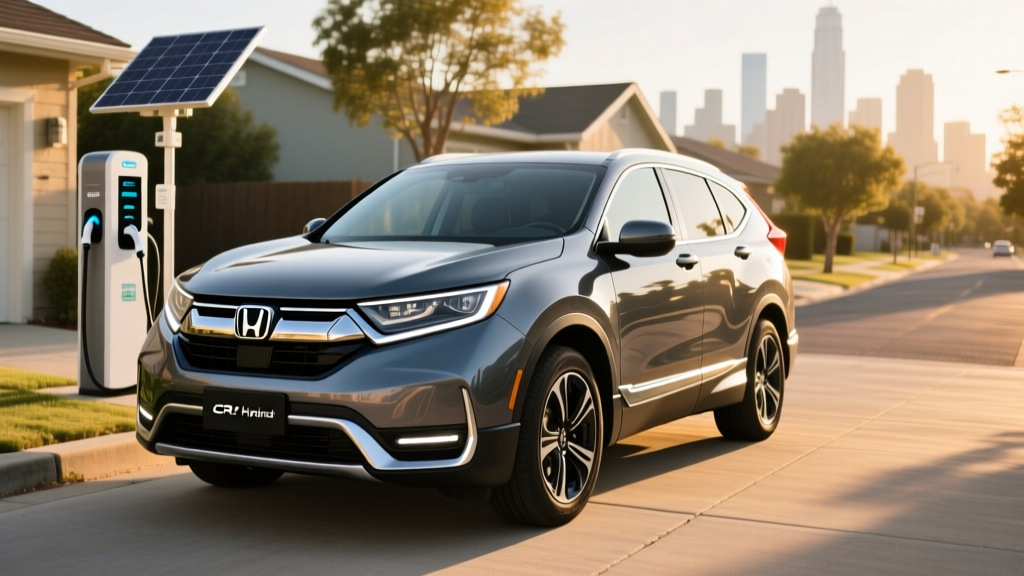
The Honda CR-V Hybrid has become one of the most popular compact SUVs for buyers who want electric-motor efficiency without changing how they refuel. If you've been searching for 2024 Honda CR-V Hybrid miles per gallon data, you're not alone — fuel economy is the single biggest reason buyers choose this powertrain over the turbocharged gas model. But the EPA sticker only tells part of the story. In this guide, we break down every efficiency number, compare the hybrid against plug-in and full-electric alternatives, and give you the real-world ownership data you need before signing a purchase agreement.
2024 Honda CR-V Hybrid MPG: The Official EPA Numbers
The 2024 Honda CR-V Hybrid uses a two-motor hybrid system paired with a 2.0-liter Atkinson-cycle four-cylinder engine. The EPA rates it differently depending on whether you choose front-wheel drive (FWD) or all-wheel drive (AWD), and the gap matters if you live in a snowy climate.
| Drivetrain | City MPG | Highway MPG | Combined MPG | Annual Fuel Cost* |
|---|---|---|---|---|
| FWD (Sport, Sport Touring) | 43 | 36 | 40 | $1,550 |
| AWD (Sport, Sport Touring) | 40 | 34 | 37 | $1,700 |
*Based on 15,000 miles/year, 55% city driving, and $3.50/gallon regular unleaded. Your costs will vary with local fuel prices.
Two things stand out in these numbers. First, the city MPG is significantly higher than the highway number — this is normal for conventional hybrids, which recapture braking energy in stop-and-go traffic and run on the electric motor at low speeds. Second, choosing AWD costs you 3 MPG combined. If you don't need all-wheel traction, FWD is the efficiency play.
Real-World MPG: What Owners Actually Report
EPA estimates are tested under controlled conditions. On the road, the 2024 CR-V Hybrid's real-world fuel economy depends heavily on your driving mix.
- City-dominant commute: 38–44 MPG (hybrids shine here — the electric motor handles low-speed propulsion, and regenerative braking recharges the battery constantly)
- Mixed driving (50/50 city/highway): 35–39 MPG
- Highway-dominant (70+ mph sustained): 31–35 MPG (aerodynamic drag dominates; the gas engine does most of the work)
- Cold weather (below 30°F): Expect a 5–10% drop. Engine runs more often for cabin heat, and battery chemistry is less efficient in the cold.
Owner forums and aggregators like Fuelly consistently show the CR-V Hybrid averaging 36–39 MPG in mixed driving, which aligns closely with the EPA combined figure. Drivers who do mostly city errands frequently report exceeding the EPA city number — something almost unheard of with conventional gas vehicles. This is because the EPA city test cycle involves frequent stops, which is exactly where a hybrid's regenerative braking and electric-motor assist deliver the most benefit.
Powertrain Specs: How the CR-V Hybrid Makes Its Power
The 2024 CR-V Hybrid uses Honda's fourth-generation two-motor hybrid system. It's a series-parallel design, meaning the vehicle can operate in three modes: EV drive (battery powers the motor alone at low speeds), hybrid drive (engine generates electricity to power the motor), and engine drive (engine directly powers the wheels at highway cruising speeds via a lockup clutch).
| Specification | Value |
|---|---|
| Engine | 2.0L Atkinson-cycle DOHC 4-cylinder |
| Engine Horsepower | 146 hp @ 6,100 rpm |
| Engine Torque | 134 lb-ft @ 4,500 rpm |
| Electric Motor Output | 184 hp / 247 lb-ft |
| Combined System Horsepower | 204 hp |
| Combined System Torque | 247 lb-ft (motor-driven) |
| Transmission | Direct-drive (e-CVT, no traditional gears) |
| Hybrid Battery | Lithium-ion, ~1.06 kWh (propulsion assist only) |
| 0–60 mph | ~7.6 seconds |
| Fuel Tank Capacity | 14.0 gallons |
| Total Driving Range (FWD) | ~560 miles |
The 204 combined horsepower is a meaningful upgrade over the non-hybrid CR-V's 190-hp turbocharged 1.5-liter engine. More importantly, the electric motor delivers its 247 lb-ft of torque instantly from a stop, making the hybrid feel noticeably quicker off the line in city driving, even though the 0–60 time is only marginally faster. The trade-off is that the hybrid is roughly 200 pounds heavier than the gas model, which slightly affects highway passing responsiveness.
HEV vs PHEV vs EV: Which Powertrain Fits Your Life?
The 2024 CR-V Hybrid is a conventional hybrid (HEV). It does not plug in. The small lithium-ion battery recharges through regenerative braking and the gas engine. Honda does not currently sell a CR-V plug-in hybrid (PHEV) in the United States, though the closely related Honda Clarity PHEV was discontinued after 2021. If you want a plug-in compact SUV from Honda, you'll need to wait for future model announcements or look at competitors like the Toyota RAV4 Prime.
| Factor | HEV (CR-V Hybrid) | PHEV (e.g., RAV4 Prime) | BEV (e.g., Tesla Model Y) |
|---|---|---|---|
| Plug in to charge? | No | Yes (but can drive on gas alone) | Yes (required) |
| Electric-only range | ~1 mile at low speed | 25–42 miles typical | 250–330 miles EPA |
| Home charging needed? | No | Recommended (Level 2) | Yes (Level 2 strongly recommended) |
| MPG / MPGe | 37–40 MPG | 38 MPG gas + 94 MPGe electric | 110–130 MPGe |
| Federal tax credit | Not eligible | Up to $7,500 (if qualified) | Up to $7,500 (if qualified) |
| Best for | No home charging access; want simplicity | Short commute + home charging; road trips | Home charging + mostly under 250 mi/day |
| Upfront cost premium | +$1,000–$1,500 over gas | +$5,000–$8,000 over gas | Varies; often higher than gas |
Look at a PHEV instead if: You have a garage or driveway where you can install a Level 2 charger, your daily commute is under 35 miles round-trip, and you want to drive mostly on electricity while keeping the gas engine for longer road trips.
Consider a full EV if: You have reliable home charging, your daily driving is under 200 miles, you want the lowest per-mile energy cost, and you're ready to plan around DC fast charging on road trips.
Pricing, Trims, and Tax Credit Eligibility
The 2024 Honda CR-V Hybrid is offered in two trims: Sport and Sport Touring. Both come standard with the hybrid powertrain — you don't need to "add" hybrid to a base model.
| Trim | FWD MSRP | AWD MSRP | Key Features |
|---|---|---|---|
| Sport | $33,950 | $35,450 | 18-inch wheels, 7-inch touchscreen, wireless Apple CarPlay/Android Auto, Honda Sensing suite |
| Sport Touring | $38,350 | $39,850 | 9-inch touchscreen, wireless phone charging, Bose 12-speaker audio, heated rear seats, hands-free power tailgate, navigation |
Destination charge of $1,350 applies to all trims. Prices reflect 2024 MSRP; dealer pricing may vary.
Federal Tax Credit: Not Eligible
Under current IRS §30D rules, the 2024 Honda CR-V Hybrid does not qualify for the federal clean vehicle tax credit. The credit applies only to plug-in electric vehicles (BEVs and PHEVs) with a minimum battery capacity of 7 kWh. The CR-V Hybrid's propulsion battery is approximately 1.06 kWh — far below the threshold. This is the case for all conventional (non-plug-in) hybrids from every manufacturer.
Some states offer their own incentives for hybrid purchases, but these vary widely and change frequently. Check your state's energy or environmental agency website for current programs. The CR-V Hybrid's value proposition is fuel savings, not tax incentives — at 40 MPG combined versus the gas model's 30 MPG combined, you'll save roughly $500–$600 per year on fuel at 15,000 miles driven annually.
Battery Warranty, Lifespan, and Replacement Cost
Hybrid battery longevity is one of the most common concerns among first-time hybrid buyers. Here's what Honda covers and what the data shows.
- Duration: 8 years / 100,000 miles (whichever comes first)
- CARB states: 10 years / 150,000 miles in states that follow California Air Resources Board emissions standards (CA, CO, CT, DE, ME, MD, MA, MN, NJ, NM, NY, OR, PA, RI, VT, WA, and others adopting CARB rules)
- Coverage: Defects and capacity loss below a specified threshold (typically 60–70% of original capacity)
- Powertrain warranty: 5 years / 60,000 miles (covers engine, transmission, and hybrid system components)
How Long Do Honda Hybrid Batteries Last in Practice?
Honda's hybrid systems have proven durable. The lithium-ion hybrid battery in the CR-V is small (~1.06 kWh) and is never deeply discharged — the system maintains a narrow state-of-charge window (roughly 40–80%) to minimize degradation. This shallow-cycling strategy dramatically extends battery life compared to full EVs that regularly cycle between 10% and 90%.
Real-world data from Honda hybrid owners (including earlier-generation Insight and Accord Hybrid models using similar architecture) shows hybrid batteries commonly lasting 150,000–200,000+ miles before any significant capacity loss. Failures within the warranty period are uncommon and covered at no cost.
Battery Replacement Cost
If the hybrid battery does need replacement outside of warranty, expect to pay between $2,000 and $4,000 for a new OEM battery pack installed at a Honda dealer. Third-party refurbished or reconditioned packs are available for $1,000–$2,000. Given that the battery is small and shallow-cycled, replacement is rare within the typical ownership period of a CR-V.
Reliability Ratings and Safety
The 2024 CR-V Hybrid inherits the strong reliability reputation of the broader CR-V lineup. Honda's hybrid system is now in its fourth generation and has been refined over more than two decades of production, starting with the original Insight in 1999.
The NHTSA awarded the 2024 CR-V a 5-star overall safety rating. The IIHS named it a Top Safety Pick, with top marks in all crashworthiness categories. The Honda Sensing suite — standard on all trims — includes adaptive cruise control, lane-keeping assist, forward collision warning with automatic emergency braking, and traffic sign recognition. Note that these are SAE Level 2 driver-assistance features, meaning you must remain fully engaged with hands on the wheel and eyes on the road at all times.
Pros
- 40 MPG combined (FWD) — class-leading for a compact SUV
- 204 hp feels responsive; instant electric torque in city driving
- No plug-in required — zero lifestyle change from a gas car
- Strong safety ratings (5-star NHTSA, IIHS Top Safety Pick)
- Spacious interior with 36.3 cu-ft cargo room (seats up)
- 8-year/100,000-mile hybrid battery warranty (10/150k in CARB states)
- Proven, fourth-generation hybrid system reliability
Cons
- No PHEV option — can't drive on electric-only for commutes
- AWD drops fuel economy to 37 MPG combined
- Hybrid only available in Sport/Sport Touring trims ($33,950+ starting)
- Not eligible for federal EV/PHEV tax credits
- Engine drone noticeable under hard acceleration (e-CVT characteristic)
- Regenerative braking feel takes adjustment if you're new to hybrids
5-Year Ownership Cost Snapshot
Here's how the CR-V Hybrid stacks up on running costs compared to the gas-only CR-V and a comparable full EV over five years and 75,000 miles.
| Cost Factor | CR-V Hybrid (FWD) | CR-V Gas (AWD EX) | Tesla Model Y LR (AWD) |
|---|---|---|---|
| Fuel / Energy | $7,750 | $10,500 | $3,400 (home charging avg.) |
| Maintenance | $2,800 | $3,500 | $1,500 |
| Insurance (avg.) | $7,500 | $7,000 | $9,000 |
| Federal Tax Credit | $0 | $0 | Up to $7,500* |
| Estimated Depreciation | $14,000 | $15,500 | $18,000 |
| Total Estimated Cost | ~$32,050 | ~$36,500 | ~$34,400 (after credit) |
*Tesla Model Y eligibility for the §30D credit depends on current-year IRS rules including MSRP caps, buyer income limits, and battery sourcing requirements. Verify at IRS.gov. Fuel costs based on $3.50/gal regular and 15,000 mi/yr. Electricity at $0.14/kWh national average. Actual costs vary significantly by region and driving habits.
Frequently Asked Questions
How many MPG does the 2024 Honda CR-V Hybrid get?
The EPA rates the FWD model at 43 city / 36 highway / 40 combined MPG. The AWD model drops to 40 city / 34 highway / 37 combined. In real-world city-dominant driving, many owners report matching or slightly exceeding these numbers thanks to regenerative braking and electric-motor assist at low speeds.
Does the CR-V Hybrid need to be plugged in?
No. The CR-V Hybrid is a conventional (self-charging) hybrid. The battery recharges through regenerative braking and the gasoline engine. You never plug it in — you simply refuel at any gas station as you would with a regular car.
Can I get the CR-V as a plug-in hybrid (PHEV)?
Not in the United States. Honda does not currently offer a CR-V PHEV in the US market. If you want a plug-in hybrid compact SUV, the Toyota RAV4 Prime (42 miles electric-only range, 94 MPGe) is the closest competitor. Honda has not announced a US-market CR-V PHEV for 2025 or 2026 as of this writing.
Is the Honda CR-V Hybrid reliable?
Yes. Honda's hybrid system is in its fourth generation and has a long track record of durability. The hybrid battery is shallow-cycled (never fully drained or fully charged), which significantly extends its lifespan. The hybrid battery is covered by an 8-year/100,000-mile warranty (10 years/150,000 miles in CARB states), and real-world data shows these batteries commonly lasting 150,000+ miles.
What does it cost to replace the CR-V Hybrid battery?
Out-of-warranty replacement typically costs $2,000–$4,000 for a new OEM battery at a Honda dealer, or $1,000–$2,000 for a refurbished unit. However, because the battery is small and shallow-cycled, replacement is uncommon within the first 150,000 miles of ownership.
Does the CR-V Hybrid qualify for any tax credits?
No. Under IRS §30D rules, the federal clean vehicle credit requires a plug-in electric vehicle with a battery capacity of at least 7 kWh. The CR-V Hybrid's battery is approximately 1.06 kWh, making it ineligible. Conventional hybrids from all manufacturers share this limitation. Some states may offer separate hybrid incentives — check your state's energy office for current programs.
How does the CR-V Hybrid compare to the Toyota RAV4 Hybrid?
The Toyota RAV4 Hybrid is the CR-V Hybrid's closest rival. The RAV4 Hybrid is rated at 41 city / 38 highway / 40 combined MPG (AWD standard on all hybrid trims). The CR-V Hybrid FWD matches the RAV4's 40 combined but requires FWD to do so; the AWD CR-V drops to 37 combined. The RAV4 Hybrid starts lower (around $31,000 on the LE trim), while the CR-V Hybrid starts at $33,950. Both have strong reliability records and similar cargo space. The choice often comes down to brand preference, dealer availability, and whether you prioritize a lower starting price (RAV4) or a more refined interior (CR-V Sport Touring).
Is the CR-V Hybrid worth it over the gas model?
If you plan to keep the vehicle for 4+ years and drive 12,000+ miles annually, yes. The hybrid's $1,000–$1,500 price premium over a comparably equipped gas model is typically recovered through fuel savings within 2–3 years. You also gain smoother, quieter low-speed driving and the environmental benefit of burning roughly 25–30% less fuel. If you drive very few miles per year or plan to trade in within two years, the payback may not justify the premium.