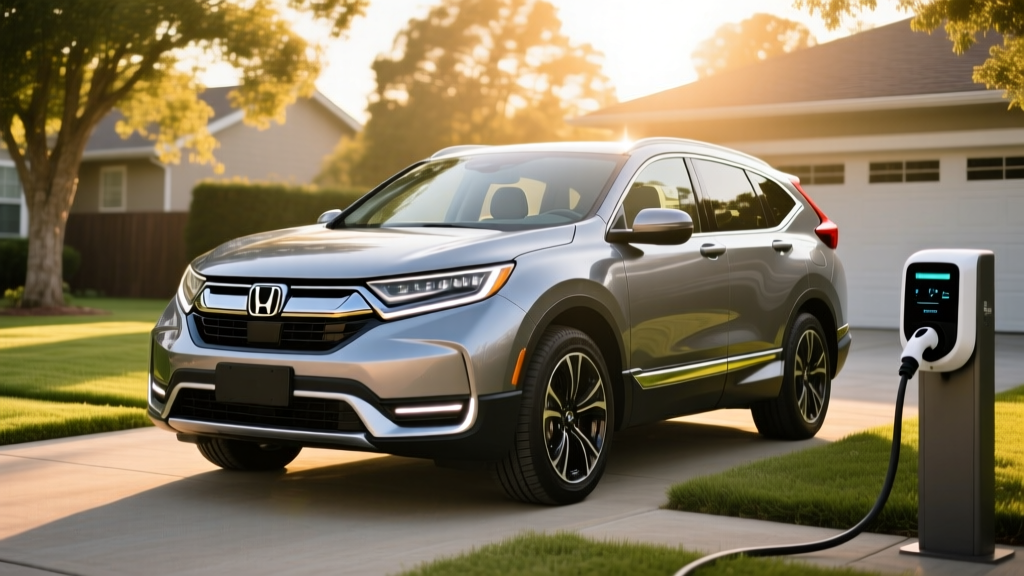
The 2024 Honda CR-V Hybrid pairs a 2.0-liter Atkinson-cycle engine with a two-motor hybrid system to deliver 40 MPG combined in front-wheel-drive form — making it one of the most efficient compact SUVs you can buy without plugging in. With 204 combined horsepower, standard Honda Sensing safety tech, and a proven hybrid powertrain now in its sixth generation, the CR-V Hybrid targets buyers who want EV-like city efficiency without charging infrastructure or range anxiety.
This guide covers the exact EPA numbers, real-world fuel economy expectations, battery longevity data, warranty coverage, and how the CR-V Hybrid stacks up against plug-in hybrids and full battery-electric vehicles for different driving patterns.
EPA Fuel Economy and Real-World MPG
| Drivetrain | City MPG | Highway MPG | Combined MPG |
|---|---|---|---|
| FWD (Sport, Sport Touring) | 43 | 36 | 40 |
| AWD (Sport, Sport Touring) | 40 | 34 | 37 |
Source: EPA / fueleconomy.gov
Honda's two-motor hybrid system operates primarily as a series hybrid at low and moderate speeds — the engine generates electricity while the drive motor propels the wheels. This means city and suburban driving often exceeds the EPA city estimate. Owners regularly report 42–46 MPG in stop-and-go traffic and warm weather.
Highway driving is the CR-V Hybrid's relative weak point. At sustained 70–80 mph speeds, the engine engages directly through a lock-up clutch, and aerodynamic drag reduces efficiency. Expect 32–35 MPG on the highway in real-world conditions, slightly below the EPA sticker. In cold weather (below 30°F), overall MPG typically drops 10–15% due to increased engine runtime for cabin heat and reduced battery efficiency.
HEV vs PHEV: Understanding What the CR-V Hybrid Is
The 2024 CR-V Hybrid is a conventional hybrid electric vehicle (HEV) — it has no plug, no charging port, and no electric-only driving range to manage. The 1.06 kWh lithium-ion battery recharges exclusively through regenerative braking and the gasoline engine. You fuel it like any other car and never think about charging.
This is fundamentally different from a plug-in hybrid (PHEV) like the Toyota RAV4 Prime or Hyundai Tucson PHEV, which carries a larger battery (typically 15–20 kWh), offers 30–42 miles of electric-only range, and requires regular plug-in charging to realize its efficiency advantage.
| Feature | CR-V Hybrid (HEV) | Typical Compact PHEV | Full EV (BEV) |
|---|---|---|---|
| Plug-in charging required | No | Yes (for max benefit) | Yes (mandatory) |
| Electric-only range | ~1 mile (low speed) | 30–42 miles | 230–350+ miles |
| Battery capacity | 1.06 kWh | 15–18 kWh | 60–100 kWh |
| DC fast charging | N/A | Rarely available | Standard |
| Fueling | Gas station only | Gas + plug | Plug only |
| Federal tax credit (§30D) | Not eligible | Up to $7,500 (if eligible) | Up to $7,500 (if eligible) |
Powertrain and Performance Specs
| Specification | 2024 Honda CR-V Hybrid |
|---|---|
| Engine | 2.0L DOHC Atkinson-cycle 4-cylinder |
| Engine output | 145 hp / 138 lb-ft torque |
| Drive motor output | 184 hp / 247 lb-ft torque |
| Combined system output | 204 hp / 247 lb-ft torque |
| Transmission | Direct-drive (no traditional gearbox) |
| 0–60 mph | ~7.6 seconds (AWD) |
| Drivetrain options | FWD or Real Time AWD™ |
| Hybrid battery | 1.06 kWh lithium-ion |
| Towing capacity | 1,000 lbs |
| Cargo volume (rear seats up) | 36.3 cu ft |
| Cargo volume (rear seats folded) | 76.5 cu ft |
Honda's fourth-generation two-motor hybrid system is one of the most sophisticated on the market. Under most city driving conditions, the engine acts solely as a generator — the traction motor drives the wheels using electricity produced on demand or drawn from the small battery buffer. Only at highway cruising speeds does a lock-up clutch mechanically connect the engine to the wheels for direct drive efficiency.
The result is seamless, electric-like acceleration from a stop with none of the gear-hunting feel common in CVT-equipped hybrids. The 247 lb-ft of instant electric torque gives the CR-V Hybrid confident merge and passing response, even though 0–60 times are unremarkable at 7.6 seconds.
Pricing, Trims, and Tax Credit Eligibility
| Trim | Drivetrain | MSRP |
|---|---|---|
| Sport | FWD | $33,950 |
| Sport | AWD | $35,450 |
| Sport Touring | AWD (standard) | $40,850 |
Source: Honda.com official specifications
The 2024 Honda CR-V Hybrid is a conventional HEV and does not qualify for the IRS §30D Clean Vehicle Credit. That credit applies only to plug-in electric vehicles (BEVs and PHEVs) meeting battery sourcing, MSRP, and buyer income requirements.
Some states offer rebates for conventional hybrids, though these have become rare as incentive programs shift toward plug-in vehicles. Check your state energy office or AFDC alternative fuels database for current state-level programs.
Battery Warranty, Longevity, and Replacement Cost
- Hybrid battery: 8 years / 100,000 miles (10 years / 150,000 miles in CARB states including CA, NY, MA, and others)
- Hybrid system components: 8 years / 100,000 miles
- Coverage threshold: Honda warrants the battery against defects and excessive capacity loss that impairs hybrid system function
The CR-V Hybrid's 1.06 kWh battery is small and operates within a narrow state-of-charge window — typically between 20% and 80% SoC — managed by the hybrid control system. This shallow cycling dramatically reduces stress compared to the deep discharge cycles in a full EV. Honda's hybrid batteries in the Accord and CR-V lines have demonstrated strong longevity, with many examples surpassing 200,000 miles without replacement.
If replacement becomes necessary outside warranty, a new OEM hybrid battery pack for the CR-V Hybrid typically costs between $2,000 and $3,500 including installation at a Honda dealer. Third-party refurbishment options exist for $1,200–$2,000. This is a fraction of the $8,000–$20,000+ replacement cost for a full EV traction battery.
The hybrid system's power electronics — the inverter, DC-DC converter, and motor control unit — carry the same 8-year/100,000-mile warranty. Failures are uncommon based on historical data from Honda's two-motor system introduced in 2014.
Reliability and Safety Ratings
The 2024 CR-V earned top safety marks across the board:
- NHTSA: 5-Star Overall Safety Rating
- IIHS: Top Safety Pick+ (with specific headlight trims)
Honda Sensing — the brand's Level 2 driver-assistance suite — is standard on every CR-V Hybrid trim. It includes adaptive cruise control with low-speed follow, lane-keeping assist, road departure mitigation, and collision mitigation braking. This is a hands-on-wheel, eyes-on-road system (SAE Level 2), not autonomous driving.
For reliability, Honda's fourth-generation two-motor hybrid system has accumulated millions of fleet and consumer miles since its 2014 debut in the Accord Hybrid. The system eliminates the traditional transmission entirely — no planetary gearset, no belt-driven CVT — reducing mechanical failure points. Consumer Reports and J.D. Power data consistently place Honda hybrids above segment average for powertrain reliability.
Who Should Choose the CR-V Hybrid vs a PHEV or Full EV
- You lack access to home or workplace charging (apartment, street parking, no garage)
- You regularly drive 300+ miles in a single trip and don't want to plan charging stops
- You want maximum efficiency with zero behavior change — just fill up with gas
- Your budget is under $40,000 and you need AWD and cargo space
- You live in an area with limited public charging infrastructure
- You can charge at home nightly and your daily commute is under 35 miles
- You want electric-only daily driving but gas flexibility for road trips
- You qualify for the §30D federal tax credit (income and sourcing requirements apply)
- You have reliable Level 2 home charging
- Your daily driving is under 250 miles and you can plan for longer trips
- You want the lowest per-mile fuel cost (electricity vs gas) and minimal maintenance
- You want to maximize federal and state incentives
Pros and Cons at a Glance
- 40 MPG combined (FWD) — best in compact SUV segment
- No plug required — zero charging infrastructure needed
- Smooth, EV-like acceleration feel from the two-motor system
- Top Safety Pick+ rating with standard Honda Sensing
- Generous cargo space: 36.3 cu ft / 76.5 cu ft
- Proven hybrid reliability with 8–10 year battery warranty
- Low battery replacement cost vs full EV ($2,000–$3,500)
- Highway MPG drops to low 30s at 75+ mph
- No federal tax credit eligibility (HEV, not PHEV/BEV)
- Towing limited to 1,000 lbs
- AWD system is reactive (torque-to-rear) — not for off-road use
- Sport Touring trim pushes past $40,000 — approaching PHEV territory
- No spare tire (tire repair kit only)
Frequently Asked Questions
How many MPG does the 2024 Honda CR-V Hybrid get?
The FWD CR-V Hybrid achieves 43 city / 36 highway / 40 combined MPG per the EPA. The AWD version rates 40 city / 34 highway / 37 combined. In real-world city driving, many owners report exceeding 42 MPG thanks to the series-hybrid operation at low speeds. Highway driving at 75+ mph typically returns 32–35 MPG.
Does the CR-V Hybrid need to be plugged in?
No. The CR-V Hybrid is a conventional hybrid (HEV), not a plug-in hybrid (PHEV). The 1.06 kWh battery charges entirely through regenerative braking and the gasoline engine. You simply fill the 14-gallon fuel tank at any gas station. Total range on a tank is approximately 560 miles (FWD) or 518 miles (AWD).
How far can the CR-V Hybrid drive on electric power alone?
Effectively about one mile at very low speeds (under 25 mph) on a fully charged battery. The hybrid system is designed for electric assist and engine-off coasting, not sustained EV driving. If electric-only commuting is a priority, a PHEV like the Toyota RAV4 Prime (42 miles EV range) or a full EV is the better fit.
Is the CR-V Hybrid reliable, and what does a battery replacement cost?
Honda's two-motor hybrid system has been in production since 2014 with strong reliability records. The hybrid battery is warranted for 8 years/100,000 miles (10 years/150,000 miles in CARB states). Out-of-warranty replacement runs $2,000–$3,500 at a dealer — significantly less than a full EV battery. The system has no traditional transmission, reducing long-term mechanical risk.
Does the 2024 CR-V Hybrid qualify for any tax credit?
No. The federal §30D Clean Vehicle Credit applies only to plug-in vehicles (BEVs and PHEVs) with qualifying battery sourcing. As a conventional hybrid, the CR-V Hybrid is not eligible. Some states may offer small hybrid rebates — check the AFDC state incentive database for your area. The IRS publishes current credit rules at irs.gov.
CR-V Hybrid vs RAV4 Hybrid — which is more efficient?
The Toyota RAV4 Hybrid (AWD standard) rates at 41 MPG combined, edging out the CR-V Hybrid AWD's 37 MPG combined. However, the CR-V Hybrid FWD matches or exceeds the RAV4's number at 40 MPG combined, and the RAV4 does not offer a FWD-only hybrid trim. The RAV4 Hybrid also offers slightly more horsepower (219 hp vs 204 hp) and a higher tow rating (1,750 lbs vs 1,000 lbs). Choose based on cargo preference, safety ratings, and dealer relationship — both are segment leaders.