Quick Verdict: A Spacious, Efficient Hybrid That Doesn't Need a Plug
The 2024 Honda CR-V Hybrid pairs a roomy, well-finished cabin with a two-motor hybrid powertrain that delivers 40 MPG combined in EPA testing — and often better in real-world city driving. It's a conventional hybrid (HEV), meaning it never needs to be plugged in. For buyers searching for a 2024 Honda CR-V Hybrid interior that balances cargo space, tech, and fuel savings without the complexity of plug-in charging, this SUV makes a compelling case. But how does it stack up against a PHEV or a full EV? Let's break down every number that matters.
| Spec | Value |
|---|---|
| Powertrain | 2.0L Atkinson-cycle 4-cyl + 2 electric motors |
| Combined Horsepower | 204 hp |
| Combined Torque | 247 lb-ft (electric motors) |
| EPA MPG (City / Hwy / Combined) | 43 / 36 / 40 (FWD); 40 / 34 / 37 (AWD) |
| Fuel Tank | 14.0 gallons |
| Total Range (EPA est.) | ~560 miles (FWD) |
| 0-60 mph | ~7.8 seconds |
| Cargo Volume (behind rear / max) | 36.3 / 76.5 cu ft |
| Hybrid Battery Warranty | 8 years / 100,000 miles |
| Base MSRP (Sport FWD) | $35,395 |
| Federal EV Tax Credit | Not eligible (HEV) |
2024 Honda CR-V Hybrid Interior: Space, Materials, and Tech
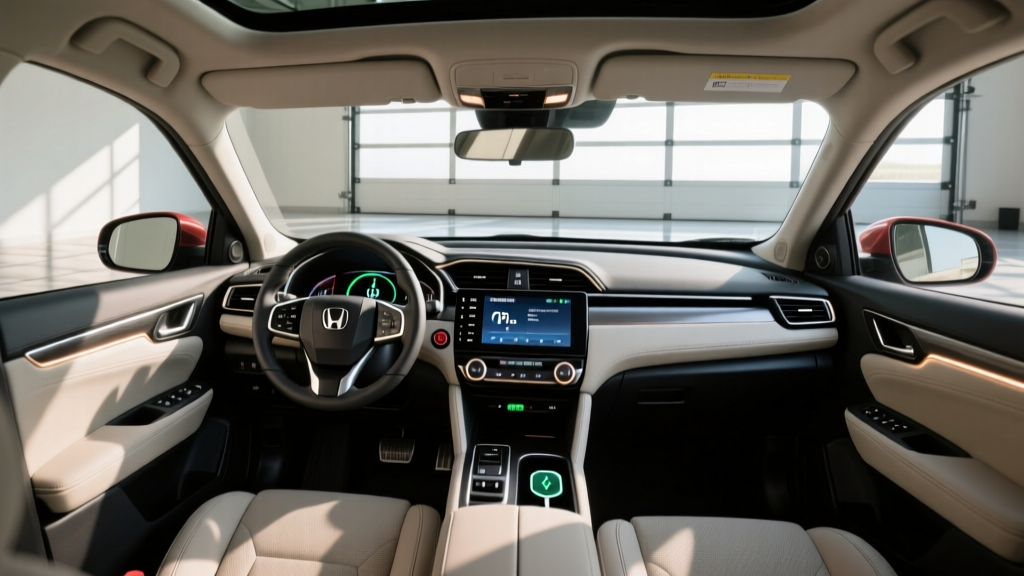
Honda redesigned the CR-V for the 2023 model year, and the 2024 carryover retains that generation's notable interior upgrades. The cabin uses a honeycomb mesh air vent design that spans the dashboard width, a 7-inch or available 9-inch touchscreen (depending on trim), and physical knobs for climate and volume — a practical choice that many EV touchscreens still lack.
Hybrid trims (Sport and Sport Touring) get exclusive interior touches including a black headliner, orange contrast stitching on higher trims, and a leather-wrapped steering wheel. The Sport Touring adds leather-trimmed seats, heated front seats, a heated steering wheel, and a wireless phone charger.
Cargo space is one of the CR-V Hybrid's strongest interior selling points. With 36.3 cubic feet behind the second row and 76.5 cubic feet with the rear seats folded, it outpaces many compact SUV rivals — hybrid or otherwise. The hybrid battery pack is mounted low and does not intrude into the cargo floor, preserving a flat load area.
On the tech front, the 2024 CR-V Hybrid includes wireless Apple CarPlay and Android Auto (on 9-inch trims), a 10.2-inch digital instrument cluster with hybrid-specific energy flow displays, and Honda Sensing — the brand's Level 2 driver-assistance suite featuring adaptive cruise control, lane-keeping assist, and automatic emergency braking.
Fuel Economy: How Many MPG Does the CR-V Hybrid Actually Get?
| Drivetrain | City | Highway | Combined |
|---|---|---|---|
| FWD (Sport) | 43 MPG | 36 MPG | 40 MPG |
| AWD (Sport / Sport Touring) | 40 MPG | 34 MPG | 37 MPG |
Data source: fueleconomy.gov
The CR-V Hybrid's two-motor system operates primarily in electric-drive mode at low speeds, with the gasoline engine acting as a generator. At highway speeds, a lock-up clutch connects the engine directly to the wheels for efficiency. This architecture is why the city MPG is higher than the highway figure — the opposite of most gas-only vehicles.
Real-World MPG vs. EPA Estimates
In mixed suburban and city driving, many owners report exceeding the EPA combined figure, with 42-45 MPG achievable on the FWD model in warm weather with moderate acceleration. Highway-only trips at 75+ mph tend to yield 33-36 MPG for AWD models. Cold weather (below 30°F) can reduce fuel economy by 5-10% due to increased engine running for cabin heat and reduced battery efficiency — a smaller penalty than the 20-30% range loss a full EV experiences in the same conditions.
HEV vs. PHEV vs. EV: Which Powertrain Fits Your Life?
The CR-V Hybrid is a conventional HEV — it generates all its electricity onboard through regenerative braking and the gasoline engine. There is no plug, no electric-only range, and no home charger to install. Here's how it compares to the other options:
| Factor | HEV (CR-V Hybrid) | PHEV (e.g., Toyota RAV4 Prime) | BEV (e.g., Tesla Model Y) |
|---|---|---|---|
| Plug-in Required? | No | Yes (optional for full benefit) | Yes (mandatory) |
| Electric-Only Range | 0 miles (EV assist only) | ~42 miles | 260-330 miles |
| Total Range | ~560 miles | ~600+ miles | 260-330 miles |
| Fuel / Energy Cost per Mile | ~$0.11 (at $3.50/gal) | ~$0.04 electric / $0.11 gas | ~$0.04 (home charging) |
| Home Charging Needed? | No | Recommended (Level 2) | Yes (Level 2 strongly recommended) |
| Federal Tax Credit (§30D) | Not eligible | Up to $7,500 (if eligible) | Up to $7,500 (if eligible) |
| Maintenance | Oil changes, standard | Oil changes, standard | Minimal (no oil changes) |
Choose the CR-V Hybrid (HEV) if: You don't have access to home or workplace charging, you want fuel savings without behavioral changes, or you frequently drive in areas with sparse charging infrastructure.
Choose a PHEV if: You can install a Level 2 charger at home and most daily trips are under 40 miles, but you want gas-engine flexibility for road trips.
Choose a full EV if: You have reliable home charging, want the lowest per-mile energy cost, and are comfortable planning longer trips around DC fast charging.
Powertrain Deep Dive: How Honda's Two-Motor Hybrid Works
The 2024 CR-V Hybrid uses Honda's fourth-generation two-motor hybrid system. A 2.0-liter Atkinson-cycle four-cylinder engine produces 146 hp on its own, but the combined system output is 204 hp thanks to two electric motors that contribute 247 lb-ft of torque. The larger traction motor drives the wheels in most conditions, while a smaller generator motor starts the engine and manages energy flow.
The lithium-ion hybrid battery is relatively small — approximately 1.06 kWh — because it doesn't need to store energy for plug-in electric driving. Instead, it acts as a buffer, capturing energy from regenerative braking and releasing it for acceleration assist. This small battery is a key reason the CR-V Hybrid does not qualify for the federal §30D tax credit, which requires battery capacities of at least 7 kWh for plug-in vehicles.
Acceleration to 60 mph takes approximately 7.8 seconds, which is adequate for highway merging but not sporty. The hybrid system is notably smooth in stop-and-go traffic, where the electric motor handles low-speed propulsion and the engine engages seamlessly at higher loads.
Pricing, Trims, and Tax Credit Eligibility
The 2024 CR-V Hybrid is available in two trims:
- Sport (FWD): $35,395 MSRP — 7-inch touchscreen, cloth seats, Honda Sensing
- Sport (AWD): $36,895 MSRP — adds torque-vectoring AWD
- Sport Touring (AWD): $40,895 MSRP — 9-inch touchscreen, leather, Bose audio, wireless CarPlay, heated seats/steering wheel, power tailgate
Federal Tax Credit: Not Eligible
The CR-V Hybrid is a conventional HEV, not a plug-in vehicle. The IRS §30D Clean Vehicle Credit applies only to plug-in electric vehicles (BEVs and PHEVs) with qualifying battery capacity and sourcing. The CR-V Hybrid does not qualify. Some states may offer small rebates for high-efficiency hybrids — check your state's energy office or IRS.gov for current rules.
Reliability, Battery Lifespan, and Replacement Cost
Honda's hybrid systems have a strong reliability track record. The CR-V Hybrid's lithium-ion battery is covered by an 8-year / 100,000-mile warranty (10 years / 150,000 miles in California and states that follow CARB emissions standards). This warranty covers battery capacity loss below a defined threshold and any defects.
Real-world data from earlier Honda hybrids (Insight, Accord Hybrid) suggests the hybrid battery typically lasts 150,000-200,000 miles before significant degradation. Because the CR-V Hybrid's battery is small and operates in a narrow state-of-charge window (never fully depleted or fully charged), stress on the cells is minimal compared to a full EV battery.
If replacement is needed out of warranty, a new Honda hybrid battery for the CR-V Hybrid costs approximately $2,000-$3,500 including labor — far less than the $10,000-$20,000 replacement cost for a full EV battery pack. Independent hybrid shops often offer refurbished batteries for $1,200-$2,000.
According to IIHS, the 2024 CR-V earned a Top Safety Pick designation, and NHTSA awarded it a 5-star overall safety rating.
Pros
- 40 MPG combined (FWD) — class-leading for a compact hybrid SUV
- Spacious 36.3 cu ft cargo area with flat floor
- No plug-in charging required — zero infrastructure dependency
- Strong reliability record and 8yr/100k battery warranty
- Physical climate controls alongside modern touchscreen
- Top Safety Pick (IIHS) and 5-star NHTSA rating
Cons
- No federal tax credit eligibility (HEV, not PHEV)
- AWD drops combined MPG to 37
- CVT-like drone under hard acceleration
- Base Sport trim uses 7-inch screen (small for 2024)
- Sport Touring AWD at $40,895 approaches luxury-compact pricing
- No electric-only driving mode — always burns some fuel
Who Should Buy the 2024 CR-V Hybrid?
Buy the CR-V Hybrid if:
- You live in an apartment or lack home charging access and can't use a PHEV or EV effectively
- Your commute is 20-50 miles of mixed city/highway driving
- You want a compact SUV with strong cargo space and family-friendly features
- You plan to keep the vehicle 8+ years (warranty coverage + proven reliability)
Look elsewhere if:
- You have home charging and want the lowest possible per-mile cost → consider a BEV like the Hyundai Ioniq 5 or Tesla Model Y
- You want electric-only commuting but gas-engine road-trip flexibility → consider the Toyota RAV4 Prime PHEV (42 miles electric-only)
- You need towing capacity above 1,000 lbs (the CR-V Hybrid is rated for 1,000 lbs; the gas CR-V manages 1,500 lbs)
Frequently Asked Questions
How many MPG does the 2024 Honda CR-V Hybrid get?
The FWD model is EPA-rated at 43 city / 36 highway / 40 combined MPG. The AWD model rates 40 city / 34 highway / 37 combined. Real-world city driving often yields 42-45 MPG on the FWD model in moderate temperatures.
Does the CR-V Hybrid need to be plugged in?
No. The CR-V Hybrid is a conventional HEV. It charges its small lithium-ion battery through regenerative braking and the gasoline engine. You simply fill it with gas like any other car.
How far can the CR-V Hybrid drive on electric power alone?
Not far — roughly 1-2 miles at very low speeds (under 25 mph) in EV mode, and only when the battery has sufficient charge. The system is designed for electric assist, not electric-only driving. If you need meaningful electric-only range, you need a PHEV or BEV.
Is the CR-V Hybrid battery expensive to replace?
Out-of-warranty replacement costs approximately $2,000-$3,500 for a new OEM battery. However, Honda's 8-year/100,000-mile warranty covers defects and excessive capacity loss, and real-world data suggests these batteries often last 150,000-200,000 miles.
Does the 2024 CR-V Hybrid qualify for any tax credit?
No. The federal §30D Clean Vehicle Credit applies only to plug-in electric vehicles (BEVs and PHEVs). The CR-V Hybrid is a conventional HEV and does not qualify. Check your state's energy office for any local hybrid incentives.
How does the CR-V Hybrid compare to the Toyota RAV4 Hybrid?
The RAV4 Hybrid (AWD standard) rates 41/38/40 MPG and starts at ~$32,395. The CR-V Hybrid FWD matches the combined 40 MPG at $35,395. The RAV4 offers slightly more cargo space (37.6 cu ft), while the CR-V Hybrid has a more refined interior and a more modern infotainment system on the Sport Touring trim.
What is the Honda hybrid battery warranty?
Honda covers the hybrid battery for 8 years or 100,000 miles nationwide, and 10 years or 150,000 miles in California Air Resources Board (CARB) states. This covers capacity loss below Honda's defined threshold and manufacturing defects.