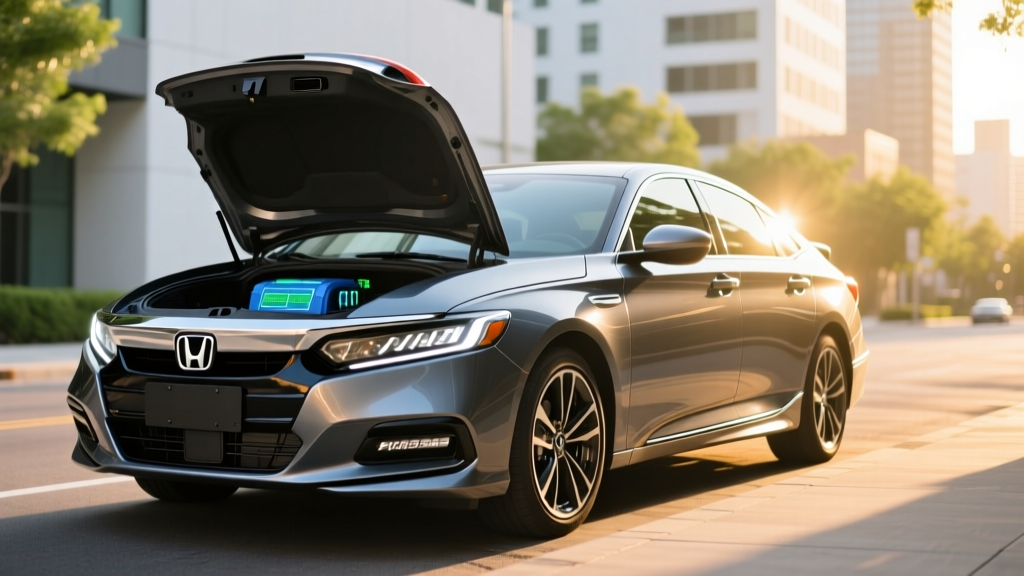
The 2024 Honda Accord Sport Hybrid occupies a specific niche: a midsize sedan that delivers hybrid efficiency without requiring you to plug in, change your driving habits, or pay an EV premium. With an EPA-estimated 48 MPG combined and a starting MSRP around $32,990 (including destination), the Sport Hybrid trim targets buyers who want genuine fuel savings wrapped in a conventional ownership experience. This guide breaks down the powertrain, real-world efficiency, battery longevity, and how the Accord Sport Hybrid compares to plug-in hybrids and full EVs for different driving patterns.
HEV vs PHEV: Why the Accord Sport Hybrid Doesn't Plug In
Before examining the numbers, it's critical to distinguish what the Accord Sport Hybrid is — and isn't. It is a conventional hybrid electric vehicle (HEV), not a plug-in hybrid (PHEV). This distinction drives everything from how you fuel it to whether it qualifies for federal tax credits.
Conventional Hybrid (HEV) — Accord Sport Hybrid
- No plug required. The battery charges exclusively through regenerative braking and the gasoline engine.
- No electric-only driving range. The electric motor assists the engine but cannot propel the car alone for meaningful distances.
- No §30D federal tax credit. The IRS clean vehicle credit applies only to plug-in vehicles with sufficient battery capacity.
- Lower upfront cost. Typically $3,000–$8,000 less than comparable PHEVs or BEVs.
Plug-In Hybrid (PHEV) — e.g., Toyota Prius Prime, Honda Clarity PHEV (discontinued)
- Plugs into a wall outlet or Level 2 charger to fill a larger battery (typically 10–20 kWh).
- 25–44 miles of electric-only range before the gas engine engages.
- May qualify for up to $7,500 federal tax credit under current IRS §30D rules, subject to MSRP caps, income limits, and battery-sourcing requirements.
- Higher purchase price and added weight from a larger battery pack.
The Accord lineup has not offered a PHEV variant in the U.S. market since the Clarity Plug-In Hybrid was discontinued after 2021. If plug-in capability is a priority, you'll need to look at competitors like the Toyota Prius Prime or consider a full battery-electric vehicle.
Fuel Economy: EPA Ratings and Real-World MPG
The 2024 Accord Sport Hybrid pairs a 2.0-liter Atkinson-cycle four-cylinder engine with Honda's two-motor hybrid system. The result is an EPA-estimated efficiency that punches well above its class weight.
| Metric | EPA Estimate | Real-World Expectation |
|---|---|---|
| City MPG | 51 MPG | 48–53 MPG (hybrids excel in stop-and-go) |
| Highway MPG | 44 MPG | 40–45 MPG (sustained 75+ mph reduces regen benefit) |
| Combined MPG | 48 MPG | 44–50 MPG depending on driving mix |
Why real-world MPG often beats EPA in the city: Honda's hybrid system uses the electric motor as the primary drive source at low speeds, with the gasoline engine acting mostly as a generator. Stop-and-go traffic maximizes regenerative braking, recapturing energy that a conventional car wastes as heat. On a 15-mile urban commute with frequent lights, owners routinely report 50+ MPG.
Where efficiency drops: Sustained highway driving above 70 mph reduces the hybrid advantage. The engine must directly drive the wheels via a lock-up clutch, and aerodynamic drag dominates. In cold weather (below 35°F), expect a 5–10% efficiency penalty as the engine runs more frequently to provide cabin heat and warm up the catalytic converter. According to fueleconomy.gov, the Accord Hybrid's combined rating places it among the most efficient midsize sedans available.
Powertrain: 204 Horsepower from Two Motors and a 2.0L Engine
| Specification | 2024 Accord Sport Hybrid |
|---|---|
| Engine | 2.0L Atkinson-cycle DOHC 4-cylinder |
| Engine Output | 146 hp @ 6,100 rpm / 134 lb-ft torque |
| Drive Motor | 181 hp / 247 lb-ft torque |
| Combined System Output | 204 hp / 247 lb-ft torque |
| Transmission | eCVT (single-speed direct drive with engine clutch) |
| Drivetrain | Front-wheel drive |
| 0–60 mph (est.) | ~7.2 seconds |
| Hybrid Battery | ~1.1 kWh lithium-ion (nominal, non-plug) |
| Fuel Tank | 12.8 gallons |
| Total Range (est.) | ~614 miles (12.8 gal × 48 MPG) |
Honda's fourth-generation two-motor hybrid system operates in three modes:
- EV Drive: Battery powers the drive motor alone (low-speed, light-load conditions — typically under 1–2 miles).
- Hybrid Drive: Engine spins the generator motor, which feeds electricity to the drive motor. The engine does not mechanically connect to the wheels.
- Engine Drive: At steady highway speeds, a lock-up clutch connects the engine directly to the wheels for maximum efficiency.
The Sport trim comes exclusively with the hybrid powertrain in the 2024 model year — Honda dropped the turbocharged 1.5T four-cylinder from the Sport trim, reserving it for the lower LX and SE trims. This means every Accord Sport you see is a hybrid.
Pricing, Trims, and Tax Credit Eligibility
The 2024 Accord Sport Hybrid starts at an MSRP of approximately $32,990 (including $1,095 destination charge). Key standard equipment includes:
- 18-inch alloy wheels
- 7-inch digital instrument cluster + 12.3-inch infotainment touchscreen
- Wireless Apple CarPlay and Android Auto
- Honda Sensing suite (adaptive cruise, lane-keeping, collision mitigation)
- Heated front seats
- LED headlights and taillights
Federal Tax Credit: Does the Accord Sport Hybrid Qualify?
No. The Accord Sport Hybrid is a conventional HEV, not a plug-in vehicle. Under IRS §30D rules, the federal clean vehicle credit requires a vehicle to have a battery capacity of at least 7 kWh and the ability to be charged from an external source. The Accord Hybrid's ~1.1 kWh self-charging battery does not meet these criteria.
What about state incentives? Some states offer modest rebates or HOV-lane access for conventional hybrids, but these vary widely by jurisdiction and change frequently. Check your state's energy office or DMV for current programs. Do not rely on generic online calculators — verify with official state sources.
Battery Longevity, Warranty, and Replacement Cost
Hybrid battery anxiety is the number-one concern for first-time hybrid buyers. Here's the data:
| Item | Details |
|---|---|
| Hybrid Battery Warranty | 8 years / 100,000 miles (10 years / 150,000 miles in CARB states) |
| Powertrain Warranty | 5 years / 60,000 miles |
| Hybrid System Warranty | 8 years / 100,000 miles (includes inverter, motor, control unit) |
| Expected Battery Lifespan | 150,000–200,000+ miles based on historical Honda hybrid data |
| Battery Replacement Cost (out of warranty) | $2,000–$4,000 (refurbished/aftermarket) to $5,000–$7,000 (OEM new) |
Honda's hybrid battery in the Accord is relatively small (~1.1 kWh) and operates within a narrow state-of-charge window — typically between 20% and 80%. This shallow cycling dramatically reduces degradation compared to a full EV battery that cycles from 10% to 90% daily. Honda has been refining this system since the 2005 Accord Hybrid, and real-world failure rates before 150,000 miles are low.
CARB state bonus: If you register the vehicle in California or a state that follows California Air Resources Board emissions standards (including Colorado, Connecticut, Maine, Maryland, Massachusetts, New Jersey, New York, Oregon, Rhode Island, Vermont, and Washington), the hybrid battery warranty extends to 10 years / 150,000 miles. This is a significant longevity backstop.
Who Should Choose the Accord Sport Hybrid vs. a PHEV or Full EV?
Pros
- 48 MPG combined with zero behavior change — just fill up with gas
- ~614 miles of total range eliminates range anxiety entirely
- Lower purchase price than PHEVs and EVs in the same class
- Proven Honda reliability and strong resale value
- Spacious midsize sedan with 16.7 cu-ft trunk (no battery intrusion)
- Smooth, torquey acceleration from the electric drive motor
Cons
- No electric-only driving — every mile burns some gasoline
- No federal tax credit eligibility
- No plug-in option in the Accord lineup
- FWD only — no AWD availability (unlike the Toyota Camry Hybrid)
- Engine drone under hard acceleration (eCVT characteristic)
- Road noise on coarse pavement at highway speeds
Choose the Accord Sport Hybrid If:
- You drive 12,000–20,000 miles/year with a mix of city and highway
- You lack reliable access to home or workplace charging (apartment, street parking)
- You want fuel savings without learning new habits or installing a charger
- You plan to keep the car 8–12 years and want proven long-term reliability
- Your budget is $30,000–$38,000 and you need a spacious sedan
Consider a PHEV Instead If:
- Your daily commute is under 30 miles and you can charge at home
- You want to drive most weekdays on electricity but take gas-free road trips
- You qualify for the §30D federal tax credit (income under $150K single / $300K joint, vehicle under MSRP cap)
Consider a Full EV Instead If:
- You have Level 2 home charging and drive under 250 miles/day
- You want zero tailpipe emissions and minimal maintenance (no oil changes, no spark plugs)
- You qualify for the full $7,500 federal credit, which can make an EV price-competitive with a hybrid
Real-World Ownership Costs: Fuel Savings vs. a Gas-Only Sedan
At 48 MPG combined, the Accord Sport Hybrid uses approximately 250 gallons per year if you drive 12,000 miles annually. At a national average of $3.40/gallon (regular unleaded — the Accord Hybrid does not require premium), that's roughly $850/year in fuel.
Compare this to a similarly equipped non-hybrid midsize sedan averaging 30 MPG combined: 400 gallons/year at $3.40 = $1,360/year. The hybrid saves approximately $510 per year in fuel, or about $2,550 over five years. While that doesn't offset the entire hybrid premium over a base gas model, the Sport Hybrid's standard equipment level (heated seats, larger touchscreen, 18-inch wheels) narrows the gap considerably when compared trim-for-trim.
Insurance costs for the Accord Hybrid are generally in line with the gas Accord — typically $1,400–$1,800/year depending on your profile and state. IIHS awarded the 2024 Accord its Top Safety Pick+ rating, which can help with insurance premiums from carriers that weight crash-test performance.
Frequently Asked Questions
How many MPG does the 2024 Honda Accord Sport Hybrid get?
The EPA rates it at 51 city / 44 highway / 48 combined MPG. In real-world city driving with frequent stops, owners often see 50–53 MPG thanks to aggressive regenerative braking. Highway-only driving at 75+ mph typically yields 40–44 MPG.
Does the Accord Sport Hybrid need to be plugged in?
No. It is a conventional hybrid (HEV). The battery charges through regenerative braking and the gasoline engine. You fuel it exactly like a regular car — at a gas station.
How far can the Accord Sport Hybrid go on electric only?
Less than 1 mile at very low speeds. The electric motor assists the engine and can propel the car solo briefly in parking lots or heavy traffic, but it is not designed for meaningful electric-only driving. If you want EV-mode commuting, you need a PHEV or full EV.
Is the hybrid battery reliable, and what does replacement cost?
Honda's hybrid batteries have demonstrated strong longevity, with many lasting 150,000–200,000+ miles. The battery is warranted for 8 years/100,000 miles (10/150,000 in CARB states). Out-of-warranty replacement runs $2,000–$4,000 for a refurbished unit or $5,000–$7,000 for a new OEM pack. Given the shallow charge cycling, premature failure is uncommon.
Does the 2024 Accord Sport Hybrid qualify for any tax credit?
It does not qualify for the federal §30D clean vehicle credit, which requires plug-in capability and a minimum 7 kWh battery. Some states offer minor hybrid incentives or HOV-lane stickers, but these vary by jurisdiction and change frequently. Verify with your state's official energy or DMV website before counting on any incentive.
How does the Accord Sport Hybrid compare to the Toyota Camry Hybrid?
The Camry Hybrid (LE trim) rates at 52 MPG combined vs. the Accord's 48, but the Camry also offers available AWD (the Accord is FWD only). The Accord provides more rear-seat legroom (40.8" vs. 38.0"), a larger trunk, and a more premium interior feel. Both are strong choices — the Camry wins on peak efficiency and AWD availability, while the Accord wins on space and driving refinement.
What's the difference between the Accord Sport Hybrid and the Accord EX-L Hybrid?
Both use the identical 204 hp hybrid powertrain and achieve the same EPA MPG. The Sport Hybrid adds sport-tuned suspension, 18-inch wheels, paddle shifters, and black exterior accents. The EX-L Hybrid ($36,690 MSRP) swaps the sport aesthetic for leather seats, a power passenger seat, wireless phone charging, and a slightly softer ride. The Sport is the value-oriented sporty choice; the EX-L is the luxury-oriented choice.
The 2024 Honda Accord Sport Hybrid delivers on a straightforward promise: midsize sedan practicality with genuinely low fuel consumption, no plug required, and the reliability Honda has built over two decades of hybrid engineering. For drivers who can't charge at home, who take regular road trips, or who simply want to spend less time and money at the gas station without overhauling their routine, it remains one of the most rational choices in the segment.