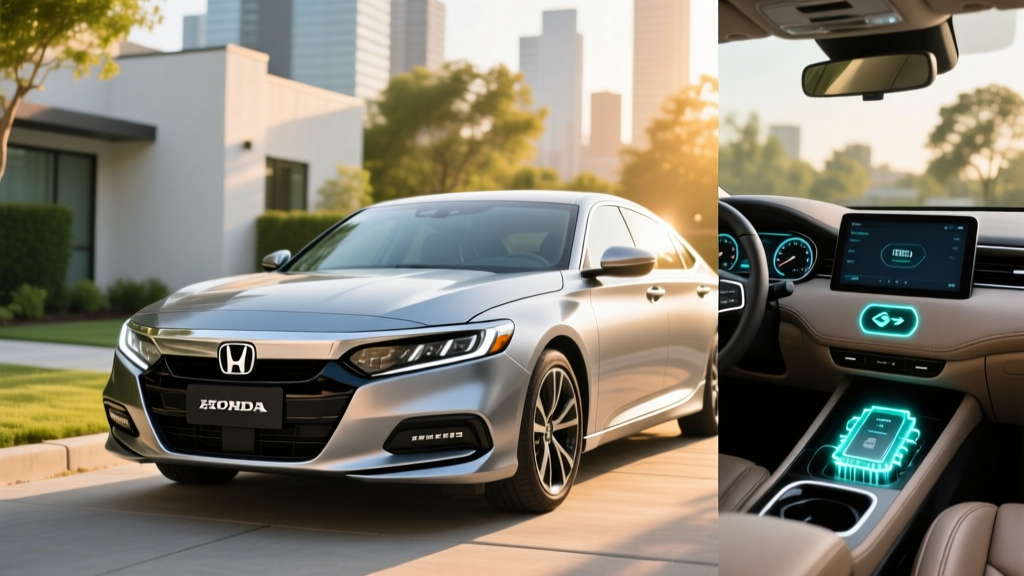
The midsize sedan segment hasn't surrendered to SUVs without a fight, and the 2024 Honda Accord Hybrid is one of its strongest defenders. With a two-motor hybrid system delivering 204 horsepower and an EPA-estimated 48 MPG combined, it targets buyers who want electric-car-like efficiency without plugging in or changing their driving habits. This guide breaks down every critical spec — from powertrain architecture to real-world fuel economy to long-term battery costs — so you can decide whether the Accord Hybrid fits your garage.
2024 Honda Accord Hybrid Powertrain and Performance Specs
The Accord Hybrid uses Honda's fourth-generation two-motor hybrid system. Unlike some competitors that rely on a traditional geared transmission, this setup operates primarily as a series hybrid at low and moderate speeds: the 2.0-liter Atkinson-cycle four-cylinder engine acts as a generator, while an electric traction motor drives the wheels. At highway speeds, a lock-up clutch connects the engine directly to the front axle for optimal efficiency.
| Spec | Value |
|---|---|
| Engine | 2.0L Atkinson-cycle DOHC 4-cylinder |
| Engine Output | 146 hp / 134 lb-ft torque |
| Traction Motor Output | 181 hp / 247 lb-ft torque |
| Combined System Horsepower | 204 hp |
| Combined System Torque | 247 lb-ft |
| Transmission | Direct-drive (no conventional gearbox) |
| Drivetrain | Front-wheel drive |
| Hybrid Battery | 1.06 kWh lithium-ion (HEV, not plug-in) |
| 0–60 mph (est.) | ~7.2 seconds |
| Curb Weight | ~3,477 lbs (Sport-L Hybrid) |
The 247 lb-ft of torque from the electric motor is available from near-zero RPM, which gives the Accord Hybrid a responsive, EV-like feel in city driving. It's noticeably punchier off the line than the Toyota Camry Hybrid, though the Camry counters with available all-wheel drive — something the Accord Hybrid does not offer.
Fuel Economy: EPA Ratings vs. Real-World MPG
Fuel economy is the Accord Hybrid's headline act. Here's how the EPA rates each hybrid trim, sourced from fueleconomy.gov:
| Trim | City MPG | Highway MPG | Combined MPG |
|---|---|---|---|
| Sport Hybrid | 46 | 41 | 44 |
| Sport-L Hybrid | 46 | 41 | 44 |
| EX-L Hybrid | 51 | 44 | 48 |
The EX-L's higher rating comes down to lighter 17-inch wheels and lower rolling-resistance tires. The Sport and Sport-L trims ride on 19-inch wheels that trade a few MPG for sharper handling and aesthetics.
For context, the non-hybrid 2024 Accord with the 1.5L turbo gets 29 city / 37 highway / 32 combined. The hybrid's advantage is most dramatic in urban driving, where it nearly doubles the gas model's city MPG.
HEV vs. PHEV vs. EV: Where Does the Accord Hybrid Fit?
A common point of confusion: the Accord Hybrid is a conventional hybrid (HEV). It does not plug in. Honda does not currently offer a plug-in hybrid (PHEV) Accord in the U.S. market, and a fully electric Accord does not exist. Here's how these three electrification levels differ:
| Factor | HEV (Accord Hybrid) | PHEV (e.g., Toyota Prius Prime) | BEV (e.g., Tesla Model 3) |
|---|---|---|---|
| Plug-in Required? | No — self-charging via regen & engine | Yes — Level 1 or Level 2 | Yes — Level 2 or DC fast |
| Electric-Only Range | ~1 mile at low speed | 25–44 miles typical | 250–360+ miles |
| Total Range | ~560 miles (12.8-gal tank) | ~500–600 miles combined | 250–360 miles |
| Fuel/Energy Cost | Gasoline only | Gas + electricity | Electricity only |
| Federal Tax Credit (§30D) | Not eligible | Up to $7,500 (if eligible) | Up to $7,500 (if eligible) |
| Home Charging Needed? | No | Recommended for EV-mode benefit | Essential |
Choose the Accord Hybrid (HEV) if: You don't have access to home or workplace charging, you want maximum simplicity, or your daily commute is long and highway-heavy where PHEV electric-only range offers little benefit.
Choose a PHEV if: You can charge at home, your daily driving is under 30–40 miles (so you mostly run on electricity), but you still want gas-engine flexibility for road trips.
Choose a full EV if: You have reliable home charging, want the lowest per-mile fuel cost, and your typical trips fit within 250+ miles of range.
Pricing, Trims, and Tax Credit Eligibility
The 2024 Accord Hybrid is available in three trims. All use the identical powertrain; differences are in wheels, interior materials, and tech features.
| Trim | MSRP (incl. destination) | Key Features |
|---|---|---|
| Sport Hybrid | $33,990 | 19" wheels, sport styling, heated front seats, wireless CarPlay/Android Auto |
| Sport-L Hybrid | $35,975 | Leather-trimmed seats, wireless phone charger, upgraded audio |
| EX-L Hybrid | $36,690 | 17" wheels (higher MPG), leather, power passenger seat, low-speed braking control |
Federal tax credit status: The Accord Hybrid does not qualify for the IRS §30D clean vehicle credit. That credit applies only to plug-in electric vehicles (PHEVs and BEVs) with sufficient battery capacity and meeting critical-mineral and battery-component sourcing requirements. As a conventional HEV with a 1.06 kWh battery, the Accord Hybrid falls outside the program's scope. For current §30D rules and eligible vehicle lists, refer to IRS.gov.
Some states offer separate incentives for high-efficiency hybrids, but these vary widely by jurisdiction. Check your state's energy or DMV website for current programs.
Battery Warranty, Lifespan, and Replacement Cost
Hybrid battery longevity is consistently the top concern among first-time hybrid buyers. Here's what Honda covers:
- Hybrid Battery (High-Voltage): 10 years / 150,000 miles (in CARB states); 8 years / 100,000 miles (non-CARB states)
- Hybrid System Components: 8 years / 100,000 miles nationwide (includes inverter, motor, control unit)
- Powertrain Warranty: 5 years / 60,000 miles
- Limited Vehicle Warranty: 3 years / 36,000 miles
The Accord Hybrid's 1.06 kWh battery is far smaller than a PHEV or BEV pack, and because Honda's system keeps it operating in a narrow state-of-charge window (roughly 40–60% SoC), degradation is minimal. Honda's hybrid batteries from the third-generation system (2018–2022 Accord Hybrid) have shown excellent longevity, with widespread owner reports of original batteries lasting well past 150,000 miles.
Replacement cost: If the hybrid battery does need replacement out of warranty, a new OEM unit currently runs approximately $3,000–$4,000 installed at a Honda dealer. Third-party refurbished options may be available for $1,500–$2,500. For perspective, this is a fraction of the $10,000–$20,000+ cost of replacing a large BEV traction battery.
The 12-volt auxiliary battery (a standard lead-accent or AGM unit that powers accessories and starts the hybrid system) is a separate wear item, typically lasting 3–5 years and costing $150–$250 to replace.
Driving Impressions and Practical Ownership Notes
The Accord Hybrid's two-motor system creates a driving experience that feels more electric than its specs suggest. Because the traction motor handles most acceleration duties, throttle response is immediate and linear — no turbo lag, no gear hunting. The engine only engages directly at steady highway speeds, and even then, the transition is nearly imperceptible.
Regenerative braking is adjustable via steering-wheel paddles, offering four levels of deceleration. At the highest setting, you can approximate one-pedal driving in city traffic, though the car won't come to a complete stop without touching the brake pedal — this isn't true one-pedal driving like a BEV offers.
Cargo and interior: The hybrid battery is packaged under the rear seats, preserving the Accord's full 16.7 cubic feet of trunk space — identical to the gas model. Rear seat room remains class-leading at 40.8 inches of legroom.
Safety: The 2024 Accord earned the IIHS Top Safety Pick+ designation and a 5-star overall rating from NHTSA. Honda Sensing (adaptive cruise, lane-keeping, collision mitigation) is standard on all trims. This is an SAE Level 2 driver-assistance system — you must remain engaged and keep your hands on the wheel at all times.
Pros and Cons
- 48 MPG combined (EX-L) — best in class for a midsize sedan
- EV-like low-speed torque and refinement
- No plugging in — zero behavior change required
- Full-size trunk (16.7 cu ft) — no battery intrusion
- 10-year/150k-mile hybrid battery warranty (CARB states)
- Top Safety Pick+ from IIHS
- Spacious rear seat, premium interior for the price
- No all-wheel-drive option (Camry Hybrid offers AWD)
- No PHEV variant — can't run on electric-only for commutes
- Not eligible for the $7,500 federal EV tax credit
- Sport trims sacrifice 4 MPG for larger wheels
- Engine drone under hard acceleration (CVT-like effect)
- Only three hybrid trims — no entry-level LX Hybrid
Frequently Asked Questions
How many MPG does the 2024 Honda Accord Hybrid get?
The EX-L Hybrid achieves an EPA-estimated 51 city / 44 highway / 48 combined MPG. The Sport and Sport-L trims, equipped with larger 19-inch wheels, are rated at 46 city / 41 highway / 44 combined. In real-world city driving, many owners report matching or slightly exceeding these figures, while sustained highway driving at higher speeds typically yields 38–42 MPG.
Does the Accord Hybrid need to be plugged in?
No. The Accord Hybrid is a conventional hybrid (HEV). It charges its small 1.06 kWh battery through regenerative braking and the gasoline engine. You never plug it in — you simply fill up at the gas station as you would with any other car.
Is there a plug-in hybrid (PHEV) Honda Accord?
Not in the United States. Honda has not offered a plug-in Accord in the U.S. market. If you want a midsize PHEV sedan, the closest competitor is the Toyota Prius Prime (up to 44 miles electric-only, EPA-estimated) or the Hyundai Sonata Plug-In Hybrid (if available in your market).
How long will the Accord Hybrid battery last, and what does replacement cost?
Honda's hybrid batteries are designed to last the life of the vehicle. The battery is covered by an 8-year/100,000-mile warranty nationwide, extending to 10 years/150,000 miles in CARB-adopting states (California, New York, and others). Real-world data from prior-generation Accord Hybrids suggests these batteries routinely exceed 150,000 miles. Out-of-warranty replacement costs approximately $3,000–$4,000 for a new OEM battery installed.
Does the 2024 Accord Hybrid qualify for any tax credit?
No. The federal §30D clean vehicle credit applies only to plug-in vehicles (PHEVs and BEVs) that meet battery-sourcing and MSRP/income requirements. The Accord Hybrid, as a conventional HEV, is not eligible. Check your state's incentive programs — some states offer rebates or HOV-lane access for high-efficiency hybrids, but these vary by location and change frequently.
How does the Accord Hybrid compare to the Toyota Camry Hybrid?
The Camry Hybrid (2024 redesign) is rated at up to 51 MPG combined and offers available all-wheel drive — a significant advantage in snow-belt states. The Accord Hybrid counters with a more spacious rear seat, a larger trunk, and a more refined powertrain feel. Both are excellent choices; AWD need favors the Camry, while interior space and driving refinement favor the Accord.
Is the Accord Hybrid reliable?
Honda's two-motor hybrid system has an excellent reliability track record across the Accord, CR-V, and Civic lineups. The system has fewer moving parts than a conventional automatic transmission (no planetary gearset, no torque converter), and the battery's shallow charge-discharge cycles minimize degradation. IIHS and NHTSA safety ratings are top-tier, and Honda's hybrid component warranty provides long-term peace of mind.