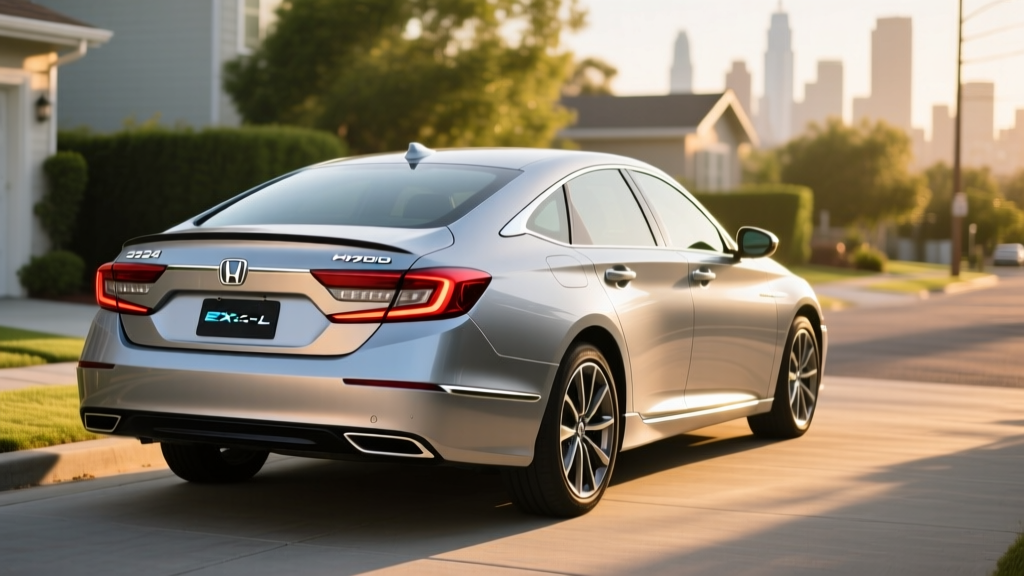
Quick Verdict: The Accord Hybrid EX-L Sweet Spot
The 2024 Honda Accord Hybrid EX-L sits in the middle of Honda's hybrid sedan lineup — above the base Sport and Sport-L trims, below the top-tier Sport Touring — and it nails the assignment for buyers who want premium comfort without paying for features they won't use. With an EPA-estimated 48 MPG combined, a 204-horsepower two-motor hybrid system, and leather-trimmed seating, the EX-L trim targets the practical luxury buyer who isn't ready to plug in.
Let's be precise about what this car is and isn't. The Accord Hybrid is a conventional hybrid (HEV), not a plug-in hybrid (PHEV). You never plug it in. It recovers energy through regenerative braking and its gasoline engine to charge a small 1.06 kWh lithium-ion battery pack. If you're looking for electric-only driving, you need a PHEV or a full BEV — but if you want set-it-and-forget-it fuel savings with zero charging infrastructure hassle, this is one of the most refined executions on the market.
| Specification | 2024 Accord Hybrid EX-L |
|---|---|
| Powertrain | 2.0L 4-cyl + 2-motor hybrid system |
| Combined Horsepower | 204 hp (146 hp engine + 184 hp electric motor peak) |
| Combined Torque | 247 lb-ft (electric motor) |
| Transmission | e-CVT (no traditional gears) |
| Battery Capacity | 1.06 kWh lithium-ion |
| EPA MPG (City / Hwy / Combined) | 51 / 44 / 48 |
| Fuel Tank | 12.8 gallons |
| Total Range | ~614 miles (EPA est.) |
| 0–60 mph | ~7.2 seconds |
| Drivetrain | Front-wheel drive |
| MSRP (incl. destination) | $34,990 |
| Federal Tax Credit (§30D) | Not eligible (HEV, not PHEV/BEV) |
| Hybrid Battery Warranty | 8 years / 100,000 miles |
HEV vs. PHEV: Why the Accord Hybrid Doesn't Plug In
A common question we field: "Do I need to charge the Accord Hybrid?" No. The distinction between a conventional hybrid and a plug-in hybrid is the single most important thing to understand before shopping this segment.
| Feature | Conventional Hybrid (HEV) | Plug-In Hybrid (PHEV) |
|---|---|---|
| Plug in to charge? | No — self-charging via engine + regen | Yes — Level 1/Level 2 charging |
| Electric-only range | Less than 1 mile at low speed | Typically 20–50 miles |
| Battery size | ~1–2 kWh | ~10–25 kWh |
| Federal tax credit | Not eligible under §30D | Up to $7,500 (subject to sourcing/income rules) |
| Home charging needed? | No | Yes, for full benefit |
| Example | Honda Accord Hybrid | Toyota RAV4 Prime, Chrysler Pacifica PHEV |
The Accord Hybrid's 1.06 kWh battery is small by design. It serves as an energy buffer — capturing braking energy, smoothing out engine load, and enabling brief low-speed electric assist. The gasoline engine remains the primary power source. Honda's two-motor system is clever: under most city driving conditions, the engine acts as a generator while the larger traction motor drives the wheels directly, giving you the smooth, torque-rich feel of an EV without ever needing a plug.
Fuel Economy: EPA Ratings vs. Real-World MPG
| Driving Scenario | EPA Estimate | Real-World Expectation |
|---|---|---|
| City | 51 MPG | 48–55 MPG (hybrids often beat EPA in stop-and-go) |
| Highway (70 mph) | 44 MPG | 40–44 MPG (aerodynamic drag reduces hybrid advantage) |
| Combined | 48 MPG | 44–50 MPG (depends on driving mix) |
| Cold Weather (below 32°F) | — | 38–44 MPG (engine runs more for cabin heat) |
Hybrids have an unusual characteristic that surprises first-time owners: they often achieve better fuel economy in the city than on the highway. This is the inverse of a conventional gas car. The Accord Hybrid's 51 MPG city rating comes from frequent regenerative braking opportunities, low-speed electric motor assist, and the engine shutting off at stops. On the highway, the gasoline engine is doing most of the work, and aerodynamic drag at 70+ mph works against every vehicle equally.
According to fueleconomy.gov, the Accord Hybrid's 48 MPG combined rating places it among the most efficient midsize sedans available. For context, a comparable gasoline-only midsize sedan averages around 30–32 MPG combined — meaning the Accord Hybrid uses roughly 35% less fuel for the same miles driven.
Cold weather reality check: Expect a 10–15% fuel economy drop in sustained sub-freezing temperatures. The engine runs longer to generate cabin heat (there's no resistive heater on the hybrid variant drawing from a large battery), and the battery's charge/discharge efficiency decreases in the cold. Owners in northern climates should budget for 40–43 MPG combined in January, not 48.
Powertrain Deep Dive: How the Two-Motor System Works
Honda's fourth-generation two-motor hybrid system is one of the most sophisticated setups in the mainstream market. Here's the component breakdown:
- 2.0-liter Atkinson-cycle 4-cylinder engine: Produces 146 hp and 134 lb-ft of torque. The Atkinson cycle prioritizes thermal efficiency over peak power — ideal for a hybrid where the electric motor compensates for low-end torque.
- Primary traction motor: 184 hp, 247 lb-ft. This motor drives the front wheels in EV and hybrid drive modes.
- Generator motor: Converts engine output to electricity and handles engine starting.
- Combined system output: 204 hp. The combined figure is lower than a simple addition because the engine and motor don't peak simultaneously.
Under normal acceleration from a stop, the Accord Hybrid launches on electric motor torque alone — giving it a responsive, EV-like feel up to about 30 mph. Under harder acceleration or at highway speeds, the engine engages either as a generator (feeding the traction motor) or, above ~45 mph under steady cruise, through a lock-up clutch that creates a direct mechanical connection between the engine and wheels for maximum efficiency.
The result is a 0–60 mph time of approximately 7.2 seconds — brisk enough for confident highway merging, though not sporty. The e-CVT eliminates shift shock entirely, and Honda has programmed a simulated stepped shift pattern under hard acceleration to avoid the droning "rubber band" effect that older CVTs suffered from.
Pricing, Trims, and Tax Credit Eligibility
The 2024 Accord Hybrid is offered in four trims, and the EX-L occupies the value-luxury position:
- Sport Hybrid: $32,990 — cloth/leatherette, 19-inch wheels, sport styling
- Sport-L Hybrid: $33,650 — leather-trimmed, heated front seats, black accents
- EX-L Hybrid: $34,990 — leather, heated front seats, wireless CarPlay/Android Auto, power moonroof, 10-speaker audio
- Sport Touring Hybrid: $38,890 — full leather, ventilated front seats, heated rear seats, Bose 12-speaker audio, wireless charging, Honda Sensing with low-speed braking
The EX-L's $34,990 MSRP (including $1,095 destination) buys you the most meaningful comfort upgrades — genuine leather, a moonroof, and the upgraded infotainment system — without the Sport Touring's $3,900 premium for features like ventilated seats and premium audio that many buyers can live without.
Federal Tax Credit: Not Eligible
The 2024 Honda Accord Hybrid does not qualify for the IRS §30D Clean Vehicle Credit. That credit applies only to plug-in electric vehicles (BEVs and PHEVs) with battery capacities of at least 7 kWh, per IRS guidelines. The Accord Hybrid's 1.06 kWh battery is far below that threshold. Some states offer hybrid-specific rebates or HOV lane access — check your state's energy office for current programs.
Reliability and Hybrid Battery Longevity
Hybrid battery anxiety is the number-one concern we hear from first-time hybrid buyers. Let's address it with data.
Honda covers the Accord Hybrid's lithium-ion battery pack under a federal emissions warranty of 8 years or 100,000 miles (extended to 10 years/150,000 miles in California Air Resources Board states). This warranty covers battery capacity loss below a functional threshold — not gradual, normal degradation.
Real-world longevity data: Honda's hybrid systems have been in production since the 1999 Insight, with the Accord Hybrid specifically using iterations of this two-motor system since 2014. The fourth-generation system in the 2024 model uses a smaller, more energy-dense battery pack than its predecessor. Based on long-term fleet data from earlier Accord Hybrid generations, battery packs routinely exceed 150,000 miles before requiring attention.
Replacement cost if out of warranty: A complete hybrid battery pack replacement for the Accord Hybrid runs approximately $2,000–$4,000 at a Honda dealer, including labor. Independent hybrid specialists can often perform the same service for $1,500–$2,500. Individual cell module replacement (rare) costs significantly less. For context, this is roughly equivalent to a transmission replacement on a conventional vehicle — a major repair, but not a vehicle-totalling expense.
The battery management system (BMS) in the Accord Hybrid is deliberately conservative: it never allows the pack to fully charge or fully discharge, maintaining a state-of-charge window that dramatically extends cycle life. You'll never see a "full" or "empty" battery indicator on the dash — that buffer is working to protect your investment.
Who Should Choose the Accord Hybrid EX-L vs. a PHEV or Full EV?
| Choose the Accord Hybrid EX-L if... | Look at a PHEV or BEV instead if... |
|---|---|
| You can't charge at home (apartment, street parking) | You have reliable home Level 2 charging |
| You want zero behavior change — just gas and go | You want to drive on electricity for daily commutes |
| You take frequent long road trips and don't want to plan charging stops | Your daily commute is under 30–40 miles round-trip |
| You want the lowest upfront cost in the electrified segment | You want to maximize federal tax credit eligibility |
| You live in an area with sparse public charging infrastructure | You want to eliminate gasoline use entirely |
The Accord Hybrid EX-L is the rational choice for the buyer who wants meaningful fuel savings without lifestyle adaptation. You'll spend roughly $1,100–$1,300 per year on gasoline (at 15,000 miles/year and $3.50/gallon), compared to $1,800–$2,100 for a comparable gas-only midsize sedan. That's $500–$800 in annual fuel savings with no plug, no app, no charging network membership, and no range planning.
If you have home charging and a short commute, a PHEV like the Toyota Prius Prime (44 miles electric-only, EPA est.) lets you drive most weekdays without burning a drop of gas — and qualifies for up to $7,500 in federal credits if sourcing requirements are met. A full BEV like the Tesla Model 3 or Hyundai Ioniq 6 eliminates tailpipe emissions entirely but requires charging infrastructure commitment and carries a higher purchase price.
Pros and Cons
Pros
- 48 MPG combined with no plug-in requirement — genuine fuel savings with zero behavior change
- Smooth, torque-rich electric motor launch in city driving
- Spacious cabin with 16.7 cu ft of trunk space (unchanged from gas trims)
- Honda Sensing suite standard: adaptive cruise, lane-keeping, collision mitigation
- Competitive $34,990 price for a leather-trimmed, feature-rich midsize sedan
- Strong resale value — Accord historically retains value well
- 8-year/100,000-mile hybrid battery warranty
Cons
- No federal tax credit eligibility (HEV, not PHEV/BEV)
- Highway MPG drops to 44 — hybrid advantage diminishes at sustained high speed
- FWD only — no AWD option for snow-belt buyers (unlike the Toyota Camry Hybrid AWD)
- CVT-like driving feel under hard acceleration, despite simulated steps
- No spare tire — tire repair kit only
- Cold-weather MPG penalty of 10–15% is unavoidable
Frequently Asked Questions
How many MPG does the 2024 Honda Accord Hybrid EX-L actually get?
The EPA rates it at 51 city / 44 highway / 48 combined. In real-world driving, most owners report 44–50 MPG combined depending on their driving mix. City-heavy commuters often exceed the EPA combined rating thanks to regenerative braking, while highway-dominant drivers should expect closer to 42–44 MPG. Cold weather reduces these figures by 10–15%.
Do I need to plug in the Accord Hybrid to charge it?
No. The Accord Hybrid is a conventional hybrid (HEV), not a plug-in hybrid. The battery charges itself through regenerative braking and the gasoline engine. There is no charging port. You simply fill the 12.8-gallon tank with regular unleaded gasoline and drive.
Does the 2024 Accord Hybrid qualify for any federal tax credit?
No. The IRS §30D Clean Vehicle Credit applies only to plug-in electric vehicles (BEVs and PHEVs) with battery packs of at least 7 kWh. The Accord Hybrid's 1.06 kWh battery doesn't meet this threshold. Some states may offer hybrid-specific incentives — consult your state energy office or a tax professional for current programs.
How long will the hybrid battery last and what does replacement cost?
Honda warranties the hybrid battery for 8 years/100,000 miles (10 years/150,000 miles in CARB states). Based on historical data from prior Accord Hybrid generations, the battery pack commonly lasts 150,000+ miles before significant degradation. Out-of-warranty replacement runs $2,000–$4,000 at a dealer, or $1,500–$2,500 at an independent hybrid specialist. The battery management system's conservative charge window significantly extends pack life.
Should I get the Accord Hybrid or a plug-in hybrid instead?
If you can't charge at home or frequently take long road trips, the Accord Hybrid is the better fit — no infrastructure needed, no range planning. If you have home charging and a daily commute under 40 miles, a PHEV lets you drive most days on electricity alone and may qualify for federal tax credits up to $7,500. The Accord Hybrid prioritizes simplicity; a PHEV prioritizes electric miles.
Is the Accord Hybrid EX-L available with all-wheel drive?
No. The 2024 Accord Hybrid is front-wheel drive only across all trims. If AWD is a priority, the Toyota Camry Hybrid offers an electronic AWD system (with a slight MPG trade-off: 44 combined vs. the Accord's 48), and the Hyundai Sonata Hybrid is also FWD-only. For AWD in a hybrid sedan, Toyota remains the primary option.
How does the Accord Hybrid compare to the Toyota Camry Hybrid?
The 2024 Camry Hybrid LE achieves 52 MPG combined (vs. the Accord's 48) and offers AWD on select trims. However, the Accord Hybrid EX-L provides a more premium interior at its price point, a larger trunk (16.7 vs. 15.1 cu ft), and a more refined driving feel. The Camry Hybrid XLE with comparable features prices slightly lower, but the Accord's cabin materials and ride quality edge it out for luxury-minded buyers. Check IIHS safety ratings for both — both earn top marks.