Quick Verdict: The Family Hauler That Sips Fuel
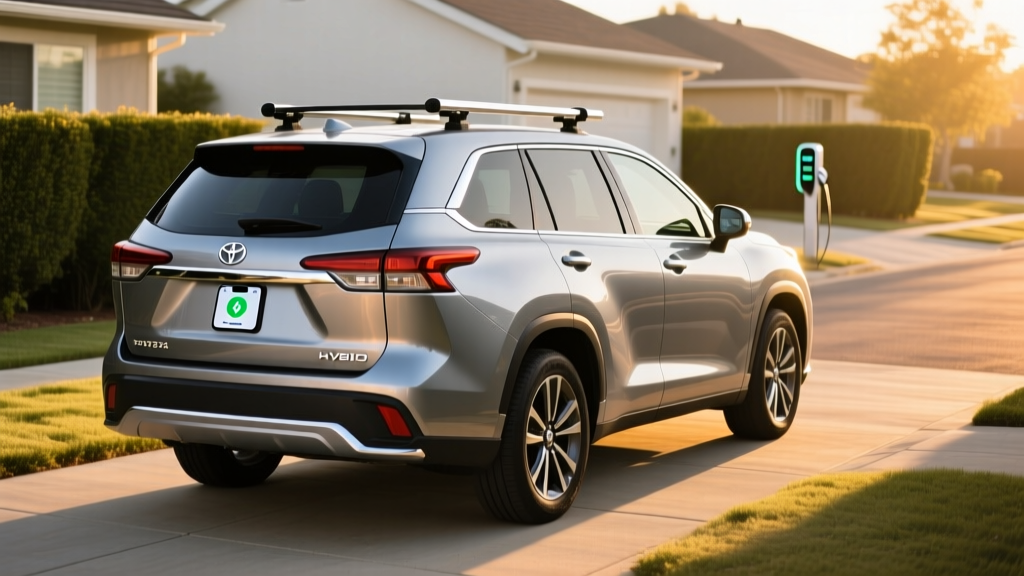
The 2024 Toyota Highlander Hybrid remains one of the most practical three-row hybrid SUVs on the market, delivering an EPA-estimated 35 MPG combined while seating up to seven passengers. Unlike plug-in hybrids or full electric vehicles, this conventional hybrid (HEV) requires zero behavioral change — no charging cables, no range anxiety, no plug-in infrastructure needed. You simply fill it with gas and drive, while Toyota's proven hybrid system silently recovers energy during braking and coasting.
For 2024, Toyota continues offering the Highlander Hybrid exclusively with a 2.5-liter four-cylinder engine paired with electric motors — the V6 hybrid option was discontinued after 2022. This powertrain prioritizes efficiency over acceleration, producing 243 combined horsepower. If you need more power or electric-only driving capability, you'll want to look at plug-in hybrid alternatives like the Toyota RAV4 Prime or consider a full EV like the Kia EV9.
HEV vs PHEV vs EV: Where Does the Highlander Hybrid Fit?
The Highlander Hybrid is a conventional hybrid (HEV), meaning it cannot plug in and has no electric-only driving mode. This distinction matters because buyers often confuse HEVs with plug-in hybrids (PHEVs) like the Toyota Prius Prime or Chrysler Pacifica Hybrid. Here's how the three electrified vehicle types compare:
| Feature | Conventional Hybrid (HEV) | Plug-in Hybrid (PHEV) | Battery Electric (BEV) |
|---|---|---|---|
| Plug-in charging | No — self-charging via regen | Yes — required for EV range | Yes — only energy source |
| Electric-only range | None (motor assists engine) | 20-50 miles typical | 200-400+ miles |
| Battery size | 1-2 kWh | 10-25 kWh | 60-120+ kWh |
| Federal tax credit (§30D) | Not eligible | Up to $7,500 (if eligible) | Up to $7,500 (if eligible) |
| Best for | No home charging access, simplicity | Short commutes + long road trips | Home charging + lower running costs |
The Highlander Hybrid's advantage is simplicity. If you live in an apartment without charging access, frequently take long road trips through charging deserts, or simply don't want to think about plugging in, this HEV eliminates those concerns while still cutting fuel consumption roughly in half compared to a gas-only three-row SUV.
Fuel Economy: EPA Numbers vs Real-World MPG
The 2024 Highlander Hybrid's EPA fuel economy ratings vary slightly by drivetrain:
| Drivetrain | City MPG | Highway MPG | Combined MPG |
|---|---|---|---|
| FWD (LE trim) | 36 | 35 | 36 |
| AWD (all other trims) | 35 | 35 | 35 |
According to fueleconomy.gov, these figures represent the official EPA estimates. But how do they translate to real-world driving?
City driving: Hybrids typically exceed their EPA city ratings because regenerative braking recovers more energy in stop-and-go traffic. Owners report 37-40 MPG in urban conditions, especially in moderate temperatures where the engine doesn't need to run constantly for cabin heat.
Highway driving: Expect 32-34 MPG at sustained 70-75 mph speeds. Hybrids lose their city advantage on the highway because there's less braking to recover energy, and the small 2.5L engine works harder to maintain speed. This is the opposite of gas-only vehicles, which typically get better highway than city MPG.
Cold weather impact: In sub-freezing temperatures, expect a 10-15% fuel economy drop (roughly 30-32 MPG combined). The engine runs more frequently to warm the cabin and keep the hybrid battery at optimal temperature. This is far less severe than the 30-40% range loss EVs experience in cold weather, but it's still noticeable.
Real-world expectation: While the EPA rates the AWD Highlander Hybrid at 35 MPG combined, most owners see 33-37 MPG depending on driving mix. Highway-heavy drivers should budget for 32-34 MPG; city-heavy drivers can expect 36-38 MPG.
Powertrain & Performance Specs
| Specification | 2024 Highlander Hybrid |
|---|---|
| Engine | 2.5L 4-cylinder + 2 electric motors (3 motors AWD) |
| Combined horsepower | 243 hp |
| 0-60 mph | ~7.8 seconds |
| Drivetrain | FWD (LE) or electronic AWD |
| Hybrid battery | 1.6 kWh nickel-metal hydride (NiMH) |
| Towing capacity | 3,500 lbs |
| Cargo volume (behind 3rd row) | 16.1 cu ft |
| Seating | 7 passengers (8 on LE with bench) |
The Highlander Hybrid uses Toyota's fourth-generation hybrid system with a 2.5-liter Atkinson-cycle four-cylinder engine. The FWD model uses two electric motors (one for propulsion, one as a generator/starter), while AWD models add a third motor powering the rear wheels. This electronic AWD system doesn't use a mechanical driveshaft — the rear motor engages only when needed for traction or acceleration.
Performance is adequate but not sporty. The 7.8-second 0-60 time is slower than the turbocharged four-cylinder gas Highlander (which hits 60 in about 6.8 seconds) and significantly slower than performance-oriented EVs. However, the hybrid's smooth electric torque delivery makes it feel responsive in city driving, even if it lacks passing punch at highway speeds.
Pricing, Trims & Tax Credit Eligibility
The 2024 Highlander Hybrid starts at $40,220 for the base LE FWD trim (including destination) and climbs to over $53,000 for a fully loaded Platinum AWD. Here's the trim breakdown:
- LE FWD: $40,220 — 8-passenger seating, Toyota Safety Sense 2.5+
- LE AWD: $41,620 — adds electronic AWD
- XLE AWD: $44,820 — SofTex seats, sunroof, power liftgate
- Limited AWD: $48,420 — leather, heated/ventilated front seats, 12.3" display
- Platinum AWD: $50,420 — panoramic roof, 360° camera, head-up display
Federal Tax Credit: Not Eligible
The 2024 Highlander Hybrid does not qualify for the federal §30D clean vehicle tax credit. Under current IRS rules, only plug-in electric vehicles (BEVs and PHEVs) with sufficient battery capacity are eligible. Conventional hybrids like this one haven't qualified for federal incentives since the early 2010s.
Some states offer their own hybrid incentives, but these are increasingly rare as policy shifts toward plug-in vehicles. Check your state's energy office or DMV website for current programs, but don't count on significant rebates.
Total cost context: While you won't get a tax credit, the Highlander Hybrid's fuel savings partially offset its $4,000-$6,000 price premium over the gas-only Highlander. At 15,000 miles per year and $3.50/gallon gas, the hybrid saves roughly $700-$900 annually versus the gas model (which averages 24 MPG combined), paying back the premium in 5-7 years depending on trim.
Battery Warranty, Reliability & Replacement Cost
Hybrid battery warranty: 10 years or 150,000 miles (whichever comes first) in all 50 states. This covers the hybrid battery pack against defects and capacity loss below a specified threshold.
Powertrain warranty: 5 years / 60,000 miles
Bumper-to-bumper: 3 years / 36,000 miles
How Long Do Highlander Hybrid Batteries Last?
Toyota's hybrid battery longevity is well-documented. The Highlander Hybrid uses a nickel-metal hydride (NiMH) battery pack — older technology than the lithium-ion packs in EVs, but extremely proven. Toyota has been refining this chemistry since the 1997 Prius, and failure rates are low.
Based on data from high-mileage Prius and Camry Hybrid fleets, expect the Highlander's hybrid battery to last 150,000-200,000+ miles before needing replacement. Many original Prius batteries from 2004-2009 are still in service at 200,000+ miles. The battery doesn't "die" suddenly — it gradually loses capacity, reducing fuel economy by 2-5 MPG as it ages.
Battery Replacement Cost
If your hybrid battery fails outside warranty coverage (after 10 years/150,000 miles), replacement costs $3,000-$5,000 at a Toyota dealer, including parts and labor. Independent hybrid specialists often offer refurbished battery packs for $2,000-$3,500. This is dramatically cheaper than EV battery replacement ($10,000-$20,000+), largely because the Highlander's 1.6 kWh pack is tiny compared to a 75-100 kWh EV battery.
According to Consumer Reports, the Highlander Hybrid earns above-average reliability ratings, with the hybrid system being one of the least problematic components. The main complaints center on infotainment quirks and third-row space, not the powertrain.
Who Should Buy the Highlander Hybrid (And Who Shouldn't)
Pros
- 35-36 MPG combined — cuts fuel costs ~40% vs gas Highlander
- No plug-in charging required — works for apartments/renters
- Proven Toyota hybrid reliability with 10-year battery warranty
- 7-8 passenger seating with AWD availability
- Strong resale value — Highlanders hold value better than most SUVs
- Standard Toyota Safety Sense 2.5+ (AEB, lane-keeping, adaptive cruise)
Cons
- Slower acceleration than gas model (7.8s vs 6.8s 0-60)
- No federal tax credit eligibility
- Third row is tight for adults (better for kids)
- 16.1 cu ft cargo space behind 3rd row is limited
- Higher upfront cost vs gas Highlander ($4-6K premium)
- No electric-only driving mode for silent neighborhood operation
Choose the Highlander Hybrid if:
- You need three rows but can't charge at home (apartment, street parking, no garage)
- You drive 15,000+ miles/year and want fuel savings without plug-in complexity
- You prioritize long-term reliability and resale value over cutting-edge tech
- You take frequent road trips through areas with sparse charging infrastructure
Look elsewhere if:
- You want electric-only commuting — consider the Chrysler Pacifica Hybrid (32 miles EV range) or wait for three-row PHEVs
- You need maximum cargo space — the gas Highlander offers slightly more, or consider the larger Toyota Grand Highlander
- You want the lowest running costs and have home charging — a full EV like the Kia EV9 (300-mile range, $7,500 tax credit) saves more long-term
- You prioritize acceleration — the gas Highlander or turbocharged competitors are quicker
Frequently Asked Questions
How many MPG does the 2024 Highlander Hybrid get?
The EPA rates it at 36 MPG combined (FWD) or 35 MPG combined (AWD), with 35-36 city and 35 highway. Real-world results typically range from 32-38 MPG depending on driving conditions, with city driving often exceeding the EPA estimate and highway driving falling slightly short.
Does the Highlander Hybrid need to be plugged in?
No. This is a conventional hybrid (HEV), not a plug-in hybrid. The battery charges itself through regenerative braking and the gas engine. You never plug it in — just fill it with gas like a normal car.
Is there a plug-in hybrid (PHEV) version of the Highlander?
Not in the US market as of 2024. Toyota offers the RAV4 Prime (42 miles EV range) and Prius Prime (44 miles EV range) as PHEVs, but the Highlander is hybrid-only. If you need a three-row PHEV, the Chrysler Pacifica Hybrid is the main option (32 miles EV range, qualifies for partial tax credit).
Does the 2024 Highlander Hybrid qualify for any tax credit?
No. Federal §30D tax credits only apply to plug-in vehicles (BEVs and PHEVs). The Highlander Hybrid, as a conventional HEV, is not eligible for federal or most state incentives. Some states may offer minor rebates, but don't expect significant savings.
How reliable is the Highlander Hybrid battery?
Very reliable. Toyota's NiMH hybrid batteries routinely last 150,000-200,000+ miles. The battery is covered by a 10-year/150,000-mile warranty. Replacement cost (if needed after warranty) is $3,000-$5,000 — far less than EV battery replacement.
Is the Highlander Hybrid worth the extra cost over the gas model?
It depends on your mileage. The hybrid costs $4,000-$6,000 more upfront but saves $700-$900/year in fuel at 15,000 miles/year. Payback takes 5-7 years. If you keep the vehicle 8+ years or drive more than 15,000 miles annually, the hybrid pays for itself. If you drive less or trade in frequently, the gas model may be more economical.
How does the Highlander Hybrid compare to the Grand Highlander Hybrid?
The Grand Highlander Hybrid is larger (more third-row and cargo space) and offers a Hybrid MAX powertrain with 362 hp. It gets slightly lower MPG (34 combined vs 35) and starts around $45,000. Choose the Grand if you regularly use the third row for adults or need more cargo capacity; choose the regular Highlander if you want better fuel economy and a lower price.