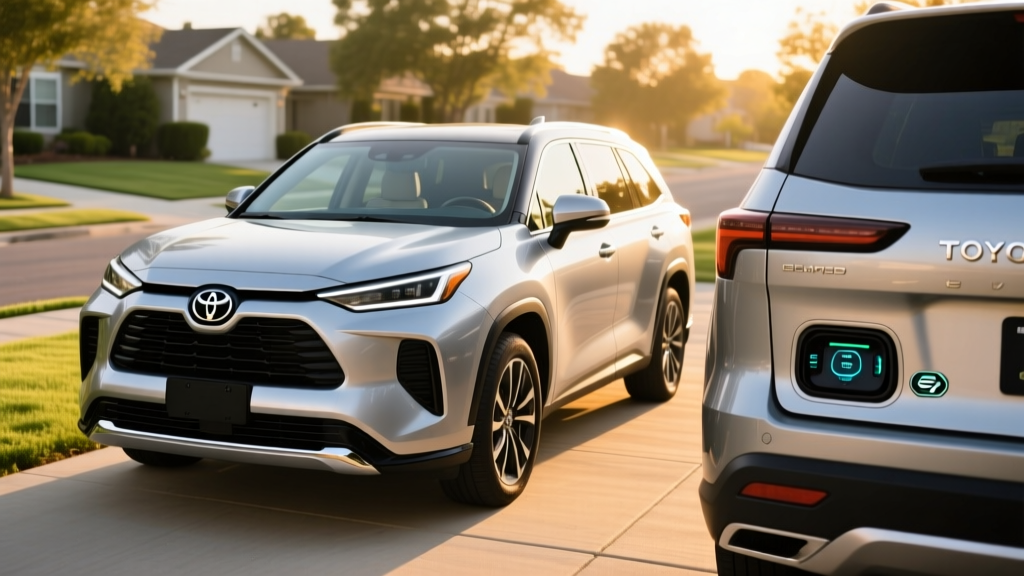
The 2024 Toyota Grand Highlander Hybrid Limited occupies a narrow but compelling space in the three-row SUV market: it delivers genuine three-row passenger space while returning fuel economy numbers that embarrass many compact crossovers. For buyers weighing a hybrid against a plug-in hybrid or full EV, the Grand Highlander Hybrid makes a strong case for simplicity — no plug, no range anxiety, no charging infrastructure dependency — while still cutting fuel costs dramatically versus a gas-only rival.
This guide breaks down the exact EPA fuel economy figures, the Hybrid MAX powertrain specs, real-world MPG expectations, battery longevity data, tax credit eligibility, and whether the Limited trim justifies its MSRP. We'll also clarify where a conventional hybrid (HEV) fits versus a PHEV or BEV for your specific driving pattern.
EPA Fuel Economy: How Many MPG Does the Grand Highlander Hybrid Get?
The 2024 Grand Highlander Hybrid comes in two distinct powertrain configurations, and the fuel economy differs meaningfully between them. The standard Hybrid uses a 2.5-liter four-cylinder paired with electric motors, while the Hybrid MAX pairs a 2.4-liter turbocharged four-cylinder with a more powerful electric motor system. Here's the EPA breakdown for each:
| Powertrain | Drivetrain | City MPG | Highway MPG | Combined MPG |
|---|---|---|---|---|
| 2.5L Hybrid | FWD | 37 | 34 | 36 |
| 2.5L Hybrid | AWD (eAWD) | 36 | 32 | 35 |
| Hybrid MAX (2.4T) | AWD | 27 | 28 | 27 |
Source: EPA Fuel Economy Guide
The Limited trim is available with both powertrains. If fuel economy is your priority, the standard 2.5L Hybrid in FWD configuration delivers the best numbers. The Hybrid MAX sacrifices roughly 9 MPG combined in exchange for substantially more power — a trade-off we'll detail below.
Real-World MPG vs. EPA Sticker: What to Actually Expect
Toyota's hybrid system excels in city driving, where regenerative braking and electric-motor assist do the heavy lifting. In real-world ownership, the 2.5L Hybrid often exceeds its EPA city rating in stop-and-go traffic — owners regularly report 38-40 MPG in urban commuting. Highway driving tells a different story: at sustained 75-80 MPH speeds, expect the AWD 2.5L Hybrid to return 30-32 MPG, a few ticks below the EPA highway estimate.
For the Hybrid MAX, real-world fuel economy tends to track closely with the EPA estimate in mixed driving. Aggressive acceleration and towing will push it into the low-to-mid 20s. Cold weather affects both powertrains, but the impact is less severe than with a full EV — expect a 5-10% reduction in MPG during winter months, primarily from increased engine idling for cabin heat and reduced battery efficiency at low temperatures.
Hybrid MAX vs. Standard Hybrid: Powertrain Specs Compared
The Grand Highlander Hybrid's two powertrains serve different buyer priorities. The standard 2.5L Hybrid prioritizes efficiency with adequate power, while the Hybrid MAX targets buyers who want V6-rivaling acceleration without the V6 fuel penalty.
| Specification | 2.5L Hybrid | Hybrid MAX (2.4T) |
|---|---|---|
| Engine | 2.5L inline-4 | 2.4L turbo inline-4 |
| Combined System Horsepower | 245 hp | 362 hp |
| Combined System Torque | 173 lb-ft (engine) | 400 lb-ft |
| 0-60 MPH (est.) | ~7.8 sec | ~6.3 sec |
| Transmission | eCVT | 6-speed automatic |
| Drivetrain | FWD or eAWD | AWD standard |
| Towing Capacity | 3,500 lbs | 5,000 lbs |
| Seating | 7 or 8 passengers | 7 passengers |
The Hybrid MAX's 362 combined horsepower and 400 lb-ft of torque make it genuinely quick for a three-row SUV, and the 6-speed automatic avoids the drone associated with eCVT transmissions under hard acceleration. The standard Hybrid's eCVT is smoother in normal driving but lacks the engagement of the MAX's conventional automatic. If you tow regularly or want confident highway merging, the Hybrid MAX justifies its fuel economy trade-off.
HEV vs. PHEV vs. EV: Which Powertrain Fits Your Life?
The Grand Highlander is a conventional hybrid (HEV). It does not plug in. Its small traction battery recharges through regenerative braking and the gasoline engine. This is a critical distinction from a plug-in hybrid (PHEV) like the Toyota RAV4 Prime or a full battery-electric vehicle (BEV) like the Kia EV9.
| Factor | HEV (Grand Highlander Hybrid) | PHEV (e.g., Mazda CX-90 PHEV) | BEV (e.g., Kia EV9) |
|---|---|---|---|
| Plug-in Required? | No | Yes (for EV range) | Yes |
| Electric-Only Range | ~1 mile at low speed | 25-35 miles typical | 250-310 miles |
| Home Charging Needed? | No | Recommended (Level 2) | Essential (Level 2) |
| Fuel Cost per Mile | ~$0.10-$0.12 | ~$0.04 (EV mode) / $0.12 (gas) | ~$0.04-$0.06 |
| Federal Tax Credit | None (§30D excludes HEVs) | Up to $7,500 (if eligible) | Up to $7,500 (if eligible) |
| Best For | No home charging, long trips, simplicity | Short commute + home charger + road trips | Home charging + mostly under 250 mi/day |
Choose the Grand Highlander Hybrid (HEV) if: You lack access to home or workplace charging, you regularly drive more than 300 miles in a day, you want zero behavior change from your current gas car, or you live in an apartment without charging infrastructure.
Consider a PHEV instead if: Your daily commute is under 30 miles, you can install a Level 2 charger at home, and you want to drive most weekdays on electricity while retaining gas-engine range for weekend road trips.
Consider a full EV instead if: You have reliable home charging, your daily driving rarely exceeds 200 miles, you want the lowest per-mile fuel cost, and you're willing to plan around DC fast charging on road trips.
2024 Grand Highlander Hybrid Limited: Pricing and Tax Credit Eligibility
The 2024 Grand Highlander Hybrid Limited started at an MSRP of approximately $51,405 for the standard 2.5L Hybrid AWD configuration, with the Hybrid MAX Limited starting around $54,040. Destination charges add roughly $1,395. Options packages, premium paint, and accessories can push the Limited well above $55,000.
Regarding federal tax incentives: the Grand Highlander Hybrid does not qualify for the §30D federal clean vehicle tax credit. The IRS restricts this credit to plug-in electric vehicles (PHEVs and BEVs) with sufficient battery capacity and meeting critical mineral and battery component sourcing requirements. Conventional hybrids like the Grand Highlander Hybrid are excluded regardless of price or efficiency. There is no federal tax credit available for HEV purchases as of current IRS rules.
Some states offer separate incentives for hybrid vehicles, though these are increasingly rare as state programs shift focus to plug-in vehicles. Check your state's energy office or department of environmental quality for current programs — a few states maintain modest rebates for high-MPG vehicles, but amounts and eligibility vary significantly by jurisdiction.
Battery Longevity, Warranty, and Replacement Cost
Hybrid battery longevity is consistently the top concern among first-time hybrid buyers. Toyota's track record here is among the best in the industry, with two decades of hybrid system data supporting its durability claims.
The Grand Highlander Hybrid uses a nickel-metal hydride (NiMH) battery pack in the standard 2.5L Hybrid, while the Hybrid MAX uses a lithium-ion pack. Both are significantly smaller than a PHEV or BEV battery — typically in the 1.5-2.0 kWh range — because they only need to store energy captured from regenerative braking, not provide meaningful electric-only driving range.
Based on Toyota's historical data with the Highlander Hybrid and Camry Hybrid platforms, battery degradation in conventional hybrids is minimal. The battery is never deeply discharged or fully charged — the hybrid system maintains a narrow state-of-charge window (roughly 40-80%) that dramatically reduces cell stress. Real-world failure rates for Toyota hybrid batteries remain low well past the 150,000-mile mark.
If replacement is needed out of warranty, a Toyota hybrid battery replacement typically costs between $2,000 and $4,000 depending on the specific pack and labor rates. Refurbished battery modules are increasingly available for $1,000-$2,000 from independent hybrid specialists. This is a fraction of BEV battery replacement costs, which can exceed $10,000-$20,000.
Limited Trim: What You Get for the Money
The Limited sits in the upper-middle of the Grand Highlander Hybrid trim ladder, below the Platinum and above the XLE. For the 2024 model year, the Limited adds several meaningful upgrades over the XLE:
- Interior: SofTex-trimmed heated and ventilated front seats, heated second-row seats, leather-trimmed steering wheel, panoramic moonroof
- Technology: 12.3-inch Toyota Audio Multimedia touchscreen with wireless Apple CarPlay and Android Auto, 11-speaker JBL audio system, wireless phone charging
- Convenience: Hands-free power liftgate, smart key system on all doors, auto-dimming rearview mirror with HomeLink
- Safety: Toyota Safety Sense 3.0 suite including Pre-Collision System with Pedestrian Detection, Full-Speed Range Dynamic Radar Cruise Control, Lane Departure Alert with Steering Assist, Lane Tracing Assist, and Road Sign Assist
- Exterior: 20-inch alloy wheels, LED headlights and taillights, roof rails
The Grand Highlander's defining advantage over the standard Highlander is third-row space. The Grand Highlander's third row accommodates adults on longer trips — a genuine differentiator in the segment. Cargo volume behind the third row is approximately 20.6 cubic feet, expanding to 57.9 cubic feet with the third row folded and 97.5 cubic feet with both rear rows folded.
Pros and Cons: An Honest Assessment
Pros
- Class-leading fuel economy for a 3-row SUV (35-36 MPG combined)
- Genuinely usable adult-sized third row
- No charging infrastructure required — fuel like any gas car
- 10-year/150,000-mile hybrid battery warranty
- Hybrid MAX offers 362 hp and 5,000-lb towing
- Strong Toyota reliability and resale value history
Cons
- No federal tax credit eligibility (HEV excluded from §30D)
- Limited trim pushes past $51,000 before options
- Standard Hybrid's eCVT drones under hard acceleration
- Hybrid MAX sacrifices 9 MPG for performance
- No plug-in hybrid variant available
- Third-row access requires folding second-row seat forward
Frequently Asked Questions
How many MPG does the 2024 Grand Highlander Hybrid Limited get in real-world driving?
The EPA rates the 2.5L Hybrid AWD at 36 city / 32 highway / 35 combined MPG. In real-world driving, city-heavy commutes often return 37-40 MPG thanks to Toyota's regenerative braking system. Sustained highway driving at 75+ MPH typically yields 30-32 MPG. The Hybrid MAX returns approximately 27 MPG combined in both EPA testing and real-world mixed driving.
Does the Grand Highlander Hybrid need to be plugged in?
No. The Grand Highlander Hybrid is a conventional hybrid (HEV), not a plug-in hybrid (PHEV). Its battery recharges automatically through regenerative braking and the gasoline engine. You fuel it exactly like a conventional gas car — there is no charging port and no electric-only driving range to manage.
Does the 2024 Grand Highlander Hybrid qualify for any federal tax credit?
No. Under current IRS §30D rules, the federal clean vehicle tax credit applies only to plug-in electric vehicles (PHEVs and BEVs) that meet battery sourcing and MSRP requirements. Conventional hybrids are excluded. Some states may offer separate incentives for high-efficiency vehicles, but these vary by jurisdiction.
Is the Grand Highlander Hybrid reliable, and what does battery replacement cost?
Toyota's hybrid systems have demonstrated strong reliability over two decades of production. The hybrid battery is covered by a 10-year/150,000-mile warranty. Based on historical Toyota hybrid data, out-of-warranty battery replacement typically costs $2,000-$4,000, with refurbished options available for less. The hybrid system's narrow state-of-charge operating window minimizes battery degradation.
Should I buy the Grand Highlander Hybrid or wait for a PHEV version?
Toyota has not announced a Grand Highlander PHEV variant as of this writing. If you need three-row seating with plug-in capability today, alternatives like the Mazda CX-90 PHEV or the Kia Sorento PHEV offer 25-32 miles of electric-only range, though with less third-row space. If you lack home charging access or prioritize maximum range and simplicity, the Grand Highlander Hybrid is the stronger choice now.
How does the Grand Highlander Hybrid compare to the standard Highlander Hybrid?
The Grand Highlander is approximately 6.5 inches longer than the standard Highlander, with the extra length dedicated primarily to third-row legroom and cargo space behind the third row. The Grand Highlander Hybrid uses the same 2.5L hybrid powertrain but returns slightly lower MPG (35 vs. 36 combined for AWD) due to its greater weight. If you regularly use the third row for adults, the Grand Highlander is the clear upgrade.
For the latest EPA fuel economy data, visit fueleconomy.gov. For current federal tax credit rules, consult IRS.gov or a qualified tax professional. Specifications and pricing reflect the 2024 model year as published by Toyota; verify current availability and pricing with your local dealer.