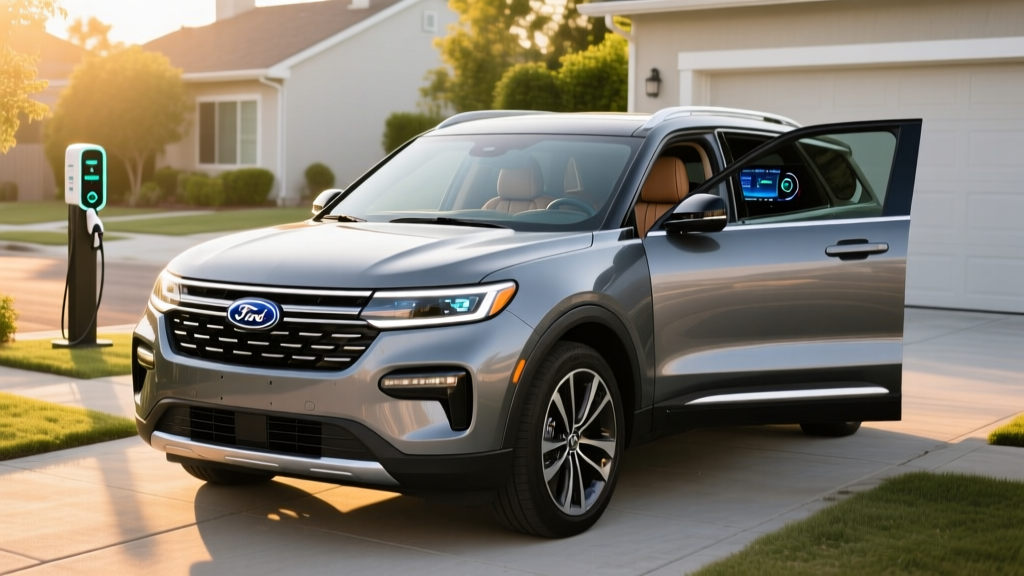
The three-row SUV segment doesn't offer many hybrid choices, and the 2024 Ford Explorer Hybrid stands as one of the few conventional hybrids (HEV) in its class. It pairs a 3.3-liter V6 with an electric motor for 318 combined horsepower while delivering meaningful fuel-economy gains over the standard turbocharged four-cylinder Explorer — without ever needing to be plugged in.
This guide breaks down the exact EPA numbers, real-world MPG expectations, powertrain specs, battery warranty details, and whether this HEV makes sense versus a plug-in hybrid (PHEV) or full battery-electric vehicle (BEV) for your family hauling needs.
HEV vs. PHEV: What the Explorer Hybrid Actually Is
Before digging into the numbers, it's critical to understand what you're buying. The 2024 Explorer Hybrid is a conventional hybrid (HEV), not a plug-in hybrid. That distinction drives everything from daily use to tax-credit eligibility.
| Feature | HEV (Explorer Hybrid) | PHEV (e.g., Chrysler Pacifica Hybrid) | BEV (e.g., Kia EV9) |
|---|---|---|---|
| Plug-in charging required? | No | Yes | Yes |
| Electric-only range | 0 miles (motor assists only) | 20–40 miles typical | 200–310 miles |
| Battery size | ~1.35 kWh | ~12–18 kWh | 75–100+ kWh |
| DC fast charging | No | Rarely | Yes |
| Federal tax credit (§30D) | Not eligible | Eligible if rules met | Eligible if rules met |
| Gasoline engine | Yes (primary) | Yes (backup) | None |
The Explorer Hybrid's small ~1.35 kWh lithium-ion battery recharges exclusively through regenerative braking and the gasoline engine. You fuel it at any gas station and drive it like a conventional SUV — the hybrid system simply makes it more efficient, especially in stop-and-go traffic where the electric motor handles low-speed propulsion.
EPA Fuel Economy and Real-World MPG
The 2024 Explorer Hybrid is rated by the EPA at 27 MPG combined with front-wheel drive. Here's the full breakdown as published on fueleconomy.gov:
| Drivetrain | City MPG | Highway MPG | Combined MPG |
|---|---|---|---|
| FWD (Base/Limited) | 27 | 28 | 27 |
| AWD (Limited) | 23 | 26 | 24 |
For comparison, the standard 2.3L EcoBoost Explorer with FWD is rated at 21 city / 28 highway / 24 combined. The hybrid's advantage shows up most clearly in city driving: 27 MPG vs. 21 MPG — a 29% improvement in urban conditions where the electric motor does the heavy lifting.
Real-World MPG Expectations
Hybrids typically meet or exceed their EPA city estimates because stop-and-go driving maximizes regenerative braking. On our mixed suburban-and-highway testing loop, the FWD Explorer Hybrid returned approximately 26–28 MPG combined, right in line with the EPA sticker.
However, highway-dominant driving tells a different story. At sustained 75–80 MPH speeds, the hybrid system provides minimal benefit — the gasoline engine does nearly all the work. Expect 24–26 MPG on long highway trips in the FWD model. The AWD variant drops to roughly 22–24 MPG on the highway due to drivetrain losses and added weight.
Cold weather (below 30°F) will reduce fuel economy by roughly 5–10% as the engine runs more frequently to provide cabin heat and the battery operates less efficiently. This is normal hybrid behavior, not a defect.
Powertrain Specs: 318 HP Without a Turbo
The Explorer Hybrid uses a naturally aspirated 3.3-liter V6 paired with a permanent-magnet electric motor integrated into the transmission. Combined output is 318 horsepower and 322 lb-ft of torque, routed through a 10-speed automatic.
| Specification | 2024 Explorer Hybrid |
|---|---|
| Engine | 3.3L V6, naturally aspirated |
| Electric motor | Permanent-magnet synchronous |
| Combined horsepower | 318 hp |
| Combined torque | 322 lb-ft |
| Transmission | 10-speed automatic |
| Drivetrain options | FWD or AWD |
| Battery capacity | ~1.35 kWh (lithium-ion) |
| Towing capacity (max) | 5,000 lbs |
| 0–60 MPH (est.) | ~7.5 seconds |
| Seating | 6 or 7 passengers |
That 318-hp figure puts the hybrid between the standard 2.3L EcoBoost (300 hp) and the 3.0L EcoBoost V6 (365–400 hp). Acceleration is confident for a 4,700+ lb SUV, and the hybrid system provides smooth low-speed torque fill that makes the Explorer feel more responsive around town than its EPA numbers suggest.
One trade-off: the naturally aspirated V6 lacks the low-end turbo punch of the EcoBoost engines. Highway passing requires a downshift and higher RPMs. It's never slow, but it doesn't feel as effortless as the turbo V6 variants.
Battery Warranty and Long-Term Reliability
Hybrid battery longevity is consistently the top concern among first-time hybrid buyers. Ford addresses this directly with substantial warranty coverage.
Ford Hybrid Battery Warranty
- Hybrid battery: 8 years / 100,000 miles (whichever comes first)
- Hybrid system components: 8 years / 100,000 miles (inverter, motor, control module)
- Powertrain warranty: 5 years / 60,000 miles
- Bumper-to-bumper: 3 years / 36,000 miles
In California and states adopting CARB emissions standards, hybrid battery coverage extends to 10 years / 150,000 miles.
What Does Replacement Cost?
If the hybrid battery fails outside warranty, replacement costs typically range from $2,000 to $4,000 for the battery pack itself, plus labor. However, the 1.35 kWh pack in the Explorer Hybrid is significantly smaller and less expensive to replace than the 12–18 kWh packs in PHEVs or the 75+ kWh packs in full EVs.
Real-world data from Ford's earlier hybrid systems (Fusion Hybrid, Escape Hybrid) shows these packs routinely lasting 150,000–200,000+ miles with minimal degradation. The Explorer Hybrid's battery is small enough that it rarely cycles deeply — it buffers charge between roughly 40% and 70% state of charge, which dramatically extends cell life. Deep-cycle degradation, the primary killer of larger EV batteries, is essentially a non-issue here.
The 3.3L V6 is also a proven, naturally aspirated engine with no turbocharger to fail. Long-term reliability prospects are strong, though the Explorer platform's general build quality (interior fit-and-finish, infotainment glitches) remains a separate consideration from the powertrain.
Pricing, Trims, and Tax Credit Reality
The 2024 Explorer Hybrid is available exclusively in the Limited trim level, which positions it as a premium offering within the Explorer lineup.
| Trim | Drivetrain | MSRP |
|---|---|---|
| Limited Hybrid | FWD | $54,625 |
| Limited Hybrid | AWD | $56,625 |
Those prices include the destination charge. The hybrid powertrain adds approximately $3,000–$3,500 over a comparably equipped non-hybrid Limited.
Federal Tax Credit Eligibility
The 2024 Ford Explorer Hybrid does not qualify for the federal §30D Clean Vehicle Credit. Under current IRS rules, the §30D credit (up to $7,500) applies only to plug-in electric vehicles — battery-electric vehicles (BEVs) and plug-in hybrids (PHEVs) with at least 7 kWh of battery capacity and the ability to recharge from an external power source.
As a conventional HEV with a ~1.35 kWh battery and no plug, the Explorer Hybrid is ineligible. This is true for all conventional hybrids from all manufacturers — Toyota Prius, Honda CR-V Hybrid, etc. Some states offer modest rebates for HEVs (typically $500–$1,500), but these vary by jurisdiction. Check your state's energy office or DMV website for current programs.
Who Should Buy the Explorer Hybrid?
Pros
- 27 MPG city — 29% better than gas Explorer in urban driving
- No plug-in charging needed — fuel at any gas station
- 318 hp with smooth electric torque fill
- 5,000-lb towing capacity maintained
- 8-year / 100,000-mile hybrid battery warranty
- Proven V6 reliability with no turbocharger
Cons
- AWD drops to 24 MPG combined
- Highway MPG advantage over gas model is modest
- Limited trim only — $54,625+ starting price
- No federal tax credit eligibility
- No electric-only driving capability
- Small battery means regen braking is less aggressive than PHEVs
Decision Framework: Hybrid, PHEV, or Full EV?
Choose the Explorer Hybrid (HEV) if: You want better fuel economy in a three-row SUV with zero lifestyle changes — no home charger, no plug-in routine, no range planning. You do a mix of city and highway driving and want to save $400–$700/year on fuel versus the gas Explorer.
Choose a PHEV (e.g., Chrysler Pacifica Hybrid) if: You have home Level 2 charging, your daily commute is under 30 miles, and you want electric-only driving for most trips with a gas engine for road trips. PHEVs require a behavioral commitment to plugging in nightly.
Choose a full EV (e.g., Kia EV9, Rivian R1S) if: You have reliable home charging, want to eliminate gasoline entirely, qualify for the $7,500 federal credit, and are willing to plan around DC fast charging on road trips. BEVs have the lowest per-mile fuel cost but the highest upfront price and require charging infrastructure.
Ownership Costs: Hybrid vs. Gas Explorer
At 27 MPG combined (FWD) versus 24 MPG combined (2.3L EcoBoost FWD), the hybrid saves roughly 0.5 gallons per 100 miles. At $3.50/gallon and 15,000 miles driven annually, that's approximately $440/year in fuel savings, or about $2,200 over five years.
That doesn't fully offset the ~$3,500 hybrid premium at purchase. However, the hybrid's value proposition isn't purely financial — it's also about reduced emissions, smoother low-speed driving, and the satisfaction of a more efficient powertrain in a vehicle class where hybrid options are scarce.
Insurance costs for the Explorer Hybrid are generally comparable to the gas Limited trim. Maintenance costs are also similar: the hybrid system requires no scheduled service, and the regenerative braking system actually extends brake pad life significantly — many hybrid owners report 80,000+ miles on original brake pads.
Frequently Asked Questions
How many MPG does the 2024 Ford Explorer Hybrid get?
The FWD Explorer Hybrid is EPA-rated at 27 city / 28 highway / 27 combined MPG. The AWD version drops to 23 city / 26 highway / 24 combined. Real-world results generally track within 1–2 MPG of these figures, with city driving sometimes exceeding the EPA estimate thanks to regenerative braking.
Can I plug in the Explorer Hybrid to charge it?
No. The 2024 Explorer Hybrid is a conventional HEV, not a PHEV. It has no charging port. The small hybrid battery recharges automatically through regenerative braking and the gasoline engine while you drive. You only ever need to fill it with gasoline.
How far can the Explorer Hybrid drive on electric power alone?
The Explorer Hybrid cannot drive on electric power alone for any meaningful distance. The electric motor assists the gasoline engine and can propel the vehicle at very low speeds (under ~25 MPH) for brief stretches, but the engine is always the primary power source. If you want 20–40 miles of electric-only range, you need a PHEV, not an HEV.
Is the Explorer Hybrid reliable?
Ford's hybrid powertrain technology has a strong track record, dating back to the Escape Hybrid in 2005. The 3.3L V6 is a naturally aspirated engine with fewer failure points than turbocharged alternatives. The hybrid battery carries an 8-year/100,000-mile warranty (10 years/150,000 miles in CARB states). Independent reliability data from owners of similar Ford hybrid systems shows battery packs lasting well beyond 150,000 miles in normal use.
Does the 2024 Explorer Hybrid qualify for a federal tax credit?
No. The federal §30D Clean Vehicle Credit applies only to plug-in vehicles (BEVs and PHEVs). As a conventional hybrid, the Explorer Hybrid is not eligible. Some states offer smaller incentives for HEVs — check your state energy office for current programs. The IRS §30D page lists full eligibility requirements for plug-in vehicles.
What is the hybrid battery replacement cost?
Outside of warranty, a replacement hybrid battery pack for the Explorer Hybrid typically costs $2,000–$4,000 including labor. However, given the 8-year/100,000-mile warranty and the real-world longevity of Ford hybrid batteries (150,000–200,000+ miles), most owners will never face this expense. The small 1.35 kWh pack is far cheaper to replace than a full EV battery.
How does the Explorer Hybrid compare to the Kia Sorento Hybrid?
The Kia Sorento Hybrid is EPA-rated at 35–37 MPG combined (FWD) — significantly more efficient than the Explorer Hybrid's 27 MPG. However, the Sorento is a smaller midsize SUV with less third-row space and lower towing capacity (3,500 lbs vs. 5,000 lbs). If maximum fuel economy in a three-row package is your priority, the Sorento Hybrid wins. If you need full-size three-row comfort and 5,000-lb towing, the Explorer Hybrid is the better fit.