Quick Verdict: The Hornet R/T Is a PHEV, Not a Conventional Hybrid
If you've been searching for a "2024 Dodge Hornet hybrid," you're looking at one specific trim: the Hornet R/T, which is a plug-in hybrid electric vehicle (PHEV). Dodge does not offer a conventional self-charging hybrid (HEV) in the Hornet lineup. The R/T pairs a turbocharged engine with a larger battery and electric motor you can plug in to charge — giving it meaningful electric-only range before the gas engine kicks on.
The base Hornet GT and the hotter GT Plus are conventional gas models with no hybridization. This guide focuses squarely on the R/T PHEV variant, with enough context to help you decide whether it's the right electrified choice versus a full EV or a simpler gas crossover.
HEV vs PHEV: What You're Actually Buying
Conventional Hybrid (HEV)
- Small battery (~1–2 kWh), recharged by regenerative braking and the engine
- Never plugs in
- Electric motor assists at low speeds; engine does the heavy lifting
- Typical MPG: 35–50+ combined
- No federal tax credit under §30D
Plug-In Hybrid (PHEV) — What the Hornet R/T Is
- Larger battery (15.5 kWh usable), charges via plug or regen
- Plugs into Level 1 (120V) or Level 2 (240V) chargers
- True electric-only driving for a set distance before engine starts
- Combined electric + gas range well over 350 miles
- May qualify for federal or state incentives depending on sourcing and income
The practical upshot: if you can charge at home nightly and your daily commute is under 30 miles, the Hornet R/T can run almost entirely on electricity on weekdays while still offering unrestricted road-trip range on weekends.
Fuel Economy and Electric-Only Range
| Metric | EPA Rating |
|---|---|
| Electric-only range | 32 miles |
| Combined MPGe (electric + gas) | 77 MPGe |
| Gas-only city MPG | 29 MPG |
| Gas-only highway MPG | 29 MPG |
| Gas-only combined MPG | 29 MPG |
| Total combined range (electric + gas) | ~380 miles |
| Fuel tank capacity | 11.2 gallons |
Source: EPA Fuel Economy
Powertrain, Battery, and Charging Specs
| Specification | Detail |
|---|---|
| Engine | 1.3L turbocharged inline-4 |
| Engine output | 180 hp / 199 lb-ft torque |
| Electric motor | Rear-axle P2 motor, 121 hp |
| Combined system output | 288 hp / 383 lb-ft torque |
| Drivetrain | AWD (eAWD — engine drives front, motor drives rear) |
| Transmission | 6-speed automatic (front axle) |
| 0–60 mph | 6.1 seconds |
| Battery capacity (total) | 15.5 kWh |
| Battery usable capacity | ~12.0 kWh |
| Battery chemistry | NMC (nickel manganese cobalt) |
| Level 1 charging (120V) | ~7.5 hours (full charge) |
| Level 2 charging (240V, 7.7 kW onboard) | ~2.5 hours (full charge) |
| DC fast charging | Not supported |
| Charge port | J1772 (Level 2) |
Charging in Practice
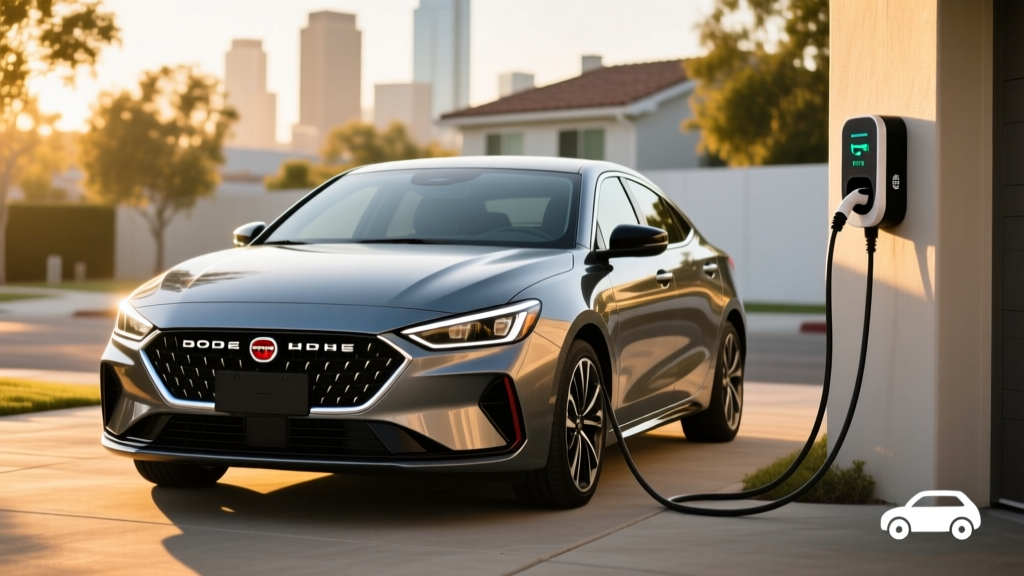
The Hornet R/T's 7.7 kW onboard charger is competitive for the PHEV segment. On a Level 2 home charger, a full recharge takes about 2.5 hours — meaning you can top up during a work-from-home lunch break or between errands. On a standard 120V wall outlet, expect roughly 7.5 hours, which is fine for overnight charging but won't fully replenish if you arrive home nearly empty in the evening.
No DC fast charging. This is typical for PHEVs in this class — the battery is small enough that Level 2 adequately serves it. You won't be pulling into Electrify America stations for a quick top-up on road trips, but with 380 miles of total range, you won't need to.
Pricing and Tax Credit Eligibility
The 2024 Dodge Hornet R/T launched with a base MSRP of approximately $41,430 (including destination). The R/T Plus trim, adding features like leather, a larger infotainment screen, and advanced driver assists, starts around $46,430.
- The Hornet R/T is assembled in Italy (Pomigliano d'Arco), which affects critical-mineral and battery-component sourcing requirements under the Inflation Reduction Act.
- For 2024, the Hornet R/T qualified for up to $3,975 under §30D (half credit — meeting critical minerals but not battery component requirements).
- Buyer income caps apply: $300,000 joint / $225,000 head of household / $150,000 individual MAGI.
- MSRP cap for SUVs: $80,000 (Hornet R/T clears this easily).
- Point-of-sale transfer is available — you can apply the credit as a down payment reduction at the dealer.
Always verify current-year eligibility on IRS.gov and confirm with a tax professional. Rules change annually and by VIN build date.
Real-World Ownership: Who Should Choose the Hornet R/T PHEV?
Pros
- 288 hp makes it the quickest compact crossover PHEV in its price bracket
- eAWD provides genuine all-weather traction without a mechanical driveshaft
- 32 miles electric covers most daily commutes
- No range anxiety — 380+ total miles with a gas station network
- Qualifies for partial federal tax credit, reducing effective price
- Practical cargo space (though slightly reduced vs. gas Hornet due to battery)
Cons
- 29 MPG gas-only is unremarkable — many HEVs do better once the battery is empty
- No DC fast charging limits on-the-go replenishment
- 15.5 kWh battery is small — electric range shrinks in cold or at highway speed
- Premium over the gas GT of ~$10,000+ (before credits) takes years to recoup in fuel savings
- Assembled in Italy — limits credit to partial amount
- Cargo floor sits slightly higher due to battery placement
Decision Framework
Choose the Hornet R/T PHEV if:
- You can charge at home (Level 2 ideal, Level 1 acceptable)
- Your weekday driving is under 30 miles round-trip
- You want AWD and strong acceleration but aren't ready for full EV
- You take road trips where charging infrastructure is sparse
Choose a full EV (e.g., Tesla Model Y, Hyundai Ioniq 5) if:
- You have reliable home charging and your daily drive is under 200 miles
- You want near-zero maintenance and lower per-mile fuel costs
- You qualify for the full $7,500 federal credit on a US-assembled EV
Choose the gas Hornet GT if:
- You cannot charge at home or at work
- Your budget is tighter and you don't need AWD or 288 hp
- You drive mostly highway miles where PHEV electric range provides little benefit
Reliability, Battery Warranty, and Replacement Cost
Dodge Hornet R/T Hybrid Battery Warranty
- Hybrid battery: 8 years / 100,000 miles (whichever comes first)
- Capacity retention threshold: Battery is warrantied against failure or capacity loss below ~60–70% of original (exact threshold per Stellantis PHEV warranty terms)
- Hybrid components (motor, inverter, controller): 8 years / 100,000 miles
- Powertrain (engine + transmission): 5 years / 60,000 miles
- Bumper-to-bumper: 3 years / 36,000 miles
Is It Reliable?
The Hornet R/T shares its platform and PHEV powertrain with the Alfa Romeo Tonale, which has been on European roads since 2022. The 1.3L turbo engine is a proven Fiat/Stellantis unit. Early reliability data is limited — the Hornet is still relatively new in the US market — but the underlying hardware is not experimental.
PHEV batteries in the 15–20 kWh range generally experience less stress than full EV batteries because they cycle through a narrower state-of-charge window. Expect gradual capacity loss of roughly 10–15% over 8–10 years based on industry averages for NMC chemistry in this application.
Battery Replacement Cost
Out-of-warranty PHEV battery replacement for a pack of this size typically runs $5,000–$8,000 including labor, based on comparable Stellantis and industry PHEV packs. This is significantly less than a full EV battery replacement ($10,000–$20,000+) but is still a meaningful expense if it occurs post-warranty. Most PHEV batteries outlast their warranty period without requiring full replacement — individual module repair is sometimes possible.
How the Hornet R/T Stacks Up Against PHEV Competitors
| Model | EV Range | Combined MPG | HP | Base MSRP |
|---|---|---|---|---|
| Dodge Hornet R/T | 32 mi | 29 | 288 | $41,430 |
| Toyota RAV4 Prime | 42 mi | 38 | 302 | $44,210 |
| Ford Escape PHEV | 37 mi | 40 | 210 | $39,400 |
| Hyundai Tucson PHEV | 33 mi | 35 | 261 | $38,725 |
| Kia Sportage PHEV | 34 mi | 35 | 261 | $39,890 |
The Hornet R/T trades fuel efficiency for performance. Its 29 MPG gas-only figure trails the RAV4 Prime and Escape PHEV by a wide margin, but no competitor at this price delivers 288 hp and a 6.1-second 0–60 time. If acceleration and driving engagement matter more than squeezing every MPG, the Hornet holds a unique niche. If maximum efficiency is the priority, the RAV4 Prime and Escape PHEV are stronger choices.
Frequently Asked Questions
How many MPG does the 2024 Dodge Hornet hybrid get?
The Hornet R/T PHEV achieves 29 MPG combined (city/highway) when operating on gasoline after the battery is depleted. In electric mode, it's rated at 77 MPGe. Real-world gas MPG varies: expect 27–31 depending on driving style, temperature, and terrain. The EPA rates it at 29 city / 29 highway.
How far can the Dodge Hornet R/T go on electric only?
The EPA rates the Hornet R/T at 32 miles of electric-only range. In real-world conditions, expect 28–32 miles in mild weather at moderate speeds, and as little as 22–26 miles in cold weather (below 30°F) or at sustained highway speeds above 70 mph.
Does the 2024 Dodge Hornet R/T qualify for a tax credit?
For 2024, the Hornet R/T qualified for up to $3,975 under the §30D federal tax credit — not the full $7,500, because battery components do not fully meet US-sourcing requirements (the vehicle is assembled in Italy). Buyer income caps apply ($150K single / $300K joint). Verify current-year rules on IRS.gov, as requirements tighten annually.
Is the Hornet hybrid reliable, and what does battery replacement cost?
The PHEV powertrain uses proven Stellantis components shared with the Alfa Romeo Tonale. The hybrid battery is warrantied for 8 years/100,000 miles. Out-of-warranty replacement is estimated at $5,000–$8,000. PHEV batteries typically experience less degradation than full EV batteries due to smaller cycling windows.
Can the Hornet R/T use DC fast chargers?
No. The Hornet R/T PHEV does not support DC fast charging. It charges via J1772 at up to 7.7 kW on Level 2 (about 2.5 hours for a full charge) or ~1.4 kW on Level 1 (about 7.5 hours). This is standard for PHEVs in this class.
Hybrid vs PHEV vs EV — which should I choose?
If you have home charging and a short commute, the Hornet R/T PHEV lets you drive electric daily while keeping gas flexibility for road trips. A conventional HEV (like a RAV4 Hybrid) is better if you can't plug in. A full EV (like an Ioniq 5) is ideal if your daily range needs are under 250 miles and you want the lowest operating costs. The PHEV splits the difference — more complexity, but maximum flexibility.
Sources: EPA Fuel Economy Guide, IRS §30D Tax Credit, Dodge/Stellantis official specifications. Pricing and credit eligibility reflect 2024 model year data and are subject to change. Confirm with your dealer and tax professional before purchase.