Quick Verdict: A Compact Hybrid Crossover That Delivers Where It Counts
The 2024 Toyota Corolla Cross Hybrid XSE occupies a narrow but compelling lane: a subcompact all-wheel-drive crossover that returns 42 MPG combined without requiring you to plug in, change your driving habits, or stretch your budget past the mid-$30,000 range. For buyers who want electrified efficiency but lack access to home charging or aren't ready to commit to a full battery-electric vehicle, this powertrain is one of the most pragmatic choices on the market.
The XSE trim sits at the top of the Corolla Cross Hybrid lineup, adding sport-tuned suspension, 18-inch alloy wheels, a 9-inch touchscreen with wireless Apple CarPlay and Android Auto, and Toyota Safety Sense 3.0 as standard. Below, we break down exactly what this hybrid delivers in fuel economy, performance, long-term reliability, and total cost of ownership — with real-world numbers, not just the EPA sticker.
How Many MPG Does the Corolla Cross Hybrid XSE Actually Get?
The EPA rates the 2024 Corolla Cross Hybrid at 45 MPG city / 38 MPG highway / 42 MPG combined across all trims, including the XSE. These figures apply uniformly because every Corolla Cross Hybrid shares the same powertrain and all-wheel-drive configuration.
| Metric | EPA Rating |
|---|---|
| City MPG | 45 MPG |
| Highway MPG | 38 MPG |
| Combined MPG | 42 MPG |
| Fuel Tank Capacity | 10.6 gallons |
| Total Range | ~445 miles |
| Annual Fuel Cost (EPA est.) | ~$1,350 (15,000 mi/yr) |
Source: fueleconomy.gov
HEV vs. PHEV: Why the Corolla Cross Hybrid Is a Conventional Hybrid
A common source of confusion is whether the Corolla Cross Hybrid needs to be plugged in. It does not. This is a conventional hybrid electric vehicle (HEV), not a plug-in hybrid (PHEV). The small traction battery recharges through regenerative braking and the gasoline engine — you simply fill up at the gas station as you would with any other car.
HEV vs. PHEV vs. BEV — Which Fits You?
| Factor | HEV (this car) | PHEV (e.g., RAV4 Prime) | BEV (e.g., bZ4X) |
|---|---|---|---|
| Plug in required? | No | Yes (for EV range) | Yes (always) |
| Electric-only range | ~1 mile (low speed) | 25–42 miles typical | 200–350 miles typical |
| Home charging needed? | No | Recommended (Level 2) | Essential (Level 2) |
| Federal tax credit (§30D) | Not eligible | Up to $7,500* | Up to $7,500* |
| Best for | No charging access, want simplicity | Short commutes + home charging | Full electrification + home charging |
| Upfront cost premium | +$1,500–$3,000 vs gas | +$5,000–$8,000 vs gas | +$8,000–$15,000 vs gas |
*§30D credit eligibility depends on MSRP caps, buyer income limits, and battery-component/critical-mineral sourcing. Verify current rules at irs.gov and consult a tax professional.
Powertrain: 196 HP and Standard Electronic AWD
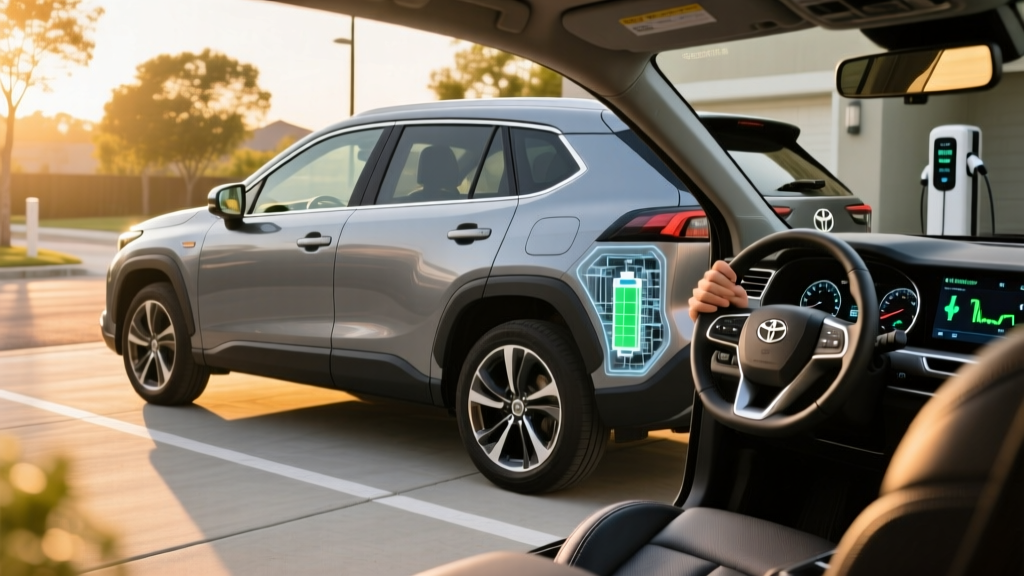
Every 2024 Corolla Cross Hybrid uses Toyota's fifth-generation hybrid system, pairing a 2.0-liter four-cylinder Atkinson-cycle engine with two motor-generators and a lithium-ion traction battery. A third motor-generator on the rear axle provides electronic all-wheel drive (AWD) — there is no mechanical driveshaft connecting front and rear wheels.
| Specification | Value |
|---|---|
| Engine | 2.0L 4-cylinder Atkinson-cycle |
| Combined System Horsepower | 196 hp |
| Front Motor Output | 83 kW (111 hp) |
| Rear Motor Output | 30 kW (40 hp) |
| Transmission | eCVT (planetary gearset) |
| Drivetrain | Electronic AWD (AWD-e) |
| 0–60 MPH | ~7.5 seconds (est.) |
| Towing Capacity | Not rated for towing |
The 196 combined horsepower is a meaningful step up from the non-hybrid Corolla Cross (169 hp from its 2.0L engine), and it shows in passing confidence and highway merging. The AWD-e system engages the rear motor automatically when slip is detected or during hard acceleration from a stop, then disengages at cruising speed to preserve efficiency. It's not an off-roader, but it handles rain, light snow, and gravel roads competently.
Pricing, Trims, and Tax Credit Eligibility
The 2024 Corolla Cross Hybrid is offered in three trims: S, SE, and XSE. The XSE is the top-tier model.
| Trim | MSRP (incl. destination) |
|---|---|
| Hybrid S | ~$29,305 |
| Hybrid SE | ~$30,655 |
| Hybrid XSE | ~$32,705 |
Source: Toyota.com
Battery Warranty, Reliability, and Replacement Cost
Hybrid battery longevity is consistently the top concern among first-time hybrid buyers. Toyota addresses this with one of the strongest hybrid battery warranties in the industry.
Hybrid Battery Warranty Coverage
- Duration: 10 years / 150,000 miles (whichever comes first)
- Coverage: Defects and capacity loss below a defined threshold
- Transferable: Yes, to subsequent owners
- Hybrid System Components: Also covered under the 8-year/100,000-mile hybrid system warranty (inverters, motor-generators, control modules)
Toyota's hybrid battery packs have demonstrated exceptional real-world longevity. The Prius, which uses a fundamentally similar hybrid architecture, routinely sees original batteries lasting 150,000–200,000+ miles before meaningful degradation. The Corolla Cross Hybrid's lithium-ion pack is smaller and less stressed than a PHEV or BEV battery, further supporting long service life.
If replacement is eventually needed outside of warranty, a new OEM hybrid battery for a Toyota compact hybrid currently costs between $2,500 and $4,000 installed, depending on the dealer and region. Third-party reconditioned packs are available for $1,500–$2,500. This is dramatically less than BEV battery replacements, which can exceed $10,000–$20,000.
Who Should Buy the Corolla Cross Hybrid XSE — And Who Shouldn't
Choose the Corolla Cross Hybrid XSE If:
- You lack access to home or workplace charging
- Your commute is city/suburban (where hybrid MPG shines)
- You want AWD without the fuel-economy penalty
- You prioritize long-term reliability and low maintenance costs
- Your budget is $30K–$35K and you don't want a payment stretching into $500+/month
- You want a crossover ride height but car-like fuel costs
Look Elsewhere If:
- You have home charging and a short commute — a PHEV (RAV4 Prime, Prius Prime) lets you drive on electricity daily
- You want full electric driving with zero tailpipe emissions — consider the Hyundai Kona Electric or Chevy Equinox EV
- You need serious cargo space or towing — the Corolla Cross is compact (25.5 cu ft behind rear seats) and not rated for towing
- You want a plug-in hybrid version of this specific model — Toyota does not offer a Corolla Cross PHEV in the US market
- You want the latest Level 2+ driver-assist features — Toyota Safety Sense 3.0 is competent but basic compared to GM Super Cruise or Ford BlueCruise
Ownership Costs: 5-Year Fuel Savings vs. Gas Corolla Cross
The hybrid premium over the gas-only Corolla Cross is roughly $2,000–$3,000 depending on trim. Here's how that premium pays back over five years at 15,000 miles per year:
| Model | Combined MPG | Gallons Used | Fuel Cost ($3.50/gal) |
|---|---|---|---|
| Corolla Cross Gas AWD | 29 MPG | 2,586 | $9,051 |
| Corolla Cross Hybrid AWD | 42 MPG | 1,786 | $6,250 |
| 5-Year Fuel Savings (Hybrid) | ~$2,801 | ||
At current fuel prices, the hybrid pays for its premium in roughly 4–5 years through fuel savings alone. If gas prices rise above $4.00/gallon in your area, the payback period shortens to roughly 3 years. Factor in typically lower brake wear (regenerative braking reduces pad wear by 30–50%) and the total cost advantage widens further.
Frequently Asked Questions
Does the 2024 Corolla Cross Hybrid need to be plugged in?
No. The Corolla Cross Hybrid is a conventional hybrid (HEV). Its lithium-ion traction battery recharges automatically through regenerative braking and the gasoline engine. You never plug it in — you simply refuel at any gas station.
How far can the Corolla Cross Hybrid drive on electric power alone?
Very short distances — typically under one mile at very low speeds (parking lots, stop-and-go traffic under ~25 MPH). This is normal for conventional hybrids. If you want meaningful electric-only range (25–42 miles), you need a plug-in hybrid like the Toyota RAV4 Prime or Prius Prime.
Is the Corolla Cross Hybrid reliable?
Toyota's hybrid powertrains are among the most proven in the automotive industry, with over 25 years of real-world deployment since the original 1997 Prius. The 2024 Corolla Cross Hybrid uses Toyota's fifth-generation hybrid system with a lithium-ion battery covered by a 10-year/150,000-mile warranty. Consumer Reports and J.D. Power consistently rate Toyota hybrids at or near the top for long-term reliability.
Does it qualify for any federal tax credit?
No. The IRS §30D clean vehicle credit applies only to plug-in hybrids and battery-electric vehicles. The Corolla Cross Hybrid, as a conventional HEV, is not eligible. Some states or municipalities may offer separate incentives for hybrids — check the Alternative Fuels Data Center for state-specific programs.
What is the hybrid battery replacement cost?
If the hybrid battery fails outside of the 10-year/150,000-mile warranty, expect to pay $2,500–$4,000 for an OEM replacement at a Toyota dealer. Third-party reconditioned batteries cost $1,500–$2,500 installed. In practice, Toyota hybrid batteries routinely last 150,000–200,000+ miles.
How does the XSE trim differ from the S and SE?
The XSE adds 18-inch alloy wheels, sport-tuned suspension, heated front seats, a leather-trimmed steering wheel, ambient interior lighting, and dual-zone automatic climate control. It also includes the 9-inch touchscreen with wireless smartphone integration. The mechanical hybrid powertrain and EPA fuel economy ratings are identical across all three trims.
Is the Corolla Cross Hybrid good in snow?
The electronic AWD system (AWD-e) provides competent traction in light to moderate snow and rain. The rear electric motor engages automatically when front-wheel slip is detected. However, ground clearance is modest (around 6.1 inches), so deep snow or unplowed roads are beyond its intended use. Pair it with dedicated winter tires for the best cold-weather performance.