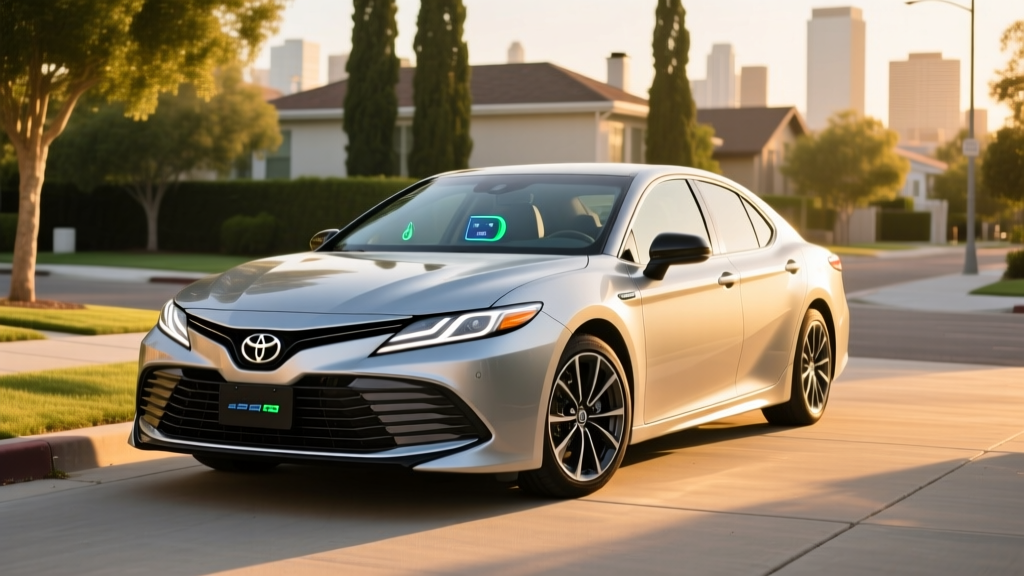
The 2024 Toyota Camry Hybrid sits in a sweet spot that full EVs still can't match for many buyers: no plug required, no range anxiety, and fuel economy that regularly exceeds 50 MPG in daily driving. With the final model year of the XV70 generation before Toyota's 2025 redesign, the 2024 Camry Hybrid offers proven powertrain maturity, strong reliability data, and a starting price that undercuts most plug-in alternatives. Here's a data-driven look at what the numbers actually mean for your wallet.
2024 Camry Hybrid MPG: EPA Ratings vs. Real-World Results
Fuel economy varies by trim because Toyota equips the LE with a lighter, more aero-optimized setup while SE, XLE, and XSE trims carry additional weight and larger wheels. The front-wheel-drive LE trim delivers the headline numbers, while the available electronic All-Wheel Drive (AWD-e) trims sacrifice a small amount of efficiency for traction.
| Trim / Drivetrain | City MPG | Highway MPG | Combined MPG |
|---|---|---|---|
| LE (FWD) | 51 | 53 | 52 |
| SE / XLE / XSE (FWD) | 44 | 47 | 46 |
| LE (AWD-e) | 51 | 53 | 52 |
| SE / XLE / XSE (AWD-e) | 44 | 47 | 46 |
Hybrid (HEV) vs. Plug-In Hybrid (PHEV): Where the Camry Fits
The 2024 Camry Hybrid is a conventional hybrid electric vehicle (HEV), not a plug-in hybrid. This is a critical distinction that confuses many shoppers.
| Feature | HEV (2024 Camry Hybrid) | PHEV (e.g., Toyota RAV4 Prime) |
|---|---|---|
| Plug-in charging? | No — self-charging via regen + engine | Yes — Level 1/Level 2 plug |
| Electric-only range | ~1 mile at low speed | 25–42 miles typical |
| Battery size | 1.6 kWh (small buffer) | 18.1 kWh (RAV4 Prime) |
| Federal tax credit | Not eligible (§30D requires plug-in) | Up to $7,500 if eligible |
| Best for | No home charging; long highway commutes | Home charging; short daily commutes |
| Total range | ~572 miles (13.2-gal tank × 52 MPG LE) | ~600+ miles combined EV + gas |
If you have access to home Level 2 charging and a commute under 30 miles, a PHEV like the RAV4 Prime or Prius Prime lets you drive most days on electricity alone while keeping a gas engine for road trips. If you live in an apartment, park on the street, or drive long highway miles daily, the Camry HEV's self-charging system is more practical — you simply fill up at any gas station and let the hybrid system optimize the rest.
Powertrain Specs: What Moves the 2024 Camry Hybrid
Toyota's fourth-generation Hybrid Synergy Drive pairs a 2.5-liter Dynamic Force four-cylinder engine running the Atkinson cycle with one or two electric motors, depending on drivetrain.
| Engine | 2.5L 4-cyl Atkinson-cycle (A25A-FXS) |
| Engine output | 176 hp / 163 lb-ft torque |
| Front electric motor | 88 kW (118 hp) / 149 lb-ft |
| Rear motor (AWD-e only) | 40 kW (54 hp) — engages on demand |
| Net combined system horsepower | 208 hp (FWD) / 218 hp (AWD-e) |
| Transmission | eCVT (planetary gearset, no belt) |
| Hybrid battery | 1.6 kWh lithium-ion (244.8V nominal) |
| 0–60 MPH | ~7.2 seconds (FWD) / ~7.0 seconds (AWD-e) |
| Fuel tank capacity | 13.2 gallons |
| Drivetrain | FWD standard; electronic AWD-e available |
The eCVT isn't a traditional belt-and-pulley CVT. Toyota uses a planetary gearset that seamlessly blends engine and motor power with no fixed gear ratios and no belt to slip or wear. This is one reason the Camry Hybrid's drivetrain has earned a reputation for longevity well beyond 200,000 miles with basic maintenance.
Pricing, Trims, and Tax Credit Eligibility
The 2024 Camry Hybrid lineup spans four trims, with the LE delivering maximum MPG and the XSE offering sportier suspension tuning at the cost of a few MPG points.
| Trim | FWD MSRP | AWD-e MSRP |
|---|---|---|
| LE | $29,690 | $30,790 |
| SE | $31,535 | $32,635 |
| XLE | $34,290 | $35,390 |
| XSE | $35,390 | $36,490 |
Without a federal credit, the value proposition rests on fuel savings. At $3.40/gallon and 12,000 miles/year, the LE trim (52 MPG combined) costs roughly $785/year in fuel. A comparable 30 MPG gas-only midsize sedan would cost about $1,360/year — a savings of ~$575 annually, or roughly $2,875 over five years. That nearly closes the gap between a Camry gas model and the Hybrid LE.
Battery Warranty, Reliability, and Replacement Cost
Hybrid battery longevity is the top concern for buyers considering a Camry Hybrid, especially on the used market. Toyota addresses this with one of the strongest hybrid battery warranties in the industry.
• Hybrid battery: 10 years / 150,000 miles (whichever comes first)
• Hybrid system components (inverter, motor, control module): 8 years / 100,000 miles
• Applies to original owner and is transferable to subsequent owners
• Covers capacity loss and defect — Toyota replaces with new or remanufactured unit
In practice, Toyota's lithium-ion hybrid batteries in the Camry and Prius lineages have shown exceptional longevity. Real-world data from fleet operators and high-mileage owners indicates most hybrid batteries retain functional capacity well past 150,000 miles. The small 1.6 kWh pack operates within a conservative state-of-charge window (roughly 40–80%), which dramatically reduces cell stress compared to the deeper cycles a full EV battery endures.
If replacement is needed out of warranty, costs break down as follows:
- New OEM battery from Toyota: $2,500–$4,000 (parts + labor at dealer)
- Remanufactured battery: $1,500–$2,500 (from specialists like Green Bean Battery)
- Individual cell/module replacement: $500–$1,200 (if only specific modules have degraded)
For context, a conventional automatic transmission replacement on a gas car often costs $3,000–$5,000. The hybrid battery, which doubles as part of the drivetrain, is comparably priced to replace and far more likely to outlast the vehicle.
2024 Camry Hybrid vs. Full EV vs. Gas Sedan: Which Fits You?
Choosing between a conventional hybrid, a plug-in hybrid, a full battery-electric vehicle, and a gas-only sedan depends on your charging access, commute pattern, and budget. Here's a decision framework:
- You don't have reliable access to home or workplace charging
- Your commute involves long highway stretches (30+ miles each way)
- You want 50+ MPG without changing any habits — just fill up at any gas station
- You want proven long-term reliability data and low maintenance costs
- Your budget is $30,000–$36,000 and you don't want to wait for EV charging infrastructure to mature in your area
- You can install a Level 2 home charger and your daily commute is under 25–40 miles
- You want electric-only daily driving with a gas backup for road trips
- You may qualify for the §30D federal tax credit (up to $7,500) and state EV incentives
- You have home charging and want to eliminate gas entirely
- Your daily driving is under 250 miles and you can plan road-trip charging stops
- You want the lowest per-mile "fuel" cost (electricity at $0.04–$0.06/mile vs. gas at $0.10–$0.15/mile)
- You qualify for the full §30D tax credit, effectively reducing purchase price
- Upfront price is the primary concern (gas Camry LE starts ~$2,500 less than Hybrid LE)
- You drive fewer than 8,000 miles/year, making fuel savings negligible
Ownership Costs: 5-Year Total Cost Breakdown
| Cost Factor | Camry Hybrid LE | Camry Gas LE (203 hp) | Tesla Model 3 RWD |
|---|---|---|---|
| Purchase price (MSRP) | $29,690 | $27,190 | $38,990 |
| Federal tax credit | $0 | $0 | $0–$7,500* |
| Fuel / energy (5 yrs) | $3,925 | $6,800 | $2,400 |
| Maintenance (5 yrs) | $1,800 | $2,200 | $1,200 |
| Insurance (est. avg) | $7,500 | $7,200 | $9,000 |
| Est. depreciation | $12,000 | $13,000 | $16,000 |
| Approx. 5-yr total | $54,915 | $56,390 | $48,090–$55,590 |
*Tesla Model 3 RWD §30D eligibility depends on battery sourcing, buyer income (≤$150K single / $300K joint), and point-of-sale transfer. Verify current status at irs.gov.
The Camry Hybrid LE essentially pays for its ~$2,500 premium over the gas model within 4–5 years through fuel savings alone. Against a Tesla Model 3, the Camry Hybrid costs less upfront and avoids EV insurance premiums, but the Model 3 can pull ahead if you qualify for the full $7,500 credit and have cheap home electricity.
Pros and Cons: An Honest Assessment
- 52 MPG combined (LE) — best-in-class midsize sedan efficiency
- No plug required — zero lifestyle change from a gas car
- 10-year / 150,000-mile hybrid battery warranty, transferable
- Proven 4th-gen Toyota hybrid system with deep reliability history
- AWD-e available across all trims for snow-belt buyers
- Strong resale value — Camry Hybrid holds value well in the used market
- Quiet, refined cabin at highway speeds; competitive with entry-luxury sedans
- No federal tax credit eligibility (HEV, not plug-in)
- SE/XLE/XSE trims drop to 46 MPG combined — a 6 MPG penalty for style and features
- eCVT drone under hard acceleration — not sporty despite XSE badging
- Infotainment (Toyota Audio Multimedia) is functional but lags rivals in responsiveness
- No DC fast charging capability (not applicable to HEV, but limits future-proofing)
- Final year of XV70 generation — 2025 redesign brings updated styling and tech
Frequently Asked Questions
How many MPG does the 2024 Camry Hybrid actually get?
The EPA rates the LE trim at 51 city / 53 highway / 52 combined MPG. In real-world driving, city and suburban commuters regularly see 50–55 MPG because regenerative braking recovers energy at every stop. Highway-only driving at 75+ MPH typically returns 42–48 MPG. SE, XLE, and XSE trims are rated at 44 city / 47 highway / 46 combined.
Does the 2024 Camry Hybrid need to be plugged in?
No. The Camry Hybrid is a conventional HEV — it charges its own 1.6 kWh battery through regenerative braking and the gasoline engine. There is no charge port and no plug. You simply drive it like any other car and refuel at a gas station.
Does the 2024 Camry Hybrid qualify for any tax credit?
The Camry Hybrid does not qualify for the federal §30D Clean Vehicle Credit because that credit requires a plug-in vehicle with at least 7 kWh of battery capacity. The Camry Hybrid has a 1.6 kWh battery and no charge port. Check your state energy office for any state-level hybrid incentives, which vary by jurisdiction.
How long will the Camry Hybrid battery last and what does replacement cost?
Toyota warrants the hybrid battery for 10 years or 150,000 miles, and real-world data shows most batteries last well beyond that threshold. The small battery operates in a narrow charge window (40–80% SoC), which minimizes degradation. If replacement is ever needed out of warranty, expect $2,500–$4,000 for a new OEM unit or $1,500–$2,500 for a remanufactured battery.
Is the 2024 Camry Hybrid better than buying a full EV?
It depends on your situation. If you lack home charging, drive long highway routes, or live in an area with sparse public charging infrastructure, the Camry Hybrid is more practical — 52 MPG with no plug and 570+ miles of total range. If you can charge at home, have a commute under 250 miles, and want the lowest operating cost and zero tailpipe emissions, a full EV like the Tesla Model 3 or Hyundai Ioniq 6 may serve you better, especially if you qualify for the $7,500 federal credit.
How does the Camry Hybrid compare to the Prius for MPG?
The 2024 Prius LE is rated at 57 city / 56 highway / 57 combined — about 5 MPG better than the Camry Hybrid LE. The Prius is smaller, lighter, and has a more aerodynamic profile. If maximum MPG is your sole priority and you don't need the Camry's extra rear-seat room and trunk space, the Prius wins. If you need a true midsize sedan with more cargo and passenger volume, the Camry Hybrid is the more practical choice at only a modest MPG penalty.
Is the AWD-e system worth the trade-off?
The electronic AWD-e adds a 40 kW rear motor that engages automatically during acceleration from a stop and when front-wheel slip is detected. It does not affect the EPA rating on the LE trim (still 52 combined), though it adds roughly $1,100 to the MSRP. For buyers in regions with frequent snow or rain, AWD-e provides meaningful traction improvement. In dry climates, the FWD version is the better value.
Sources: EPA fuel economy data from fueleconomy.gov; IRS Clean Vehicle Credit rules at irs.gov; 2024 Camry Hybrid specifications from Toyota USA.