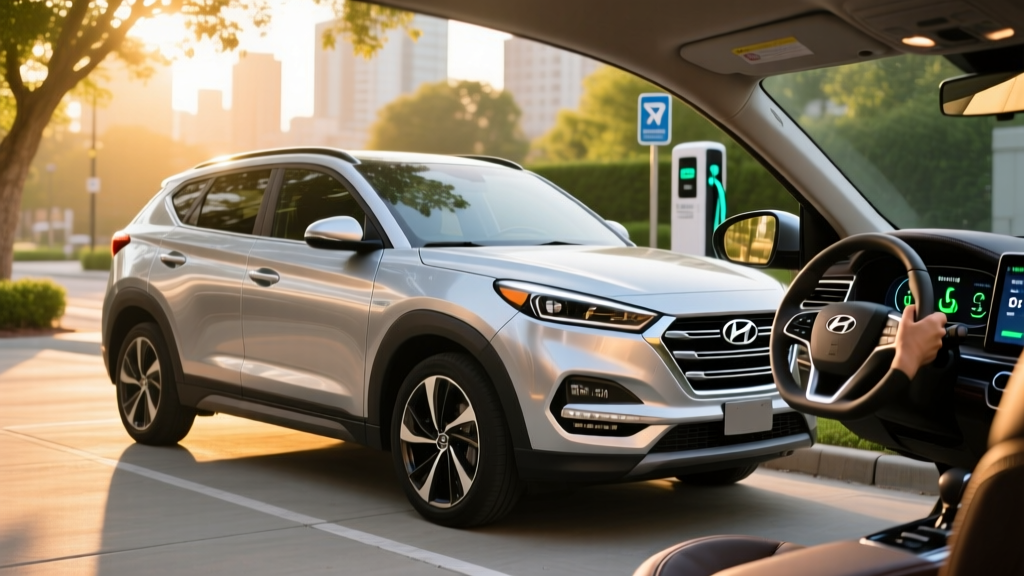
The 2023 Hyundai Tucson Hybrid SEL Convenience occupies a specific niche: a compact SUV that delivers meaningful fuel savings without requiring a plug, a charging routine, or any change in driving habits. For buyers researching this exact trim, the questions are practical — does the EPA MPG hold up in real driving, what does the hybrid battery warranty actually cover, and does this trim's feature set justify its position in the lineup? This guide answers those questions with exact figures, ownership data, and a clear framework for whether the Tucson Hybrid is the right electrified choice versus a PHEV or full EV.
HEV vs PHEV: Which Tucson Are We Talking About?
Hyundai sells the Tucson in three powertrains: a conventional gas model, a conventional hybrid (HEV), and a plug-in hybrid (PHEV). The 2023 Hyundai Tucson Hybrid SEL Convenience is the HEV — meaning it has no plug, no electric-only driving mode, and requires no charging infrastructure. It generates electricity through regenerative braking and the gasoline engine, storing it in a small battery that assists the motor during acceleration and low-speed driving.
| Attribute | Tucson Hybrid (HEV) | Tucson Plug-In Hybrid (PHEV) |
|---|---|---|
| Plug-in charging | No — self-charging | Yes — Level 1/Level 2 |
| Electric-only range | None | ~33 miles (EPA) |
| Battery capacity | 1.49 kWh | 13.8 kWh |
| Combined HP | 226 HP | 261 HP |
| EPA combined MPG | 38 MPG | 35 MPG (gas) / 80 MPGe (electric) |
| Federal tax credit | Not eligible | Up to $7,500 (§30D, subject to eligibility) |
| Starting MSRP (2023) | ~$32,590 (SEL Convenience) | ~$37,350 (SEL) |
If you have access to home or workplace charging and a commute under 33 miles, the PHEV variant can operate as a daily EV with gas-engine backup for longer trips. If you live in an apartment, lack charging access, or simply want fuel savings with zero routine changes, the HEV is the correct choice — and the SEL Convenience is its best-equipped non-Limited trim.
Fuel Economy: EPA Numbers and Real-World MPG
The EPA rates the 2023 Tucson Hybrid at 37 city / 38 highway / 38 combined MPG for the SEL Convenience trim with its standard all-wheel drive. These numbers come from fueleconomy.gov, and they apply to the AWD configuration that all Tucson Hybrid trims use.
| Driving Cycle | EPA Estimate | Real-World Expectation |
|---|---|---|
| City | 37 MPG | 38–42 MPG (hybrids excel in stop-and-go) |
| Highway | 38 MPG | 33–36 MPG (sustained 70+ mph reduces regen benefit) |
| Combined | 38 MPG | 35–39 MPG (mixed driving) |
| Cold weather (below 30°F) | — | 30–34 MPG (engine runs more for cabin heat) |
Hybrid systems typically exceed their EPA city estimate because regenerative braking recaptures energy in stop-and-go traffic. Highway driving is the opposite: sustained speeds reduce braking events, and aerodynamic drag dominates. The Tucson Hybrid's real-world combined economy for most owners falls between 35 and 39 MPG depending on climate, terrain, and driving style. In cold weather, expect a 10–15% drop as the engine runs more frequently to provide cabin heat and maintain battery temperature.
For context, the non-hybrid 2023 Tucson AWD achieves 26 MPG combined — meaning the hybrid saves roughly 3.5 gallons per 1,000 miles driven. At $3.50/gallon gas and 15,000 annual miles, that translates to approximately $184 in annual fuel savings versus the gas model.
Powertrain: 226 HP From a Turbocharged Hybrid System
The Tucson Hybrid pairs a 1.6-liter turbocharged four-cylinder engine with a 44.2 kW (59 HP) electric motor integrated into the six-speed automatic transmission. Combined output is 226 horsepower and 258 lb-ft of torque. All-wheel drive is standard across all Tucson Hybrid trims, using a conventional mechanical system rather than a dedicated rear electric motor.
| Specification | 2023 Tucson Hybrid SEL Convenience |
|---|---|
| Engine | 1.6L turbocharged GDI 4-cylinder |
| Engine output | 178 HP / 195 lb-ft |
| Electric motor | 44.2 kW (59 HP) / 195 lb-ft |
| Combined system output | 226 HP / 258 lb-ft |
| Transmission | 6-speed automatic |
| Drivetrain | AWD (standard) |
| Battery capacity | 1.49 kWh (lithium-ion polymer) |
| 0–60 mph | ~7.1 seconds |
| Towing capacity | 2,000 lbs |
| Cargo volume | 38.7 cu ft (rear seats up) |
The 1.49 kWh battery is small by EV standards — it exists to buffer regenerative energy and provide electric assist, not to drive the vehicle independently. You will notice the electric motor during initial acceleration from stops and during low-speed maneuvering, where it smooths out the turbo engine's response. The six-speed automatic is a deliberate choice over the CVT transmissions used in the Toyota RAV4 Hybrid; it provides more natural shift feel at the cost of a fraction of an MPG.
SEL Convenience Trim: What You Get for the Price
The 2023 Tucson Hybrid SEL Convenience carried an MSRP of approximately $32,590 (plus destination). It sits above the base Blue and SEL trims and below the Limited, adding features that justify its position for most buyers:
- 10.25-inch digital instrument cluster and 10.25-inch touchscreen with navigation
- Wireless Apple CarPlay and Android Auto (note: wireless only with the 8-inch screen; the 10.25-inch requires wired connection)
- Hyundai Digital Key (NFC-based smartphone-as-key)
- Hands-free smart power liftgate
- SynTex (leatherette) seating surfaces with heated front seats
- Wireless phone charging pad
- Highway Drive Assist (HDA) — adaptive cruise with lane centering, linked to speed limit data
- LED headlights with Dynamic Welcome Lighting
The SEL Convenience does not include the Limited's panoramic sunroof, ventilated seats, leather upholstery, or the more advanced Highway Driving Assist 2 (which adds lane-change assist). For buyers who want those features, the jump to Limited is roughly $4,000 on the 2023 sticker.
Tax Credit Eligibility: What Applies to the HEV?
The conventional Tucson Hybrid (HEV) does not qualify for the federal §30D clean vehicle tax credit, which applies only to plug-in electric vehicles (BEVs and PHEVs) meeting battery sourcing, MSRP, and buyer income requirements. There is no federal tax credit for conventional hybrids as of current IRS rules.
Some states offer their own incentives for hybrid purchases — these vary by jurisdiction and change frequently. Check your state's energy or environmental agency for current programs. If the federal tax credit is a priority for your purchase, the Tucson PHEV may qualify (up to $7,500, subject to income caps of $150K single / $300K joint, MSRP cap of $80,000 for SUVs, and critical mineral/battery component sourcing requirements). Consult a tax professional before relying on credit eligibility.
Battery Warranty, Lifespan, and Replacement Cost
Hyundai Hybrid Battery Warranty: 10 years / 100,000 miles (whichever comes first) for the hybrid battery pack. This applies to the original owner; subsequent owners receive 10 years / 100,000 miles from the vehicle's original in-service date in most states, though California-emissions states may extend this. The warranty covers defects and capacity loss below a functional threshold — Hyundai does not publish an exact percentage, but industry standard is replacement if capacity drops below ~70%.
Hybrid batteries in the Tucson are small (1.49 kWh) and experience shallow charge/discharge cycles — typically operating between 40% and 80% state of charge. This is far less stressful than the deep cycles in a full EV, and hybrid battery packs routinely last 150,000–200,000+ miles before meaningful degradation. Failures before 100,000 miles are uncommon.
If replacement is needed out of warranty, a Tucson Hybrid battery pack costs approximately $2,000–$3,500 including labor at a dealership. Third-party hybrid battery refurbishers can sometimes reduce this to $1,200–$2,000. For comparison, the Toyota RAV4 Hybrid battery replacement runs a similar range. This is a fraction of full EV battery replacement costs, which can exceed $10,000.
The broader powertrain warranty — covering the engine, transmission, and electric motor — is also 10 years / 100,000 miles, and the basic vehicle warranty is 5 years / 60,000 miles. These are among the strongest coverage packages in the compact SUV segment.
Reliability and Safety Ratings
The 2023 Tucson Hybrid carries strong safety credentials. The IIHS named it a Top Safety Pick when equipped with specific headlights (the LED units standard on SEL Convenience qualify). NHTSA awarded it a 5-Star Overall Safety Rating. Hyundai's SmartSense suite is standard across all trims and includes forward collision-avoidance assist with pedestrian/cyclist detection, blind-spot collision-avoidance assist, rear cross-traffic collision-avoidance assist, lane keeping assist, and driver attention warning.
Long-term reliability data for the Tucson Hybrid's powertrain is still maturing — the hybrid variant was reintroduced for the 2022 model year. However, Hyundai's 1.6L turbo engine and hybrid system share architecture with the Kia Sorento Hybrid and Hyundai Sonata Hybrid, which have accumulated more fleet miles. Early indicators from owner surveys and warranty claim data show no systemic hybrid-battery or powertrain issues. The conventional six-speed automatic avoids the reliability concerns some buyers associate with CVTs.
Who Should Choose the Tucson Hybrid SEL Convenience?
Choose the Tucson Hybrid (HEV) if:
- You lack access to home or workplace charging
- You want fuel savings without changing your fueling routine
- Your daily driving is mixed city/highway and you value AWD
- You want a proven warranty and moderate purchase price
- You drive 12,000–18,000 miles per year and want to reduce fuel cost
Choose the Tucson PHEV instead if:
- You can install a Level 2 charger at home
- Your daily commute is under 33 miles round-trip
- You qualify for the federal §30D tax credit (effectively reducing price by up to $7,500)
- You want to drive on electricity most days but need gas flexibility for road trips
Choose a full EV (e.g., Hyundai Ioniq 5) if:
- You have reliable home charging and your daily driving is under 250 miles
- You want zero tailpipe emissions and minimal maintenance
- You're ready to plan around public charging for road trips
Pros
- 38 MPG combined EPA — exceeds most compact SUV hybrids
- 226 HP provides confident highway merging and passing
- 10-year / 100,000-mile hybrid battery and powertrain warranty
- AWD standard with no fuel-economy penalty versus FWD
- SEL Convenience trim well-equipped at ~$32,590 MSRP
- Strong IIHS Top Safety Pick and NHTSA 5-Star ratings
Cons
- No federal tax credit (HEV, not PHEV)
- Highway MPG drops to low-to-mid 30s at sustained 75+ mph
- 1.49 kWh battery provides no electric-only driving
- Cold-weather fuel economy drops 10–15%
- Wireless CarPlay/Android Auto unavailable with 10.25-inch screen
- Towing limited to 2,000 lbs
Frequently Asked Questions
How many MPG does the 2023 Tucson Hybrid SEL Convenience actually get?
The EPA rates it at 37 city / 38 highway / 38 combined. Real-world driving typically yields 38–42 MPG in city conditions and 33–36 MPG on the highway. Combined real-world for most owners falls between 35 and 39 MPG depending on climate and driving style.
Does the Tucson Hybrid need to be plugged in?
No. The Tucson Hybrid (HEV) is a self-charging conventional hybrid. It charges its 1.49 kWh battery through regenerative braking and the gasoline engine. You fuel it like any other car. If you want a Tucson that plugs in, you need the Tucson Plug-In Hybrid (PHEV).
How far can the Tucson Hybrid drive on electric power alone?
The HEV cannot drive on electric power alone for any meaningful distance. The electric motor assists the gas engine during acceleration and low-speed driving but does not independently propel the vehicle. For electric-only driving, the Tucson PHEV offers approximately 33 miles of EPA-rated electric range.
Does the 2023 Tucson Hybrid qualify for a tax credit?
No federal tax credit applies to conventional hybrids under current IRS §30D rules. The credit is reserved for plug-in vehicles (BEVs and PHEVs). Some states offer separate hybrid incentives — check your state energy agency. The Tucson PHEV may qualify for up to $7,500 federally if you meet income, MSRP, and sourcing requirements.
How long will the Tucson Hybrid battery last and what does replacement cost?
Hyundai warrants the hybrid battery for 10 years / 100,000 miles. Hybrid batteries experience shallow charge cycles and routinely last 150,000–200,000+ miles. Out-of-warranty replacement costs approximately $2,000–$3,500 at a dealership, or $1,200–$2,000 through a third-party refurbisher.
Is the Tucson Hybrid SEL Convenience reliable?
Early reliability data is positive, with no systemic hybrid-battery or powertrain issues reported in owner surveys. Hyundai's 10-year / 100,000-mile powertrain warranty provides strong coverage. The conventional six-speed automatic avoids CVT-related concerns. Long-term data will mature as these vehicles accumulate higher mileage.
How does the Tucson Hybrid compare to the RAV4 Hybrid?
The Toyota RAV4 Hybrid achieves 40 MPG combined (EPA) versus the Tucson's 38 MPG, and Toyota's hybrid system has a longer reliability track record. The Tucson Hybrid counters with more horsepower (226 vs 219), a more premium interior at the SEL Convenience level, a longer powertrain warranty (10yr/100k vs 5yr/60k for Toyota's basic), and standard HDA adaptive cruise with lane centering.