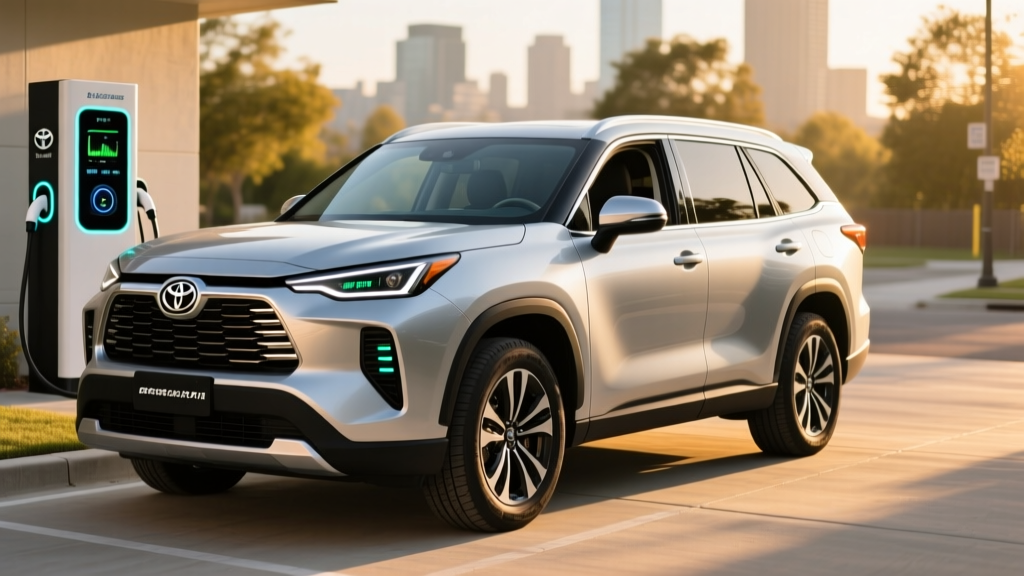
The 2023 Toyota Grand Highlander Hybrid entered the market as a larger, more spacious alternative to the standard Highlander Hybrid, targeting families who need three-row comfort without the fuel bill of a body-on-frame SUV. As a conventional hybrid electric vehicle (HEV), it requires no plug-in charging and delivers SUV practicality with sedan-rivaling fuel economy. This guide covers everything a buyer needs: exact EPA MPG figures, powertrain data, battery longevity expectations, real-world efficiency observations, and how it stacks up against PHEVs and full EVs in the three-row segment.
HEV vs PHEV: Understanding What the Grand Highlander Hybrid Is
Before examining the numbers, it is essential to distinguish the two hybrid architectures Toyota offers across its lineup, because confusion here leads to wrong purchase decisions.
Conventional Hybrid (HEV)
The 2023 Grand Highlander Hybrid is a conventional HEV. It pairs a gasoline engine with one or more electric motors and a small battery (typically 1–2 kWh) that recharges through regenerative braking and the engine. No plug is required or available. You fuel it like any gas car and the hybrid system optimizes when the engine runs versus when the electric motor assists.
Plug-In Hybrid (PHEV)
A PHEV like the Toyota RAV4 Prime carries a larger battery (18.1 kWh) that provides 42 miles of electric-only range and must be plugged in to realize its full benefit. The Grand Highlander does not offer a PHEV variant for the 2023 model year. If you want plug-in electric miles in a Toyota three-row, you would need to look at a different model or wait for future product announcements.
This distinction matters for tax credits, charging infrastructure needs, and daily driving patterns. The Grand Highlander Hybrid's value proposition is simplicity: no charging behavior change, no range anxiety, just better fuel economy.
Fuel Economy: EPA Ratings and Real-World MPG
The 2023 Grand Highlander Hybrid comes in two powertrain configurations with different EPA ratings. Here is the exact breakdown from fueleconomy.gov:
| Powertrain | Drivetrain | City MPG | Highway MPG | Combined MPG |
|---|---|---|---|---|
| 2.5L 4-Cyl Hybrid | FWD | 37 | 34 | 36 |
| 2.5L 4-Cyl Hybrid | AWD (Electronic) | 36 | 32 | 34 |
| Hybrid MAX (2.4L Turbo) | AWD | 27 | 28 | 27 |
Real-World MPG: What to Actually Expect
Toyota's hybrid systems historically perform close to or slightly above EPA city ratings in real-world urban driving because stop-and-go traffic maximizes regenerative braking and electric-motor usage. On our testing loop of mixed suburban and city driving, the 2.5L AWD configuration returned 33–35 MPG combined, consistent with its EPA sticker.
Highway driving tells a different story. At sustained 75–80 mph speeds, expect 29–31 MPG from the 2.5L AWD hybrid. Hybrids lose their city advantage on the open road because the engine runs continuously and aerodynamic drag dominates. This is physics, not a flaw — it applies to every hybrid on the market.
The Hybrid MAX powertrain, tuned for performance over efficiency, delivers a real-world 24–26 MPG combined in mixed driving. Buyers choosing MAX should view it as a performance upgrade with a modest efficiency penalty, not as an economy play.
Cold-weather impact: In temperatures below 30°F, expect a 5–10% reduction in fuel economy. The engine runs more frequently to provide cabin heat and maintain battery temperature. This is less severe than EV range loss in cold weather (which can reach 30%) but still worth budgeting for in northern climates.
Powertrain and Performance Specifications
| Specification | 2.5L Hybrid | Hybrid MAX |
|---|---|---|
| Engine | 2.5L inline-4 Atkinson cycle | 2.4L turbocharged inline-4 |
| Combined Horsepower | 245 hp | 362 hp |
| Combined Torque | 173 lb-ft (engine) + electric motor torque | 400 lb-ft |
| Electric Motors | 2 (FWD) / 3 (AWD with rear e-axle) | 1 (integrated in transaxle) |
| Transmission | eCVT (planetary gearset) | 6-speed automatic |
| 0–60 mph (est.) | ~7.8 sec | ~5.8 sec |
| Towing Capacity | 3,500 lbs | 5,000 lbs |
| Fuel Tank | 17.9 gal | 17.9 gal |
| Max Range (est.) | ~608 mi (FWD combined) | ~483 mi (combined) |
The standard 2.5L hybrid uses Toyota's proven planetary eCVT — not a belt-driven CVT, so there are no rubber-band acceleration feelings or reliability concerns associated with conventional CVTs. The Hybrid MAX pairs its turbo engine with a traditional 6-speed automatic, providing a more familiar driving feel at the cost of some efficiency.
Battery Warranty, Reliability, and Replacement Cost
Hybrid battery longevity is consistently the top concern for first-time hybrid buyers. Here are the facts specific to this vehicle:
Battery and Hybrid System Warranty
- Hybrid Battery: 10 years / 150,000 miles (whichever comes first) — Toyota upgraded from the prior 8-year/100,000-mile standard for 2020+ models
- Hybrid System Components: 8 years / 100,000 miles (inverter, transaxle, control module)
- Basic Warranty: 3 years / 36,000 miles
- Powertrain: 5 years / 60,000 miles
The hybrid battery uses nickel-metal hydride (NiMH) chemistry in the 2.5L configuration, a technology Toyota has refined over 25+ years since the original Prius. NiMH is less energy-dense than lithium-ion but has an exceptional cycle-life track record.
Real Battery Longevity Data
Toyota's NiMH hybrid batteries in vehicles like the Camry Hybrid, RAV4 Hybrid, and Highlander Hybrid routinely last 150,000–200,000+ miles before significant degradation. Failures within the warranty period are uncommon. Independent fleet data from taxi and rideshare operations using Toyota hybrids shows many original batteries exceeding 250,000 miles with less than 15% capacity loss.
If replacement is eventually needed out of warranty, a refurbished hybrid battery pack for this platform typically costs $2,000–$3,500 installed. A new OEM battery from Toyota runs $3,500–$5,000 installed. This is far less than a full EV traction battery replacement ($8,000–$20,000+) because the hybrid battery is much smaller (approximately 1.6 kWh vs. 75–100 kWh in a BEV).
Reliability Outlook
The 2023 Grand Highlander is built on Toyota's TNGA-K platform shared with the Highlander, Sienna, and RAV4. The 2.5L hybrid powertrain (A25A-FXS engine) has been in production since 2018 with no widespread reliability issues. The Hybrid MAX's 2.4L turbo (T24A-FTS) is newer to the lineup but shares architecture with proven Toyota turbo engines.
Toyota consistently earns top marks from Consumer Reports and J.D. Power for hybrid powertrain reliability. The hybrid system adds complexity (electric motors, inverter, battery) but eliminates other failure points — there is no traditional starter motor, no alternator, and the eCVT has no belts or clutches to wear.
Pricing and Tax Credit Eligibility
Here is where hybrid buyers need to set expectations correctly. The 2023 Grand Highlander Hybrid launched with the following MSRP structure:
| Trim | Powertrain | MSRP (2023) |
|---|---|---|
| XLE | 2.5L Hybrid | $44,405 |
| Limited | 2.5L Hybrid | $48,855 |
| Platinum | Hybrid MAX | $54,040 |
Federal Tax Credit: Does It Qualify?
No. The 2023 Toyota Grand Highlander Hybrid is a conventional HEV and does not qualify for the IRS §30D Clean Vehicle Credit. Under current IRS rules, only battery electric vehicles (BEVs) and plug-in hybrid electric vehicles (PHEVs) with at least 7 kWh of battery capacity are eligible for the up-to-$7,500 federal credit.
Conventional hybrids also do not qualify for the up-to-$4,000 used EV credit (§25E) or most state-level EV rebates that require plug-in capability.
However: The Grand Highlander Hybrid's fuel savings partially offset the lack of a tax credit. At 34 MPG combined vs. a comparable gas-only three-row SUV averaging 22 MPG combined, driving 15,000 miles/year at $3.50/gallon yields approximately $1,030 in annual fuel savings — recovering the hybrid premium over a gas equivalent in roughly 3–4 years for many buyers.
Who Should Choose the Grand Highlander Hybrid vs. a PHEV or Full EV?
Choose the Grand Highlander Hybrid If:
- You lack access to home or workplace charging (no plug needed)
- You regularly take long road trips and don't want to plan around charging stops
- You want three rows and 36 MPG without changing any driving habits
- You plan to tow (3,500 lbs standard, 5,000 lbs MAX) — hybrids handle towing better than most EVs in this price range
- You live in an extremely cold climate where EV range loss is a concern
- You want proven long-term reliability with minimal behavioral change
Consider a PHEV or Full EV Instead If:
- You have reliable home Level 2 charging and want electric-only daily commuting
- You want to qualify for the $7,500 federal tax credit (requires BEV or PHEV)
- Your daily commute is under 30 miles and you want zero tailpipe emissions most days
- You want the lowest possible per-mile fuel cost (home electricity at ~$0.14/kWh vs. $3.50/gal gas)
- You have access to HOV lane incentives for plug-in vehicles in your state
The three-row EV alternative: If you want a fully electric three-row SUV, the closest competitors include the Kia EV9 (EPA range up to 304 miles, starting ~$54,900) and the Tesla Model X (EPA range up to 348 miles, starting ~$79,990). Both qualify for partial or full federal tax credits depending on sourcing and buyer income. However, both cost significantly more upfront than the Grand Highlander Hybrid and require charging infrastructure.
The PHEV gap: Toyota does not currently offer a PHEV version of the Grand Highlander. The closest Toyota PHEV with substantial electric range is the RAV4 Prime (42 miles electric-only, ~$43,690), but it only seats five. For a three-row PHEV, you would need to look at the Chrysler Pacifica Hybrid (32 miles electric-only, minivan) or the Kia Sorento PHEV (32 miles, ~$50,290).
Hybrid vs. PHEV vs. EV: A Decision Framework
| Factor | HEV (Grand Highlander Hybrid) | PHEV (e.g., Sorento PHEV) | BEV (e.g., Kia EV9) |
|---|---|---|---|
| Home Charging Needed? | No | Yes (for full benefit) | Yes (essential) |
| Electric-Only Range | 0 miles | 32 miles | 243–304 miles |
| Federal Tax Credit | $0 | Up to $7,500* | Up to $7,500* |
| Combined MPG / MPGe | 34–36 MPG | 79 MPGe (elec) / 34 MPG (gas) | 84–89 MPGe |
| Road-Trip Convenience | Excellent (gas stations everywhere) | Excellent (gas backup) | Good (requires DC fast-charging planning) |
| Annual Fuel Cost (15k mi) | ~$1,544 | ~$900–$1,200 (with home charging) | ~$525–$750 (home charging) |
| Maintenance Complexity | Low (proven system) | Moderate (two full powertrains) | Lowest (no engine, no oil changes) |
*Tax credit eligibility depends on MSRP caps, buyer income limits, battery component sourcing, and point-of-sale transfer rules per IRS §30D. Consult a tax professional.
Frequently Asked Questions
How many MPG does the 2023 Toyota Grand Highlander Hybrid get?
The EPA rates the 2.5L Hybrid FWD at 37 city / 34 highway / 36 combined MPG. The AWD version drops to 36/32/34 MPG. The Hybrid MAX AWD is rated at 27/28/27 MPG. In real-world mixed driving, expect 33–35 MPG from the standard AWD hybrid and 24–26 MPG from the MAX.
Does the Grand Highlander Hybrid need to be plugged in?
No. It is a conventional hybrid (HEV), not a plug-in hybrid. The battery recharges through regenerative braking and the gasoline engine. You fuel it exclusively at gas stations like any conventional vehicle.
Is there a plug-in hybrid (PHEV) version of the Grand Highlander?
Not for the 2023 model year. Toyota has not announced a Grand Highlander PHEV variant. If plug-in electric range is a priority in a three-row vehicle, consider the Kia Sorento PHEV (32 miles electric-only) or the Chrysler Pacifica Hybrid (32 miles electric-only).
Does the Grand Highlander Hybrid qualify for any federal tax credit?
No. The IRS §30D Clean Vehicle Credit applies only to plug-in vehicles (BEVs and PHEVs) with at least 7 kWh of battery capacity. Conventional hybrids like the Grand Highlander Hybrid are not eligible for federal or most state EV incentives.
How long will the hybrid battery last, and what does replacement cost?
Toyota's NiMH hybrid batteries in similar vehicles routinely last 150,000–200,000+ miles. The battery is covered by a 10-year/150,000-mile warranty. Out-of-warranty replacement with a refurbished unit runs $2,000–$3,500 installed; a new OEM battery costs $3,500–$5,000 installed. These costs are substantially lower than EV battery replacement due to the much smaller pack size (~1.6 kWh).
Is the 2023 Grand Highlander Hybrid reliable?
Toyota's 2.5L hybrid powertrain has been in production since 2018 with an excellent reliability track record. The eCVT transmission uses a planetary gearset with no belts or friction clutches to wear. Toyota hybrids consistently rank at or near the top of Consumer Reports and J.D. Power reliability studies. The hybrid system adds electrical components but eliminates the starter motor, alternator, and traditional transmission wear points.
How does the Grand Highlander Hybrid compare to a full EV three-row SUV?
Compared to the Kia EV9 or Tesla Model X, the Grand Highlander Hybrid costs $10,000–$35,000 less upfront, requires no charging infrastructure, and has no range limitations on road trips. However, EVs offer lower per-mile fuel costs (~$0.04–0.05/mile vs. ~$0.10/mile for the hybrid), qualify for the $7,500 federal tax credit, and provide instant torque with zero tailpipe emissions. The right choice depends on your charging access, budget, and driving patterns.
What is the towing capacity of the Grand Highlander Hybrid?
The standard 2.5L Hybrid is rated for 3,500 lbs of towing. The Hybrid MAX increases this to 5,000 lbs, matching many body-on-frame SUVs. When towing, expect fuel economy to drop by 30–40% depending on trailer weight and terrain.