If you're researching the 2023 Toyota Corolla Hybrid LE, you're likely weighing fuel savings against a higher sticker price, wondering whether a conventional hybrid still makes sense in an era of plug-in hybrids and full EVs. The short answer: this is one of the most efficient non-plug-in sedans on the road, with a proven powertrain, low running costs, and zero charging hassle. Below, we break down the exact numbers — EPA and real-world MPG, powertrain specs, battery warranty, tax-credit eligibility, and who should (and shouldn't) buy this car.
2023 Toyota Corolla Hybrid LE: Quick Verdict
The Corolla Hybrid LE pairs Toyota's fifth-generation hybrid system with a 1.8-liter four-cylinder engine for a combined 138 horsepower. It's not fast, but it's extraordinarily efficient: the EPA rates it at 50 MPG combined. For buyers who want maximum fuel savings without plugging in, changing driving habits, or worrying about charging infrastructure, this trim is the sweet spot in the Corolla Hybrid lineup.
| Spec | Value |
|---|---|
| Powertrain | 1.8L 4-cyl + 2 electric motors (5th-gen Toyota Hybrid System) |
| Combined Horsepower | 138 hp |
| Drivetrain | AWD (electronic rear motor) |
| EPA MPG (City / Hwy / Combined) | 53 / 46 / 50 |
| Fuel Tank | 11.4 gallons |
| Total Range | ~570 miles |
| 0–60 mph | ~9.0 seconds (est.) |
| Hybrid Battery | ~1.3 kWh lithium-ion (sealed, not plug-in) |
| Base MSRP (2023) | $23,645 (incl. destination) |
| Hybrid Battery Warranty | 10 years / 150,000 miles |
HEV vs PHEV vs EV: Where the Corolla Hybrid Fits
Before we get into fuel economy details, it's worth clarifying what the Corolla Hybrid LE is — and isn't.
Conventional Hybrid (HEV) — This Car
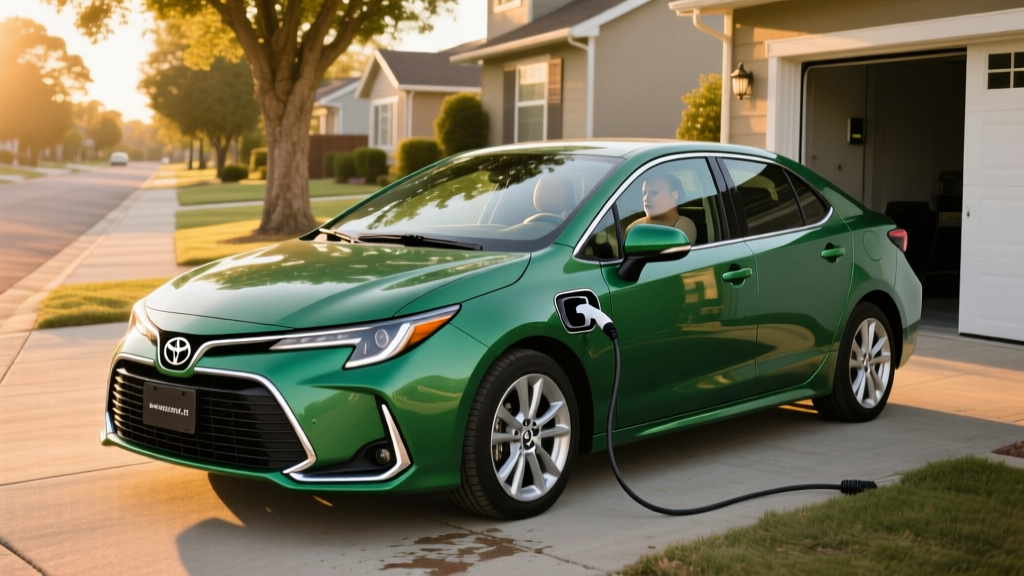
The Corolla Hybrid LE is a self-charging hybrid. It has a small lithium-ion battery (~1.3 kWh) that charges exclusively through regenerative braking and the gasoline engine. You never plug it in. The electric motor assists the engine during acceleration and enables brief electric-only driving at low speeds, but there is no meaningful electric-only range.
Plug-In Hybrid (PHEV) — e.g., Toyota Prius Prime
A PHEV has a larger battery (typically 10–18 kWh) that you can plug in, giving 25–44 miles of electric-only range before the gas engine kicks in. PHEVs are ideal for short commutes with home charging but cost more upfront.
Battery Electric Vehicle (BEV) — e.g., Tesla Model 3, Chevy Bolt
A full EV has no gas engine. Range comes entirely from a large battery (50–80+ kWh). EVs offer the lowest per-mile energy cost but require access to home or public charging and carry higher purchase prices.
Bottom line: If you don't have reliable access to a plug (apartment dweller, street parker, frequent road-tripper), the HEV approach of the Corolla Hybrid LE removes every charging concern while still cutting your fuel bill roughly in half versus a comparable gas-only compact sedan.
Fuel Economy: EPA Numbers vs Real-World MPG
The EPA rates the 2023 Corolla Hybrid LE at 53 MPG city / 46 MPG highway / 50 MPG combined when equipped with AWD. The FWD variant (not offered on the LE in 2023 — AWD is standard on the Hybrid LE) would be slightly higher, but the all-weather traction trade-off is minimal at only 1–2 MPG.
| Driving Cycle | EPA MPG | Real-World Expectation |
|---|---|---|
| City | 53 | 52–58 MPG (hybrids often exceed EPA in stop-and-go) |
| Highway | 46 | 42–47 MPG (aerodynamic drag reduces hybrid advantage at 70+ mph) |
| Combined | 50 | 47–52 MPG (mixed driving) |
Real-World MPG Insight
Toyota hybrids consistently match or beat their EPA city estimates because regenerative braking recovers more energy in stop-and-go traffic. On fueleconomy.gov, owner-reported averages for the Corolla Hybrid cluster around 48–52 MPG combined. In cold weather (below 30°F), expect a 5–10% drop as the engine runs more often for cabin heat. Highway-heavy commuters at 75+ mph will see the low-to-mid 40s.
At $3.40/gallon (national average regular unleaded), 50 MPG translates to roughly $0.068 per mile in fuel. A comparable gas-only Corolla LE (33 MPG combined) would cost about $0.103/mile — a savings of ~$525 per year at 15,000 miles driven.
Powertrain Deep Dive: How 138 HP Gets 50 MPG
The 2023 Corolla Hybrid LE uses Toyota's fifth-generation hybrid system, which debuted in the redesigned 2023 Prius. Here's the hardware:
- Gasoline engine: 1.8-liter Atkinson-cycle 4-cylinder producing 96 hp and 105 lb-ft of torque. The Atkinson cycle sacrifices peak power for thermal efficiency (~40%).
- Front electric motor: Integrated into the transaxle, providing torque fill during acceleration and acting as a generator during braking.
- Rear electric motor: A small motor on the rear axle provides electronic AWD — no mechanical driveshaft. It engages on-demand for traction in rain, snow, or hard launches.
- Combined system output: 138 hp. Toyota's hybrid system blends engine and motor power seamlessly; you won't feel a distinct "EV mode" the way you would in a PHEV.
- Hybrid battery: ~1.3 kWh lithium-ion pack located under the rear seat. This is a small buffer battery — it stores energy recovered from braking and feeds the electric motors. It is not user-chargeable via a plug.
The 0–60 mph time sits around 9.0 seconds. That's adequate for merging and passing but not quick by modern standards. If performance matters, the Corolla Hybrid isn't the play — but neither is fuel economy at this level ever paired with sportiness.
Pricing, Trims, and Tax Credit Eligibility
The 2023 Toyota Corolla Hybrid LE carried a base MSRP of $23,645 including destination. Key standard features include Toyota Safety Sense 3.0 (adaptive cruise, lane-keeping, automatic emergency braking), an 8-inch touchscreen with wireless Apple CarPlay and Android Auto, and the electronic AWD system.
Higher trims (SE, XLE) add features like sport-tuned suspension, larger wheels, and upgraded interiors but sacrifice 1–3 MPG due to weight and rolling resistance.
Does the Corolla Hybrid LE Qualify for a Federal Tax Credit?
No. The IRS §30D Clean Vehicle Credit applies only to plug-in electric vehicles — battery electric vehicles (BEVs) and plug-in hybrids (PHEVs) with a minimum battery capacity of 7 kWh. Because the Corolla Hybrid LE is a conventional HEV with a ~1.3 kWh battery and no plug, it does not qualify for the federal credit.
Some states and utilities offer small rebates for conventional hybrids, but these vary widely. Check your state energy office or utility provider for current programs.
Hybrid Battery Longevity, Warranty, and Replacement Cost
This is the top concern for hybrid buyers, and it's where Toyota's track record is strongest.
Toyota Hybrid Battery Warranty
Toyota covers the hybrid battery in the 2023 Corolla Hybrid LE for 10 years or 150,000 miles, whichever comes first. This applies in all 50 states (previously, California-emissions states received 10/150k while others got 8/100k — Toyota unified the coverage starting with the 2020 model year).
How long do Toyota hybrid batteries actually last? Data from Prius fleets (which share similar hybrid architecture) shows most batteries lasting 150,000–200,000+ miles before significant degradation. The small 1.3 kWh pack in the Corolla Hybrid operates in a narrow state-of-charge window (roughly 40–80%), which dramatically reduces stress on the cells compared to a full EV battery that cycles from 10–90%.
Replacement cost if out of warranty: A new OEM hybrid battery for the Corolla Hybrid runs approximately $2,000–$3,500 installed at a dealership. Third-party reconditioned packs are available for $1,000–$2,000. Given the 10-year/150k warranty and Toyota's reliability history, most original owners will never face this expense.
Who Should Buy the Corolla Hybrid LE — and Who Shouldn't
Choose the Corolla Hybrid LE If:
- You drive 12,000–20,000 miles/year and want maximum fuel savings without plugging in
- You live in an apartment or park on the street with no charging access
- You want a proven, low-risk powertrain with a decade-long battery warranty
- You regularly drive in cold climates where EV range loss is a concern
- Your budget is under $28,000 and you want AWD standard
Look Elsewhere If:
- You have home charging and a short commute — a PHEV (Prius Prime) could eliminate most gas use
- You want strong acceleration (consider the Hyundai Elantra N Line or a sport EV)
- You want to go fully electric — the Chevy Bolt, Hyundai Ioniq 5, or Tesla Model 3 offer 250+ miles of EV range
- You need a spacious rear seat or large trunk (Corolla's rear legroom is tight at 34.8 inches)
Corolla Hybrid LE vs the Competition
| Vehicle | EPA Combined MPG | HP | Base MSRP | AWD |
|---|---|---|---|---|
| Toyota Corolla Hybrid LE | 50 | 138 | $23,645 | Standard |
| Hyundai Elantra Hybrid Blue | 54 | 139 | $25,900 | No |
| Honda Civic Hybrid (2024+) | 49 | 200 | $29,845 | No |
The Elantra Hybrid Blue edges out the Corolla on EPA MPG but lacks AWD. The Civic Hybrid (redesigned for 2024) offers substantially more power but at a higher price. The Corolla Hybrid LE's combination of 50 MPG, standard AWD, and sub-$24,000 pricing makes it a uniquely practical value.
Frequently Asked Questions
How many MPG does the 2023 Toyota Corolla Hybrid LE get?
The EPA rates it at 53 city / 46 highway / 50 combined. Real-world drivers report 47–52 MPG in mixed driving, with city-heavy commutes sometimes exceeding the EPA estimate thanks to regenerative braking.
Does the Corolla Hybrid need to be plugged in?
No. The Corolla Hybrid LE is a conventional hybrid (HEV). It charges its own small battery through regenerative braking and the gasoline engine. There is no plug, no charging cable, and no electric-only range to manage.
How far can the Corolla Hybrid drive on electric power alone?
Only very short distances at low speeds (under ~15 mph, such as creeping through a parking lot). The 1.3 kWh battery is too small for sustained electric-only driving. If electric-only range is a priority, look at a PHEV like the Prius Prime (44 miles EV) or a full EV.
Is the Corolla Hybrid reliable?
Toyota's hybrid system is among the most proven in the industry, with over 25 years of production since the original 1997 Prius. NHTSA and consumer reliability surveys consistently rate Toyota hybrids at or near the top of their segments. The hybrid battery carries a 10-year/150,000-mile warranty.
Does the 2023 Corolla Hybrid LE qualify for any federal tax credit?
No. The IRS §30D credit requires a vehicle to be a plug-in EV or PHEV with at least 7 kWh of battery capacity. The Corolla Hybrid's ~1.3 kWh battery and lack of a plug disqualify it. Check your state and utility for possible hybrid rebates.
What does it cost to replace the hybrid battery?
Out of warranty, expect $2,000–$3,500 for a new OEM battery at a Toyota dealer, or $1,000–$2,000 for a reconditioned unit. However, Toyota hybrid batteries routinely last 150,000–200,000+ miles, and the 10-year/150k warranty covers most original owners.
Hybrid vs PHEV vs EV — which should I choose?
HEV (Corolla Hybrid): Best if you can't plug in at home and want zero-hassle fuel savings.
PHEV (Prius Prime): Best if you have home charging and a commute under 40 miles — you'll rarely use gas.
BEV (Model 3, Bolt): Best if you want the lowest per-mile cost, have reliable charging access, and are ready to go gas-free.
Sources: EPA fueleconomy.gov, IRS §30D Clean Vehicle Credit, NHTSA, Toyota Motor North America press materials.