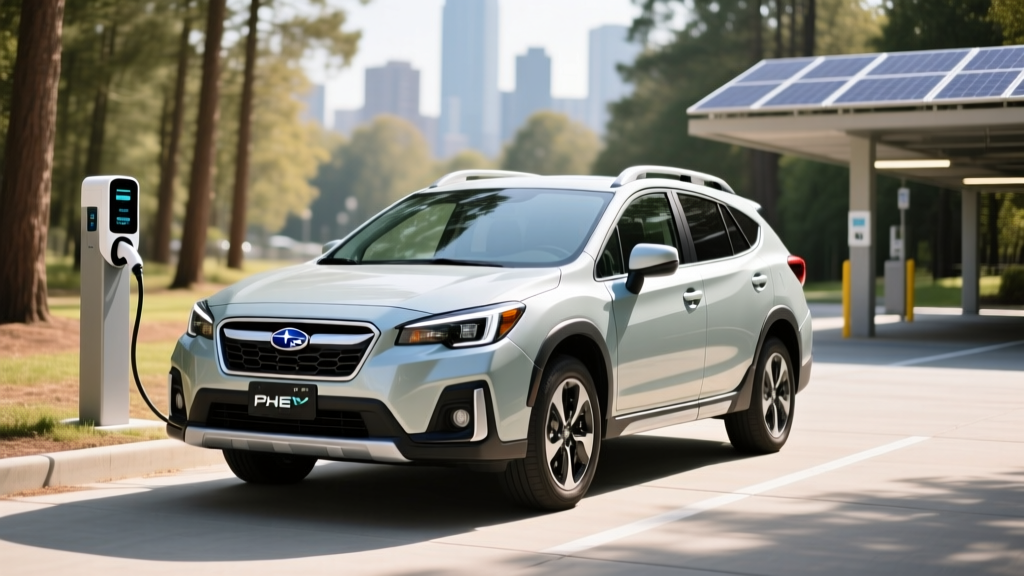
The Subaru Crosstrek Hybrid occupies a narrow but important niche: it's one of the few plug-in hybrid (PHEV) subcompact crossovers that pairs genuine electric-only commuting with Subaru's trademark all-wheel-drive capability. For 2023, the Crosstrek Hybrid returned with a Toyota-sourced powertrain, modest electric range, and a price tag that demands careful evaluation against both its gas-only sibling and the growing field of full EVs. This guide dissects every critical spec — from real-world MPG to battery warranty — so you can decide whether this PHEV fits your garage.
2023 Subaru Crosstrek Hybrid: Core Specifications
| Spec | Value |
|---|---|
| Powertrain Type | Plug-in Hybrid (PHEV) |
| Engine | 2.0L 4-cylinder Boxer + 2 electric motors |
| Combined System Horsepower | 148 hp |
| Transmission | CVT (continuously variable) |
| Drivetrain | Symmetrical All-Wheel Drive (standard) |
| Battery Capacity | 8.8 kWh (lithium-ion) |
| EPA Electric-Only Range | 17 miles |
| EPA Combined Range (EV + Gas) | 480 miles |
| EPA MPG (Gas-Only Mode) | 35 combined (34 city / 36 highway) |
| MPGe (EV + Gas Combined) | 90 MPGe |
| Level 2 Charging Time (0–100%) | ~2 hours at 240V / 3.3 kW |
| DC Fast Charging | Not supported |
| 0–60 mph | ~8.5 seconds (estimated) |
| Cargo Volume | 43.1 cu ft (rear seats folded) |
| Base MSRP (2023) | $36,845 (single trim) |
| Battery Warranty | 8 years / 100,000 miles |
HEV vs PHEV: What the Crosstrek Hybrid Actually Is
Before examining the numbers, it's essential to understand what you're buying. The 2023 Crosstrek Hybrid is a plug-in hybrid (PHEV), not a conventional hybrid (HEV). Here's the practical difference:
| Feature | Conventional Hybrid (HEV) | Plug-in Hybrid (PHEV) — Crosstrek Hybrid |
|---|---|---|
| Plug-in charging | No — charges via regenerative braking and engine | Yes — plug in to access electric-only range |
| Electric-only range | None (or under 1 mile at low speed) | 17 miles EPA |
| Battery size | Small (~1–2 kWh) | Larger (8.8 kWh) |
| Gas engine | Always supplements electric drive | Can operate engine-free for short trips |
| Tax credit eligibility | None (federal) | Historically eligible (see §30D details below) |
The Crosstrek Hybrid can drive up to 17 miles on electricity alone before the 2.0L Boxer engine engages. If you never plug it in, it functions as a conventional hybrid — but you're paying a premium for battery capacity you never use. Plugging in is what unlocks the PHEV's value.
Fuel Economy: EPA Ratings vs Real-World MPG
| Mode | City | Highway | Combined |
|---|---|---|---|
| Electric-Only (EV Mode) | 120 MPGe city / 99 MPGe highway / 105 MPGe combined (EPA) | ||
| Hybrid (Gas-Only, Battery Depleted) | 34 MPG | 36 MPG | 35 MPG |
| Blended (EV + Gas, Full Charge Start) | 90 MPGe combined | ||
According to fueleconomy.gov, the 2023 Crosstrek Hybrid achieves 35 MPG combined when operating purely as a hybrid (battery depleted). That's a meaningful improvement over the gas-only Crosstrek 2.0L, which rates at 30 MPG combined.
Real-world expectations: PHEVs typically exceed their EPA city ratings in stop-and-go driving because regenerative braking recaptures energy that a gas car wastes as heat. Owners who charge nightly and commute under 17 miles may go weeks without visiting a gas station. However, highway-heavy driving at sustained speeds depletes the battery quickly, and once it's gone, you're operating at 35 MPG — respectable, but not class-leading. In cold weather (below 30°F), expect the electric-only range to drop by 20–30% due to cabin heating demands and reduced battery efficiency. The engine will also engage more readily to provide heat.
Electric-Only Range and Charging: The 17-Mile Reality
The 8.8 kWh lithium-ion battery delivers an EPA-rated 17 miles of electric-only range. In practice, owners report between 14 and 20 miles depending on temperature, terrain, and driving style. Gentle city driving in mild weather can stretch it to 20 miles; aggressive acceleration or winter cold compresses it to 12–14 miles.
Charging the Crosstrek Hybrid is straightforward but limited:
- Level 1 (120V household outlet): Approximately 5 hours from empty to full. Adequate for overnight charging if your commute is short.
- Level 2 (240V home or public charger): Approximately 2 hours at the vehicle's maximum acceptance rate of 3.3 kW. This is slow by PHEV standards — the Toyota RAV4 Prime, by comparison, charges at up to 6.6 kW.
- DC Fast Charging: Not available. The Crosstrek Hybrid uses a J1772 connector for AC charging only. There is no CCS or CHAdeMO port.
The 3.3 kW onboard charger is the Crosstrek Hybrid's most significant charging limitation. Even at a public Level 2 station, you're bottlenecked by the car's hardware, not the charger's output. For a PHEV with only 17 miles of range, this isn't a dealbreaker — you're adding roughly 8–10 miles of range per hour of Level 2 charging — but it does mean mid-day top-ups are less practical than in PHEVs with faster onboard chargers.
Powertrain and Performance
The Crosstrek Hybrid's powertrain is sourced from Toyota's hybrid system, adapted for Subaru's Boxer engine layout:
- Engine: 2.0-liter horizontally opposed (Boxer) 4-cylinder, producing 137 hp on its own
- Electric Motors: Two motor-generators integrated into the transaxle — one primarily for propulsion (118 hp peak), one for starting the engine and generating electricity
- Combined System Output: 148 hp (net, accounting for power overlap between engine and motors)
- All-Wheel Drive: Subaru's Symmetrical AWD is standard. Unlike some PHEV competitors that use the rear motor for AWD (e.g., Toyota RAV4 Prime), the Crosstrek Hybrid uses a mechanical AWD system linked to the transaxle.
Performance is adequate rather than exciting. The estimated 0–60 mph time of ~8.5 seconds is slower than the gas-only Crosstrek 2.5L (which hits 60 in about 8.0 seconds). The PHEV carries roughly 400 pounds of additional weight from the battery pack and electric motors, and you feel it during highway merges. However, in EV mode, the instant torque from the electric motor makes city driving feel responsive and smooth, with no transmission shift shock thanks to the CVT.
Pricing, Trims, and Tax Credit Eligibility
The 2023 Crosstrek Hybrid was offered in a single, well-equipped trim at an MSRP of $36,845 (including destination). That placed it approximately $11,000 above the base gas-only Crosstrek and roughly $5,000 above the top-trim Crosstrek Limited.
Standard equipment included EyeSight driver-assist technology (adaptive cruise control, lane-keep assist, pre-collision braking), an 8-inch touchscreen with Apple CarPlay and Android Auto, heated front seats, keyless entry with push-button start, and roof rails.
Federal Tax Credit (§30D) — Important Update
The 2023 Subaru Crosstrek Hybrid no longer qualifies for the federal §30D new clean vehicle tax credit under the post-Inflation Reduction Act rules. The battery sourcing and critical mineral requirements enacted in 2023 eliminated most PHEVs with Toyota-sourced battery components from eligibility. Subaru discontinued the Crosstrek Hybrid after the 2023 model year, so no new units are available for the 2024–2026 model years.
For buyers considering a used 2023 Crosstrek Hybrid, the §25E used clean vehicle credit may apply: up to $4,000 or 30% of the sale price (whichever is lower), subject to income caps ($75,000 single / $150,000 joint) and a dealer sale-price cap of $25,000. Consult the IRS §25E page and a tax professional to confirm eligibility based on your specific purchase price and filing status.
Battery Warranty, Reliability, and Replacement Costs
High-Voltage Battery Warranty: 8 years / 100,000 miles (whichever comes first), covering defects and capacity loss below a specified threshold. This warranty is standard across Subaru's hybrid and PHEV lineup and aligns with the industry norm for hybrid battery coverage.
The Toyota-derived hybrid system in the Crosstrek Hybrid benefits from decades of proven reliability. Toyota's hybrid synergy drive architecture has demonstrated exceptional longevity — Prius batteries routinely exceed 150,000 miles with minimal degradation. The Crosstrek Hybrid's smaller 8.8 kWh pack is less stressed than a full EV battery, as it operates within a narrower state-of-charge window and is buffered by the engine.
Battery replacement cost: If the high-voltage battery fails outside warranty, expect a replacement cost between $3,500 and $5,500 including parts and labor at a Subaru dealer. Independent hybrid specialists may offer refurbished packs for $2,000–$3,500. However, given the proven durability of this Toyota-sourced system and the 8-year/100,000-mile warranty, out-of-pocket battery replacement is uncommon within the first decade of ownership.
The conventional 12V auxiliary battery (which powers lights, infotainment, and computers) is a separate maintenance item and typically lasts 3–5 years, like any vehicle.
Crosstrek Hybrid vs Full EV vs Gas Crosstrek: Which Fits You?
Choose the 2023 Crosstrek Hybrid (PHEV) if:
- Your daily commute is under 20 miles and you can charge at home nightly
- You need AWD for snow, gravel, or light off-road use
- You want to reduce gas consumption without committing to a full EV
- You take occasional long road trips and don't want to plan around charging infrastructure
- You value Subaru's ground clearance (8.7 inches) and standard EyeSight safety suite
Choose a full EV (e.g., Hyundai Ioniq 5, Tesla Model Y) if:
- You have reliable home Level 2 charging
- Your daily driving is under 200 miles and you're comfortable with road-trip charging planning
- You want lower per-mile fuel costs (electricity is cheaper than gas in most markets)
- You want access to current federal tax credits (up to $7,500 for eligible new EVs under §30D)
- You want stronger acceleration and a quieter, smoother driving experience
Choose the gas-only Crosstrek (2.5L) if:
- You cannot charge at home or at work
- Your budget is under $30,000
- Your annual mileage is low enough that fuel savings won't offset the PHEV premium
- You want a simpler powertrain with no high-voltage system to maintain long-term
The math matters. At $36,845, the 2023 Crosstrek Hybrid cost roughly $11,000 more than a base gas Crosstrek. If you drive 12,000 miles per year at 35 MPG (PHEV in hybrid mode) versus 30 MPG (gas model), you save approximately 11 gallons per year — about $38 at $3.50/gallon. The fuel savings alone will never close an $11,000 gap. The PHEV's value lies in the electric-only commuting: if your 17-mile EV range covers your daily driving, you might use only 200–300 gallons of gas annually instead of 400, saving closer to $350–$700 per year. Over 8 years, that's $2,800–$5,600 in fuel savings — still short of the purchase premium, but closer. The environmental benefit and the satisfaction of electric commuting are the intangible returns.
Pros
- Standard AWD with 8.7 inches of ground clearance
- 17-mile EV range covers many daily commutes
- Proven Toyota-sourced hybrid powertrain reliability
- 35 MPG in hybrid mode beats gas Crosstrek by 5 MPG
- Comprehensive EyeSight safety suite included
- No range anxiety — gas engine covers long trips
Cons
- $36,845 MSRP is steep for a subcompact crossover
- Slow 3.3 kW Level 2 charging — no DC fast charge
- 17-mile EV range is below PHEV competitors (RAV4 Prime: 42 mi)
- No longer eligible for federal §30D tax credit
- Discontinued after 2023 — limited future availability
- Added weight reduces performance vs gas Crosstrek 2.5L
Frequently Asked Questions
How many MPG does the 2023 Subaru Crosstrek Hybrid get?
The EPA rates the Crosstrek Hybrid at 35 MPG combined (34 city / 36 highway) when operating in hybrid mode with a depleted battery. In blended mode (starting with a full charge), it achieves 90 MPGe combined. Real-world city driving often exceeds the EPA city rating due to regenerative braking, while sustained highway driving may fall slightly below the highway estimate.
How far can the Crosstrek Hybrid go on electric only?
The EPA-rated electric-only range is 17 miles. Real-world results vary between 14 and 20 miles depending on temperature, driving style, and terrain. Cold weather (below 30°F) typically reduces this to 12–14 miles due to cabin heating demands and lower battery efficiency.
Does the 2023 Crosstrek Hybrid qualify for a tax credit?
No. The 2023 Crosstrek Hybrid does not qualify for the federal §30D new clean vehicle tax credit under current IRS rules due to battery component sourcing requirements. However, buyers purchasing a used 2023 model may qualify for the §25E used clean vehicle credit (up to $4,000), subject to income limits and a sale-price cap of $25,000. Always verify with the IRS and a tax professional.
Is the Crosstrek Hybrid reliable, and what does a battery replacement cost?
The Toyota-sourced hybrid system has an excellent reliability track record. The high-voltage battery is warrantied for 8 years / 100,000 miles. Out-of-warranty replacement costs range from $3,500–$5,500 at a dealer, or $2,000–$3,500 for a refurbished pack from an independent hybrid specialist. Battery failure within the first decade is rare for this powertrain architecture.
Can the Crosstrek Hybrid DC fast charge?
No. The 2023 Crosstrek Hybrid supports only AC charging via a J1772 connector — Level 1 (120V, ~5 hours) or Level 2 (240V at 3.3 kW, ~2 hours). There is no DC fast charging capability. This is typical for PHEVs with smaller batteries.
Should I buy the Crosstrek Hybrid or a full EV?
If you can charge at home and your daily driving stays under 17 miles, the Crosstrek Hybrid lets you commute on electricity while keeping a gas engine for road trips and cold-weather flexibility. If you have home charging and are comfortable planning longer trips around DC fast chargers, a full EV like the Hyundai Ioniq 5 or Tesla Model Y will deliver lower per-mile costs, stronger performance, and access to current federal tax credits up to $7,500.
Why did Subaru discontinue the Crosstrek Hybrid?
Subaru ended production of the Crosstrek Hybrid after the 2023 model year. The decision reflected shifting consumer demand toward full EVs, tightening emissions and battery-sourcing regulations, and Subaru's partnership with Toyota to develop dedicated EV platforms (resulting in the Solterra). For 2024–2026, Subaru's Crosstrek lineup is gas-only, with the Solterra serving as the brand's electric offering.