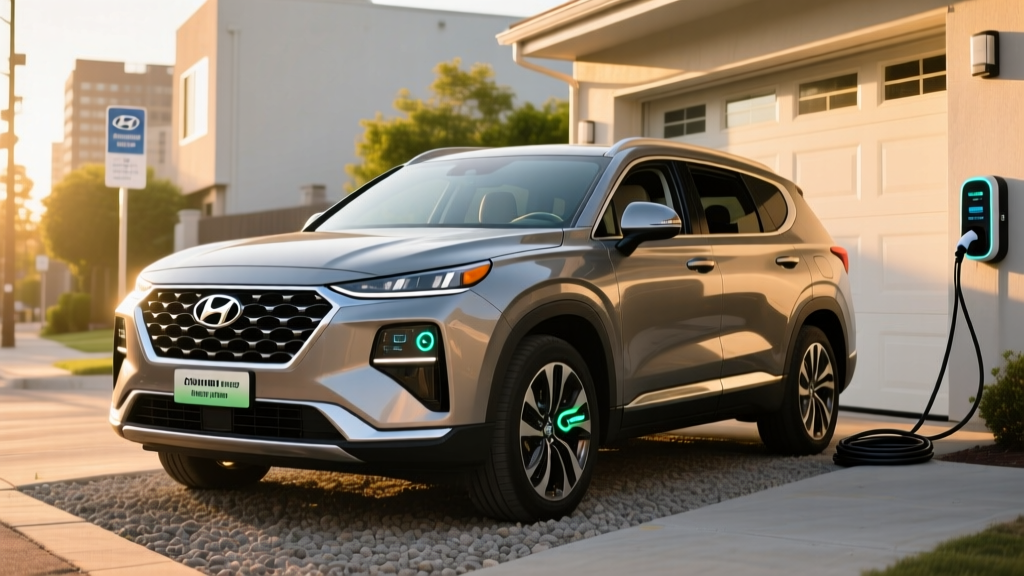
The 2023 Hyundai Santa Fe Plug-In Hybrid occupies a specific niche: a midsize, two-row SUV that can handle daily commutes on electricity alone while retaining a gasoline engine for road trips. With 31 miles of EPA-rated electric-only range and a combined 261 horsepower, it targets buyers who want EV-like city driving without committing to a full battery-electric vehicle. Now that the redesigned 2024+ Santa Fe has arrived with its boxier styling and three-row layout, the 2023 model remains relevant on the used and certified-pre-owned market — often at prices where federal and state incentives still tilt the math in its favor.
This guide covers everything a prospective buyer or current owner needs: real-world MPG versus EPA estimates, electric range under different conditions, charging logistics, powertrain specs, tax credit eligibility under current IRS §30D rules, and how the Santa Fe PHEV stacks up against its conventional hybrid sibling and full EVs.
HEV vs PHEV: Which Santa Fe Hybrid Is Which?
Hyundai sells (and sold) two distinct hybrid versions of the Santa Fe. Confusing them is common, so let's draw a hard line:
| Attribute | Santa Fe Hybrid (HEV) | Santa Fe Plug-In Hybrid (PHEV) |
|---|---|---|
| Plugs in to charge? | No — regenerative braking only | Yes — Level 1 (120V) or Level 2 (240V) |
| Battery capacity | 1.49 kWh | 13.8 kWh (usable ~12.4 kWh) |
| Electric-only driving | Very short, low-speed assists only | 31 miles EPA rated |
| Combined horsepower | 226 HP | 261 HP |
| EPA combined MPG (gas mode) | 34 MPG | 33 MPG |
| MPGe (electric + gas) | N/A | 79 MPGe |
| Drivetrain | AWD | AWD (HTRAC) |
| DC fast charging | N/A | No — AC only |
The conventional HEV never plugs in. It uses a small battery buffer and regenerative braking to assist the gasoline engine, delivering strong fuel economy with zero behavior change. The PHEV, by contrast, carries a substantially larger battery and a more powerful electric motor. When charged, it drives like a quiet EV for roughly 31 miles before the 1.6-liter turbocharged engine seamlessly engages. If you can charge at home or work, the PHEV's operating cost drops dramatically for daily driving under ~30 miles round-trip.
Fuel Economy: EPA Numbers vs Real-World MPG
The EPA rates the 2023 Santa Fe PHEV at 79 MPGe combined when operating in blended electric-gasoline mode, and 33 MPG combined once the battery is depleted and the vehicle runs as a conventional hybrid. Here is the full breakdown:
| Mode | City | Highway | Combined |
|---|---|---|---|
| Blended (MPGe) | 80 MPGe | 78 MPGe | 79 MPGe |
| Charge-depleted (MPG) | 33 MPG | 30 MPG | 33 MPG |
Source: fueleconomy.gov — 2023 Hyundai Santa Fe PHEV
Real-World MPG Observations
Hyundai's hybrid powertrains tend to perform close to or slightly above EPA city estimates in stop-and-go traffic, where regenerative braking recaptures energy most effectively. Owners reporting on Fuelly and similar tracking platforms typically log 32–35 MPG in mixed driving once the battery is depleted, which aligns with the EPA's 33 MPG combined figure.
Highway fuel economy is the weaker point. At sustained 70–80 mph speeds, expect 28–31 MPG — the boxy SUV profile and AWD drivetrain create more drag and mechanical loss than the EPA's 30 MPG highway estimate suggests. In cold weather (below 35°F), the gasoline engine starts more frequently to provide cabin heat, reducing electric-only range and dropping blended MPGe by roughly 15–20%.
Electric-Only Range and Total Range
The EPA rates the 2023 Santa Fe PHEV at 31 miles of electric-only range. That figure assumes moderate temperatures, mixed city/highway driving, and no heavy HVAC use.
- Mild weather, city driving (under 45 mph): 28–33 miles
- Highway driving (65–75 mph): 22–26 miles
- Cold weather (below 35°F), cabin heat on: 18–24 miles
- Hot weather, A/C max: 25–29 miles
The 13.8 kWh battery pack (approximately 12.4 kWh usable) provides enough energy for most daily commutes. Once depleted, the gasoline tank — 14.8 gallons — extends total range to approximately 440–470 miles combined, eliminating range anxiety for road trips.
One practical note: the Santa Fe PHEV uses a heat pump for cabin heating, which is more efficient than resistive heating. This helps preserve electric range in cold weather compared to PHEVs that rely solely on resistive elements, though the gasoline engine will still cycle on in very cold conditions to supplement heat.
Charging: Times, Connectors, and Limitations
The 2023 Santa Fe PHEV charges exclusively via AC — there is no DC fast-charging capability. This is typical for PHEVs in this class, where the relatively small battery makes DC infrastructure unnecessary for most use cases.
| Charging Level | Voltage / Power | 0–100% Time | Connector |
|---|---|---|---|
| Level 1 (household outlet) | 120V / ~1.4 kW | ~10–11 hours | J1772 |
| Level 2 (home/public AC) | 240V / ~7.2 kW | ~2 hours | J1772 |
| DC Fast Charge | Not supported | N/A | N/A |
The onboard charger is rated at 7.2 kW, which is competitive for the PHEV segment. A Level 2 home charger (240V, 32A or higher circuit) will replenish the battery in approximately two hours — meaning you can easily recharge during the workday if your workplace offers Level 2 charging, or overnight at home with a standard Level 2 installation.
On a standard 120V household outlet (Level 1), a full charge takes roughly 10–11 hours. This is viable for overnight charging if your daily electric-only needs are under ~25 miles, as a 10-hour session will add approximately 14 kWh — enough for a near-full charge.
Connector note: The 2023 model uses the J1772 connector standard on all non-Tesla EVs. With the industry's shift to NACS (Tesla's connector), adapters are available, but for AC charging on a PHEV, J1772 remains universally compatible at public Level 2 stations.
Powertrain and Performance Specs
| Specification | Value |
|---|---|
| Engine | 1.6L turbocharged 4-cylinder |
| Engine output | 178 HP / 195 lb-ft torque |
| Electric motor output | 90.5 kW (~121 HP) / 258 lb-ft torque |
| Combined system output | 261 HP / 258 lb-ft torque |
| Transmission | 6-speed automatic |
| Drivetrain | HTRAC AWD (electric motor powers rear axle) |
| Battery capacity | 13.8 kWh gross (~12.4 kWh usable) |
| Battery chemistry | NMC (nickel manganese cobalt) lithium-ion |
| 0–60 mph | ~7.0 seconds (est.) |
| Fuel tank capacity | 14.8 gallons |
| Towing capacity | 2,000 lbs |
The PHEV's 261 combined horsepower gives it a meaningful advantage over the HEV's 226 HP, particularly during highway merging and passing. The electric motor's instant torque (258 lb-ft) means acceleration from a stop is responsive even before the turbo spools up. The 6-speed automatic is a conventional torque-converter unit — not a CVT — which most drivers find more natural and less droning under hard acceleration.
The HTRAC AWD system on the PHEV uses the electric motor to drive the rear wheels, with no mechanical connection between the front engine and rear axle. This provides competent all-weather traction but is not designed for off-road use or heavy towing.
Pricing and Tax Credit Eligibility
The 2023 Santa Fe PHEV was offered in two trims:
| Trim | Original MSRP | Key Features |
|---|---|---|
| SEL Premium | $43,460 | Leather seats, 10.25" nav, Harman Kardon audio, Highway Driving Assist |
| Limited | $47,160 | Panoramic sunroof, ventilated front seats, head-up display, surround-view monitor |
As a 2023 model now appearing on the used and CPO market, expect pricing in the $28,000–$38,000 range depending on mileage, condition, and trim.
Federal Tax Credit (§30D) — Current Rules
The 2023 Santa Fe PHEV was eligible for a partial federal tax credit when new, but eligibility under current IRS §30D rules depends on several factors that change annually:
- MSRP cap: SUVs must be under $80,000 — both trims qualify
- Buyer income cap: AGI must not exceed $150K (single), $225K (head of household), or $300K (joint)
- Battery sourcing: Critical minerals and battery component requirements phase in annually; the Santa Fe PHEV's Korean-sourced battery may not meet current-year thresholds for the full $7,500
- Point-of-sale transfer: As of 2024, eligible buyers can transfer the credit to the dealer for an immediate price reduction at purchase
For used purchases: The §25E used-EV credit offers up to $4,000 or 30% of the sale price (whichever is lower) on eligible used PHEVs priced at $25,000 or less, with lower income caps ($75K single, $150K joint). Check the current IRS §25E page for the latest eligibility details, as battery-sourcing rules and qualifying model lists update frequently.
Always verify your personal eligibility with a tax professional before relying on any credit amount.
Battery Warranty, Reliability, and Replacement Cost
- Coverage: 10 years / 100,000 miles (whichever comes first)
- Capacity retention threshold: Hyundai warrants the battery against dropping below approximately 70% of original capacity during the warranty period
- Transferability: The 10-year/100,000-mile powertrain warranty is not fully transferable to second owners — it reduces to 5 years/60,000 miles upon resale. However, the emissions-related warranty (which covers the battery as an emissions component) may extend further under federal law.
Hyundai's hybrid battery track record is solid. The NMC cells in the Santa Fe PHEV are liquid-cooled, which significantly reduces degradation compared to passively cooled packs. Based on data from Hyundai's earlier PHEV models (Ioniq PHEV, Niro-related platforms), owners typically see 5–10% capacity loss over the first 5 years — meaning the 31-mile electric range might decrease to approximately 28–29 miles after several years of normal use.
Battery replacement cost: If the pack eventually needs replacement outside of warranty, expect a dealer-quoted price of approximately $5,000–$8,000 including parts and labor. Third-party hybrid battery refurbishers may offer rebuilt packs for $3,000–$5,000. However, given the 10-year warranty and the moderate size of the pack, most owners will never face this expense.
The conventional hybrid components (engine, transmission, motor-generator) carry Hyundai's standard 5-year/60,000-mile new-vehicle warranty and 10-year/100,000-mile powertrain warranty. Hyundai's overall reliability ratings for the Santa Fe nameplate have been above average in J.D. Power and Consumer Reports assessments, with the hybrid powertrain showing fewer issues than some competitors' more complex CVT-based systems.
Who Should Choose the Santa Fe PHEV vs an EV or Gas Car?
- Your daily commute is under 35 miles round-trip and you can charge at home
- You take road trips of 200+ miles several times per year and don't want to plan around charging stops
- You want AWD and a midsize SUV without the $50K+ price tag of a full EV
- You live in a region with extreme cold, where EV range loss is a concern
- You want the lowest operating cost for daily driving without committing to a BEV
- You can install a Level 2 charger at home and rarely drive more than 250 miles in a day
- You want zero gasoline expenses and minimal maintenance (no oil changes, no engine)
- You qualify for the full $7,500 federal credit on a qualifying new EV
- You value the quiet, instant-torque driving experience above all else
- You cannot charge at home or at work (apartment, street parking)
- You want maximum simplicity — just fill up with gas and drive
- Your budget is tighter and you want the lower upfront cost of the HEV
- Your daily driving is mostly highway, where PHEV electric range offers less advantage
Pros and Cons
- 31 miles of electric range covers most daily commutes
- 261 HP provides confident highway merging and passing
- 6-speed automatic feels more natural than CVT competitors
- 10-year/100,000-mile battery warranty
- Heat pump improves cold-weather efficiency
- Spacious cargo area (36.4 cu ft behind rear seats)
- Comprehensive ADAS suite standard (Highway Driving Assist, Smart Cruise)
- No DC fast-charging capability
- Electric range drops significantly in cold weather and at highway speeds
- Only two rows — no third-row option (2024+ redesign added one)
- Charge-depleted highway MPG (~28–30) is average for the class
- Limited trim availability on the used market
- Federal tax credit eligibility is uncertain for used purchases above $25K
Frequently Asked Questions
How many MPG does the 2023 Santa Fe Plug-In Hybrid get?
The EPA rates it at 33 MPG combined (33 city / 30 highway) once the battery is depleted. In blended mode with a charged battery, it achieves 79 MPGe combined. Real-world owners typically report 32–35 MPG in mixed driving when operating as a conventional hybrid.
How far can the Santa Fe PHEV go on electric only?
The EPA rates it at 31 miles of electric-only range. In real-world conditions, expect 28–33 miles in mild-weather city driving, 22–26 miles at highway speeds, and 18–24 miles in cold weather with cabin heat active.
Does the 2023 Santa Fe PHEV qualify for a federal tax credit?
When new, it qualified for a partial credit. For current used purchases, the §25E used-EV credit may provide up to $4,000 if the sale price is $25,000 or less and your income falls under the cap. Eligibility depends on battery sourcing requirements that update annually — consult the IRS used vehicle credit page and a tax professional.
Is the Santa Fe PHEV reliable, and what does battery replacement cost?
Hyundai's hybrid powertrains have an above-average reliability record. The battery is covered for 10 years / 100,000 miles and typically loses only 5–10% capacity in the first five years. Out-of-warranty battery replacement runs approximately $5,000–$8,000 at a dealer, though most owners will never need one.
Can the Santa Fe PHEV use DC fast chargers?
No. The 2023 Santa Fe PHEV charges only via AC (Level 1 at 120V or Level 2 at 240V). A full Level 2 charge takes about 2 hours at its 7.2 kW onboard charger rate. This is standard for PHEVs — the smaller battery doesn't require DC fast charging for practical daily use.
What's the difference between the Santa Fe Hybrid and the Plug-In Hybrid?
The conventional HEV cannot plug in, has a 1.49 kWh battery, makes 226 HP, and gets 34 MPG combined. The PHEV plugs in, has a 13.8 kWh battery, makes 261 HP, gets 31 miles of electric-only range, and achieves 33 MPG once the battery is depleted. The PHEV costs more upfront but offers dramatically lower fuel costs for short daily commutes when charged regularly.
Should I buy the Santa Fe PHEV or a full EV?
If you can charge at home and your daily driving stays under 30 miles, the PHEV delivers EV-like daily costs with road-trip flexibility. If you rarely exceed 250 miles between charges and want zero gasoline maintenance, a full EV like the Ioniq 5 or Model Y offers lower long-term operating costs and a smoother driving experience. The PHEV is the pragmatic bridge for buyers who aren't ready to go fully electric.