Quick Verdict: The RAV4 Hybrid Still Sets the Compact SUV Bar
Even three model years later, the 2023 Toyota RAV4 Hybrid remains one of the most efficient non-plug-in compact crossovers on the road. EPA-rated at 41 MPG city, 38 highway, and 40 combined, it undercuts nearly every rival on fuel consumption while delivering standard all-wheel drive and a spacious cargo area. For buyers who want hybrid efficiency without ever plugging in, the RAV4 Hybrid is the default answer — and for good reason.
But real-world mileage tells a more nuanced story. City drivers frequently report 42–44 MPG thanks to Toyota's series-parallel hybrid system leaning heavily on the electric motor at low speeds, while sustained highway cruising and cold-weather operation can drop figures to the mid-30s. Below, we dissect every efficiency number, compare the standard Hybrid (HEV) to the plug-in RAV4 Prime (PHEV), and help you decide which powertrain — or a full battery-electric vehicle — actually fits your driving pattern.
2023 RAV4 Hybrid Miles Per Gallon: EPA Ratings by Trim
Every 2023 RAV4 Hybrid trim shares the same powertrain and therefore the same EPA fuel-economy ratings. There is no efficiency penalty for stepping up from the LE to the Woodland Edition, though the latter's all-terrain tires may shave 1–2 MPG in practice.
| Metric | EPA Rating |
|---|---|
| City MPG | 41 |
| Highway MPG | 38 |
| Combined MPG | 40 |
| Annual Fuel Cost (15,000 mi, $3.50/gal) | ~$1,313 |
| Fuel Type | Regular Unleaded (87 octane) |
Source: fueleconomy.gov — 2023 Toyota RAV4 Hybrid AWD
RAV4 Hybrid (HEV) vs. RAV4 Prime (PHEV): Which Powertrain Fits?
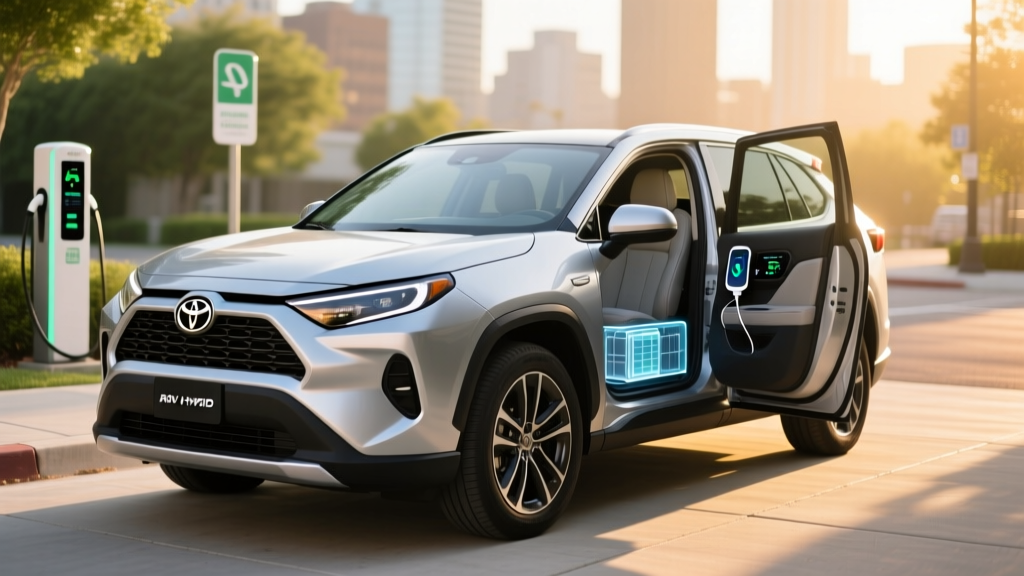
The 2023 RAV4 lineup actually offers two distinct hybrid flavors, and confusing them is a common buyer mistake. The standard RAV4 Hybrid is a conventional hybrid (HEV) — it never plugs in and charges its small battery entirely through regenerative braking and the gasoline engine. The RAV4 Prime is a plug-in hybrid (PHEV) with a much larger battery you charge from a wall outlet or public station, enabling a meaningful electric-only driving range before the gas engine kicks in.
| Attribute | RAV4 Hybrid (HEV) | RAV4 Prime (PHEV) |
|---|---|---|
| Powertrain Type | Series-parallel hybrid | Plug-in hybrid |
| Plugs In? | No | Yes |
| Engine | 2.5L 4-cyl + 3 electric motors | 2.5L 4-cyl + 2 electric motors (front/rear) |
| Combined Horsepower | 219 hp | 302 hp |
| Battery (gross / usable) | ~1.6 kWh / ~1.0 kWh | 18.1 kWh / ~14.9 kWh |
| Electric-Only Range | <1 mile at low speed | 42 miles (EPA) |
| Total Combined Range | ~580 miles | ~600 miles (electric + gas) |
| Combined MPG / MPGe | 40 MPG | 94 MPGe (EV mode) / 38 MPG (gas mode) |
| 0–60 MPH | 7.4 seconds | 5.7 seconds |
| Level 2 Charge Time (0–100%) | N/A (self-charging) | ~2.5 hours (240V, 32A) |
| DC Fast Charging | No | No |
| Starting MSRP (2023) | $30,765 (LE) | $43,090 (SE) |
| Federal Tax Credit (§30D) | Not eligible | Not eligible (phased out for Toyota) |
When the Standard Hybrid (HEV) Makes Sense
- You don't have reliable access to a plug at home or work.
- Your commute is longer than 42 miles and mostly highway — the Prime's EV advantage shrinks on long trips.
- You want the lowest purchase price and lowest complexity.
- You drive 12,000–15,000 miles per year and want steady 40 MPG without behavioral changes.
When the RAV4 Prime (PHEV) Makes Sense
- Your daily round-trip commute is under 42 miles and you can charge at home overnight.
- You want near-EV operating costs on weekdays but road-trip flexibility on weekends.
- You value the 302-hp performance bump — the Prime is the quickest RAV4 Toyota makes.
- Local utility rates make electricity significantly cheaper per mile than gasoline.
Powertrain Deep Dive: What Makes the RAV4 Hybrid Tick
The 2023 RAV4 Hybrid pairs a 2.5-liter Dynamic Force four-cylinder engine (176 hp, 163 lb-ft) with Toyota's fourth-generation hybrid transaxle. Two electric motor-generators sit in the front transaxle, and a third independent rear motor provides electronic all-wheel drive (AWD-i). Combined system output is 219 horsepower.
Unlike simpler parallel-hybrid systems, Toyota's series-parallel design can run the engine and motors in multiple combinations: pure EV mode at low speeds, engine-only at steady highway cruise, or blended power under hard acceleration. The result is a system that continuously optimizes for efficiency. The 1.6 kWh nickel-metal hydride (NiMH) traction battery is small by EV standards — it stores only enough energy for brief electric-only bursts — but it's purpose-built for thousands of shallow charge-discharge cycles rather than deep cycling.
The AWD-i rear motor engages automatically during acceleration, slippery conditions, or when the front wheels lose traction. It disconnects during steady cruising to eliminate drag, which is why the RAV4 Hybrid achieves the same EPA ratings with AWD as many competitors manage with front-wheel drive only.
Battery Warranty, Lifespan, and Replacement Costs
How Long Do Toyota Hybrid Batteries Actually Last?
Real-world data from over two decades of Toyota hybrids (dating back to the 2001 Prius) suggests that NiMH hybrid batteries routinely last 150,000–200,000+ miles before requiring replacement. The shallow cycling strategy — the car never fully charges or fully depletes the pack — dramatically reduces stress on the cells. Many first-generation Prius taxis surpassed 300,000 miles on the original battery.
For the RAV4 Hybrid, the battery management system keeps the state of charge between roughly 40% and 80%, which is the sweet spot for NiMH longevity. You'll never see a full-charge indicator or an empty indicator on the dash by design.
Replacement Cost If Out of Warranty
If a hybrid battery does need replacement after the warranty expires, expect the following:
- New OEM Toyota battery: $3,000–$4,500 (parts + labor at a dealership)
- Refurbished/remanufactured battery: $1,500–$2,500 (aftermarket specialists)
- Individual cell module replacement: $500–$1,200 (if only 1–2 of the 34 modules have failed — requires a specialist shop)
Given the 10-year/150,000-mile warranty and Toyota's track record, battery replacement is a low-probability event for most original owners. It becomes more relevant if you're buying a high-mileage used RAV4 Hybrid outside the warranty window.
Pricing, Trims, and Tax Credit Eligibility
The 2023 RAV4 Hybrid was offered across six trims. Here's the original MSRP breakdown:
| Trim | MSRP (incl. destination) |
|---|---|
| LE | $30,765 |
| XLE | $32,250 |
| XLE Premium | $34,245 |
| SE | $34,960 |
| XSE | $36,145 |
| Limited | $38,600 |
| Woodland Edition | $35,585 |
Federal Tax Credit Status
The standard RAV4 Hybrid (HEV) does not qualify for the federal §30D clean vehicle tax credit. Under current IRS rules, conventional hybrids that cannot be plugged in are categorically excluded — the credit applies only to plug-in electric vehicles (BEVs and PHEVs) that meet battery capacity, sourcing, MSRP, and buyer income requirements.
The RAV4 Prime (PHEV) would normally be a candidate, but Toyota hit the 200,000-vehicle manufacturer cap under the original credit structure, meaning the Prime is also not eligible for the federal credit. Some state-level incentives may still apply to the Prime — check your state's energy office or the AFDC state incentive database for specifics.
RAV4 Hybrid vs. Full EV: Which Is Right for You?
The decision between the RAV4 Hybrid and a fully electric compact SUV (such as the Hyundai Ioniq 5, Tesla Model Y, or Ford Mustang Mach-E) comes down to three variables: charging access, driving patterns, and budget.
- You live in an apartment or street-park and cannot install a home charger.
- You regularly drive 300+ miles in a single day (road trips, rural routes).
- You live in an area with sparse public DC fast-charging infrastructure.
- Your budget is under $35,000 and you want a new AWD crossover.
- You want zero behavior change — just fill up with gas and go.
- You can install a Level 2 (240V) home charger and start every day with a full battery.
- Your daily driving is under 250 miles and you can plan DC fast-charge stops on road trips.
- You want the lowest per-mile fuel cost (electricity at $0.13/kWh ≈ $4.00/gallon equivalent).
- You qualify for the §30D federal tax credit on an eligible BEV (up to $7,500 with point-of-sale transfer).
- You want to eliminate oil changes, transmission fluid, and most drivetrain maintenance.
For the average US driver covering 37 miles per day with home charging access, a full EV delivers lower operating costs. But for the roughly 30% of US households without reliable home-charging options, the RAV4 Hybrid offers the best of both worlds: dramatically better fuel economy than a gas-only SUV with zero infrastructure dependency.
Reliability Ratings and Ownership Costs
Toyota's hybrid powertrain is among the most proven in the industry. The RAV4 Hybrid earned a Top Safety Pick designation from the Insurance Institute for Highway Safety (IIHS) when equipped with LED projector headlights (available on XLE and above). NHTSA awarded it a 5-star overall safety rating.
On the reliability front, Consumer Reports has consistently rated the RAV4 Hybrid as one of the most reliable compact SUVs, with the hybrid system itself being one of Toyota's least problematic components. The eCVT (planetary gearset) has no belts, clutches, or traditional transmission fluid to replace, and regenerative braking significantly extends brake pad life — many owners report 70,000+ miles on original brake pads.
Estimated 5-Year Ownership Cost Comparison
| Cost Category | RAV4 Hybrid (40 MPG) | RAV4 Gas AWD (28 MPG) | Comparable EV (3.5 mi/kWh) |
|---|---|---|---|
| Fuel / Energy | $6,563 (gas at $3.50/gal) | $9,375 (gas at $3.50/gal) | $2,893 (elec at $0.135/kWh) |
| Maintenance (est.) | $2,200 | $2,800 | $1,400 |
| Savings vs. Gas RAV4 | +$3,412 | Baseline | +$7,882 |
The RAV4 Hybrid saves roughly $3,400 in fuel and maintenance over five years compared to the gas-only RAV4 AWD. A comparable EV saves nearly $7,900 over the same period — but carries a higher purchase price and requires home-charging infrastructure.
Frequently Asked Questions
How many MPG does the 2023 RAV4 Hybrid get in real-world driving?
The EPA rates it at 41 city / 38 highway / 40 combined. In real-world use, city-heavy drivers often see 42–44 MPG because the hybrid system favors electric motor operation at low speeds. Highway-heavy drivers at 70–80 MPH typically see 35–38 MPG. Cold weather below 20°F can reduce combined figures by 10–15% as the engine runs more frequently for cabin heat.
Does the RAV4 Hybrid need to be plugged in?
No. The standard RAV4 Hybrid is a conventional hybrid (HEV). It charges its battery entirely through regenerative braking and the gasoline engine. You never plug it in. Only the RAV4 Prime (PHEV) requires plugging in to access its 42-mile electric-only range.
How far can the RAV4 Prime go on electric power alone?
The 2023 RAV4 Prime has an EPA-rated 42 miles of electric-only range. In mild weather with moderate speeds, some drivers report 45–48 miles. In cold weather or at highway speeds, expect 30–36 miles before the gasoline engine engages.
Is the RAV4 Hybrid reliable? What about battery replacement cost?
Toyota's hybrid system is one of the most reliable powertrains on the market, with two decades of proven durability. The hybrid battery is warranted for 10 years/150,000 miles. Out-of-warranty replacement runs $3,000–$4,500 for a new OEM battery, but most batteries last well beyond 150,000 miles with Toyota's shallow-cycling management strategy.
Does the 2023 RAV4 Hybrid qualify for any tax credits?
No. Conventional hybrids (HEVs) are not eligible for the federal §30D clean vehicle credit, which applies only to plug-in vehicles. The RAV4 Prime PHEV is also ineligible because Toyota surpassed the manufacturer cap. Check your state's incentive programs — some states offer rebates for PHEVs even when the federal credit is unavailable. Consult a tax professional for personal eligibility guidance.
What is the RAV4 Hybrid's towing capacity?
The 2023 RAV4 Hybrid is rated to tow up to 1,750 pounds across all trims. This is adequate for a small utility trailer or a pair of dirt bikes but not sufficient for most boat or camper trailers. The gas-only RAV4 with the Adventure or TRD Off-Road trim can tow up to 3,500 pounds.