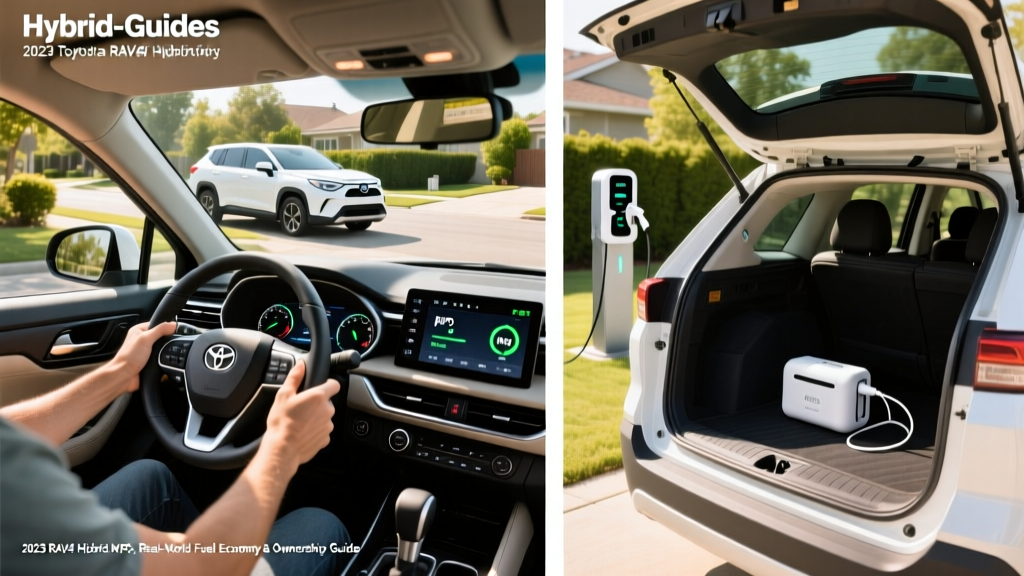
If you've been searching for 2023 RAV4 Hybrid MPG numbers, you've likely seen the EPA sticker: 41 city, 38 highway, 40 combined for the all-wheel-drive LE trim. But sticker numbers only tell part of the story. Toyota's fifth-generation hybrid system behaves differently in stop-and-go traffic versus open highway, and real-world results vary significantly based on driving style, climate, and trim level.
This guide breaks down every efficiency figure, compares the conventional RAV4 Hybrid (HEV) against the plug-in RAV4 Prime (PHEV), and gives you the ownership data — battery warranty, reliability track record, and total cost context — that actually matters when you're deciding between a hybrid, a PHEV, or a full battery-electric vehicle.
2023 RAV4 Hybrid MPG: EPA Ratings by Trim
The 2023 Toyota RAV4 Hybrid comes in six trims (LE, XLE, XLE Premium, SE, XSE, and Limited), all sharing the same 2.5-liter four-cylinder hybrid powertrain and electronic all-wheel drive (AWD-i). Because every trim uses AWD, the MPG spread is narrow — but it does exist.
| Trim | City MPG | Highway MPG | Combined MPG | Fuel Tank (gal) | Est. Total Range |
|---|---|---|---|---|---|
| LE | 41 | 38 | 40 | 14.5 | ~580 mi |
| XLE / XLE Premium | 41 | 38 | 40 | 14.5 | ~580 mi |
| SE | 41 | 38 | 40 | 14.5 | ~580 mi |
| XSE | 41 | 38 | 40 | 14.5 | ~580 mi |
| Limited | 41 | 38 | 40 | 14.5 | ~580 mi |
Source: EPA fueleconomy.gov
All trims share the same 40 MPG combined rating. The only variation comes if you opt for the RAV4 Hybrid Woodland Edition, which wears more aggressive all-terrain tires and carries a slightly lower rating of 39 MPG combined (38 city / 35 highway) due to increased rolling resistance.
Real-World MPG: What Owners Actually Report
EPA test cycles are conducted on a dynamometer under controlled conditions. Real-world driving introduces variables the sticker can't capture. Here's what the data shows for the 2023 RAV4 Hybrid in practice:
- City / suburban driving: 38–44 MPG. Hybrids excel here — frequent braking regenerates the battery, and the electric motor handles low-speed propulsion. Many owners report exceeding the 41 MPG city EPA figure in warm-weather stop-and-go traffic.
- Highway cruising (70–80 mph): 33–37 MPG. At sustained high speed, the gasoline engine does most of the work. Aerodynamic drag and the added weight of the hybrid system reduce efficiency compared to the city cycle.
- Cold weather (below 32°F): 32–36 MPG combined. The engine runs more frequently to generate cabin heat and warm the catalytic converter, reducing electric-motor utilization.
- Mixed driving (annual average): 37–41 MPG combined, closely tracking the EPA 40 MPG figure for most drivers.
According to user-submitted data on fueleconomy.gov, the average owner-reported fuel economy for the 2023 RAV4 Hybrid hovers around 38–39 MPG — slightly below the EPA combined estimate, which is typical because EPA testing doesn't fully account for aggressive acceleration, extreme heat A/C usage, or roof-rack drag.
The key insight: if your commute is mostly city and suburban driving, the RAV4 Hybrid will likely meet or beat its EPA numbers. If you spend 80% of your time on the interstate, expect something closer to 35 MPG.
HEV vs PHEV: RAV4 Hybrid vs RAV4 Prime
Toyota offers two electrified RAV4 variants, and confusing them is one of the most common buyer mistakes. Here's the fundamental distinction:
- RAV4 Hybrid (HEV): A conventional hybrid. You never plug it in. A small 1.6 kWh nickel-metal hydride (NiMH) battery captures energy from regenerative braking and assists the gas engine. It cannot drive on electric power alone for more than a mile or two at very low speeds.
- RAV4 Prime (PHEV): A plug-in hybrid. It carries a much larger 18.1 kWh lithium-ion battery, can be plugged into a wall outlet or Level 2 charger, and delivers an EPA-rated 42 miles of electric-only driving before the gas engine engages.
| Specification | RAV4 Hybrid (HEV) | RAV4 Prime (PHEV) |
|---|---|---|
| Powertrain | 2.5L I4 + 3 electric motors | 2.5L I4 + 3 electric motors (higher output) |
| Combined Horsepower | 219 hp | 302 hp |
| Battery Chemistry | NiMH, ~1.6 kWh | Lithium-ion, 18.1 kWh |
| Electric-Only Range | N/A (not plug-in) | 42 miles (EPA) |
| Total Range (gas + electric) | ~580 miles | ~600 miles |
| MPG (gas mode, combined) | 40 MPG | 38 MPG (94 MPGe in EV mode) |
| Plug-In Charging | No | Yes — Level 1 (120V) or Level 2 (240V) |
| DC Fast Charging | N/A | No (AC only) |
| Level 2 Charge Time (0–100%) | N/A | ~2.5 hours (6.6 kW onboard charger) |
| 0–60 mph | 7.4 seconds | 5.7 seconds |
| Starting MSRP (2023) | $30,695 (LE) | $43,090 (SE) |
The RAV4 Prime is the clear performance winner — 302 hp and a 5.7-second 0–60 time make it the quickest RAV4 ever sold. But it commands a $12,000+ premium over the base Hybrid, and its availability has been constrained by production limits. If you can charge at home and your daily commute is under 40 miles, the Prime effectively operates as an EV most days while retaining full gas-engine range for road trips.
Powertrain Deep Dive: How the Hybrid System Works
The 2023 RAV4 Hybrid uses Toyota's fourth-generation Hybrid Synergy Drive with the A25A-FXS 2.5-liter Dynamic Force engine. Here's how the components break down:
- Gasoline engine: 2.5L inline-4, 176 hp and 163 lb-ft of torque. Runs on the Atkinson cycle for higher thermal efficiency (41%) at the cost of peak power density.
- Front electric motor (MG2): 118 hp, drives the front wheels and handles regenerative braking.
- Rear electric motor: 54 hp, powers the rear axle for electronic AWD (e-AWD). Engages automatically during acceleration, slippery conditions, or when the system detects front-wheel slip.
- Generator motor (MG1): Starts the engine and acts as a generator to charge the hybrid battery or power MG2 directly.
- NiMH battery pack: Approximately 1.6 kWh total capacity, mounted under the rear seat. Toyota uses NiMH in the conventional hybrid for its proven longevity and temperature tolerance.
- eCVT transmission: A planetary gearset (not a belt-driven CVT) that seamlessly blends engine and motor power. There are no fixed gear ratios and no rubber belt to wear out.
The combined system output is 219 horsepower. The eCVT is one of the most reliable transmissions in the industry — it has no clutch packs, torque converter, or shifting mechanism to fail.
Battery Warranty, Lifespan, and Replacement Cost
- Hybrid battery: 10 years / 150,000 miles (whichever comes first), federally mandated minimum is 8 years / 100,000 miles; Toyota exceeds this.
- Hybrid system components: 8 years / 100,000 miles — covers the inverter, converter, MG1/MG2 motors, and eCVT.
- Capacity retention: Toyota does not publish a specific degradation threshold for the HEV battery. Because the NiMH pack is small and the system never deeply cycles it (typically operating between 40–80% state of charge), degradation is minimal over normal ownership.
Source: Toyota Warranty Guide
How Long Do RAV4 Hybrid Batteries Last?
Toyota's NiMH hybrid batteries have one of the best longevity records in the industry. Data from fleet operators and long-term owners indicates most RAV4 Hybrid batteries last 150,000–200,000+ miles before any meaningful capacity loss. The system's conservative charge window (never fully charging or fully depleting the pack) is the primary reason for this durability.
For context, the Toyota Prius — which uses the same hybrid architecture — has documented cases of original batteries exceeding 300,000 miles in taxi service.
Hybrid Battery Replacement Cost
If your battery does fail outside of warranty, here's what to expect:
- New OEM battery (Toyota dealer): $3,000–$4,000 including labor
- Refurbished / reconditioned battery: $1,500–$2,500 from independent hybrid specialists
- Individual module replacement: Some shops replace only the failed cells within the pack for $500–$1,200, though this is less common and may not be available in all areas
Given the 10-year / 150,000-mile warranty and the battery's proven track record, replacement cost should be a minor concern for most buyers planning typical ownership of 5–8 years.
Pricing, Trims, and Tax Credit Eligibility
The 2023 RAV4 Hybrid started at $30,695 for the LE trim and topped out around $40,055 for the Limited with options. Here's the trim ladder:
| Trim | 2023 MSRP | Key Features |
|---|---|---|
| LE | $30,695 | Toyota Safety Sense 2.5, 8" touchscreen, wireless CarPlay/Android Auto |
| XLE | $32,195 | Dual-zone climate, blind-spot monitor, 18" alloy wheels |
| XLE Premium | $34,025 | SofTex seats, moonroof, power liftgate |
| SE | $33,895 | Sport-tuned suspension, 19" wheels, paddle shifters |
| XSE | $36,050 | Two-tone paint, heated front seats, 9" touchscreen |
| Limited | $39,055 | Leather, panoramic moonroof, JBL audio, 360° camera |
Does the RAV4 Hybrid Qualify for a Federal Tax Credit?
No. The conventional RAV4 Hybrid (HEV) does not qualify for the federal §30D Clean Vehicle Credit. Under current IRS rules, only plug-in electric vehicles (BEVs and PHEVs) with sufficient battery capacity (≥7 kWh) are eligible. The RAV4 Hybrid's ~1.6 kWh NiMH pack falls far below this threshold.
The RAV4 Prime (PHEV), with its 18.1 kWh lithium-ion battery, previously qualified for a $7,500 federal credit. However, under the Inflation Reduction Act's battery sourcing and critical mineral requirements that phased in during 2023–2024, eligibility has become dependent on specific manufacturing and sourcing criteria. Buyers should verify current eligibility on the IRS clean vehicle credit page and consult a tax professional before assuming credit availability.
Some states offer separate incentives for hybrids and PHEVs. Check your state's energy or environmental agency website for current programs, as these vary significantly by jurisdiction and change frequently.
RAV4 Hybrid vs Full EV vs Gas: Which Should You Choose?
Choose the RAV4 Hybrid (HEV) If:
- You don't have reliable access to home or workplace charging
- You want maximum simplicity — no plugs, no charging apps, no range planning
- Your budget is under $35,000 and you want proven reliability
- You drive 10,000–15,000 miles/year with a mix of city and highway
- You want to reduce fuel costs by ~35% vs a gas-only RAV4 without changing habits
Choose the RAV4 Prime (PHEV) If:
- You can install a Level 2 (240V) charger at home
- Your daily commute is under 42 miles round-trip
- You want EV-like daily driving with gas-engine freedom for road trips
- You value the 302 hp performance upgrade
- You can absorb the ~$12,000 price premium (offset partially by fuel savings and potential tax credits)
Choose a Full EV (e.g., Tesla Model Y, Hyundai Ioniq 5) If:
- You have home charging and your daily driving is under 250 miles
- You want the lowest per-mile fuel cost (electricity at $0.13/kWh ≈ $0.04/mile vs gas at ~$0.12/mile)
- You're ready to plan road-trip charging stops using networks like Tesla Supercharger or Electrify America
- You want minimal maintenance (no oil changes, no spark plugs, regenerative braking extends pad life)
- You qualify for the full $7,500 federal tax credit on an eligible BEV
Annual Fuel Cost Comparison
Assuming 15,000 miles/year, $3.50/gallon gas, and $0.13/kWh electricity:
| Vehicle | Efficiency | Annual Fuel Cost | 5-Year Fuel Cost |
|---|---|---|---|
| RAV4 Gas (AWD, 28 MPG combined) | 28 MPG | $1,875 | $9,375 |
| RAV4 Hybrid (HEV, 40 MPG) | 40 MPG | $1,313 | $6,563 |
| RAV4 Prime (PHEV, 50% EV / 50% gas) | Mixed | ~$950 | ~$4,750 |
| Comparable BEV (3.5 mi/kWh) | 115 MPGe | $557 | $2,786 |
The RAV4 Hybrid saves roughly $562/year vs the gas model — about $2,800 over five years. The PHEV and BEV save significantly more, but require home charging infrastructure and, for the BEV, some lifestyle adaptation for longer trips.
Reliability, Safety, and Long-Term Ownership
The 2023 RAV4 Hybrid benefits from one of the most mature hybrid platforms in production. Toyota has sold over 20 million hybrid vehicles globally since 1997, and the A25A-FXS engine and fourth-generation hybrid transaxle have been in production since 2019 with minimal revisions — a sign of a design that got things right early.
Safety Ratings
The 2023 RAV4 Hybrid earned top marks across the board:
- NHTSA: 5-Star Overall Safety Rating
- IIHS: TOP SAFETY PICK+ (highest honor), with Good ratings in all crashworthiness tests
- Standard ADAS: Toyota Safety Sense 2.5 includes pre-collision braking with pedestrian detection, full-speed adaptive cruise control, lane-departure alert with steering assist, lane-tracing assist, and automatic high beams. This is an SAE Level 2 driver-assistance system — the driver must remain engaged and supervising at all times.
Common Ownership Considerations
- Brake longevity: Regenerative braking significantly reduces wear on the friction brakes. Many RAV4 Hybrid owners report original brake pads lasting 80,000–100,000+ miles.
- Oil change intervals: Toyota recommends every 10,000 miles or 12 months using 0W-16 synthetic oil. The engine runs less frequently than in a gas-only vehicle, so oil degrades more slowly.
- Tire wear: The added weight of the hybrid system (~175 lbs over the gas model) can increase tire wear slightly. Expect 40,000–50,000 miles from the OEM all-season tires.
- Insurance: Hybrid variants typically carry insurance premiums 5–10% higher than gas equivalents due to higher repair costs for the hybrid components. Get a quote before purchasing.
Frequently Asked Questions
How many MPG does the 2023 RAV4 Hybrid get?
The EPA rates the 2023 RAV4 Hybrid at 41 city / 38 highway / 40 combined MPG for all AWD trims except the Woodland Edition (39 combined). In real-world driving, city-heavy commuters often see 41–44 MPG, while highway-dominant drivers should expect 33–37 MPG.
Does the RAV4 Hybrid need to be plugged in?
No. The RAV4 Hybrid (HEV) is a self-charging conventional hybrid. It generates all its electricity through regenerative braking and the gasoline engine. You simply fuel it like any other car. Only the RAV4 Prime (PHEV) requires plug-in charging to access its electric-only range.
How far can the RAV4 Prime go on electric only?
The 2023 RAV4 Prime delivers an EPA-rated 42 miles of all-electric range on a full charge. In mild weather with moderate driving, some owners report 44–48 miles. In cold weather (below freezing), expect 32–38 miles of electric range due to reduced battery efficiency and cabin heating demands.
Is the RAV4 Hybrid reliable?
Yes. The RAV4 Hybrid uses Toyota's proven fourth-generation hybrid system with a planetary eCVT that has no wearing clutch components. The NiMH hybrid battery is warrantied for 10 years / 150,000 miles and commonly lasts 150,000–200,000+ miles. Toyota's hybrid track record since 1997 is among the best in the industry.
What does a RAV4 Hybrid battery replacement cost?
A new OEM hybrid battery replacement runs $3,000–$4,000 at a Toyota dealer. Refurbished options are available for $1,500–$2,500. Given the 10-year / 150,000-mile warranty and the battery's conservative charge management, most owners will never need a replacement during typical ownership.
Does the 2023 RAV4 Hybrid qualify for any tax credits?
The conventional RAV4 Hybrid (HEV) does not qualify for the federal §30D Clean Vehicle Credit — that credit applies only to plug-in vehicles. The RAV4 Prime (PHEV) may qualify depending on current battery sourcing requirements under the Inflation Reduction Act. Verify eligibility at IRS.gov and consult a tax professional. Some states offer additional hybrid or PHEV incentives — check your state energy office for current programs.