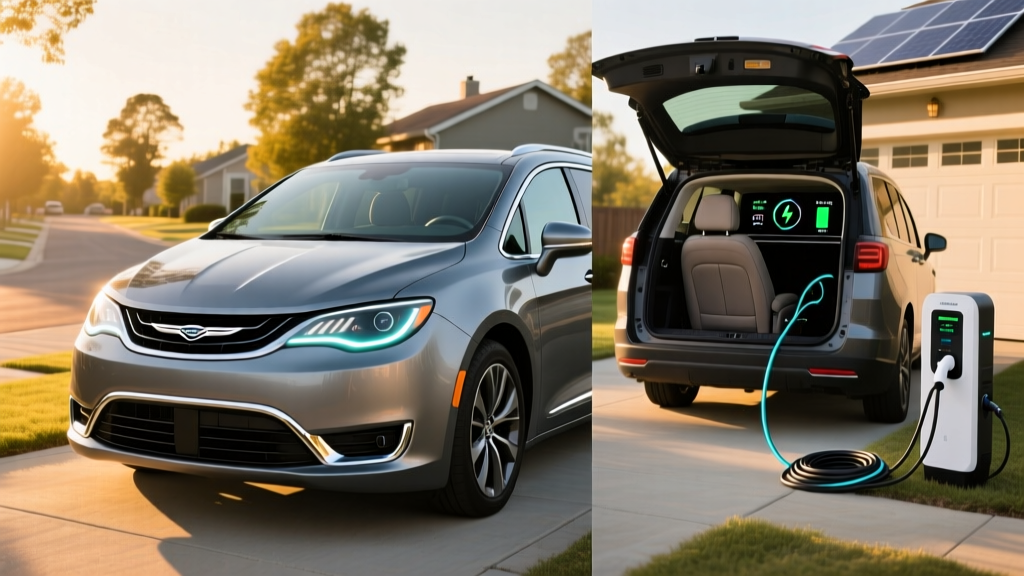
The 2023 Chrysler Pacifica Hybrid remains the only plug-in hybrid minivan sold in the United States, occupying a niche that neither Tesla nor Toyota has contested. For families who want school-run electric commuting without sacrificing the 500-plus-mile road-trip range of a gas engine, it's a compelling proposition. But with a starting MSRP near $50,000 and a 16 kWh battery that limits electric-only travel to 32 EPA miles, the Pacifica Hybrid demands a specific ownership profile to justify its premium over the conventional gas Pacifica.
This guide breaks down every number that matters — from EPA MPG and real-world efficiency to battery warranty, charging logistics, and whether the federal tax credit still applies to a 2023 model purchased in 2026.
PHEV vs Conventional Hybrid: What the Pacifica Hybrid Actually Is
Before diving into specs, it's critical to understand the distinction between a conventional hybrid (HEV) and a plug-in hybrid (PHEV), because Chrysler sells both versions of the Pacifica.
The gas Pacifica Hybrid (not the PHEV) uses a smaller battery and electric motor to assist the gas engine. It never plugs in, recovers energy through regenerative braking, and achieves slightly better MPG than a pure gas car. Chrysler discontinued the conventional hybrid Pacifica after the 2021 model year. The 2023 Pacifica Hybrid is exclusively a PHEV.
The 2023 Pacifica Hybrid carries a 16 kWh lithium-ion battery pack that can be charged from a wall outlet or Level 2 charger. It drives on pure electricity for up to 32 EPA-rated miles before the 3.6L V6 engine engages. It does not support DC fast charging. Think of it as a short-range EV bolted to a conventional minivan powertrain.
Powertrain Specs: 260 HP and a Continuously Variable Transmission
| Specification | 2023 Chrysler Pacifica Hybrid |
|---|---|
| Engine | 3.6L Atkinson-cycle V6 |
| Electric Motors | Two integrated electric drive motors |
| Combined System Output | 260 horsepower |
| Transmission | eFlite EVT (electrically variable transmission) |
| Battery Capacity (Gross / Usable) | 16 kWh gross / ~13.5 kWh usable |
| Battery Chemistry | NMC (Nickel Manganese Cobalt) |
| Drivetrain | Front-wheel drive |
| 0–60 mph | ~7.1 seconds |
| Towing Capacity | Not rated (PHEV); gas Pacifica rated 3,600 lbs |
| Base MSRP (Hybrid Touring) | $49,995 |
The Atkinson-cycle V6 sacrifices some peak power for thermal efficiency, while the two electric motors handle low-speed propulsion and regenerative braking. The eFlite transmission eliminates traditional gear shifts entirely — acceleration is smooth and linear, though highway passing power feels adequate rather than brisk at 260 combined horsepower.
Fuel Economy: EPA MPG and Real-World Numbers
The Pacifica Hybrid operates in two distinct modes, and the EPA rates them separately:
| Mode | City | Highway | Combined |
|---|---|---|---|
| Charge-Sustaining (gas-only, after battery depleted) | 29 MPG | 30 MPG | 30 MPG |
| Electric + Gas (blended, fully charged start) | 82 MPGe combined | ||
Real-world MPG vs EPA: According to fueleconomy.gov, owners report an average of 28–31 MPG in charge-sustaining mode — right in line with EPA estimates. In city driving with a full charge and trips under 30 miles, many owners report burning almost no gasoline for weeks, effectively achieving 100+ MPGe. Highway road trips with a depleted battery settle around 27–29 MPG at 70–75 mph, slightly below the EPA's 30 MPG highway figure due to the minivan's aerodynamic profile and 5,000+ lb curb weight.
Charging: Level 1 and Level 2 Only — No DC Fast Charging
The Pacifica Hybrid's 16 kWh battery (approximately 13.5 kWh usable, with the remainder reserved as a buffer to protect battery longevity) charges via the J1772 connector standard on all US-market plug-in vehicles.
| Charging Level | Power (kW) | 0–100% Time | Connector |
|---|---|---|---|
| Level 1 (120V household outlet) | ~1.4 kW | ~13 hours | J1772 |
| Level 2 (240V, 32A circuit) | ~7.2 kW | ~2 hours | J1772 |
| DC Fast Charging | Not supported | ||
Practical charging note: Because the battery is small (16 kWh), Level 1 charging from a standard 120V outlet is actually viable for many owners. If you drive 30 miles per day and plug in overnight for 10+ hours, you'll recover most of the battery without installing a 240V circuit. However, a Level 2 home charger (typically $500–$1,500 installed) cuts charge time to about 2 hours, which matters if you want to recharge mid-day for a second electric trip.
The onboard charger maxes out at 7.2 kW, so there's no benefit to installing a 48A or higher-capacity Level 2 circuit specifically for this vehicle — a standard 32A/240V circuit is sufficient.
Pricing, Trims, and Federal Tax Credit Eligibility
The 2023 Chrysler Pacifica Hybrid was offered in three trims:
- Hybrid Touring: $49,995 MSRP
- Hybrid Limited: $53,490 MSRP
- Hybrid Pinnacle: $57,400 MSRP
Federal tax credit status (2026 purchase of a 2023 model): Under current IRS §30D rules, the Pacifica Hybrid was eligible for up to $7,500 in federal tax credits when new. However, several factors affect eligibility today:
- Point-of-sale transfer: As of 2024, buyers can transfer the credit to the dealer for an immediate price reduction — but this applies to new vehicle purchases, not used.
- Buying new leftover 2023 inventory in 2026: If you find an unsold new 2023 Pacifica Hybrid at a dealer, it may still qualify for the §30D credit, subject to battery-sourcing and critical-mineral requirements that tightened in 2024 and beyond. Verify current sourcing compliance with the dealer.
- Used EV credit (§25E): If purchasing a pre-owned 2023 Pacifica Hybrid from a dealer, you may qualify for up to $4,000 (30% of sale price, capped) under the used clean vehicle credit, subject to income caps ($75,000 single / $150,000 joint) and a sale price cap of $25,000.
- MSRP cap: The Pacifica Hybrid falls under the van/SUV category with an $80,000 MSRP cap — all trims clear this easily.
- Income limits (new credit): $150,000 single / $225,000 head of household / $300,000 joint MAGI.
Always consult a tax professional and verify eligibility on irs.gov before relying on credit amounts for purchase decisions. Rules change annually.
Battery Warranty, Lifespan, and Replacement Cost
Battery degradation reality: PHEV batteries experience more charge-discharge cycles than full EV batteries because the usable window is smaller and drivers deplete it daily. However, Chrysler's 70% retention threshold over 10 years is consistent with industry norms. Based on data from Pacifica Hybrid owners, most report minimal degradation in the first 3–5 years — typically losing 1–3 miles of electric range over that period.
Replacement cost: If the battery falls outside warranty coverage, a replacement 16 kWh pack for the Pacifica Hybrid currently costs between $6,500 and $9,000 including parts and labor at a Stellantis dealer. Third-party hybrid battery rebuilders offer refurbished packs for $3,500–$5,500. This is significantly less than full EV battery replacements because the pack is small.
Reliability and Ownership Considerations
The Pacifica Hybrid's reliability record has been mixed. Early model years (2017–2019) saw several recalls related to the high-voltage battery system, including a notable fire-risk recall that required a software update and, in some cases, battery module replacement. The 2023 model benefits from years of iterative fixes, but the PHEV powertrain is inherently more complex than either a pure gas engine or a pure electric drivetrain — there are two systems that can fail.
The NHTSA gave the 2023 Pacifica Hybrid a 5-star overall safety rating. The IIHS has not separately crash-tested the Hybrid variant but rated the conventional Pacifica as a Top Safety Pick in prior years.
Ownership costs to budget for:
- Insurance: Typically 10–20% higher than the gas Pacifica due to the high-voltage system and higher MSRP.
- Maintenance: Oil changes still apply (the V6 runs frequently once the battery depletes), but brake wear is reduced thanks to regenerative braking.
- Tires: Heavier than the gas Pacifica (~5,200 lbs), so tire wear can be slightly accelerated.
Who Should Choose the Pacifica Hybrid vs a Full EV or Gas Minivan?
Choose the 2023 Pacifica Hybrid if:
- You have home charging access (even a 120V outlet works) and a daily commute under 30 miles round-trip.
- You need a minivan (7-passenger, sliding doors, cargo volume) but want to minimize gasoline use on school runs and errands.
- You regularly take road trips exceeding 200 miles and don't want to plan around DC fast-charging stops with kids in the car.
- You want the federal or used-EV tax credit to offset the price premium over the gas Pacifica.
Choose a full EV (e.g., Kia EV9, Tesla Model X) if:
- You have reliable Level 2 home charging and access to DC fast chargers for road trips.
- You want to eliminate oil changes, emissions testing, and gasoline entirely.
- Your daily driving exceeds 32 miles but stays under 250 miles — a full EV's larger battery covers more daily scenarios.
Choose the gas Pacifica (or Toyota Sienna HEV) if:
- You lack any home charging access (apartment, street parking).
- You need AWD (the Pacifica Hybrid is FWD-only; the gas Pacifica offers AWD, and the Sienna is AWD standard on some trims).
- You need towing capacity (the Pacifica Hybrid is not rated for towing; the gas Pacifica tows 3,600 lbs).
- You want a lower upfront price — the gas Pacifica starts around $38,000.
- Only PHEV minivan on the market
- 32 miles electric covers most school/errand trips
- 520+ mile total range eliminates road-trip anxiety
- Level 1 (120V) charging is practical due to small battery
- Eligible for up to $7,500 federal credit (new) or $4,000 (used)
- Smooth, quiet electric-mode driving
- Stow 'n Go second-row seating (unique to Pacifica Hybrid)
- No DC fast charging
- FWD only — no AWD option
- Not rated for towing
- $50K+ starting price is steep for a minivan
- Early model-year reliability concerns linger in reputation
- 32-mile electric range falls short of newer PHEVs (e.g., Toyota RAV4 Prime: 42 mi)
- Third-row and cargo space slightly reduced vs gas Pacifica due to battery placement
Frequently Asked Questions
How many MPG does the 2023 Pacifica Hybrid get?
In charge-sustaining mode (after the battery is depleted), the EPA rates it at 29 city / 30 highway / 30 combined MPG. When starting with a full charge, it achieves 82 MPGe combined over the first 32 miles of electric driving. Real-world owners report 27–31 MPG in gas-only highway driving and near-zero gasoline consumption on sub-30-mile daily trips with nightly charging.
How far can the 2023 Pacifica Hybrid go on electric only?
The EPA rates it at 32 miles of pure electric range. In warm-weather city driving, expect 28–34 miles. In cold weather (below 35°F), expect 22–26 miles due to cabin heating demands and reduced battery efficiency. Once the battery depletes, the V6 engine engages seamlessly and the van operates as a conventional hybrid.
Does the Pacifica Hybrid qualify for a tax credit in 2026?
If you purchase a new leftover 2023 Pacifica Hybrid from dealer inventory, it may qualify for up to $7,500 under the §30D new clean vehicle credit, subject to your income, the vehicle's battery sourcing compliance, and MSRP caps (which the Pacifica clears). If you purchase a used 2023 Pacifica Hybrid from a dealer for $25,000 or less, you may qualify for up to $4,000 under the §25E used vehicle credit, subject to income limits ($75K single / $150K joint). Consult IRS.gov and a tax professional for your specific situation.
Is the Pacifica Hybrid battery reliable and what does replacement cost?
The battery carries a 10-year/100,000-mile warranty (10 years/150,000 miles in CARB states) covering defects and capacity loss below 70%. Out-of-warranty replacement costs $6,500–$9,000 at a dealer, or $3,500–$5,500 from third-party rebuilders. Most owners report minimal degradation (1–3 miles of range loss) in the first 5 years.
Can the Pacifica Hybrid DC fast charge?
No. The Pacifica Hybrid supports only Level 1 (120V, ~1.4 kW) and Level 2 (240V, up to 7.2 kW) AC charging via a J1772 connector. A full Level 2 charge takes about 2 hours. Given the small 16 kWh battery, DC fast charging was not included — and for most PHEV use cases (overnight home charging), it's unnecessary.
Hybrid vs PHEV vs EV — which is right for a family minivan buyer?
A conventional hybrid (HEV) like the Toyota Sienna requires no plug-in and delivers consistent 36 MPG combined — ideal if you lack home charging. A PHEV like the Pacifica Hybrid gives you 32 electric miles for daily errands plus a gas engine for road trips — ideal if you can charge at home and drive under 35 miles daily. A full EV like the Kia EV9 offers 270–300 miles of range and zero gasoline — ideal if you have Level 2 home charging and access to DC fast-charging networks for trips.
Sources: fueleconomy.gov — 2023 Chrysler Pacifica Hybrid, NHTSA — 2023 Chrysler Pacifica Hybrid Safety Ratings, IRS — Clean Vehicle Tax Credits.