Quick Verdict: The 2023 Lexus UX 250h at a Glance
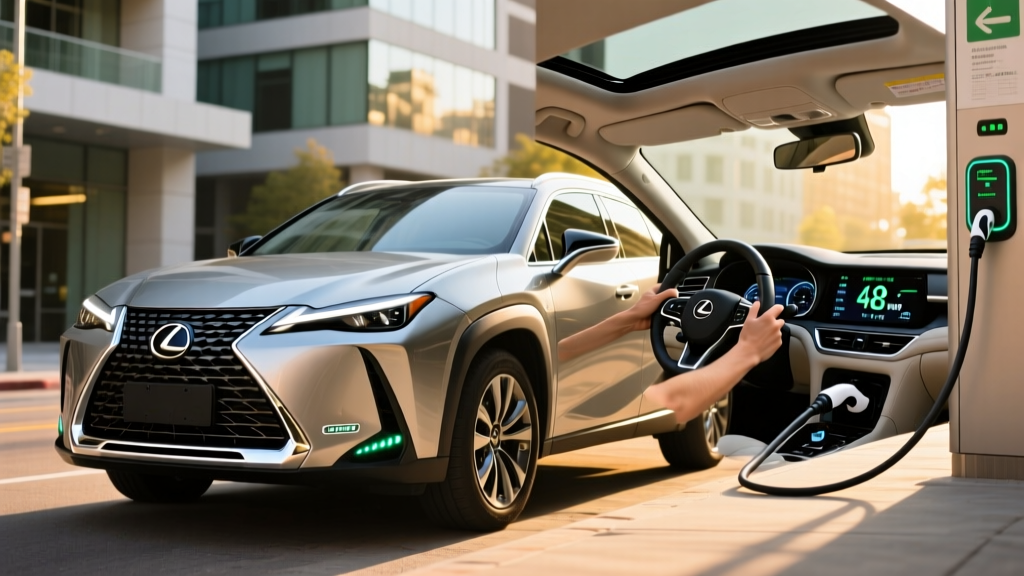
The 2023 Lexus UX 250h occupies a specific niche: a luxury-badged subcompact crossover that prioritizes fuel efficiency and refinement over outright performance or cargo space. As a conventional hybrid (HEV) — not a plug-in — it requires no charging infrastructure, making it a practical choice for apartment dwellers and drivers without home charging access. With an EPA-estimated 42 MPG combined and a starting MSRP around $37,500, it competes against the Toyota RAV4 Hybrid, BMW X1, and Mazda CX-50 in the premium small-crossover segment.
For 2023, Lexus dropped the gas-only UX 200 from the U.S. lineup, making the hybrid UX 250h the sole variant. This streamlined the lineup and reinforced the model's identity as an efficiency-first luxury commuter.
| Specification | 2023 Lexus UX 250h |
|---|---|
| Powertrain Type | Conventional Hybrid (HEV) — no plug |
| Engine | 2.0L inline-4 Atkinson-cycle |
| Combined Horsepower | 181 hp (net system) |
| Drivetrain | AWD (e-AWD with rear electric motor) |
| EPA MPG (City / Hwy / Combined) | 43 / 41 / 42 MPG |
| Hybrid Battery | ~1.4 kWh nickel-metal hydride (NiMH) |
| 0–60 mph | ~8.6 seconds |
| Cargo Volume (rear seats up / folded) | 17.1 / 36.4 cu ft |
| Base MSRP (UX 250h Base) | ~$37,540 |
| Hybrid Battery Warranty | 10 years / 150,000 miles |
| Federal EV Tax Credit | Not eligible (HEV, not PHEV/BEV) |
HEV vs. PHEV: Understanding What the UX 250h Actually Is
A common point of confusion in the hybrid market is the difference between a conventional hybrid (HEV) and a plug-in hybrid (PHEV). The 2023 Lexus UX 250h is a conventional hybrid. Here is what that means in practical terms:
| Feature | HEV (UX 250h) | PHEV (e.g., Toyota RAV4 Prime) |
|---|---|---|
| Plug-in Charging Required? | No — self-charging via regen & engine | Yes — plug in for electric-only range |
| Electric-Only Range | None (motor assists engine at low speeds) | Typically 20–45 miles |
| Battery Size | ~1.4 kWh | Typically 14–18 kWh |
| Federal Tax Credit (§30D) | Not eligible | Up to $7,500 (if eligible) |
| Best For | No home charging; wants better MPG | Home charging; short electric commutes |
The UX 250h's hybrid system captures energy during braking and deceleration to recharge its small battery. The electric motor assists the gasoline engine during acceleration and can power the vehicle at very low speeds for brief distances, but it does not provide meaningful electric-only driving range. You will never need to find a charger or plug this vehicle in — it operates like a conventional car at the fuel pump.
Fuel Economy: EPA Ratings vs. Real-World MPG
The EPA rates the 2023 Lexus UX 250h with AWD at 43 MPG city, 41 MPG highway, and 42 MPG combined, according to fueleconomy.gov. These are strong numbers for a luxury-branded AWD crossover.
| Driving Scenario | EPA Estimate | Real-World Expectation |
|---|---|---|
| City | 43 MPG | 44–47 MPG (hybrids excel in stop-and-go) |
| Highway (65–75 mph) | 41 MPG | 37–40 MPG (aero drag reduces hybrid advantage) |
| Combined | 42 MPG | 39–43 MPG (depends on driving mix) |
| Cold Weather (below 30°F) | — | 35–38 MPG (engine runs more for cabin heat) |
Conventional hybrids like the UX 250h typically exceed their EPA city rating in real-world stop-and-go driving, because frequent braking maximizes regenerative energy capture. Highway driving is the opposite: sustained high speeds reduce the hybrid system's advantage, and real-world highway MPG often falls 2–4 MPG below the sticker. In cold weather, expect a 5–8 MPG drop because the gasoline engine runs more frequently to provide cabin heat and maintain battery temperature.
For context, the non-hybrid BMW X1 xDrive28i achieves roughly 28 MPG combined. The UX 250h's 42 MPG combined represents approximately a 50% improvement in fuel economy, translating to roughly $500–$700 in annual fuel savings for a driver covering 12,000 miles per year at $3.50/gallon.
Powertrain and Driving Dynamics
The UX 250h pairs a 2.0-liter Atkinson-cycle inline-4 engine with two electric motor-generators and an electronically controlled continuously variable transmission (eCVT). The rear axle is driven by a separate electric motor, providing all-wheel drive without a mechanical driveshaft — a setup Toyota/Lexus calls e-AWD.
Combined net system output is 181 horsepower. The eCVT delivers smooth, linear acceleration without the shift shock of a conventional automatic, but it also means the engine can drone under hard acceleration as the transmission holds high RPM. In normal driving, the cabin is well-insulated from powertrain noise.
The 0–60 mph time of approximately 8.6 seconds places the UX 250h in the adequate-but-not-quick category. It handles freeway merges confidently but is not a sporty performer. The low center of gravity from the hybrid battery pack contributes to composed handling for a tall-riding subcompact, and the ride quality is firm but controlled — typical of Lexus's tuning philosophy.
Reliability, Battery Lifespan, and Warranty Coverage
Lexus consistently ranks at or near the top of J.D. Power and Consumer Reports reliability surveys, and the UX 250h's powertrain shares architecture with the Toyota Corolla Hybrid and Prius — systems with well-documented long-term durability.
Hybrid Battery Warranty
Lexus covers the UX 250h's hybrid battery for 10 years or 150,000 miles, whichever comes first. This is an improvement over the earlier 8-year/100,000-mile coverage and applies to all 2020 and newer Lexus hybrids. The warranty covers the hybrid battery pack, battery control module, and related hybrid-system components against defects and capacity loss below a defined threshold.
Real-world hybrid battery longevity data from Toyota/Lexus vehicles is encouraging. NiMH hybrid batteries in the Prius and related models routinely last 150,000–200,000+ miles before requiring replacement. The UX 250h's NiMH pack is less energy-dense than a lithium-ion EV battery, but NiMH chemistry is well-proven for longevity in low-capacity hybrid applications where the battery is never deeply discharged.
If replacement is needed out of warranty, a new OEM hybrid battery for the UX 250h typically costs between $2,500 and $4,000 installed at a dealership, though refurbished or aftermarket options may be available for $1,500–$2,500 as the vehicle ages. This is a fraction of the $10,000–$20,000+ cost of replacing a full EV traction battery.
Pricing, Trim Levels, and Tax Credit Eligibility
For 2023, the Lexus UX 250h was offered in several trims:
- UX 250h Base: ~$37,540 MSRP
- UX 250h Premium: ~$39,640 MSRP
- UX 250h F SPORT Design: ~$40,340 MSRP
- UX 250h F SPORT Handling: ~$43,190 MSRP
- UX 250h Luxury: ~$42,540 MSRP
All trims include AWD as standard. Destination charges add approximately $1,150.
Federal Tax Credit Status
The 2023 Lexus UX 250h does not qualify for the federal §30D clean vehicle tax credit. Under current IRS rules, only battery electric vehicles (BEVs) and plug-in hybrid electric vehicles (PHEVs) with sufficient battery capacity (≥7 kWh) are eligible. The UX 250h's ~1.4 kWh NiMH battery and conventional hybrid architecture place it outside the credit's scope.
Some states offer their own incentives for conventional hybrids, though these are increasingly rare as state programs shift focus to BEVs and PHEVs. Check your state's energy or environmental agency website for current programs.
Who Should Buy the UX 250h — and Who Should Look Elsewhere
Pros
- 42 MPG combined with no plug-in requirement
- Strong Lexus reliability and 10-year hybrid battery warranty
- Standard AWD across all trims
- Quiet, well-built cabin with quality materials
- Compact dimensions ideal for urban parking
Cons
- Limited cargo space (17.1 cu ft behind rear seats)
- No federal tax credit eligibility
- Modest 181 hp — not a performance crossover
- Infotainment system was redesigned for 2023 but still lags rivals
- Rear seat space is tight for taller passengers
Decision Framework: Is the UX 250h Right for You?
Choose the 2023 Lexus UX 250h if: You want a luxury subcompact crossover with excellent fuel economy, you lack home charging access (making a PHEV or BEV impractical), and you prioritize reliability and low running costs over cargo space or acceleration.
Consider a PHEV (like the Toyota RAV4 Prime or Lexus NX 450h+) if: You have home charging and a short commute. A PHEV gives you 25–37 miles of electric-only driving for daily errands, plus a gas engine for longer trips — and may qualify for the $7,500 federal credit.
Consider a full BEV (like the Hyundai Ioniq 5 or Tesla Model Y) if: You have reliable home or workplace charging, want zero tailpipe emissions, and are ready to transition fully to electric. BEVs offer lower per-mile fuel costs and qualify for federal and state incentives.
Consider a gas-only competitor if: You drive mostly highway miles at high speeds (where hybrid advantages diminish), want maximum cargo space, or are on a tighter budget and don't need a luxury badge.
Frequently Asked Questions
How many MPG does the 2023 Lexus UX 250h hybrid get?
The EPA rates the UX 250h at 43 MPG city, 41 MPG highway, and 42 MPG combined. In real-world city driving with frequent stops, owners often report 44–47 MPG. Highway driving at sustained speeds above 70 mph typically yields 37–40 MPG.
Does the Lexus UX 250h need to be plugged in?
No. The UX 250h is a conventional hybrid (HEV), not a plug-in hybrid (PHEV). Its small battery recharges through regenerative braking and the gasoline engine. You refuel only at the gas pump, just like a conventional car.
How far can the UX 250h drive on electric power alone?
The UX 250h does not have a meaningful electric-only range. Its electric motor assists the gasoline engine and can move the car at very low speeds (under ~25 mph) for short distances in EV mode, but the 1.4 kWh battery is too small for sustained electric driving. If electric-only commuting is your goal, you need a PHEV or BEV.
Is the 2023 Lexus UX 250h reliable?
Yes. Lexus ranks among the most reliable automotive brands in J.D. Power and Consumer Reports surveys. The UX 250h's hybrid powertrain shares proven architecture with the Toyota Prius family, and the NiMH hybrid battery is covered for 10 years / 150,000 miles. Hybrid battery replacements are rarely needed before 150,000+ miles.
What does a Lexus UX hybrid battery replacement cost?
Out of warranty, a new OEM hybrid battery replacement typically costs $2,500–$4,000 installed at a Lexus dealership. Refurbished or third-party options may reduce this to $1,500–$2,500. Given the 10-year/150,000-mile warranty and the proven longevity of Toyota/Lexus NiMH hybrid batteries, most owners will never face this expense.
Does the UX 250h qualify for any federal tax credit?
No. Under IRS §30D rules, only plug-in hybrids (PHEVs) and battery electric vehicles (BEVs) with battery packs of at least 7 kWh qualify for the federal clean vehicle credit. The UX 250h's conventional hybrid system with a ~1.4 kWh battery does not meet this threshold. Check your state's programs for any local hybrid incentives.
Hybrid vs PHEV vs EV — which should I choose?
A conventional hybrid (HEV) like the UX 250h is best if you want better MPG without changing your fueling habits or needing charging access. A plug-in hybrid (PHEV) suits drivers with home charging who want electric-only commutes plus gas-engine flexibility. A battery electric vehicle (BEV) is ideal if you have reliable charging and want the lowest per-mile cost and zero tailpipe emissions. Your charging access, commute distance, and budget should drive the decision.